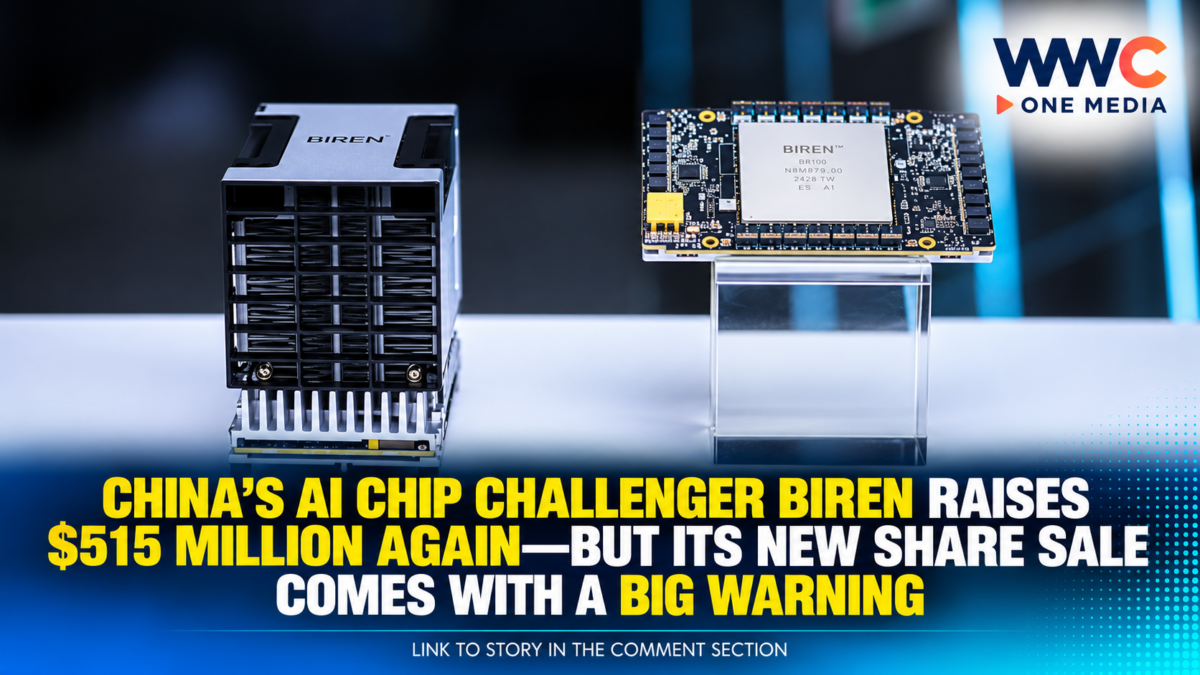
HONG KONG — China’s artificial-intelligence chip race is getting another multibillion-dollar injection of capital.
Shanghai Biren Technology, one of China’s emerging challengers in the AI accelerator market, is raising roughly HK$4.04 billion (about US$520 million) in gross proceeds through a new placement of 130 million Hong Kong-listed shares.
After fees and expenses, Biren expects to receive approximately HK$4.02 billion, or roughly US$515 million.
But there is a catch.
The new shares are being sold at HK$31.08 each, a discount of about 9.76% to Biren’s October 7 closing price of HK$34.44 and 13.73% below its five-day average.
The move gives Biren a fresh war chest to secure chip-production capacity, prepare its next-generation products for mass production and expand its software ecosystem.
It also highlights the enormous amount of capital Chinese AI-chip companies now need to compete in a market dominated globally by Nvidia.
Biren is raising billions—again
The latest deal is not Biren’s first post-IPO capital raise.
The company completed a previous placement of 153 million new H shares in July, according to its latest HKEX filing. That earlier transaction also used the company’s general mandate.
The latest placement will add another 130 million H shares.
Those shares represent about 5% of Biren’s existing total share capital and approximately 4.76% of the enlarged share capital after the placement, meaning existing shareholders will face dilution.
The transaction is being arranged through placing agents, who are expected to find at least six professional, institutional or other independent investors.
No single placee is expected to become a substantial shareholder as a result of the deal.
The placement still requires approval for the new shares to be listed and traded on the Hong Kong Stock Exchange, and Biren said the transaction could fail to complete if the conditions are not satisfied by the October 15 deadline.
So this is a planned capital raise—not yet a completed cash injection.
Why does Biren need another $515 million?
The answer is simple: China’s AI-chip industry is moving faster than Biren expected.
In its HKEX announcement, Biren said demand for AI computing continues to grow rapidly as large language models, multimodal AI, agentic AI and AI infrastructure expand.
At the same time, the company says the semiconductor supply chain has become tighter, with higher prices and longer lead times for critical materials, components and production capacity.
That combination is forcing chip companies to spend earlier.
They cannot simply wait until a new processor is fully commercialized before reserving manufacturing capacity.
If production slots, components or advanced packaging are unavailable when customer demand arrives, a chipmaker can lose an entire product cycle.
Biren is therefore attempting to secure capacity before its next-generation products reach full commercial production.
Its next-generation chip has reached a critical stage
Biren says its new-generation product has completed bring-up and entered post-silicon validation.
That means the company has moved beyond the initial stage of getting the new silicon operational and is now testing and validating the chip before broader customer qualification and mass production.
The company says customer sampling and volume production are expected over the coming quarters, subject to successful validation and qualification.
That explains why the timing of the fund-raising matters.
Biren is trying to finance manufacturing and inventory commitments before the product reaches full-scale commercialization.
In semiconductor markets, that can be crucial.
The company says key customers are demanding greater inventory readiness, delivery volumes and the ability to fulfill large orders on schedule.
70% of the money is going straight into the AI-chip supply chain
Biren has laid out a very specific spending plan.
Of the approximately HK$4.02 billion in net proceeds:
- 70% — HK$2.814 billion: strategic supply-chain procurement, production readiness and commercialization of next-generation products;
- 20% — HK$804 million: research and development plus the software ecosystem;
- 10% — HK$402 million: working capital and general corporate purposes.
The company expects the supply-chain and commercialization allocation to be fully used by the end of 2027, the R&D/software allocation by the end of 2029 and the working-capital allocation by the end of 2028.
The message to investors is clear:
Biren is not raising this money simply to strengthen its balance sheet. It wants to spend aggressively to turn chip designs into commercially scalable products.
The previous cash pile is being consumed faster than expected
This is one of the most revealing details in the announcement.
As of September 30, Biren said it had used approximately HK$814.8 million, or 19%, of the previous placement proceeds allocated specifically to accelerating commercialization and production of next-generation products.
The company expects the remaining approximately HK$3.408 billion earmarked for that purpose from the previous placement to be substantially, if not fully, used by the end of 2026.
That is significantly earlier than the original expected timeline of the end of 2027.
In other words, Biren is effectively saying:
The AI-chip opportunity is arriving faster—and costing more upfront—than we previously anticipated.
That is bullish in one sense because it points to strong demand and faster product development.
But it also demonstrates just how capital-intensive the AI semiconductor race has become.
Biren’s business is growing rapidly—but it is still losing money
The company’s latest financial results provide important context.
For the six months ended June 30, 2026, Biren reported RMB1.236 billion in revenue, compared with only RMB58.9 million in the same period a year earlier.
That represents growth of roughly 1,998%.
Its gross profit jumped to RMB527.1 million, while gross margin reached 42.7%, up from roughly 32.0% a year earlier.
But Biren still reported a RMB377.2 million net loss for the first half.
Its adjusted loss was RMB337.2 million.
That distinction is important.
Biren is no longer merely a pre-revenue semiconductor startup.
It is shipping products and generating meaningful sales.
But it has not yet reached sustainable profitability.
R&D remains extremely expensive
Biren spent RMB804.4 million on research and development during the first half of 2026, up 40.7% from the previous year.
That spending reflects the reality of competing in advanced AI processors.
A successful chip company cannot simply develop one GPU and stop.
It has to continually improve:
- computing performance;
- memory bandwidth;
- power efficiency;
- interconnect technology;
- software compatibility;
- rack-scale systems;
- and AI-model support.
Every generation requires another enormous investment.
Biren’s latest fund-raising is therefore partly a bet that its current generation of technology can generate enough commercial revenue to finance the next generation.
The company already has a surprisingly large liquidity base
Biren’s decision to raise more money is especially interesting because it was not starting from an empty balance sheet.
As of June 30, 2026, the company reported total liquidity of approximately RMB6.15 billion, including cash and cash equivalents, bank deposits, structured deposits and restricted cash.
It also reported only about RMB300 million in bank borrowings at that date.
So why raise another roughly US$515 million?
The company’s explanation is that its procurement and production plans have accelerated and now require more upfront capital than originally anticipated.
The strategy appears to be preserving the ability to scale quickly rather than waiting for existing cash to run down.
That can be particularly important in semiconductors because manufacturing capacity has to be reserved months in advance.
The discount is the part investors cannot ignore
Biren’s new shares are priced at HK$31.08.
The stock closed at HK$34.44 on October 7, meaning the placement price represents a nearly 10% discount.
That discount makes the fund-raising easier to execute, but it also creates a clear cost for existing shareholders.
More shares are entering the market at a price below the prevailing market price.
That creates dilution.
Market trading reflected the pressure.
ET Net reported on October 8 that Biren shares were down about 4.8%, after falling for a third consecutive session and losing roughly 10.9% over three days.
That reaction does not necessarily mean investors reject Biren’s strategy.
It illustrates the tension between two competing forces:
more capital for growth versus dilution for existing shareholders.
China needs companies like Biren
Biren’s fund-raising is taking place against a much bigger geopolitical backdrop.
China is aggressively trying to reduce its dependence on foreign AI processors.
That effort has become more urgent as U.S. export controls restrict access to some advanced American semiconductor technologies.
Reuters Breakingviews has described Biren, Moore Threads, MetaX and Enflame as part of a group of emerging Chinese GPU companies challenging Nvidia’s dominance in China’s AI-chip market, alongside larger players such as Huawei.
The opportunity is enormous.
But the challenge is equally enormous.
Chinese AI-chip companies must compete not only on raw chip performance but also on software, developer tools, networking, memory, manufacturing capacity and the ability to build complete computing systems.
The real battlefield is moving beyond the chip
That is why Biren’s latest fund-raising is not exclusively about processors.
The company says a portion of the new capital will go toward developing its full-stack software platform, developer tools, software applications and compatibility with mainstream AI models and frameworks.
That is strategically important.
Nvidia’s advantage is not just its GPUs.
It is also the enormous software ecosystem surrounding CUDA.
For Chinese competitors, building a credible alternative ecosystem is one of the hardest parts of the challenge.
A faster chip is not enough if developers have to rewrite their entire software stack to use it.
Biren is also moving toward rack-scale AI systems
Another significant development is the shift from individual GPUs toward integrated computing systems.
Biren says customer demand is increasingly moving toward SuperPod and rack-scale systems that combine large numbers of GPGPUs with interconnects, networking, memory, power and cooling infrastructure.
That means the company is no longer competing purely as a chip designer.
It is increasingly trying to participate in the broader AI-computing infrastructure stack.
That could increase revenue opportunities.
It also increases the amount of capital required.
Building an AI accelerator is expensive.
Building the surrounding system is even more capital-intensive.
Biren’s IPO was only the beginning
Biren became publicly traded on the Hong Kong Stock Exchange in January 2026.
Its original offering consisted of 284.85 million shares at HK$19.60 each, followed by a fully exercised over-allotment option that added another 42.73 million shares.
The company’s rapid return to the capital markets shows how dramatically its financing needs have changed since listing.
Instead of treating the IPO as the final major funding event before profitability, Biren is using public markets as an ongoing source of capital to accelerate manufacturing and product development.
That is a very different model from a mature semiconductor company.
The bigger question: Can Biren turn growth into profits?
This is where the story gets much more complicated.
Biren’s first-half revenue growth is spectacular.
But the comparison starts from a very small base.
The company generated only RMB58.9 million of revenue in the first half of 2025, before exploding to RMB1.24 billion this year.
Its 42.7% gross margin is encouraging.
But the company is still spending hundreds of millions of yuan on R&D and remains loss-making.
It must therefore prove that the current revenue surge is sustainable rather than simply the first wave of China’s push toward domestic AI hardware.
China’s AI-chip market is becoming crowded
Biren is also not alone.
Huawei remains the heavyweight domestic challenger.
Other emerging Chinese GPU companies include Moore Threads, MetaX and Enflame.
Reuters Breakingviews has noted that these companies are part of Beijing’s broader effort to reduce reliance on Nvidia.
That creates both opportunity and risk.
The Chinese market is large enough to support several successful AI-chip companies.
But not every company will survive.
The winners will likely be determined by a combination of:
chip performance + software + manufacturing capacity + customer relationships + financing.
Biren is now aggressively strengthening the final two.
The U.S. technology war remains an important backdrop
The geopolitical environment is another reason the company is moving quickly.
U.S. restrictions on advanced semiconductor technology have helped accelerate China’s search for domestic alternatives.
Biren has also been involved in U.S. litigation concerning access to information from the U.S. Commerce Department and Bureau of Industry and Security. A federal court docket shows the company filed a case in June 2026.
That legal proceeding should not be interpreted as proof of a particular export-control violation or regulatory outcome.
But it underscores the wider environment in which Chinese AI-chip companies are operating.
The strategic race is no longer purely commercial.
It is also tied to national technology policy.
The $515 million bet is really a bet on timing
Biren’s management is effectively making a high-stakes calculation:
If it can secure manufacturing capacity now, accelerate customer qualification and get its next-generation chips into production quickly, it can capture demand before competitors close the gap.
That is why the company is willing to raise capital at a discount.
Waiting could be more expensive if supply constraints worsen or competitors secure the available capacity first.
The risk is equally clear.
If demand fails to materialize at the expected scale, Biren could end up with substantially higher production commitments, more shares outstanding and continuing R&D expenses without enough revenue to generate profits.
The Bottom Line
Biren Technology is raising approximately HK$4.04 billion gross and HK$4.02 billion net, equivalent to roughly US$515 million in net proceeds, through a placement of 130 million new H shares.
The money is primarily aimed at one thing:
getting Biren’s next-generation AI chips into commercial production faster.
About 70% will go toward supply-chain procurement, production readiness and commercialization, while another 20% will support R&D and the software ecosystem.
The timing is striking.
Biren’s revenue exploded nearly 20-fold in the first half of 2026, but the company still lost RMB377 million and continues to spend heavily on R&D.
Its latest share sale therefore represents both confidence and urgency.
Confidence that China’s AI market is large enough to justify aggressive investment.
Urgency because securing semiconductor capacity and delivering competitive chips quickly may determine which domestic companies survive the race.