SINGAPORE — Artificial intelligence is rewriting the rules of one of finance’s most exclusive games.
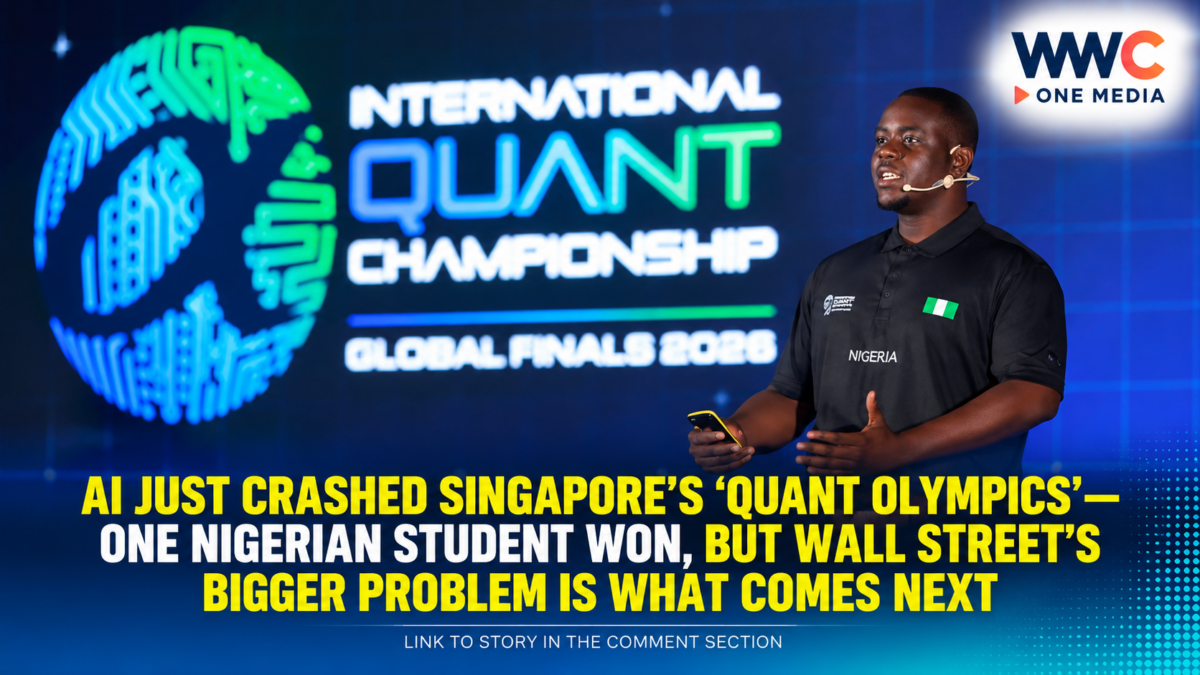
At this year’s International Quant Championship in Singapore, more than 156,000 students from 13 countries competed for a chance to prove they could build mathematical strategies capable of finding opportunities in financial markets.
But the most revealing result wasn’t simply who won.
It was how many people were suddenly able to compete.
Nigerian student Victor Ayebameru emerged as this year’s champion, while the number of participants nearly doubled from the previous year. The competition, organized by quantitative investment firm WorldQuant, offered a $100,000 prize pool and a potential route into an industry where elite mathematical and programming talent can command enormous compensation.
The explosion in participation has a clear explanation:
AI.
AI Is Changing Who Gets to Become a Quant
Quantitative finance has traditionally been one of the most technically demanding corners of Wall Street.
The job requires a combination of mathematics, statistics, programming and financial-market knowledge.
For decades, that combination created a formidable barrier to entry.
A talented student might have the mathematical ability to design a trading model but lack the programming expertise to implement it. Another might understand financial markets but struggle with the complex mathematics required to test a strategy.
AI is changing that equation.
According to the Financial Times, competitors increasingly used AI tools to help develop and test trading strategies, allowing individuals to accomplish work that previously could have required an entire research team.
That is perhaps the most important development to emerge from this year’s competition.
AI isn’t merely helping established quants work faster.
It is creating more quants.
The Numbers Tell the Story
The 2026 competition attracted more than 156,000 students from 13 countries, almost twice last year’s participation.
But the most dramatic change occurred among individual competitors.
The number of solo entrants increased by more than 75,000, while the number of additional teams grew by only around 1,000.
That distinction matters.
A quantitative trading strategy once often required a team with complementary skills.
One person might handle the mathematics.
Another would build the software.
Another would research the market data.
Another would test the strategy.
Generative AI can increasingly bridge some of those gaps.
The result is a new type of competitor:
one person, equipped with AI, capable of doing work that previously demanded several specialists.
The Winner Came From Nigeria
The competition’s champion, Victor Ayebameru of Nigeria, illustrates another consequence of AI’s expansion.
The global quant industry has historically been concentrated around major financial and technology centres such as New York, London, Hong Kong and Singapore.
But AI tools are reducing some of the geographic and technical barriers that have traditionally restricted access to sophisticated quantitative work.
The competition attracted participants from a broad range of countries, with particularly strong participation from places including India, Kenya, China and Nigeria.
That could eventually reshape the industry’s talent map.
The next generation of quantitative researchers may not necessarily emerge from the traditional pipelines of elite Western universities and financial centres.
They can come from almost anywhere.
And increasingly, they can compete with almost anyone.
Singapore Is Becoming a Major Quant Finance Hub
The competition’s location is significant.
Singapore has spent years positioning itself as one of Asia’s leading centres for asset management, hedge funds and financial technology.
The Monetary Authority of Singapore said in August that the country’s asset-management industry had grown at an average annual rate of 7.5% over the previous five years, reaching almost S$7 trillion. The industry accounts for about 15% of financial-sector output and 13% of employment.
Singapore is now taking additional steps to attract hedge funds, fund managers and investment professionals.
MAS announced a proposed tax exemption for certain profit-related returns from qualifying fund-management services, a new Hedge Fund Investment Programme, and an expanded investment-management immigration track designed to attract senior investment professionals.
Reuters reported that the measures are part of Singapore’s effort to remain competitive with Hong Kong, which is also trying to attract financial talent and investment firms.
That makes the timing of the quant competition especially significant.
Singapore isn’t simply hosting a student contest.
It is trying to remain a global centre for the exact industry being transformed by AI.
Hedge Funds Are Already Feeling the Change
The transformation isn’t theoretical.
Quantitative hedge funds have been among the strongest beneficiaries of recent market volatility.
Reuters reported that systematic equity long-short hedge funds gained an average 3.46% in September 2026, their strongest monthly performance of the year, while fundamental equity long-short funds fell 0.55%.
Large systematic and trend-following funds have also performed strongly amid major movements in government bonds, commodities, currencies and other markets.
The implication is obvious:
When markets become more volatile and complex, quantitative strategies can have more opportunities to exploit patterns that humans might miss.
AI could make those strategies even more sophisticated.
But AI Is Also Making the Industry More Competitive
There is a paradox at the centre of the AI revolution.
AI can make a quant researcher more productive.
But if everyone gets access to the same tools, the competitive advantage may disappear.
If 100 researchers can use AI to generate trading ideas in minutes, those ideas become less valuable.
If 10,000 researchers can do the same thing, the market becomes even more competitive.
The result could be an arms race.
Hedge funds may increasingly compete over:
- Better AI models
- Better proprietary data
- Faster computing
- More sophisticated simulations
- Better risk-management systems
- Higher-quality researchers
- More effective human-AI collaboration
In other words, AI could democratize access to quantitative finance while simultaneously making professional quantitative trading more difficult to win.
The Biggest Threat May Be Entry-Level Jobs
There is another uncomfortable consequence.
If AI allows one researcher to accomplish what previously required several junior analysts, firms may need fewer entry-level employees.
The Financial Times highlighted this tension, noting that AI could make hedge-fund managers less collaborative and more competitive as individual researchers gain capabilities that previously required teams.
That raises an important question for young people entering finance:
If AI can perform the work traditionally assigned to junior quants, where will future senior quants come from?
The industry has historically trained future investment leaders by giving junior researchers increasingly sophisticated responsibilities.
If AI removes much of that entry-level work, firms may need to rethink how they develop talent.
AI Doesn’t Mean Humans Are Finished
Despite the hype, the emerging quant industry isn’t simply replacing humans with machines.
The more realistic transformation is human-plus-AI trading.
Experienced researchers still need to determine which problems are worth solving, evaluate whether a model makes economic sense, identify statistical mistakes and understand when a strategy is vulnerable to changing market conditions.
AI can generate code.
It can search for patterns.
It can test hypotheses.
But markets are adversarial.
Once a profitable strategy becomes widely known, other investors can exploit it, reducing its effectiveness.
That means the fundamental challenge of quantitative finance remains:
Finding an edge that other traders haven’t already found.
AI Could Also Make Quant Finance Less Exclusive
The positive side of the revolution is equally significant.
For decades, quantitative finance was dominated by people with access to advanced mathematical education, elite universities, expensive computing resources and specialized professional networks.
Generative AI lowers some of those barriers.
A student with a strong mathematical intuition can now use AI to help write code.
Someone learning programming can use AI to debug sophisticated models.
A researcher can rapidly test multiple hypotheses without spending hours building infrastructure from scratch.
That doesn’t make someone a successful trader.
But it can make the starting line much more accessible.
The 156,000-plus participants in this year’s competition are evidence of that shift.
Singapore Is Becoming the Testing Ground
The timing could hardly be more important for Singapore.
The city-state is competing with Hong Kong and other global financial centres for hedge funds, investment managers and high-value financial talent.
At the same time, AI is changing what those firms actually need.
Singapore’s strategy is therefore evolving from simply attracting financial capital to attracting the people, technology and firms capable of deploying it in an AI-driven market.
MAS’s new initiatives show that policymakers understand the competition is intensifying.
The quant championship adds another dimension.
It gives Singapore a front-row seat to the emergence of a new generation of AI-assisted financial talent.
The Quant Olympics May Have Changed the Game
The most revealing lesson from this year’s competition isn’t that AI can help students write better trading algorithms.
That was already becoming obvious.
The bigger lesson is that AI is changing who gets to participate in the game at all.
A competition that once rewarded teams with specialized technical skills is increasingly becoming accessible to individuals who can effectively use AI.
That could create a much larger global pool of potential quant researchers.
But it could also create a brutal new talent market.
If AI makes thousands of people capable of doing work that once required highly specialized teams, the value of simply knowing how to code or build a model could fall.
The value of having better judgment, proprietary information, original ideas and the ability to discover an edge before everyone else could rise instead.
And that is where the real Wall Street battle may begin.
The Bottom Line
Singapore’s 2026 “quant Olympics” offered a glimpse into the future of finance: AI is lowering the barriers to quantitative trading while simultaneously raising the competitive stakes.
More than 156,000 students participated, nearly twice last year’s number, while solo participation surged dramatically. Victor Ayebameru of Nigeria ultimately took the title.
For Singapore, the transformation arrives as the city-state aggressively strengthens its position as a global asset-management and hedge-fund hub.
For hedge funds, however, the implications are much bigger.
The industry’s next competitive advantage may no longer belong simply to the person with the best mathematical education.
It may belong to the person who can work with AI better than everyone else.
And if that happens, the quant industry’s biggest problem won’t be finding talented people.
It will be figuring out what happens when almost everyone has the tools to become one.