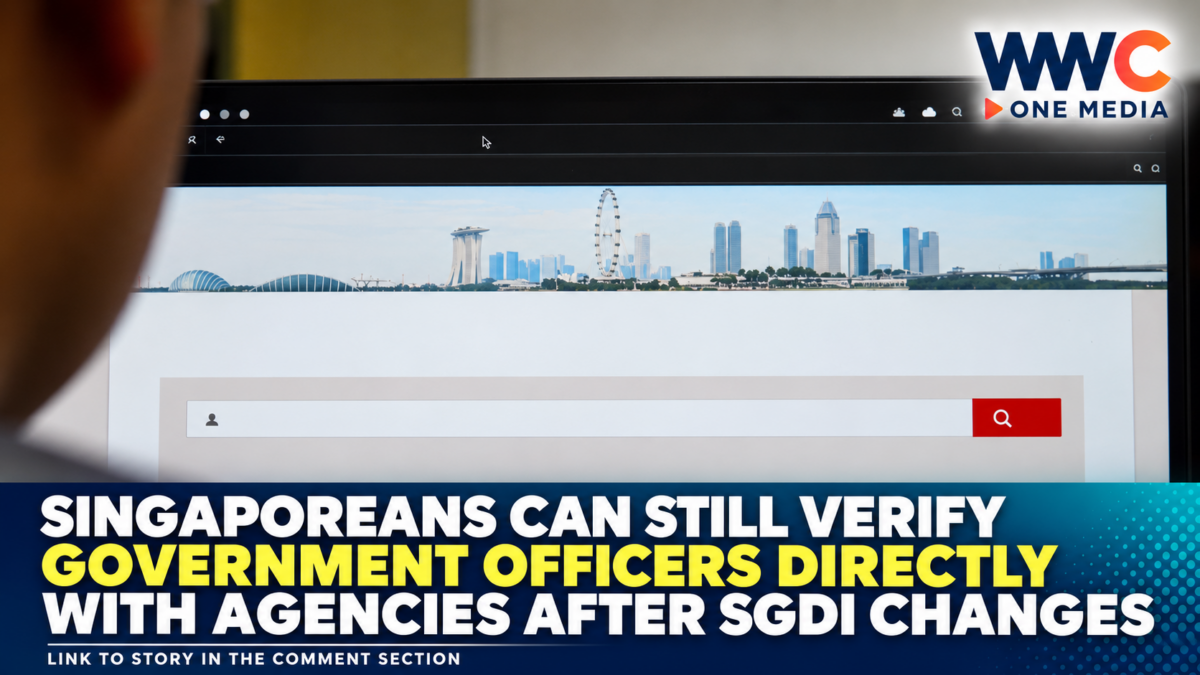
Members of the public can still verify whether a person claiming to be a government officer is genuine by contacting the relevant agency directly, even after changes to the Singapore Government Directory were introduced to reduce impersonation scams.
Senior Minister of State for Digital Development and Information Jasmin Lau said in Parliament on Tuesday (Oct 6) that people who are unsure whether a government officer is genuinely trying to contact them should use the agency’s official channels to verify the communication.
The clarification comes after the Singapore Government Directory (SGDI) was streamlined on July 1 as part of efforts to prevent scammers from exploiting officers’ names and contact details to impersonate public servants.
Government directory changes aimed at tackling scams
The SGDI is an online directory containing information about Singapore’s ministries, statutory boards, organs of state and public services.
The directory previously made it possible for members of the public to search for individual government officers and obtain their contact details.
Following the changes introduced in July, the Government has sought to strike a balance between protecting officers from impersonation scams and ensuring that members of the public can still communicate with public agencies when necessary.
Lau was responding to parliamentary questions from Sengkang GRC MP Louis Chua and Hougang SMC MP Dennis Tan, who asked how members of the public could verify an officer’s identity if they were uncertain about a communication.
Chua also asked how people could obtain the contact details of a specific government officer when there was a legitimate reason to contact that officer.
Public can verify officers through official channels
Lau said members of the public should contact the relevant government agency directly when they need to confirm whether an officer is genuinely attempting to reach them.
This can be done through the agency’s official website or its Quality Service Manager (QSM).
The QSM contact details have also been made more prominent on the SGDI, providing members of the public with a clearer route for enquiries and feedback.
The Government’s advice effectively means that people do not have to rely solely on the information contained in the SGDI to determine whether a caller or message claiming to be from the Government is legitimate.
Instead, they can independently contact the agency using an official channel and ask the agency to verify the officer’s identity or the purpose of the communication.
How to contact a specific officer
For people who need to reach a particular government officer for legitimate business, Lau said they can use contact details contained in previous official correspondence with the relevant agency.
This could include contact information previously provided in letters, emails or other official communications.
The approach allows government agencies to remain accessible while reducing the amount of personal contact information publicly exposed through a central directory.
The official SGDI continues to provide searches by name, organisation, job title, telephone number and email, alongside contact information for government services and agencies.
Government impersonation scams more than doubled
The changes come against a backdrop of a sharp increase in government official impersonation scams.
Singapore recorded 3,363 cases of government official impersonation scams in 2025, more than double the 1,504 cases recorded in 2024, according to figures cited in Parliament.
Scammers can use publicly available information about real government officers to make fraudulent calls, messages or emails appear more convincing.
By reducing the amount of easily accessible personal contact information, the Government hopes to make such impersonation attempts more difficult.
The directory changes are therefore part of a broader effort to reduce opportunities for scammers while retaining official avenues for members of the public to verify suspicious communications.
Government calls to get a common identifier
The Government is also working on additional measures to make legitimate government calls easier to recognise.
Minister for Digital Development and Information Josephine Teo said in a written parliamentary reply that government agencies will eventually use a common, recognisable prefix for calls made to members of the public.
The police are expected to pilot the initiative later this year.
The Government is also working on other ways to make official calls easier to authenticate, including tagging calls with a recognisable username and adopting authentication protocols based on international standards.
The measures are intended to address a common problem: even if someone receives a genuine call from a government agency, they may have no immediate way of knowing whether the person on the other end is really who they claim to be.
A common identifier could give members of the public another way to distinguish legitimate government communications from scam calls.
Agencies expected to maintain response standards
Chua also asked whether the new arrangement could result in longer response times for members of the public, given that QSMs could receive a significantly higher volume of enquiries.
Lau said agencies would continue directing enquiries through their official channels and would be expected to maintain their existing service standards.
This includes responding to enquiries and escalating cases when necessary.
She stressed that preventing impersonation scams requires a whole-of-government effort, suggesting that security measures should not come at the expense of public access to government services.
What the public should do when unsure
The changes mean members of the public should be cautious when receiving unexpected calls, messages or emails from someone claiming to represent a government agency.
Rather than relying on a phone number, name or other information supplied by the person contacting them, they can independently locate the agency’s official contact details and make a separate enquiry.
The SGDI itself remains an official source for government agency information and public-service contacts.
The Government’s wider approach is to make legitimate communications easier to authenticate while limiting the information that scammers can exploit.
For now, Lau’s message is that streamlining the directory does not mean the public has lost the ability to check whether a government officer is genuine.
Members of the public can still contact the relevant agency directly through official channels — and agencies are expected to continue providing assistance within their existing service standards.