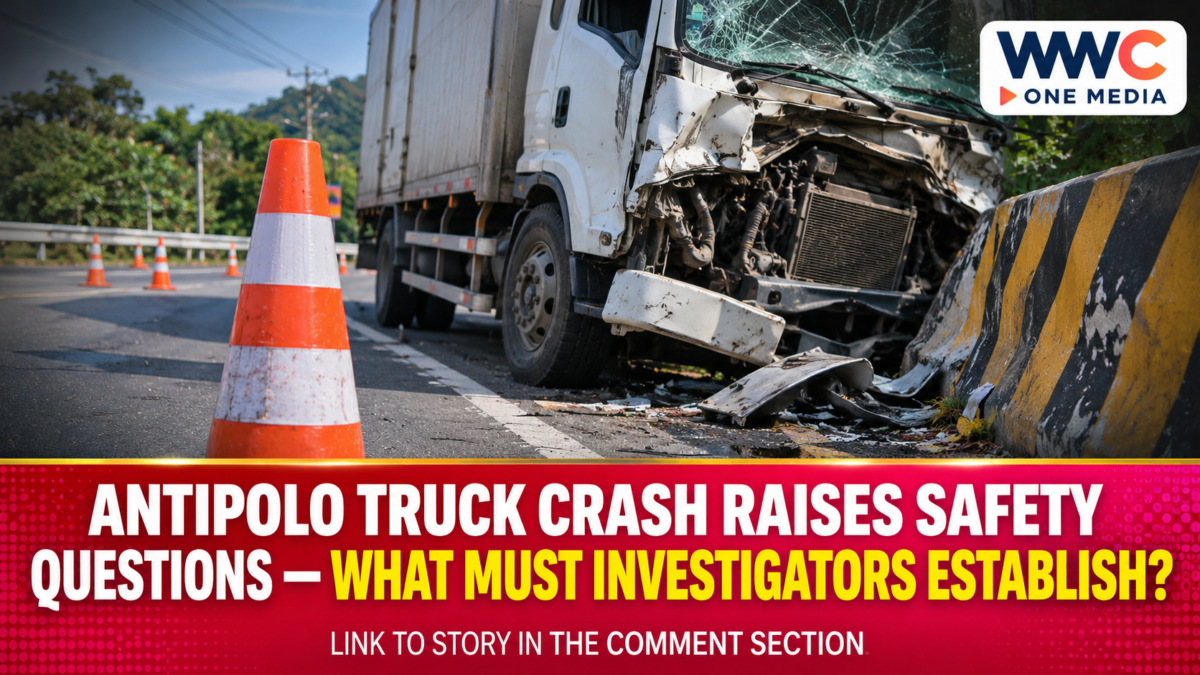
ANTIPOLO CITY, Philippines — A reported truck collision in Antipolo on Nov. 17, 2026, has prompted questions about heavy-vehicle safety and how investigators establish the cause of a serious road incident. WWC ONE MEDIA has not independently confirmed the incident’s casualty count, vehicle movements or suspected mechanical condition against an accessible official incident record.
The distinction matters because an early description of a collision is not the same as an investigation’s findings. For residents, motorists and businesses, a reliable account must distinguish what happened, why it happened and what the evidence can legally establish.
Antipolo truck crash: Which facts still need confirmation?
Before the Antipolo incident can be presented as a fully verified news report, an official police incident report or authenticated statement must establish the date, precise location, vehicles involved, casualties, property damage and investigation status. A hospital or emergency-response record may also be necessary to confirm outcomes without relying on secondhand accounts.
The available primary records reviewed for this article concern Philippine road safety law, inspection standards and national policy. They do not establish the individual circumstances of the Antipolo collision. This is why no victim’s identity, exact number of vehicles struck or driver’s explanation is presented here as confirmed.
A preliminary account may change as investigators reconcile witness statements, vehicle positions, physical damage and recordings. That is a reason to publish carefully, not a reason to treat an initial theory as a conclusion.
Why a brake-failure claim requires technical evidence
Whether a truck’s brakes were defective is an engineering question, not a conclusion that can be settled by a driver’s recollection alone. Investigators would need to examine the service-brake system, relevant components and maintenance documentation, while also considering the road gradient and how the vehicle was operated.
The Land Transportation Office’s published motor-vehicle inspection standards include examination of brake systems. Those standards demonstrate why brake condition is a legitimate part of a safety inquiry, but they do not prove that any particular truck failed inspection or suffered a mechanical defect.
A useful comparison is WWC ONE MEDIA’s earlier coverage of a truck collision in Cotabato, which shows why reported mechanical problems must be separated from a verified technical finding. That earlier event is unrelated to the Antipolo incident and supplies no evidence about its cause.
There is also an important difference between a defect developing unexpectedly and a defect that reasonable maintenance could have detected. The existence of a defect, when it developed and whether it caused the collision are separate questions.
What Philippine road traffic law requires
Republic Act No. 4136, the Land Transportation and Traffic Code, sets standards for driving behaviour and vehicle use. Section 48 prohibits operating a vehicle recklessly or without reasonable caution in view of conditions such as road width, gradients, visibility and traffic.
The law does not make a person legally responsible simply because a crash occurred. Investigators must examine the conduct and circumstances, while any criminal allegation must proceed through the applicable legal process. Section 56 also addresses consequences upon conviction when negligence or reckless driving causes death or injury.
This distinction protects both the people affected by a collision and the fairness of the investigation. A police inquiry, an allegation, a filed complaint and a court judgment are not interchangeable.
For comparison, WWC’s report on a truck striking roadside premises in Southern Leyte discusses the limits of drawing conclusions from video of a collision. The two incidents should not be treated as evidence of the same mechanical or human cause.
Why roadside businesses are part of the safety discussion
Road-safety policy is not limited to drivers and passengers. People walking, shopping, working or waiting near a road may face danger when a heavy vehicle leaves its intended path. This broader exposure makes the design of the road environment a relevant public-policy question.
The Philippine Road Safety Action Plan 2023–2028 identifies safer roads and safer vehicles among its priorities. Its infrastructure approach considers vulnerable road users, while its vehicle-safety agenda includes registration and inspection systems.
Those priorities offer a practical framework for reviewing heavily used roads: how pedestrians are separated from moving traffic, whether roadside activity creates conflicts and whether vehicle checks are effective. None of these considerations, however, establishes a particular defect at the Antipolo location.
WWC has also examined the challenge of reconstructing events in its report on a Mountain Province truck crash. That separate case illustrates the value of distinguishing the outcome of an incident from a proven explanation for it.
What the national record says about road safety
The Department of Transportation and the World Health Organization launched the Philippine Road Safety Action Plan in May 2023. Their joint release says the plan aims to reduce road traffic deaths by 35% by 2028, using measures that include safer vehicles, roads and road users.
In a separate December 2023 joint announcement, the agencies cited Philippine Statistics Authority figures showing that recorded road traffic deaths rose from 7,938 in 2011 to 11,096 in 2021. Those are historical national figures, not a count for Antipolo or for 2026.
The policy implication is clear: responding to a crash and preventing the next one are different but connected responsibilities. A thorough investigation may clarify the immediate sequence, while systematic inspections and safer road design address broader risks over time.
What happens next
The next meaningful development would be publication of an authenticated police report, formal investigation update or other official record confirming the Antipolo event’s essential details. Investigators may also need technical inspection findings before making a reliable statement about the cause.
Until those records are available, it would be premature to state that brake failure caused the collision, identify a person as legally responsible or assign a definitive casualty count. Public interest is best served by evidence that can be checked, rather than certainty that has not been established.
Frequently asked questions
What caused the Antipolo truck crash?
The cause has not been independently verified through an accessible official incident record reviewed for this article. A claim of brake failure would require supporting evidence.
Has the number of victims been officially verified?
Not for this draft. An authenticated police, medical or emergency-response record is needed before publishing a definitive count.
What law governs reckless driving in the Philippines?
Republic Act No. 4136 includes Section 48 on reckless driving. Whether that provision applies to a particular driver requires an examination of the facts and the proper legal process.
Why are truck inspections important?
Vehicle inspections can identify safety problems, including defects involving braking systems. An inspection standard alone does not prove that a specific vehicle was defective.
What should the public watch for next?
An official incident report, verified casualty information, a vehicle inspection result and any properly documented legal action would clarify what authorities have actually established.