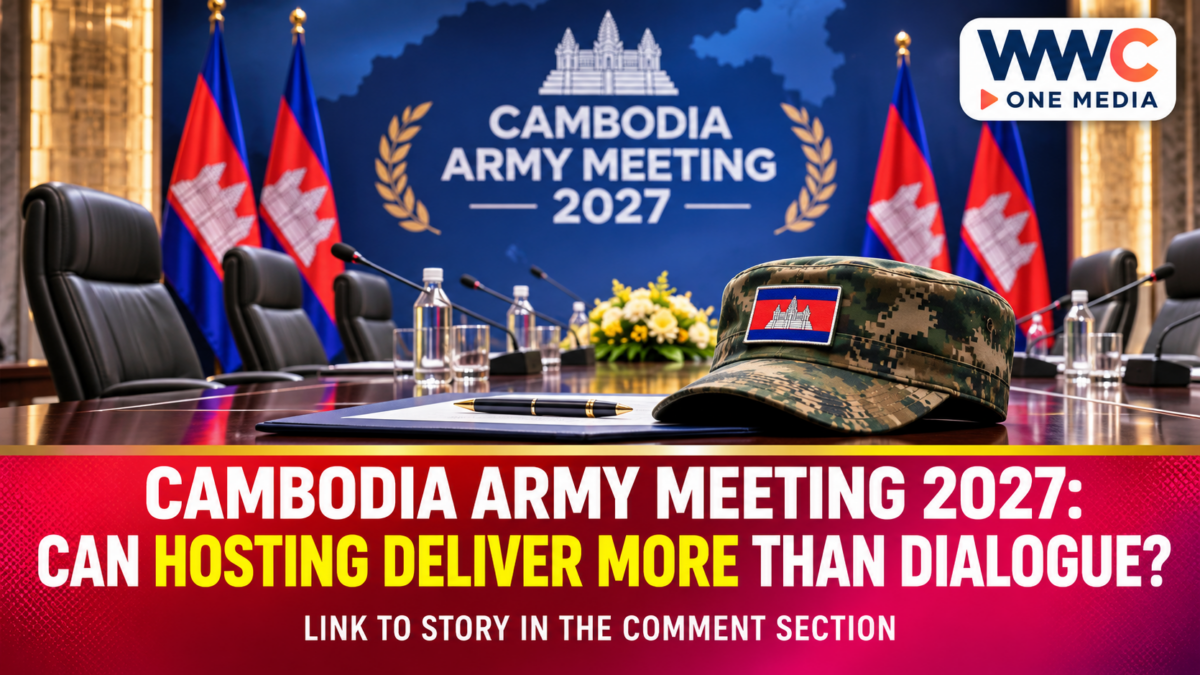
PHNOM PENH — Nov. 21, 2026. Cambodia is set to take the next turn leading the ASEAN Chiefs of Army Multilateral Meeting after the role for the 2027 gathering was handed to its army commander during a regional meeting in Malaysia on Nov. 17. The Cambodia army meeting assignment places the Royal Cambodian Army at the centre of an established forum for professional exchanges and regional security cooperation, but the original records reviewed do not disclose a 2027 venue, event dates or budget.
The immediate test is not whether delegates can assemble for another conference. It is whether the next meeting advances specific work on disaster response, information exchange and coordination between armies, without confusing discussion with binding security commitments.
Cambodia Army Meeting: What the Handover Confirms
The 27th ASEAN Chiefs of Army Multilateral Meeting took place in Malacca, Malaysia, on Nov. 17. A published account from a participating government’s official information service records that the responsibility of serving as alternate chair for the 28th meeting in 2027 was formally handed to General Mao Sophan, commander of the Royal Cambodian Army and deputy commander-in-chief of the Royal Cambodian Armed Forces.
That account identifies Malaysian Army chief General Tan Sri Azhan bin Hj Md Othman as opening the 2026 meeting. It also records the accompanying 14th ASEAN Sergeant Majors Annual Meeting. Separate public accounts describe Cambodia as the next host for both forums, but the original ceremony record inspected specifically establishes the chiefs-of-army handover.
The distinction is important. An announced chairmanship or hosting assignment does not establish a signed operational plan, an approved programme of exercises or a financial allocation. Those would need separate official documents.
Analysis: Cambodia’s next turn offers an opportunity to set practical discussion priorities, but the country cannot unilaterally determine the policies or military actions of every participating army.
Why ASEAN Armies Hold These Meetings
The forum predates the latest hosting decision. Singapore’s Ministry of Defence records that it hosted the 26th ASEAN Chiefs of Army Multilateral Meeting and the 13th ASEAN Sergeant Majors Annual Meeting on Nov. 26, 2025. Its original statement describes the gatherings as annual channels for professional relationships and cooperation among Southeast Asian land forces.
The same official record distinguishes army-chiefs meetings from the ASEAN Defence Ministers’ Meeting and other defence mechanisms. Army leaders may exchange operational experience and discuss training priorities, while ministerial meetings address broader defence-policy cooperation. Neither event should be presented as the creation of a collective ASEAN army.
WWC has covered ASEAN defence meetings held in Cebu. Those ministerial gatherings were different from the chiefs-of-army forum, although both form part of the wider regional dialogue landscape.
A practical measure of success would be clear follow-up tasks rather than confirmation that the meeting occurred.
The Existing Disaster-Response Commitments Matter
Singapore’s published 2025 joint statement provides a useful benchmark. The army chiefs agreed to strengthen cooperation and capacity-building for humanitarian assistance and disaster relief, including use of digital technology. They also pledged to work with relevant regional bodies and continue initiatives through the forum’s working group.
The accompanying Singapore defence release describes planned coordination across humanitarian response, cyber issues and military medicine under an exercise initiative for 2026. Those are commitments and plans documented for the earlier cycle; they are not proof that a new exercise has already been approved for Cambodia in 2027.
Analysis: Regional disaster operations present a concrete area for armies to demonstrate cooperation without implying a joint command structure. Procedures for sharing situational information, coordinating relief movements and working with civilian agencies can be assessed through later published plans and exercises.
A successor meeting could review what actually happened after the 2025 commitments. No original 2027 agenda obtained for this article shows that a particular exercise or technical project has been selected.
Cambodia’s Regional Security Context
The hosting assignment also comes during continued attention to the Cambodia–Thailand border. Cambodia’s Ministry of National Defence issued a July 24, 2026 statement describing the arrival of Singaporean personnel for an ASEAN observer team led by the Philippines. It said the observers’ task included monitoring and verifying implementation of the border ceasefire arrangements.
That is an example of a separately documented regional security activity, not a function automatically transferred to the 2027 army-chiefs meeting. The observer team, a bilateral boundary process and a multilateral professional conference have distinct mandates.
WWC has explained the Cambodia–Thailand border-security dispute and separately reported ASEAN observer activity along the Cambodian border. Those developments help explain why confidence-building matters, but do not establish the 2027 conference’s agenda.
Analysis: A host facing its own regional security concerns has a reason to emphasise dialogue. That does not mean participants have agreed on a common interpretation of disputed events, or that the meeting will settle territorial claims.
Malaysia and Cambodia Already Have Army Contacts
Cambodia’s official information agency recorded a virtual meeting between General Mao Sophan and Malaysian Army chief Tan Sri Azhan on Aug. 18, 2026. The statement says they discussed defence cooperation and referred to bilateral terms of reference signed in 2025.
This matters because Malaysia’s handover followed an existing institutional relationship rather than representing the first contact between the two armies. But a bilateral understanding is not the same as an ASEAN-wide agreement and should not be described as binding every regional participant.
The November gathering also included bilateral exchanges involving participating delegations. Such contact can support future training and communication, although a published meeting list does not confirm an equipment sale, troop deployment or operational arrangement.
A further distinction concerns costs. A hosting announcement may imply future logistical work, but no original budget, procurement notice or venue contract for Cambodia’s 2027 meeting was available in the records reviewed.
What Happens Next
The next meaningful official releases should establish the venue and precise dates, identify the Cambodian organising authority, publish the agenda and record any agreed practical projects. A subsequent joint statement would help readers distinguish commitments from general expressions of goodwill.
Cambodia’s selection for the 2027 army-chiefs forum is supported by the official handover record. Beyond that, success remains unmeasured. The clearest question for the next meeting is whether regional armies can demonstrate progress against their already published cooperation commitments.
Frequently Asked Questions
1. Will Cambodia lead the 2027 ASEAN army-chiefs meeting?
A government account from a participating delegation confirms that the alternate-chair responsibility for the 28th ASEAN Chiefs of Army Multilateral Meeting in 2027 was handed to Cambodia’s army commander during the November 2026 meeting in Malaysia.
2. Where and when will the 2027 meeting be held?
A specific venue and event dates were not established in the original official documents inspected for this report.
3. Is the meeting the same as the ASEAN Defence Ministers’ Meeting?
No. The chiefs-of-army forum focuses on army-to-army interaction, while the ministerial forum operates at the defence-policy level.
4. What did ASEAN army chiefs agree in 2025?
Their published statement prioritised humanitarian assistance, disaster-response coordination, digital technologies and follow-up through the chiefs-of-army working group.
5. Will the 2027 event resolve the Cambodia–Thailand border dispute?
No official document reviewed assigns that settlement role to the meeting. Border mechanisms and observer activities are distinct from this professional military forum.