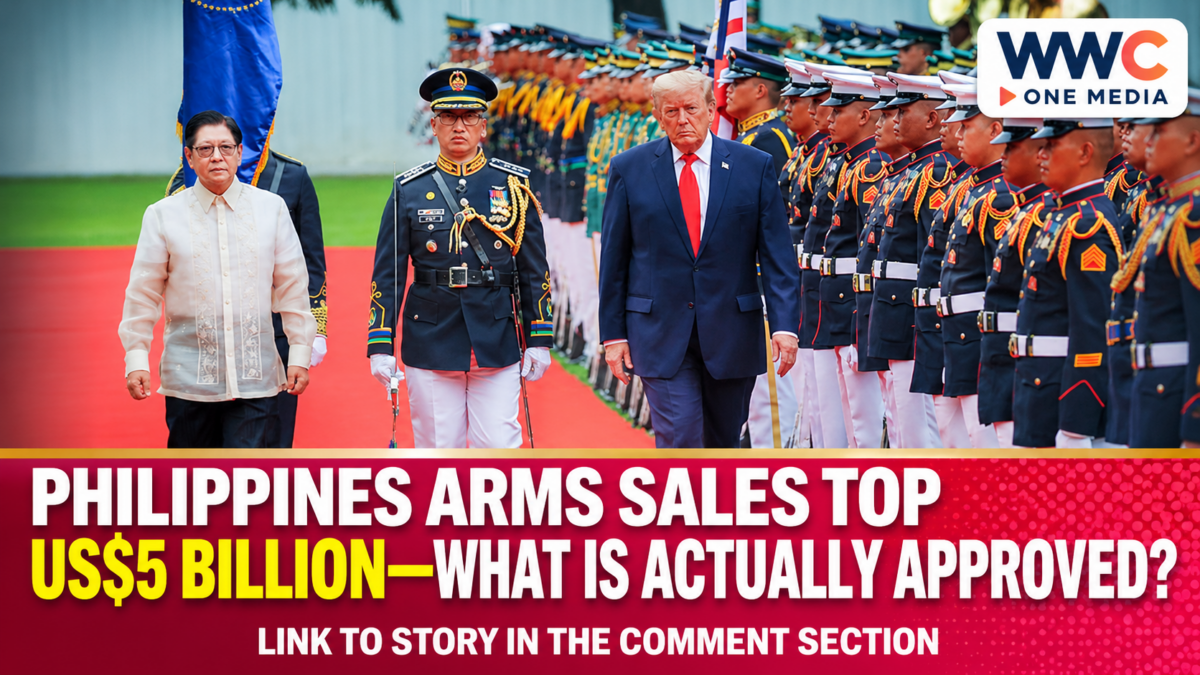
MANILA, Philippines — US President Donald Trump said on Nov. 18, 2026, that his administration had approved more than US$5 billion in arms sales for the Philippines. His statement during a meeting with President Ferdinand R. Marcos Jr. put a large figure on the defence partnership, but approval should not be mistaken for proof that every system has been purchased, paid for or delivered.
The timing matters. A separate White House announcement that day outlined proposed financing and specific security initiatives, raising a practical question for Manila: which commitments will become usable military capabilities, and under what financial arrangements?
Philippines arms sales: What the US$5 billion figure means
Trump presented the total as arms sales approved since he took office, alongside a commitment to expand bilateral defence cooperation. The figure describes approvals over a period, not a newly signed US$5-billion purchase agreement announced on Nov. 18.
An arms-sale approval is an important administrative step. It signals that the US government has authorised a proposed transaction to proceed through its applicable procedures. It does not, on its own, establish that a Philippine purchase contract has been concluded for the entire approved ceiling.
A government may ultimately buy fewer items, change the configuration or phase procurement over several budget periods. Final contract prices and actual deliveries can therefore differ from the values attached to initial approvals.
The headline may reflect a proposed ceiling while the outcome depends on later decisions.
A separate US$2 billion financing plan is still prospective
The White House said on Nov. 18 that Washington and Manila will pursue a Foreign Military Financing loan package of more than US$2 billion for Philippine defence and security acquisitions from US suppliers.
Those two words matter. A proposal to pursue a loan package is not the same as a statement that the full sum has been disbursed, or that the Philippines has already incurred a final loan obligation on the announced terms.
The same White House document said the United States would utilise US$400 million in Foreign Military Financing for Philippine military capabilities. It identified long-range fires, command and control, critical infrastructure and multi-domain drones as areas of intended support in the South China Sea.
These are separate descriptions of policy and financing activity. Without detailed accounting documents, readers should not add the US$400 million to the proposed loan amount or to the more-than-US$5-billion approved-sales figure and present the result as a new total.
WWC previously examined the larger US–Southeast Asia deal announcements and the difference between plans and signed commitments. The same discipline applies to defence procurement.
Technology and logistics are part of the defence package
The White House also identified a US$37 million contract announced by the Philippine Department of National Defense with a US firm for technology-enabled mission support. It separately described a US$63 million initiative on which the department committed to work with US technology providers to modernise defence cloud infrastructure.
The first was described as a contract; the second as an initiative. Treating both as completed purchases would erase a material difference in their stated status.
Defence modernisation is not limited to acquiring platforms. Communications, secure data handling, maintenance and the ability to coordinate units can determine how effectively a military uses equipment after delivery.
The White House also said the Philippines would modernise Basco Airport to improve operational access, disaster response and commercial supply chains. That announcement did not provide a completed construction timetable or itemised budget in the fact sheet.
Taken together, the initiatives suggest a focus on how forces communicate, move and sustain operations. That is an assessment of the published priorities, not a claim that all the announced facilities and systems are already operational.
Why the maritime-security context matters
The financing announcement specifically connected new capabilities to deterrence and operational reach in the South China Sea. For an archipelagic country, the usefulness of any acquisition depends on where and how it can be employed, the personnel trained to operate it and the resources available to maintain it.
The wider diplomatic setting is also relevant. In its review of the US–Philippines alliance and the existing treaty framework, WWC examined why political assurances and formal security obligations should not be confused.
US cooperation is not the only component of Manila’s defence planning. WWC has separately examined Australia–Philippines defence cooperation and its practical implications, a related but distinct partnership.
These initiatives do not prove any US transaction has been fulfilled; they illustrate the importance of systems integration.
What should Philippine taxpayers watch?
Three different questions deserve separate answers: What has the US government approved? What has Manila contractually agreed to acquire? And what equipment or service has actually been delivered and put into use?
The public figures released during the visit principally answer the first question and identify several financing and programme intentions. They do not provide a comprehensive, reconciled register of Philippine contracts, repayment terms, delivery dates and completed installations.
Analysis: A useful measure of progress would be public documentation showing the terms of any financing arrangement, the final cost and scope of purchases, implementation milestones and the ability of the armed forces to sustain the systems over their service lives.
Transparency matters because a large approval ceiling can attract attention even when the resulting operational improvements remain years away. Equally, a smaller programme involving secure communications or support infrastructure may materially improve readiness without making the biggest headline.
What happens next
The next test is documentary and operational. Washington and Manila would need to clarify the proposed loan package, disclose further procurement decisions where legally possible, and report progress on the financing and technology initiatives announced in November.
Until those steps are documented, more than US$5 billion in approved arms sales should be described as an approval figure—not US$5 billion of equipment already delivered to the Philippines.
Frequently asked questions
Did Trump announce more than US$5 billion in Philippine arms sales?
Yes. On Nov. 18, 2026, Trump said his administration had approved arms sales worth more than US$5 billion since he took office. This was not presented as a single completed purchase that day.
Has the Philippines received US$5 billion worth of US weapons?
The reviewed announcements do not establish that. Approved transaction values cannot be treated as confirmed deliveries or payments.
Is the proposed US$2 billion financing package already final?
The White House said both governments would pursue a loan package of more than US$2 billion. Its public announcement did not establish final loan terms or full disbursement.
What is the US$400 million intended to support?
The White House identified capabilities including long-range fires, command and control, critical infrastructure and multi-domain drones to strengthen operational reach and deterrence in the South China Sea.