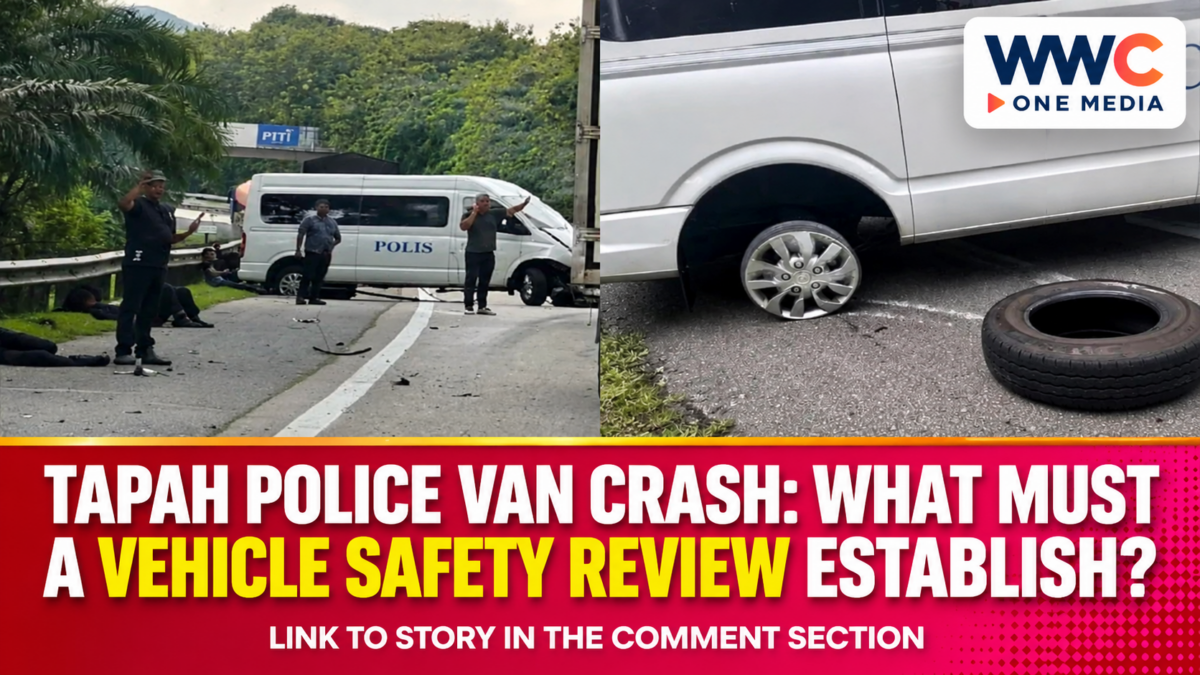
PERAK, Malaysia — Nov. 21, 2026. A police van crash near Tapah on Nov. 17 killed one officer and injured 10 others, bringing fresh attention to vehicle safety during official road journeys. Malaysia’s government broadcaster reported that the van was travelling south on the North–South Expressway when a suspected failure of its left rear tyre preceded the crash.
The tragedy is not proof that a maintenance lapse occurred. It does, however, raise a practical question: what evidence would be needed to establish the condition of the vehicle before the journey and identify any safety improvements that could help prevent another such loss?
What the Tapah police van crash record establishes
The government-published account identifies the location as around kilometre 351.7 of the southbound North–South Expressway. It says 11 police personnel were in the van; one died, four sustained serious injuries and six suffered less serious injuries. The Nov. 18 government report also records the burial of the officer who died.
The same account describes a left rear tyre burst as a suspected factor, not as a final technical finding. That distinction matters. A tyre failure can be an important part of a collision sequence without, on its own, establishing why the tyre failed or whether anyone breached a safety obligation.
A responsible investigation should keep those questions separate: what happened on the road, what mechanical condition existed beforehand, and what conclusions the available evidence can actually support.
The missing answers behind a suspected tyre failure
Tyre examination would be one sensible part of a technical review. Investigators could assess its physical condition, age, inflation history, load suitability and any available records of earlier inspections. They could also examine the vehicle, road environment and crash sequence rather than treating a single preliminary explanation as a complete account.
Those are proposed investigative questions, not findings about this particular van. No tyre-test report, workshop history or final collision reconstruction was available in the official public material reviewed for this article.
Even where a tyre rupture is established, causation requires care. Damage discovered after a serious collision may need to be distinguished from damage that existed before it. The appropriate conclusion should follow the evidence, not public pressure for a rapid answer.
WWC has examined the broader distinction between a road incident and a proven breach of driving rules in its coverage of a Penang traffic case involving a teenager. The incidents are unrelated, but both illustrate why factual findings and responsibility must be assessed separately.
What Malaysia’s road safety plan says about roadworthiness
Malaysia’s Road Safety Plan 2022–2030 identifies roadworthy vehicles as a central safety objective. Its vehicle-safety section highlights the challenge of managing older vehicles and discusses ways to encourage periodic inspections, particularly where routine inspection requirements do not already apply.
The plan distinguishes between commercial vehicles, for which periodic inspections are required under the framework it describes, and private vehicles, which generally face different inspection arrangements. It does not establish the inspection classification or maintenance schedule applicable to the police van involved at Tapah.
That limitation is important. A national strategy cannot be used as evidence that this specific vehicle was overdue for service, improperly inspected or unsafe before departure.
Nevertheless, its underlying principle applies broadly: preventive vehicle care should identify avoidable defects before they become emergency conditions on a busy highway. This is a policy lesson, not a finding of negligence.
The same distinction appears in WWC’s earlier reporting on vehicle-condition questions after a fatal bus incident in Quezon. That Philippine case is separate, with different authorities and laws; it is relevant only as an illustration of why evidence about mechanical condition matters.
Why official fleets deserve a clear audit trail
Public-service vehicles often carry personnel whose work depends on reliable transport. A transparent fleet-safety process could document servicing intervals, tyre replacement decisions, defect reports, pre-trip checks and action taken when a problem is flagged.
These are reasonable elements to examine after a serious crash, not claims that police failed to maintain them. Whether records exist, what they show and whether procedures were followed must be established before responsibility is assigned.
The wider value of an audit trail is accountability without premature blame. Complete records can help investigators rule out some explanations as well as identify deficiencies where the evidence supports them.
Elsewhere in Malaysia, WWC’s coverage of a Melaka collision and competing traffic-control claims highlighted the danger of converting public speculation into a settled conclusion. That case has no demonstrated connection to the Tapah crash.
What happens next
The useful next step would be publication of an authoritative technical conclusion, with appropriate protection for personal and investigative information. Readers should look for a clear account of the tyre examination, the van’s relevant service records, the crash reconstruction and any corrective measures that officials actually announce.
A separate hospital-status update was publicly attributed to the Perak police chief on Nov. 18, but the original statement could not be independently accessed for this review. Consequently, this article does not present the reported discharge numbers as a primary-record-verified finding or imply that no further changes have occurred since then.
The central question remains open: not simply whether a tyre failed, but whether the completed evidence can explain the failure and guide sensible improvements. A careful answer would honour the seriousness of the fatal crash without presuming misconduct.
Frequently asked questions
When did the Tapah police van crash happen?
The government-published account places the crash on Nov. 17, 2026, on the southbound North–South Expressway near Tapah, Perak.
How many police personnel were affected?
The Nov. 18 government account says 11 personnel were travelling in the van. One died and 10 were injured.
Has the exact cause been established?
The government account describes a suspected left rear tyre burst. The primary records reviewed here do not include a final technical investigation establishing the underlying cause.
Were four injured officers discharged from hospital?
A Nov. 18 hospital update was attributed publicly to the Perak police chief, but its original police statement was not available for independent primary-record verification in this review.
What should a safety review examine?
Relevant questions include tyre condition, servicing and inspection records, vehicle loading, the collision sequence and any documented corrective action. These are areas for review, not established faults.