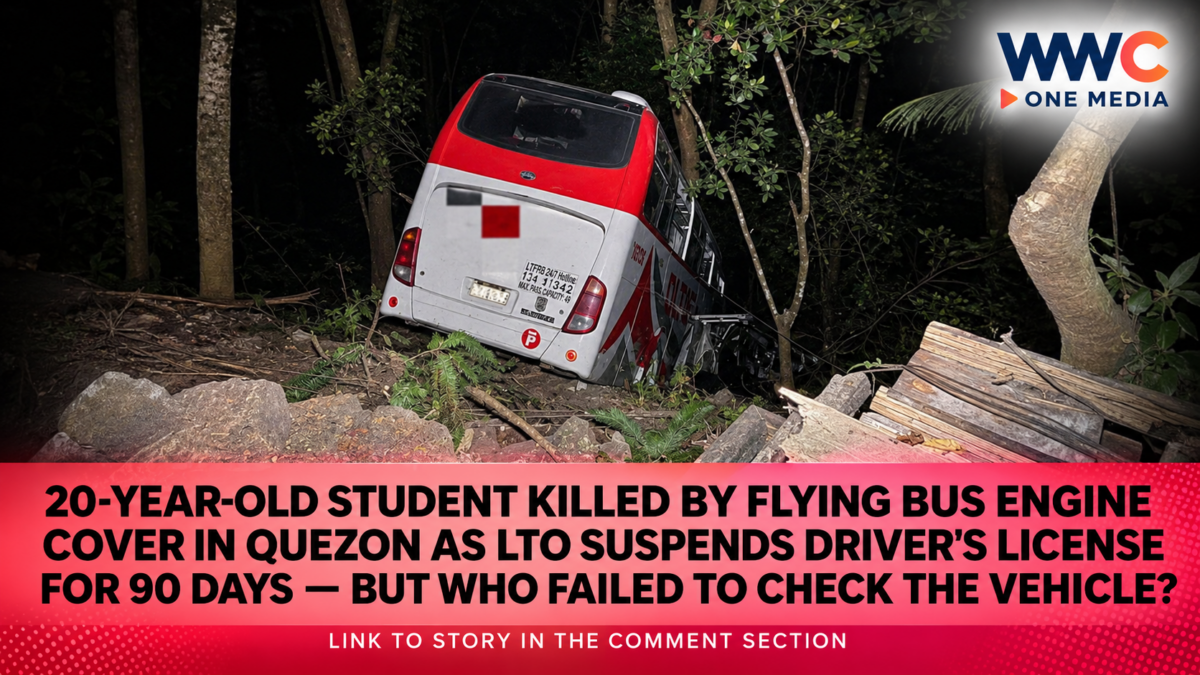
ATIMONAN, QUEZON — A 20-year-old college student waiting for a ride to Manila was killed after a metal engine compartment cover from a passing passenger bus suddenly opened and struck him along Maharlika Highway in Atimonan, Quezon.
The tragedy has triggered an investigation by the Land Transportation Office (LTO), which has summoned both the bus driver and the company responsible for operating the vehicle.
The agency has also ordered the driver to surrender his license for a 90-day preventive suspension, while the bus itself has been placed under alarm.
The accident occurred on November 5 in Barangay Tagbakin, where the victim was standing beside the highway near a fast-food establishment.
Police said the bus’s right-side engine compartment cover suddenly opened while the vehicle was moving, hitting the student with enough force to throw him several meters.
He suffered severe injuries and was rushed to Doña Marta Hospital, where he was declared dead on arrival.
But the most alarming aspect of the incident may be that a similar tragedy had reportedly occurred in the same province just one month earlier.
In October, a man jogging beside a road in Guinayangan, Quezon, was also killed after being struck by an open compartment cover from a moving bus.
Two deaths involving loose bus compartments have now raised a difficult question about public transport safety: Are the country’s vehicle inspections and maintenance practices doing enough to protect people even when they are not riding a bus?
LTO Summons Bus Driver and Operator After Fatal Atimonan Accident
The LTO confirmed that it had issued formal show-cause orders against the bus driver and operator.
LTO chief Assistant Secretary Markus Lacanilao said the agency had identified both parties and formally served the administrative orders.
They have been instructed to appear before the LTO Central Office’s Intelligence and Investigation Division on November 13.
The driver and operator must submit sworn statements, explanations and relevant supporting documents.
The proceedings will examine possible violations involving reckless driving and the condition of the passenger bus.
The operator must also answer allegations involving the employment of a reckless driver and possible breach of franchise conditions.
A show-cause order is an opportunity for a respondent to explain why sanctions should not be imposed.
It is not a final finding of liability.
The LTO must evaluate the evidence and the respondents’ explanations before deciding whether further administrative penalties are warranted.
Who Was the Victim?
Police identified the victim as a 20-year-old college student.
The Philippine Star’s Filipino-language publications referred to him by the alias “Toto.”
He was reportedly waiting for transportation to Manila.
The student had been standing beside Maharlika Highway in Barangay Tagbakin when the passing bus’s engine compartment cover struck him.
The impact reportedly threw him several meters from where he had been standing.
Emergency responders brought him to Doña Marta Hospital.
Doctors declared him dead on arrival.
The victim’s full identity was not consistently disclosed in the reports reviewed.
His name should therefore not be invented or published without reliable confirmation.
For his family, the incident represents a devastating loss involving an ordinary journey.
The student was not driving recklessly or participating in a road confrontation.
According to police accounts, he was simply waiting beside the road.
Conflicting Reports Place the Incident at Different Times
An important discrepancy remains in published accounts.
GMA News, citing the LTO’s official release, reported that the accident occurred at approximately 5 a.m. on November 5.
However, ABS-CBN News and The Philippine Star, citing the Atimonan police investigation, placed it at approximately 12:15 a.m.
Both accounts identify the same date, barangay, highway and circumstances.
The difference has not been conclusively reconciled in the reporting reviewed.
The incident can therefore be accurately described as occurring in the early hours of November 5.
Authorities may be able to clarify the precise time through police records, vehicle movement information and other evidence.
The discrepancy does not change the confirmed central fact: a pedestrian died after being struck by a bus’s engine compartment cover.
But accurate reporting requires distinguishing verified details from conflicting accounts.
What Caused the Bus’s Engine Cover to Open?
According to the Atimonan Municipal Police Station, the bus was traveling northbound along Maharlika Highway when the right-side engine compartment cover opened.
The cover then struck the student standing near the roadside.
Police Chief Major Allan Hernandez said the driver claimed he had not noticed that the compartment cover was open.
Hernandez questioned how the driver could have failed to notice the condition while the bus was moving.
However, investigators have not publicly released a complete technical finding explaining why the compartment opened.
Several questions remain.
Was the cover properly secured before departure?
Was a latch or locking mechanism defective?
Did the compartment open because of mechanical failure, improper maintenance or another circumstance?
Was the condition visible to the driver before the accident?
These possibilities should be examined rather than assumed.
The LTO investigation may help determine whether a failure to inspect or maintain the vehicle contributed to the tragedy.
Superlines Transportation Company Ordered to Explain
Abante identified the bus operator involved in the Atimonan incident as Superlines Transportation Company Inc.
The company and the driver received show-cause orders concerning the fatal accident.
The operator must explain why administrative sanctions should not be imposed for allegedly employing a reckless driver and breaching franchise conditions.
The investigation may examine whether the bus was maintained appropriately and whether the company complied with applicable operating requirements.
A transport operator’s responsibilities extend beyond collecting fares and assigning drivers.
Passenger buses must be kept in safe working condition.
This includes ensuring that mechanical components, exterior panels and compartment covers are properly secured.
But naming the operator in an administrative proceeding does not establish that company management knowingly permitted an unsafe vehicle to operate.
That conclusion would require evidence from inspections, maintenance records and the ongoing investigation.
LTO Orders Driver’s License Surrender and 90-Day Suspension
The LTO has instructed the driver to surrender his license to its Intelligence and Investigation Division.
The order provides for a 90-day preventive suspension.
The measure is intended to restrict the driver’s ability to operate a motor vehicle while the administrative proceedings continue.
The agency also placed the bus under alarm.
An alarm designation can affect how authorities process or monitor transactions involving the vehicle while an investigation is pending.
It should not automatically be described as a final confiscation or permanent cancellation of registration.
Lacanilao warned that the driver’s license could eventually be suspended further or revoked if the agency’s final decision establishes grounds to declare him an improper person to operate a motor vehicle.
The distinction is important.
The preventive suspension is an immediate regulatory measure.
Any final penalty must follow the applicable proceedings.
Driver Also Faces a Homicide Complaint
The incident has also become a police matter.
According to The Philippine Star, the driver was taken into police custody following the fatal accident.
Police identified him in their reporting as a 56-year-old man referred to as “Mando.”
He faces a complaint involving reckless imprudence resulting in homicide.
That legal issue is separate from the LTO’s administrative case.
The criminal investigation concerns whether negligent conduct caused the student’s death under applicable law.
The LTO proceedings concern licensing, operating responsibilities and transport regulations.
Both may examine overlapping evidence.
However, the outcome of one process does not automatically determine the result of the other.
The driver remains entitled to due process.
An investigation or complaint should not be reported as a criminal conviction.
A Similar Bus Compartment Accident Killed a Man in October
The Atimonan tragedy has drawn particular attention because of another death in Quezon province.
On October 5, a man jogging beside a road in Barangay Gapas, Guinayangan, was reportedly struck by the compartment cover of a passing passenger bus.
The man sustained serious injuries and later died.
Police investigated the circumstances and the condition of the compartment cover.
The incident raised questions about how a bus component could remain open or become unsecured while a vehicle was traveling.
The November Atimonan case now raises similar concerns.
However, there is no verified evidence that the two incidents involved the same bus operator or a common mechanical defect.
They should therefore be treated as separate investigations.
What connects them is the broader public-safety risk.
A moving passenger bus can endanger people outside the vehicle when external components are not securely fastened.
Why Loose Bus Components Can Be Deadly
Road-safety discussions often focus on speeding, collisions, overtaking and driver fatigue.
But vehicle maintenance can create hazards even without a conventional crash.
A poorly secured engine cover or luggage compartment door may swing open while a bus is traveling.
The movement can cause the cover to extend beyond the vehicle’s normal body profile.
If it strikes a pedestrian, cyclist or nearby motorist, the consequences can be severe.
A detached panel can also become debris that endangers other road users.
The precise mechanism depends on the vehicle’s design and the condition of its fittings.
That is why physical inspections matter.
Operators need to ensure that doors, hatches, latches, hinges and other external components are secure before dispatching vehicles.
Safety checks should not be limited to engines, tires and brakes.
LTO Chief Warns Operators Against Negligent Maintenance
Lacanilao stressed that passenger buses must be maintained in safe working condition.
The LTO chief warned that failing to secure even one component can lead to a fatal road accident.
The agency said it would hold violators accountable under transportation rules.
It also promised to strengthen monitoring of public utility vehicle roadworthiness.
The statement reflects a critical responsibility of transport regulators.
Passengers and pedestrians cannot reasonably inspect the mechanical condition of every bus passing through their communities.
They depend on operators to maintain vehicles and on authorities to enforce safety standards.
But stronger inspections must lead to consistent compliance.
An announcement of more enforcement alone does not guarantee that similar incidents will be prevented.
The effectiveness of the response will depend on actual inspection practices, documented repairs and appropriate sanctions when violations are established.
The Accident Raises Questions About Pre-Trip Inspections
An important issue is whether the bus underwent an appropriate safety check before departure.
Professional transport operations depend on regular maintenance and pre-trip inspections.
These checks can identify obvious problems involving tires, lights, brakes, emergency equipment and unsecured body components.
But not every defect is visible during a routine check.
Some problems emerge because of vibration, wear or mechanical failure while a vehicle is moving.
Investigators should therefore examine both the condition of the component and the inspections conducted before the journey.
Relevant evidence could include maintenance records, repair histories, inspection checklists and statements from personnel responsible for dispatching the bus.
Those records may help explain whether the incident could reasonably have been prevented.
No complete set of maintenance findings has been publicly established in the reporting reviewed.
LTO Recently Inspected Buses Ahead of Undas
The Atimonan accident occurred shortly after the annual Undas travel period, when large numbers of Filipinos return to their provinces.
The LTO had intensified safety inspections of passenger buses operating from major terminals.
As WWC ONE MEDIA reported in its October 25 coverage of bus roadworthiness checks, 51 of 52 buses inspected in one reported Metro Manila inspection group passed the checks.
That result suggested a high compliance rate among the inspected vehicles.
However, the result was not a nationwide certification of every bus.
It also did not establish that the vehicle involved in the Atimonan tragedy was among those inspected.
The new accident demonstrates why bus safety requires continued attention even after holiday enforcement operations end.
A vehicle that passes an inspection at one point in time still requires maintenance and monitoring afterward.
Another Provincial Bus Accident Raises Wider Safety Concerns
Road safety has also been highlighted by accidents involving buses in other provinces.
As WWC ONE MEDIA reported in its October coverage of a passenger bus that overturned in Ilocos Norte, approximately 20 people were reportedly injured in a separate incident.
The cause of that accident was not independently established in the WWC report.
It would therefore be misleading to attribute the Ilocos Norte incident to the same maintenance problem involved in Atimonan.
Nevertheless, both stories reinforce the importance of vehicle safety and careful accident investigations.
Bus incidents can involve different causes, including road conditions, driver actions and mechanical issues.
Each case requires its own evidence.
LTO Has Also Been Acting Against Dangerous Driver Conduct
The agency has recently issued show-cause orders in incidents involving dangerous or improper behavior on public roads.
In October, a confrontation between a motorcycle rider and a Ceres bus driver in Cebu prompted administrative action.
As WWC ONE MEDIA reported in its coverage of the Cebu road-rage incident, the LTO sought explanations from the parties involved and initiated proceedings concerning their driving conduct.
That incident is unrelated to the fatal Atimonan accident.
But it demonstrates how the LTO can use administrative processes to investigate possible violations involving drivers and public utility vehicles.
The important distinction is that the issuance of a show-cause order is not itself proof of misconduct.
Regulatory action must be supported by evidence and appropriate procedures.
Fatal Bus Accidents Are a Regional Road-Safety Concern
The risks associated with passenger buses are not unique to the Philippines.
In Singapore, authorities have investigated fatal accidents involving buses and other road users.
As WWC ONE MEDIA reported in its coverage of a fatal accident near the Queen Street Bus Terminal, a woman died following an accident involving a bus, and the driver was arrested as investigators examined the circumstances.
The Singapore incident involved different facts and transport regulations.
It should not be treated as evidence of the same safety failure.
However, both cases underscore a shared principle.
Public transport safety must protect not only passengers but also pedestrians, cyclists and other people who use or stand beside roads.
What Should Bus Operators Do to Prevent Similar Tragedies?
The Atimonan case highlights several practical areas for transport operators to review.
Before dispatching a passenger bus, maintenance personnel and drivers should ensure that engine compartment panels and luggage hatches are properly secured.
Mechanical defects should be documented and repaired.
Drivers should report abnormal noises or visible problems before continuing a journey.
Operators should also maintain accurate inspection records.
Where a locking mechanism or hinge is damaged, a bus may need to be removed from service until repairs are completed.
These are general safety principles rather than findings that a specific repair was neglected in the Atimonan case.
The LTO investigation must establish the actual condition of the bus and whether the responsible parties complied with applicable regulations.
What Happens at the November 13 LTO Hearing?
The driver and operator are required to appear before the LTO’s Intelligence and Investigation Division on November 13.
They must provide sworn explanations and supporting documents.
The agency may examine police findings, vehicle records and other evidence.
It must then determine whether the facts establish administrative violations.
Potential outcomes depend on the investigation and applicable regulations.
The driver’s preventive license suspension is already part of the immediate administrative response.
But further sanctions, including possible revocation, require an appropriate basis.
The criminal complaint involving the student’s death will be handled separately.
As of November 8, no final administrative or criminal determination has been reported.
Will the LTO Investigate Other Buses?
Lacanilao said the agency would intensify monitoring of public utility vehicle roadworthiness.
That announcement could lead to increased inspections or enforcement activities.
However, the reporting reviewed does not identify a specific nationwide inspection schedule resulting from the Atimonan incident.
Nor has the LTO publicly announced a blanket suspension affecting all buses operated by the company involved.
Such actions should not be assumed.
The immediate confirmed measures concern the bus driver, operator and vehicle involved in the November 5 tragedy.
The effectiveness of future enforcement will depend on whether inspections identify and correct unsafe conditions.
The Bottom Line: A Fatal Accident That Should Never Be Dismissed as a Routine Road Incident
A 20-year-old college student died after being struck by an engine compartment cover from a moving passenger bus in Atimonan, Quezon, on November 5.
The victim was waiting beside Maharlika Highway for transportation to Manila.
The LTO has summoned the driver and operator to explain possible violations involving reckless driving and franchise conditions.
The driver has been ordered to surrender his license for a 90-day preventive suspension, and the bus has been placed under alarm.
A separate police investigation is examining a complaint involving reckless imprudence resulting in homicide.
The tragedy follows another reported death in Quezon province involving a bus compartment cover in October.
The two incidents have not been proven to share the same cause or operator.
But both raise urgent concerns about vehicle inspection, maintenance and the safety of pedestrians near busy highways.
The driver’s and operator’s liability remains subject to investigation.
And as the Land Transportation Office demands answers over a bus engine cover that killed a young Filipino waiting for a ride, one question now confronts the country’s transport industry: Was this a preventable maintenance failure—or will investigators uncover a much bigger problem in how passenger buses are inspected before they are allowed onto Philippine highways?