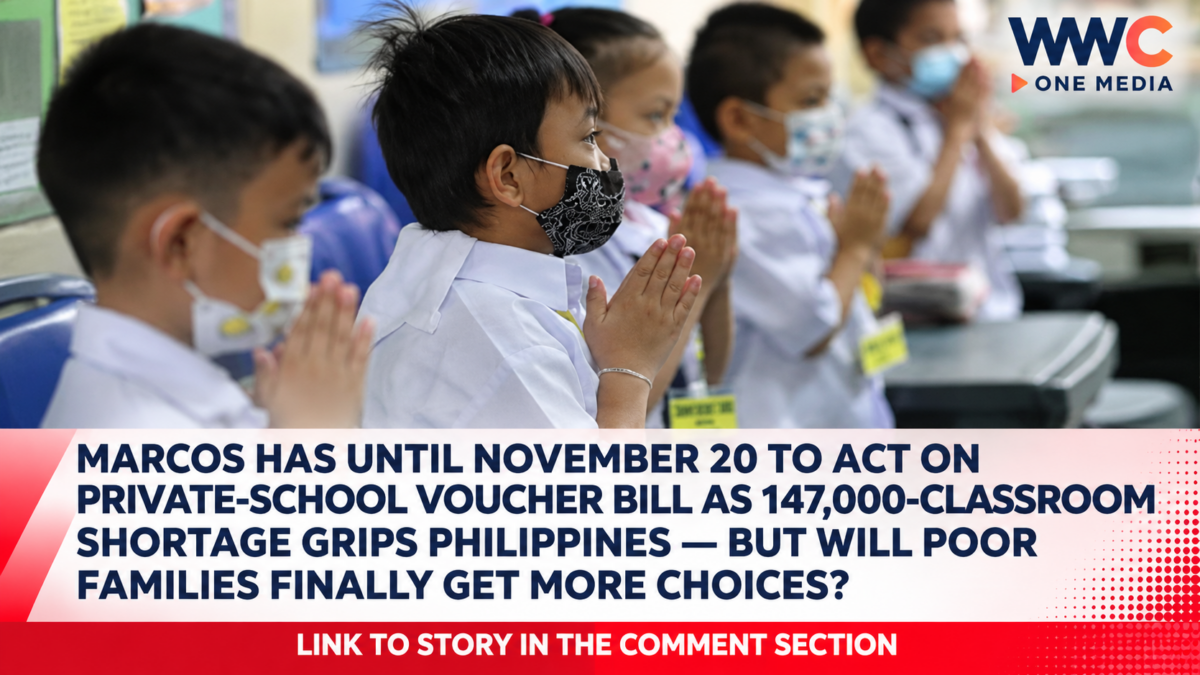
MANILA, PHILIPPINES — Thousands of Filipino families could soon have more options for their children’s education as a major bill expanding government assistance for private-school enrollment awaits action from President Ferdinand Marcos Jr.
Camarines Sur Representatives Miguel Luis “Migz” Villafuerte and Vincenzo Renato Luigi Villafuerte are urging the President to approve the proposed Basic Education Voucher Assistance Act, describing it as a potential breakthrough for families struggling with tuition expenses and overcrowded public schools.
The measure would expand government-supported access to qualified private schools for learners from Kindergarten through Grade 12.
It would also introduce a more targeted system for distributing education vouchers, prioritizing disadvantaged families and communities where public schools lack sufficient classrooms.
But an important deadline is approaching.
The enrolled bill was transmitted to the Office of the President on October 21, 2026. According to the Second Congressional Commission on Education’s legislative tracker, it is scheduled to lapse into law on November 20 unless the President signs or vetoes it earlier.
For parents, the critical question is whether the legislation will make private education genuinely affordable—or whether tuition costs, limited school slots and government funding constraints will continue to keep many children out.
Migz and Luigi Villafuerte Call for Marcos’ Signature
In a November 8 statement reported by Politiko, the Villafuerte brothers expressed optimism that Marcos would approve the legislation.
The measure consolidates reforms proposed in House Bill No. 4744 and Senate Bill No. 1981.
It seeks to modernize the Government Assistance to Students and Teachers in Private Education programme, commonly known as GASTPE.
Migz Villafuerte described the legislation as an opportunity for cooperation between public and private education providers.
Under the proposal, government subsidies would allow eligible learners to occupy available places in participating private schools.
This could help reduce overcrowding in nearby public institutions.
Luigi Villafuerte also emphasized the importance of distributing assistance fairly and transparently.
The brothers were among the authors of House Bill No. 2560, one of the proposals consolidated into the final House measure.
However, they are not the bill’s only proponents.
The wider legislation was developed through the work of lawmakers in both chambers, including Senator Bam Aquino, Senator Joel Villanueva and Representative Roman Romulo.
What Is the Basic Education Voucher Assistance Act?
The proposed law would update the existing system of government financial assistance for students attending private schools.
The existing GASTPE framework was established through Republic Act No. 6728 and expanded by Republic Act No. 8545.
It includes programmes such as Education Service Contracting and senior high school vouchers.
The new measure would broaden the system to cover qualified learners from Kindergarten through Grade 12.
Instead of treating government subsidies as a general entitlement to any private school, the measure establishes priorities based on household circumstances and public-school capacity.
The government would help eligible families enroll children in participating private institutions.
But the assistance would remain subject to programme conditions, available funding and school capacity.
The measure is intended to improve access to education while making more effective use of classrooms that already exist.
Who Would Be Eligible for the Expanded Vouchers?
The legislation seeks to prioritize several groups.
These include students from financially disadvantaged households, children attending congested public schools and learners living in communities without a reasonably accessible public school.
Eligible students from middle-income households could also benefit, subject to the income classifications and implementing rules.
Students from the most vulnerable families may receive higher assistance amounts.
However, the proposed law does not promise an identical voucher to every Filipino student.
DepEd would need to determine eligibility, identify participating schools and establish the procedures for awarding assistance.
The amount of support could vary depending on applicable rules and funding.
Parents should therefore distinguish between being potentially eligible and having an approved voucher.
Why 147,347 Missing Classrooms Matter
The proposed legislation is being advanced against the backdrop of a longstanding classroom shortage.
EDCOM 2 reported that DepEd’s backlog stood at approximately 147,347 classrooms as of September 2025.
During School Year 2024–2025, 1,889 public schools were operating double or triple shifts.
Those shifting arrangements can reduce the time available for regular classroom instruction and create scheduling difficulties for students, teachers and families.
The government has been pursuing additional classroom construction, including public-private partnerships.
But new school buildings require land, funding, procurement and construction time.
Voucher assistance offers a different approach.
Instead of waiting for additional classrooms to be built, qualified students could use existing spaces in private schools.
The aim is to reduce pressure on selected public schools while expanding families’ options.
However, vouchers cannot solve every classroom shortage.
The approach depends on whether suitable private schools exist near affected communities and whether they have enough available places.
How Public and Private Schools Could Benefit
Supporters describe the reform as a partnership that could benefit several groups.
For families, vouchers could reduce the financial barrier to private-school enrollment.
For overcrowded public schools, transferring some qualified learners could ease congestion.
For participating private schools, additional enrollment could help them use existing classrooms, employ teachers and maintain operations.
For the government, the programme could complement school construction and other education investments.
But those outcomes depend on programme design.
A private school with no available classrooms cannot accommodate additional learners simply because vouchers become available.
Similarly, a voucher that covers only a fraction of tuition may remain insufficient for a low-income household.
The success of the programme will depend on whether funding, school capacity and family needs are properly matched.
Will Private School Tuition Become Free?
Not necessarily.
The proposed programme provides financial assistance toward private basic education expenses.
It is not a universal guarantee of fully subsidized private-school tuition.
The legislation anticipates situations in which a voucher’s value may be lower than a school’s tuition fee.
In those cases, families may face a remaining amount, sometimes called a top-up.
The proposal includes transparency measures to help parents understand these potential costs.
Participating schools would be required to disclose relevant information through a public system maintained by DepEd.
This would include tuition fees, available places and any additional amount families may have to pay.
For parents, the distinction matters.
A private-school voucher could substantially reduce education expenses without eliminating them.
The final benefit will depend on the voucher amount and the participating school’s charges.
DepEd Would Create a Public Dashboard for Parents
One of the proposed law’s significant changes concerns transparency.
DepEd would establish a publicly accessible information system covering participating private schools.
The dashboard is intended to help parents compare available options.
Information would include school locations, available enrollment slots, classroom capacity, grade levels, tuition fees and applicable top-up charges.
It would also provide other school information relevant to families’ decisions.
The goal is to help parents choose schools based on reliable information rather than incomplete advertising or informal recommendations.
The system could also help government officials monitor where assistance is going.
But the dashboard has not been confirmed as fully operational under the new legislation.
Its establishment will depend on enactment and implementation.
New Bureau of Private Education Proposed
The legislation also seeks to create a Bureau of Private Education within DepEd.
The office would oversee the administration of government assistance programmes involving private basic education institutions.
Its responsibilities would include supporting programme coordination, implementation and monitoring.
A dedicated bureau could provide more consistent supervision.
But creating an additional government office does not automatically guarantee greater efficiency.
Its effectiveness would depend on staffing, administrative systems, funding and accountability measures.
DepEd would also need to coordinate the new office’s responsibilities with existing divisions and relevant education agencies.
Teacher Benefits Are Part of the Reform
The proposal is not exclusively about students.
Participating private-school teachers could also benefit from education-support provisions.
These include training opportunities, professional development and possible salary subsidies under applicable programme rules.
The legislation also includes conditions related to tuition increases at participating schools.
Those provisions are intended to ensure that additional revenues support appropriate institutional needs, including personnel and educational improvements.
Supporters argue that maintaining a healthy private education sector requires supporting teachers as well as students.
However, not every teacher would automatically receive a salary increase upon enactment.
The actual benefits would depend on the approved programme rules and funding.
DepEd Eyes ₱4.34 Billion for Initial Elementary Expansion
Separate reporting on DepEd’s preparations identified a proposed allocation of approximately ₱4.34 billion for the expansion of basic education vouchers in School Year 2027–2028.
The initial plan was expected to support more than 292,000 elementary learners and nearly 18,000 private-school teachers.
It would involve approximately 2,632 participating private schools.
The estimates show the potential scale of the programme’s early rollout.
But ₱4.34 billion is a proposed allocation, not a confirmed amount already distributed to schools or students.
Actual implementation will depend on final appropriations and administrative requirements.
Families should not assume that all the projected beneficiaries have already received approval.
Government Tightens Controls Against Voucher Fraud
Expanding subsidies creates an additional responsibility: preventing misuse of public funds.
On November 2, BusinessMirror reported that DepEd was strengthening controls following concerns about fraudulent claims under existing voucher programmes.
The department said it had withheld more than ₱238 million in suspicious billings during School Year 2025–2026.
It also reported recovering ₱79.1 million in refunds from noncompliant schools.
DepEd has introduced a five-layer billing validation process intended to detect nonexistent beneficiaries and invalid claims.
These safeguards are particularly important as the government considers expanding voucher assistance to younger learners.
The proposed legislation includes stronger accountability provisions for participating institutions.
But the reported suspicious claims do not mean every private school or voucher beneficiary engaged in wrongdoing.
The findings concern particular billings and cases examined by authorities.
Why This Reform Matters to the Philippines’ Education Crisis
The proposed law comes as DepEd attempts to improve both classroom access and the quality of basic education.
As WWC ONE MEDIA reported in its coverage of Education Secretary Sonny Angara’s efficiency-driven reforms, the department is exploring multiple approaches to classroom shortages, learning gaps and teacher support.
Vouchers could complement these reforms by reducing congestion in selected schools.
But improving education requires more than moving students between public and private institutions.
Schools need qualified teachers, appropriate learning materials, safe classrooms and consistent instruction.
The education system must also assess whether learners are actually improving.
A more accessible school is not automatically a better school.
For the voucher programme to succeed, government oversight should consider educational quality as well as enrollment numbers.
Public School Construction Will Still Be Necessary
Even if the programme becomes law, it will not eliminate the need for new public classrooms.
Some communities have no nearby private schools with available places.
Others face geographic and transportation barriers that make transferring students impractical.
As WWC ONE MEDIA reported in its coverage of the proposed ₱61.02-billion DepEd school operating budget for 2027, the department is also pursuing changes in how public-school operating funds are allocated.
Those funds support the public education system’s day-to-day needs.
The voucher proposal serves a different purpose.
It is intended to use private-school capacity where doing so can help eligible learners and reduce congestion.
The two approaches must work together rather than compete for attention.
Education Assistance Already Extends Into College
The proposed voucher reform is separate from another education law enacted earlier in 2026.
In September, Marcos signed Republic Act No. 12325, expanding access to tertiary education assistance.
As WWC ONE MEDIA reported in its analysis of the new college subsidy law, the measure strengthens the prioritization of disadvantaged students and establishes assistance for qualified learners pursuing certain programmes in private colleges and technical-vocational institutions.
That law concerns tertiary education.
The pending Basic Education Voucher Assistance Act concerns Kindergarten through Grade 12.
Both seek to reduce financial barriers to education, but they operate under different eligibility and implementation arrangements.
Families should not confuse an existing college subsidy with a proposed voucher for private elementary or high schools.
Can Private-Sector Partnerships Help Solve the Classroom Backlog?
Private organizations are already contributing to classroom construction and other education initiatives.
As WWC ONE MEDIA reported in its coverage of Security Bank Foundation’s classroom-building programme, private-sector partnerships can supplement government resources and help improve school facilities.
The proposed voucher programme takes another approach to public-private cooperation.
Rather than focusing on constructing new public classrooms, it would enable eligible students to access existing private-school capacity.
Both strategies may contribute to easing overcrowding.
But policymakers must ensure that government support does not inadvertently weaken the quality or financial stability of public schools.
The long-term objective should be to improve educational opportunities across the entire system.
What Happens Before November 20?
The reconciled bill has already passed the congressional stage.
The House and Senate ratified the bicameral conference committee report.
The enrolled measure was sent to the Office of the President on October 21, 2026.
Under Article VI, Section 27 of the Constitution, a bill generally becomes law if the President does not return it with a veto within 30 days after receiving it.
EDCOM 2 identifies November 20, 2026, as the expected lapse-into-law date for this measure.
Marcos may sign it before then.
He may also exercise his constitutional veto power.
If neither occurs within the applicable period, the bill can become law without his signature.
As of the November 8 reporting, the measure had not been confirmed as signed.
Even if enacted, the expanded voucher programme would still need implementing arrangements.
Actual student assistance would depend on programme rollout and funding.
The Bottom Line: More School Choices Are Possible, but Affordability Remains the Test
Migz and Luigi Villafuerte are urging President Marcos to approve legislation expanding government assistance for eligible learners attending private basic education schools.
The proposed Basic Education Voucher Assistance Act would extend financial support across Kindergarten through Grade 12.
It would prioritize disadvantaged students and children affected by overcrowded or inaccessible public schools.
The measure would also create a Bureau of Private Education, introduce a public school-information dashboard and strengthen oversight of voucher funding.
The proposal comes as the Philippines continues to face a major shortage of classrooms.
It offers one possible way to use existing private-school spaces while longer-term public-school construction continues.
But the policy’s success will depend on the amount of assistance provided, school participation, funding and transparency.
And with the bill now awaiting presidential action, one question stands between the government’s education promises and the families hoping to benefit: Will the new voucher system finally put private-school education within reach of more Filipino children—or will remaining tuition costs and limited school capacity leave the most vulnerable families behind?