
MANILA, Philippines — Security Bank Foundation has picked up two new Philippine Quill Awards for programs that attack two very different obstacles facing Filipino students: not having enough classrooms—and not being able to clearly see what is written inside them.
But the numbers behind the awards reveal a much bigger education story.
Security Bank Foundation Inc. received an Award of Excellence for its Bayanihan Para sa Silid-Aralan initiative and an Award of Merit for SBF-Eyes, or Security Better Future through Eyes, during the 22nd Philippine Quill Awards held on August 27 at Solaire Resort Entertainment City. The awards were announced by the foundation in September.
The recognition comes as the corporate foundation continues expanding an education program that now covers school construction and repair, teacher development, scholarships and student vision care.
And that broader footprint matters because the scale of the country’s education infrastructure problem remains enormous.
More than 900 classrooms—and still only a fraction of the gap
InsiderPH’s September 16 report said Bayanihan Para sa Silid-Aralan had helped deliver 873 classrooms across 149 schools. That figure appears to reflect an earlier measurement used for the award program.
More recent Security Bank Foundation figures are higher.
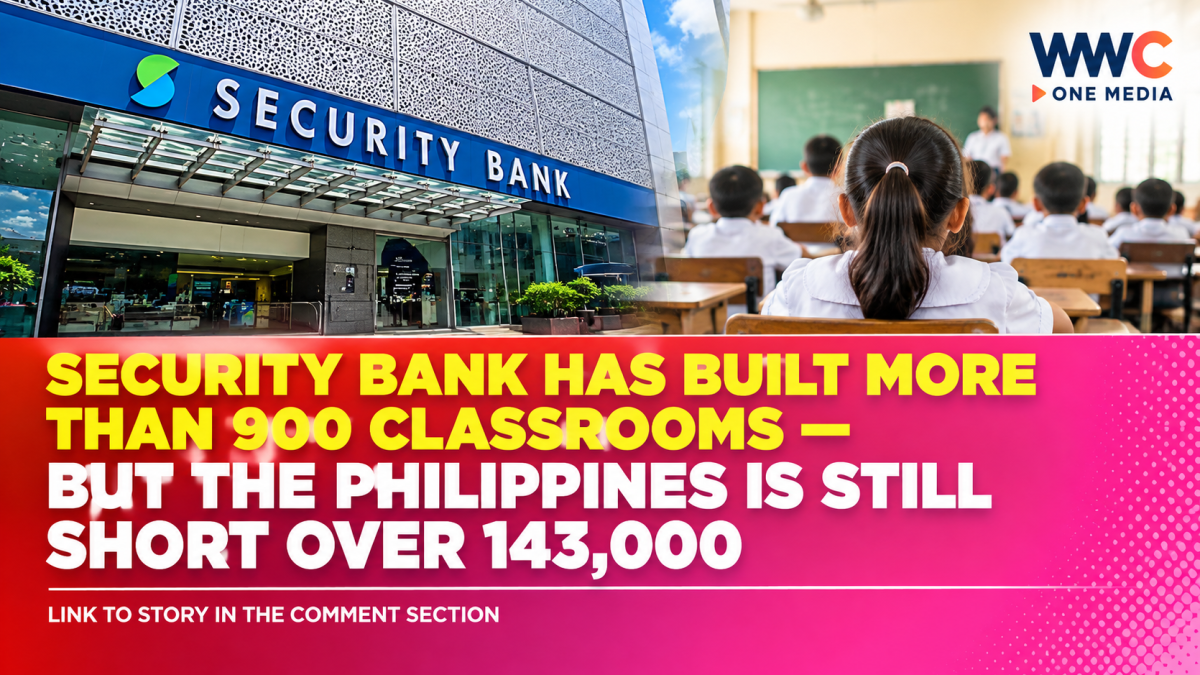
The foundation reported at the start of 2026 that its flagship Build a School, Build a Nation program had reached 901 classrooms in 153 schools across 92 cities and municipalities nationwide. Philippine Star independently reported the same totals in January.
In February, Security Bank Foundation marked its 900th classroom with the turnover of a two-story, six-classroom Technical-Livelihood Education building at Zamboanga City High School Main. The school serves more than 8,000 learners and had 136 classrooms for more than 200 class sections, according to InsiderPH’s coverage.
The milestone is substantial for a private foundation.
Against the country’s total classroom shortage, however, it also shows how large the national challenge remains.
The Department of Education said the estimated nationwide classroom backlog stood at 143,543 as of June 2026, down from 165,443 at the start of the current administration. DepEd said the figure remains subject to validation based on enrollment, school inventories and site conditions.
EDCOM 2 has produced a higher estimate of more than 166,000 classrooms using the National School Building Inventory, illustrating that even government-related assessments differ depending on methodology and timing.
So Security Bank Foundation’s classroom program is not a solution to the entire shortage. What it does demonstrate is how private-sector capital and partnerships can supplement government construction in individual communities.
The Quill-winning program is built around partnerships
The Bayanihan Para sa Silid-Aralan initiative is designed to mobilize resources from Security Bank clients and employees as well as local governments, NGOs, partner institutions and other organizations for classroom construction.
That partnership model has increasingly become part of the foundation’s strategy.
In 2025 alone, Security Bank Foundation said it turned over 62 new classrooms equivalent to nine school buildings, repaired 80 classrooms and rehabilitated 48 facilities affected by disasters or termite damage.
For 2026, the foundation said it planned to construct another 60 classrooms and repair 100 more, while continuing its teacher-training, scholarship and student-support programs.
A March partnership with A.C. Steel Industries, for example, was structured to support 28 new classrooms across schools in Iloilo City, Dipolog City and Maasin City, with the company providing metal decking and roofing materials.
In Iloilo, 51 Security Bank employees from six branches also volunteered in August to paint a new 10-classroom building at Iloilo City National High School, bringing the foundation’s school-painting volunteer effort to its 125th classroom since that program began.
That combination of construction, corporate partners and employee participation explains why the Quill recognition focused not simply on buildings but on resource mobilization.
The second award tackles a problem students may not even know they have
The other award-winning program, SBF-Eyes, approaches education from a completely different direction.
Security Bank Foundation and Ideal Vision Center provide vision screenings and prescription eyeglasses to public-school students whose eyesight problems can interfere with reading and classroom participation.
The initiative began with a pilot involving schools in South Luzon.
Security Bank Foundation said 1,012 students in Batangas and Laguna received prescription eyeglasses following screenings conducted in late 2024.
The foundation later reported striking changes among students covered by its vision initiatives: non-readers in the measured group were eliminated, the number classified as instructional readers declined 40%, frustrated readers fell 63%, and independent readers increased 328%.
Those figures are based on Security Bank Foundation’s own program assessment and should be understood as outcomes among its participating groups rather than proof that eyeglasses alone would produce the same results across the entire Philippine school system.
Still, the results gave the foundation enough confidence to expand the program.
Another 1,000 students targeted in Central Luzon
In January 2026, Security Bank Foundation and Ideal Vision signed an agreement with DepEd Region III to extend the vision program to Central Luzon, with Ideal Vision committing prescription eyeglasses for 1,000 public-school students during the year.
Central Luzon was chosen after program data identified it as having the highest number of below-proficient readers among the regions covered by the foundation.
The partnership brings DepEd directly into the implementation structure, while Security Bank Foundation handles school coordination, logistics and impact measurement and Ideal Vision supplies screening expertise, optometrists, opticians and support personnel.
That makes SBF-Eyes significant for a reason that goes beyond free glasses.
It reflects a growing recognition that educational outcomes do not depend exclusively on teachers, textbooks and classrooms. A learner who cannot clearly see the board or read printed material faces a physical barrier that better curriculum alone cannot fix.
Security Bank is also betting on teachers
Security Bank Foundation’s education strategy increasingly extends beyond physical infrastructure.
Its three-year Mentoring Future Leaders for Nation-Building program works with organizations including Ateneo de Manila University, De La Salle Philippines, The HEAD Foundation in Singapore and the University of Bristol.
Security Bank said 167 principals and teachers were participating in the program by 2025, while its wider educator initiatives have reached more than 36,000 educators since 2014.
A 2025 agreement with DepEd gave the mentoring initiative nationwide recognition, with the department helping endorse participants, grant learning and development credits and monitor the implementation of school action plans.
The foundation has argued that constructing school buildings without simultaneously strengthening school leadership and teaching capacity would leave part of the problem unresolved.
Scholarships complete the education ecosystem
Financial access is another piece of the strategy.
Security Bank Foundation reported supporting more than 300 scholars in 2025, while Philippine Star said 302 students received scholarship support during the year and 103 scholars graduated, including 31 who completed college degrees.
Its programs include scholarships for financially challenged college students, employees and the children of employees, as well as the Regalo Mo, Kinabasan Ko program for agency personnel such as security guards, janitors, drivers and messengers and their children.
For Academic Year 2026-2027, that agency-focused program is supporting 87 scholars, according to recent company information reported by InsiderPH.
The awards are the headline—but the scale is the real story
The two Philippine Quill Awards recognize communication programs, not a national ranking of education providers. The competition is organized by the International Association of Business Communicators Philippines, with entries evaluated against IABC standards for strategy, execution and measurable results.
For Security Bank Foundation, however, the trophies arrive at a useful moment.
Its classroom program has moved beyond 900 rooms. Its vision initiative is expanding into another major region. Its teacher-training partnership now has national DepEd recognition. And its scholarship programs continue to extend beyond conventional beneficiaries.
Yet the wider Philippine education numbers prevent the story from becoming a simple corporate victory lap.
DepEd still estimates a classroom deficit exceeding 143,000.
That gap is so large that neither government spending nor corporate philanthropy alone is likely to erase it quickly.
The more revealing part of Security Bank Foundation’s strategy is therefore not the two awards.
It is the attempt to attack several barriers at the same time: build the classroom, repair the damaged ones, train the people teaching inside them, help students afford school—and make sure those students can actually see the lessons in front of them.




Leave a Reply