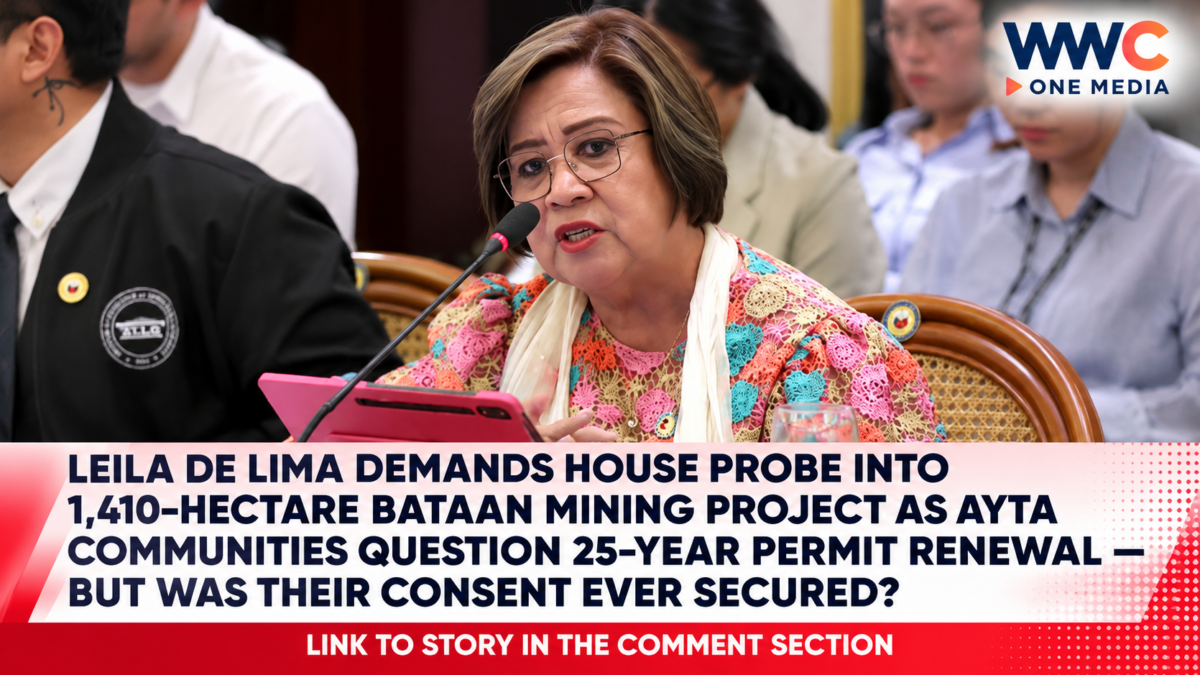
MANILA, PHILIPPINES — A mining controversy involving approximately 1,410 hectares of land in Bataan has reached the House of Representatives after lawmaker Leila de Lima called for a congressional investigation into whether Indigenous communities were properly consulted before a 25-year mineral agreement was renewed.
The dispute centers on Pantingan Peak, also known as Mount Pantingan, an area that Ayta Magbukon communities consider part of their ancestral domain.
De Lima, the House Senior Deputy Minority Leader and a representative of Mamamayang Liberal party-list, filed House Resolution No. 1569 to examine the reported exploration and mining-related activities of Balanga Bataan Minerals Corporation and Benguet Corporation.
The proposed inquiry will focus on a critical allegation: that government regulators approved the renewal of a mineral production-sharing agreement despite unresolved questions about the affected Indigenous communities’ Free, Prior and Informed Consent.
The communities also fear that exploration could threaten forests, water sources, wildlife and culturally significant areas.
But corporate disclosures add an important dimension to the controversy.
Benguet Corporation confirms that the Pantingan project is covered by an existing Mineral Production Sharing Agreement, or MPSA, that has been renewed for a second 25-year term.
The company describes the project as being in the exploration stage.
The central question is no longer merely whether a mining agreement exists. It is whether the renewal process properly respected the rights of the people whose ancestral land may be affected.
De Lima Files House Resolution No. 1569
De Lima filed the resolution on October 28, 2026.
It directs the House Committee on Indigenous Cultural Communities and Indigenous Peoples, jointly with the Committee on Natural Resources, to investigate activities involving the Pantingan project.
The measure seeks an examination of the consent process, the reported permit renewal and the potential environmental and cultural consequences for the Ayta Magbukon.
The resolution also identifies the need to determine whether the companies and concerned government agencies complied with existing laws.
According to the official House of Representatives legislative record, the resolution remained pending first reading at the time the record was checked.
That means a congressional investigation has been requested, but the filing itself does not establish that hearings have already taken place.
The investigation’s findings, if proceedings move forward, could inform possible legislative reforms.
Indigenous Communities Say Their Consent Was Never Finalized
The strongest concern involves the Free, Prior and Informed Consent process.
According to De Lima’s account, community assemblies were held on September 5, September 24 and November 29, 2024.
The meetings reportedly concerned the renewal of activities affecting Pantingan Peak.
But De Lima said no final consensus was reached during the third assembly because important documents requested by community members had allegedly not been provided.
Despite those concerns, the mineral agreement was reportedly renewed.
The lawmaker wants Congress to establish whether the required procedures were completed before approval.
The allegation is significant because an assembly is not necessarily equivalent to a community decision.
A consultation process must be assessed in light of the applicable rules, the affected community’s customary decision-making practices and the information actually provided to participants.
However, the reported absence of consensus has not yet been established through a completed official inquiry.
The National Commission on Indigenous Peoples and the relevant mining regulators should have an opportunity to provide the records supporting their actions.
Why Mount Pantingan Matters to the Ayta Magbukon
For the Ayta Magbukon communities, Pantingan Peak is more than a potential source of minerals.
Community representatives describe the mountain as part of their ancestral landscape.
It is connected to their cultural practices, identity and traditional livelihoods.
The surrounding environment provides resources including water, forest products and medicinal plants.
Communities from Bagac, Mariveles, Limay and Orion have raised concerns about the project.
The Panlalawigang Asosasyon ng mga Ayta sa Bataan, or PANABAT, has supported efforts to defend the area.
The Peoples Development Institute reports that representatives of five Ayta communities signed a petition seeking action from the National Commission on Indigenous Peoples and the Commission on Human Rights.
Their demands include suspending exploration, investigating the renewal process and reviewing the validity of the mineral agreement.
The petition reflects the communities’ position, not a final finding that the companies committed an offense.
A 25-Year Mining Agreement Is at the Center of the Dispute
Benguet Corporation’s public disclosures identify the Pantingan project under MPSA No. 154-2000-III.
The mineral tenement covers approximately 1,410.25 hectares.
Balanga Bataan Minerals Corporation is the agreement holder, while Benguet Corporation operates under a business arrangement with the holder.
Company disclosures confirm that the agreement was renewed for another 25-year term beginning March 31, 2025.
The company reports that the Department of Environment and Natural Resources approved the renewal in 2024.
There is a minor inconsistency among company disclosures concerning the exact approval date: one records September 23, 2024, while another identifies October 14, 2024.
That discrepancy should be clarified through the original DENR approval document.
The renewal itself is confirmed in the company’s filings.
But a renewed mineral agreement should not be mistaken for proof that full-scale commercial extraction has already commenced.
Benguet Corporation Says the Project Remains Under Exploration
The company’s financial disclosures provide important balance to the allegations.
Its second-quarter 2026 report states that drilling activities at Pantingan were suspended during that quarter.
Exploration work was limited to geological mapping and surface rock sampling.
The report identifies approximately 20 hectares examined through mapping and 32 altered mineralized rock samples submitted for analysis.
Earlier filings indicate that exploration drilling had taken place in 2025.
The company also identifies potential gold and copper deposits and rock aggregates within or around the mineral property.
These activities establish that the company has pursued mineral exploration.
They do not demonstrate that large-scale commercial gold or copper production is underway at the site.
Any assertion that an operating commercial mine has already devastated the entire 1,410-hectare area would go beyond the verified evidence.
At the same time, exploration can involve land disturbance and community concerns that deserve assessment.
Reports of Hot Water, Sulfur Odors and Muddy Discharge Raise Questions
De Lima’s resolution cites reports of unusual environmental conditions near certain exploration holes.
These reportedly include hot water, sulfur-like odors and muddy discharge.
The complaints have raised questions about possible effects on groundwater and the surrounding environment.
Residents and advocates have also expressed concern about potential forest degradation, wildlife disturbance and landslide risks.
Those issues merit investigation.
But their causes have not been conclusively established.
Water emerging from an exploration borehole, for example, cannot automatically be classified as toxic without appropriate testing.
Likewise, the presence of an odor does not by itself establish an environmental violation.
Regulators would need to examine site conditions, drilling records, water samples and relevant environmental monitoring data.
The results should be disclosed in a form affected communities can understand.
What Philippine Law Says About Indigenous Consent
The central legal framework is the Indigenous Peoples’ Rights Act of 1997, or Republic Act No. 8371.
The law recognizes Indigenous Peoples’ rights involving ancestral domains, cultural integrity and participation in decisions affecting their communities.
Free, Prior and Informed Consent is intended to ensure that affected Indigenous communities make decisions through appropriate processes without coercion or manipulation.
The National Commission on Indigenous Peoples plays an important role in certification and consent procedures.
The Philippine Mining Act of 1995 also establishes requirements concerning mineral agreements and activities affecting ancestral lands.
However, the application of those requirements depends on the land’s legal status, the activities proposed and the specific authorization sought.
De Lima wants Congress to determine whether the Pantingan renewal complied with the relevant rules.
That requires examining actual documents, not relying solely on assurances that meetings occurred.
Indigenous Communities Took Their Protest to the Streets
The mining controversy had already triggered public demonstrations before Politiko’s November 8 report.
On October 29, Ayta communities marched in Limay, Bataan, to defend Mount Pantingan.
The demonstration coincided with the 29th anniversary of the Indigenous Peoples’ Rights Act.
Participants raised concerns about the alleged absence of genuine consent and called for exploration to be stopped.
NET25 subsequently reported the protest on November 3.
The demonstrators argued that decisions affecting their ancestral domain should not proceed without proper community approval.
Their position emphasizes the importance of Indigenous participation before significant land-use changes take place.
The protest itself is verified.
But its occurrence does not independently establish that regulators acted unlawfully.
That question remains part of the requested investigation.
De Lima Has Challenged Mining Consultation Practices Before
The Pantingan resolution is not an isolated initiative.
In May 2026, De Lima sought a broader investigation into the renewal and extension of Financial or Technical Assistance Agreements in the mining sector.
That measure questioned whether affected communities and local governments had been properly consulted.
It specifically raised issues involving major mineral agreements in other parts of the Philippines.
In August, she also sought scrutiny of alleged weaknesses in the country’s FPIC procedures.
The concerns included claims of inadequate consultations, coercion and disputes over community representation.
Those allegations concern a wider regulatory debate.
They do not automatically establish wrongdoing at Pantingan.
But they help explain why De Lima considers the Bataan case important for possible legislative reform.
Mining Offers Economic Opportunities, but Environmental Risks Must Be Examined
Mining can contribute to investment, employment, mineral supply and government revenue.
Copper and gold have established industrial and commercial uses.
Exploration helps determine whether mineral deposits are economically viable.
But mineral development can also create environmental and social risks.
These depend on the location, methods and scale of operations, as well as the effectiveness of environmental safeguards.
As WWC ONE MEDIA reported in its analysis of mining rehabilitation and environmental accountability, the mining industry’s long-term performance should be evaluated through measurable outcomes.
These include water quality, erosion control, land rehabilitation, community participation and environmental compliance.
Mining’s economic value does not automatically justify every proposed project.
Equally, the existence of exploration does not prove that irreversible environmental destruction has occurred.
Each project needs evidence-based assessment.
The Pantingan Dispute Reflects Broader Concerns About Development and Ancestral Land
Similar questions have emerged in other Philippine development projects.
Large investments can promise jobs, infrastructure and new industries.
But residents may question whether the projects will affect ancestral domains, water supplies and traditional livelihoods.
As WWC ONE MEDIA reported in its coverage of objections to the proposed Pax Silica development, Indigenous communities and other stakeholders have called for greater transparency and meaningful consultation.
Pax Silica is a separate proposed development and should not be confused with the Pantingan mining agreement.
The comparison illustrates a common policy issue: economic development must be considered alongside community rights and environmental safeguards.
Public consultation is most meaningful when affected people have access to relevant information before decisions are finalized.
Why Mining Permits Need Transparent Oversight
The government has a responsibility to evaluate both the economic value and risks of mineral development.
This includes reviewing permits, monitoring compliance and ensuring that consultation requirements are followed.
As WWC ONE MEDIA reported in its coverage of the Department of Energy’s cancellation of its 2026 coal bidding round, resource development decisions can require additional review when officials identify unresolved concerns involving contract terms, resource management or regulatory requirements.
The coal bidding case is unrelated to Pantingan and falls under a different legal framework.
Nevertheless, it demonstrates why government approvals should be supported by transparent procedures and clear public-interest safeguards.
For Pantingan, the crucial evidence includes the original mineral agreement, renewal documents, NCIP certification records and relevant community resolutions.
Those documents can help establish whether statutory requirements were met.
What De Lima Wants Congress to Investigate
The House inquiry, if taken up, would need to examine several questions.
First, whether the relevant Indigenous communities were correctly identified and represented during consultations.
Second, whether the FPIC process was properly conducted and documented.
Third, whether regulators possessed the required certifications before approving the renewal.
Fourth, whether exploration activities complied with applicable environmental and mining requirements.
Fifth, whether reported impacts on water sources, wildlife, forests and community livelihoods have been adequately assessed.
The investigation would also need to give the companies, the DENR-MGB and NCIP an opportunity to explain their actions.
A credible inquiry should evaluate community testimony together with official records and technical evidence.
Only then can lawmakers determine whether additional legislation or stronger enforcement is necessary.
What Happens Next for Mount Pantingan?
House Resolution No. 1569 has been filed.
However, the official legislative record checked shows that it remained pending first reading.
No completed House investigation or final legislative finding has been established.
Meanwhile, the Ayta communities have separately petitioned the NCIP and Commission on Human Rights for action.
The companies’ public disclosures indicate that the Pantingan project remains in the exploration stage.
The central unresolved issue is whether the mineral agreement’s renewal complied with the laws protecting affected Indigenous communities.
A review of the actual consent records and permit documents could help settle that question.
The results may have implications beyond Bataan if they reveal weaknesses in how mining renewals are assessed.
The Bottom Line: A Renewed Mining Agreement, but Unresolved Questions About Consent
Leila de Lima is calling for a congressional investigation into mineral exploration and the renewal of an agreement covering approximately 1,410 hectares at Mount Pantingan in Bataan.
The project involves Balanga Bataan Minerals Corporation and Benguet Corporation.
The companies’ public disclosures confirm that the mineral production-sharing agreement was renewed for a second 25-year term.
But Ayta Magbukon communities say their concerns over the consent process remain unresolved.
They fear that exploration and potential future mining could harm ancestral lands, forests, water sources and traditional livelihoods.
Those concerns deserve careful investigation.
At the same time, the existing evidence does not establish that commercial mining is already underway or that the companies and regulators have been found guilty of violating Indigenous rights.
The proposed House inquiry will need to examine the relevant records before reaching conclusions.
And as an existing 25-year mineral agreement faces fresh scrutiny over approximately 1,410 hectares of Bataan’s ancestral landscape, one question now confronts Congress and mining regulators: Was the renewal approved through a lawful, genuinely informed community decision—or will the records reveal that the people most affected were never given the opportunity to make their voices count?