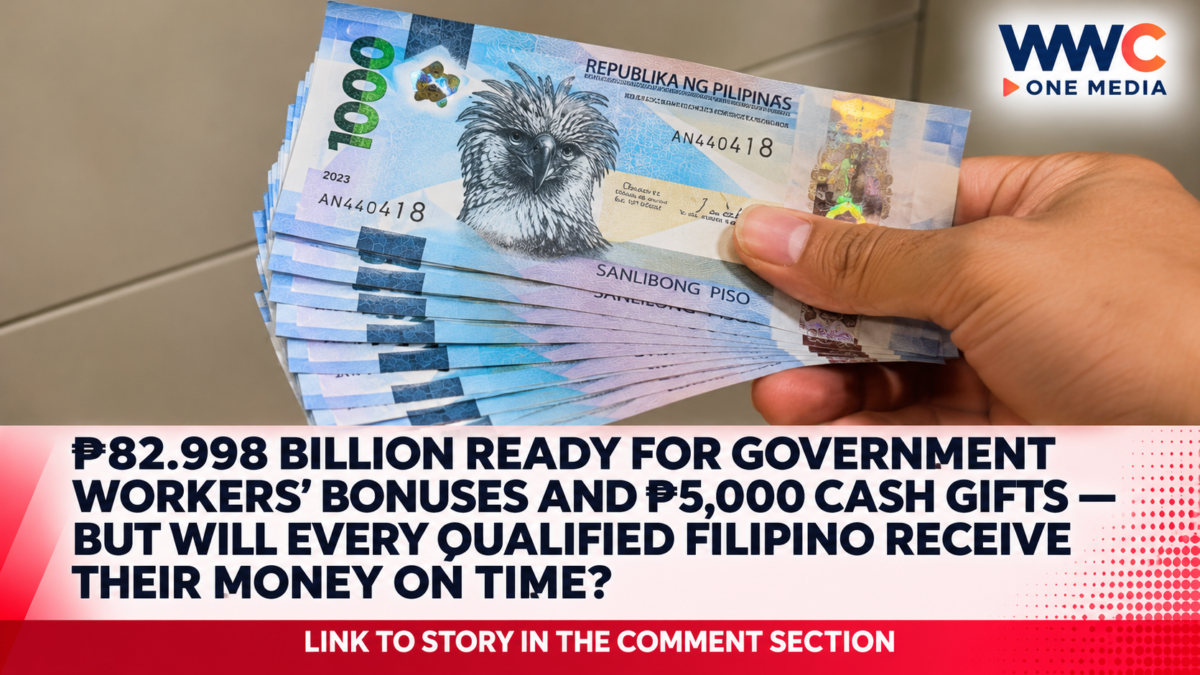
MANILA, PHILIPPINES — Millions of Filipino government employees are looking forward to their year-end bonuses as the Department of Budget and Management (DBM) confirms that ₱82.998 billion has been allocated and released to concerned agencies for annual bonuses and ₱5,000 cash gifts.
But with Christmas approaching, the government’s message is clear: Qualified public servants should not have to wait until December to receive benefits already provided under existing compensation rules.
In an announcement on Saturday, November 7, DBM Secretary Kim Robert C. De Leon reminded government agencies that employees must receive their year-end bonus and cash gift together with their first November 2026 salary.
The year-end bonus is equivalent to one month’s basic salary as of October 31, 2026.
The separate cash gift amounts to ₱5,000 for qualified employees.
The allocation covers eligible civilian personnel as well as military and uniformed personnel.
For a government worker earning ₱25,000 in monthly basic pay, the two benefits could amount to ₱30,000 before considering any applicable deductions or individual circumstances.
For someone earning ₱40,000, the combined amount would be ₱45,000.
But the ₱82.998-billion announcement also exposes an important question about the country’s public-sector workforce.
While regular, casual and qualifying contractual employees can receive these annual benefits, more than one million Job Order and Contract of Service workers generally remain outside the same compensation system.
That distinction has renewed attention on who actually benefits from government spending—and whether every qualified employee will receive the money on schedule.
DBM Confirms ₱82.998-Billion Allocation
According to the DBM, the government’s allocation consists of two components.
Year-End Bonus: ₱73.449 billion
This amount is intended to cover the annual bonus equivalent to one month’s basic salary for eligible personnel.
Cash Gift: ₱9.549 billion
This allocation funds the separate ₱5,000 cash gift.
Together, the two items total ₱82.998 billion.
The DBM said the necessary funds had already been released to the concerned agencies at the beginning of fiscal year 2026.
That means the latest announcement is not a promise to seek additional funding.
It is a reminder that agencies should implement the payments already authorized.
The key challenge is ensuring the money reaches qualified workers according to the established payroll schedule.
Government Employees Should Receive Benefits With Their First November Salary
Under DBM Budget Circular No. 2024-3, dated October 22, 2024, qualified employees should receive both benefits together with the first agency payroll for November.
The policy replaced the previous arrangement under which the year-end bonus was generally payable no earlier than November 15.
The revised schedule was designed to prevent delays and make the benefits available earlier.
De Leon emphasized that agencies must follow the prescribed payment schedule because the funding has already been released.
However, November payroll dates can vary among government agencies.
The directive does not establish one identical nationwide deposit date.
An employee’s actual payment date depends on the first November payroll of the relevant agency.
Employees should therefore verify their agency’s payroll schedule rather than assume that every government worker will receive the money on November 8 or another single date.
Who Qualifies for the 2026 Year-End Bonus?
The DBM identified two main eligibility requirements for the full year-end bonus and cash gift.
First, an employee must have completed at least four months, or 120 days, of aggregate government service from January 1 through October 31, 2026.
Second, the employee must still be in government service as of October 31, 2026.
Qualifying service may include authorized leave with pay.
The rules apply to eligible personnel holding regular, temporary, casual or contractual employee positions, subject to the applicable regulations.
The programme also covers eligible military and uniformed personnel.
Certain employees who retired or separated earlier in the year may qualify for benefits under separate prorating provisions.
The precise amount depends on the individual’s service record and applicable rules.
Workers who joined government service late in the year should consult their human resources or payroll office rather than assume they will receive the full benefit.
How Much Will Government Workers Receive?
The calculation is straightforward for a fully qualified employee.
The year-end bonus equals one month’s basic salary as of October 31, 2026.
The ₱5,000 cash gift is added separately.
Here are illustrative computations:
| Monthly basic salary | Year-end bonus | Cash gift | Combined benefits |
|---|---|---|---|
| ₱18,000 | ₱18,000 | ₱5,000 | ₱23,000 |
| ₱25,000 | ₱25,000 | ₱5,000 | ₱30,000 |
| ₱35,000 | ₱35,000 | ₱5,000 | ₱40,000 |
| ₱45,000 | ₱45,000 | ₱5,000 | ₱50,000 |
| ₱60,000 | ₱60,000 | ₱5,000 | ₱65,000 |
These are examples, not official salary classifications or guaranteed net deposits.
The computation uses basic salary, not total monthly compensation including allowances.
Individual tax treatment and other applicable payroll considerations may also affect the amount ultimately received.
Why Some Contractual Government Workers May Be Excluded
The DBM’s announcement includes eligible employees holding contractual positions.
However, contractual employees and Job Order/Contract of Service workers are not necessarily the same under government employment rules.
Personnel appointed to qualifying contractual government positions may have an employer-employee relationship with the government.
Job Order (JO) and Contract of Service (COS) workers generally operate under different engagement arrangements.
They do not automatically receive the same annual bonuses and allowances available to regular civil service employees.
As WWC ONE MEDIA reported in its September investigation of more than one million JO/COS government workers, lawmakers have questioned why government agencies continue depending on temporary workers despite thousands of vacant permanent positions.
The Civil Service Commission has acknowledged challenges involving qualifications, eligibility requirements and the availability of plantilla positions.
The situation has created a persistent divide between employees who receive standard government benefits and workers performing public services under different contractual arrangements.
That distinction is particularly important during the year-end bonus season.
A worker should not assume that being paid by a government agency automatically establishes eligibility for the bonus.
Why the Cash Gift Matters Before Christmas
The government’s decision to release bonuses early is particularly relevant to household finances.
Families often face additional spending during the final months of the year.
These expenses may include school needs, transport, groceries, utility bills and holiday purchases.
Receiving annual benefits in November gives workers more flexibility when planning their spending.
But the actual economic effect will depend on how families use the money.
Some may increase consumption.
Others may prioritize savings, outstanding debts or emergency expenses.
As WWC ONE MEDIA reported in its analysis of the ₱60 Metro Manila minimum-wage increase, higher earnings do not necessarily translate into a proportional increase in consumer spending.
That article concerns private-sector wage earners rather than government bonuses.
Nevertheless, it provides useful context for understanding household financial decisions during periods of economic uncertainty.
Why Bonus Payments Are a Test of Government Efficiency
The DBM has already released the necessary funds to concerned agencies.
That makes timely processing a major administrative responsibility.
Government payroll systems must identify eligible employees, verify service records and calculate the proper benefits.
Agencies must also ensure that their payment procedures comply with applicable budgeting and accounting requirements.
The amount involved—nearly ₱83 billion—makes accurate administration essential.
As WWC ONE MEDIA reported in its coverage of the proposed ₱7.2-trillion national budget and congressional scrutiny, public spending increasingly faces questions about how allocated funds translate into actual services and benefits.
The year-end bonus programme provides a practical test of that principle.
Government employees need more than assurances that the budget exists.
They need accurate and timely payments.
Government Agencies Are Modernizing Public Payments
The wider public sector is also adopting digital systems intended to simplify financial transactions.
As WWC ONE MEDIA reported in its coverage of DSWD’s partnership with GCash for UPLIFT assistance, some government programmes are introducing electronic payment channels to improve access and reduce distribution difficulties.
That initiative concerns social assistance, not civil service bonuses.
It does not mean that the DBM is distributing the November benefits through GCash.
However, both programmes illustrate the importance of efficient payment systems.
The government must ensure funds reach intended beneficiaries while maintaining accurate transaction records.
Another Possible Benefit: Up to ₱30,000 in December
Government workers may also have heard about a separate incentive worth up to ₱30,000.
According to The Philippine Star’s November 6 report, the DBM has issued guidelines for the 2026 Collective Negotiation Agreement (CNA) incentive.
Qualified civilian employees may receive a one-time amount of up to ₱30,000 during December 15–31.
However, the incentive is not automatic.
It depends on whether the agency meets the applicable performance and cost-saving requirements.
It must also have a qualifying collective negotiation agreement and available eligible savings.
The maximum of ₱30,000 is a ceiling, not a guaranteed payment for every employee.
This incentive is completely separate from the year-end bonus and ₱5,000 cash gift.
Employees should not combine the two programmes when calculating benefits unless they independently qualify for each.
What if a Government Employee Does Not Receive the Bonus?
A qualified government employee whose first November salary is paid without the required benefits should first verify the payroll status with the agency’s human resources or finance office.
The employee can ask whether the year-end bonus and cash gift have been processed and whether any eligibility or record issues remain.
Relevant documents may include employment status, service history and basic salary information as of October 31.
If the payment is delayed, the agency should explain the reason and identify the corrective steps.
Employees may refer to DBM Budget Circular No. 2024-3 for the applicable release schedule.
The circular does not mean every employee who raises a concern is automatically entitled to the full amount.
Eligibility must still be assessed under the rules.
The Bigger Question: Will Every Qualified Public Servant Be Paid on Time?
The DBM announcement provides a clear answer about funding.
The government has set aside ₱82.998 billion and released the appropriations to the responsible agencies.
The compensation rules also establish how the benefits should be calculated.
What remains is execution.
Eligible employees should receive the annual bonus and cash gift with their first November salary.
For workers, the release represents an important source of household income.
For government agencies, it is an obligation under existing compensation policies.
And for the broader public sector, the announcement revives debate about the different benefits available to permanent, temporary and non-employee contract workers.
The Bottom Line: ₱82.998 Billion Is Ready, but the Real Test Is Timely Distribution
The Department of Budget and Management has confirmed that ₱82.998 billion is available for 2026 year-end bonuses and ₱5,000 cash gifts for qualified government personnel.
Of the amount, ₱73.449 billion is allocated for bonuses, while ₱9.549 billion covers cash gifts.
Eligible employees will receive a year-end bonus equivalent to one month’s basic salary, plus the separate ₱5,000 benefit.
The money should be released together with each agency’s first November payroll.
Workers generally need at least four months of qualifying service between January 1 and October 31 and must remain employed as of October 31 to receive the full amount.
The announcement is welcome news for eligible public servants approaching the Christmas season.
But it also highlights the continuing debate about compensation for the more than one million JO/COS personnel who generally do not enjoy the same benefits.
And as nearly ₱83 billion in government bonuses and cash gifts moves toward eligible public employees, one question remains: Will every agency deliver the money on time—or will the massive holiday payout expose another gap between the government’s funding promises and the benefits workers actually receive?