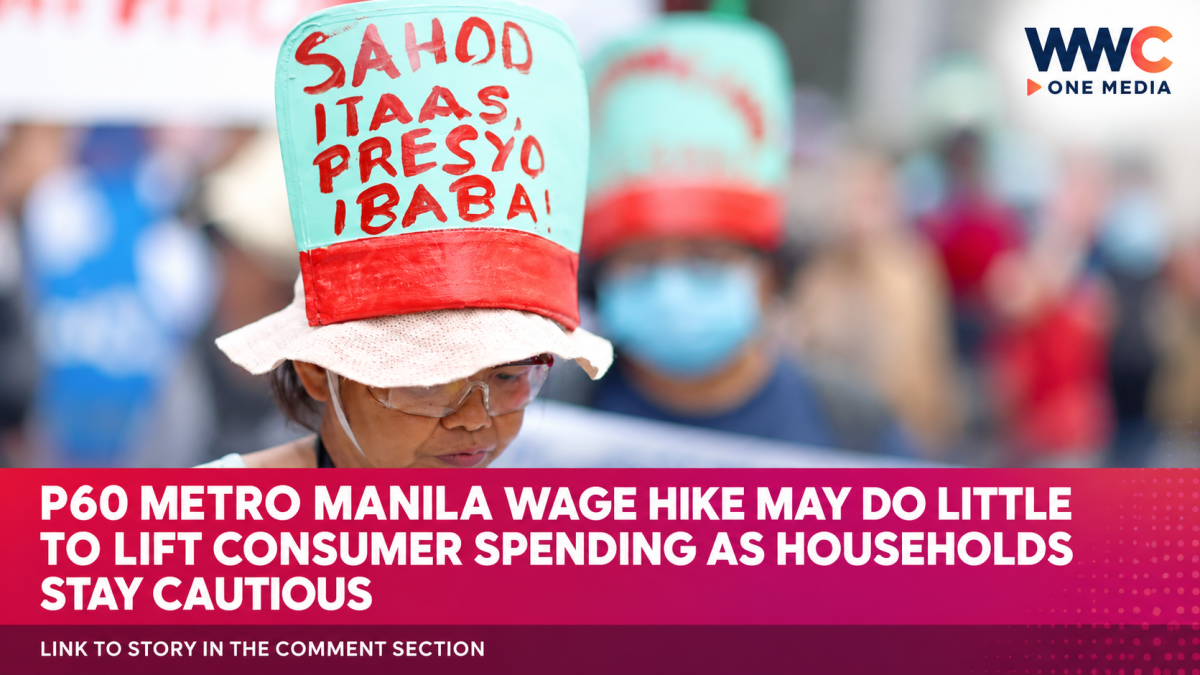
The P60 daily wage increase for workers in Metro Manila may provide additional income to about 1.1 million minimum wage earners, but it may not generate a significant boost in consumer spending as Filipino households remain cautious amid economic uncertainty.
ANZ Research said consumers are unlikely to increase spending in proportion to higher wages and may instead choose to save more as concerns over the economy persist. The assessment comes as the Philippine economy struggles with weak household consumption and slowing overall growth.
The P60 increase under Wage Order NCR-28 is scheduled to take effect on September 26. It will raise the minimum daily wage for non-agricultural workers in the National Capital Region from P695 to P755, while workers in agriculture, small service and retail establishments, and smaller manufacturing firms will see their rate rise from P658 to P718.
For a worker paid for 26 days a month, the P60 adjustment translates into roughly P1,560 in additional gross monthly income before deductions. The increase is separate from the earlier P85 wage adjustment that became the subject of legal challenges, with the latest wage order establishing the rates currently scheduled for implementation.
The timing comes as household consumption has weakened considerably. Philippine Statistics Authority data showed household spending grew by only 2.8% in the second quarter of 2026, the slowest expansion outside the pandemic period since the third quarter of 2010, when consumption increased by 2.6%.
Weak consumer spending contributed to the economy’s 2.3% second-quarter growth, down from 2.8% in the first quarter and 5.4% a year earlier. The economy expanded by only 2.6% during the first half of 2026.
ANZ has consequently lowered its 2026 Philippine growth forecast to 3.5% from 3.9%. That would put economic expansion at the bottom of the government’s revised 3.5% to 4.5% target range.
The research firm said a stronger recovery in overall economic activity, including government infrastructure spending, would be needed to generate a more meaningful improvement in household consumption. It expressed caution over whether government infrastructure spending will provide sufficient support during the second half of the year.
Government capital spending is also expected to remain an issue going into 2027. ANZ estimated total capital outlays in next year’s proposed budget at about P1.3 trillion, equivalent to roughly 4% of GDP, which it said would represent the third consecutive annual decline in capital spending as a share of economic output.
For households, the wage increase could provide some relief from higher living costs, but its broader impact on consumption will depend on how much of the additional income is actually spent rather than saved. With consumer confidence, economic growth and household purchasing power under pressure, the wage hike alone may not be enough to reverse the recent slowdown in domestic demand.