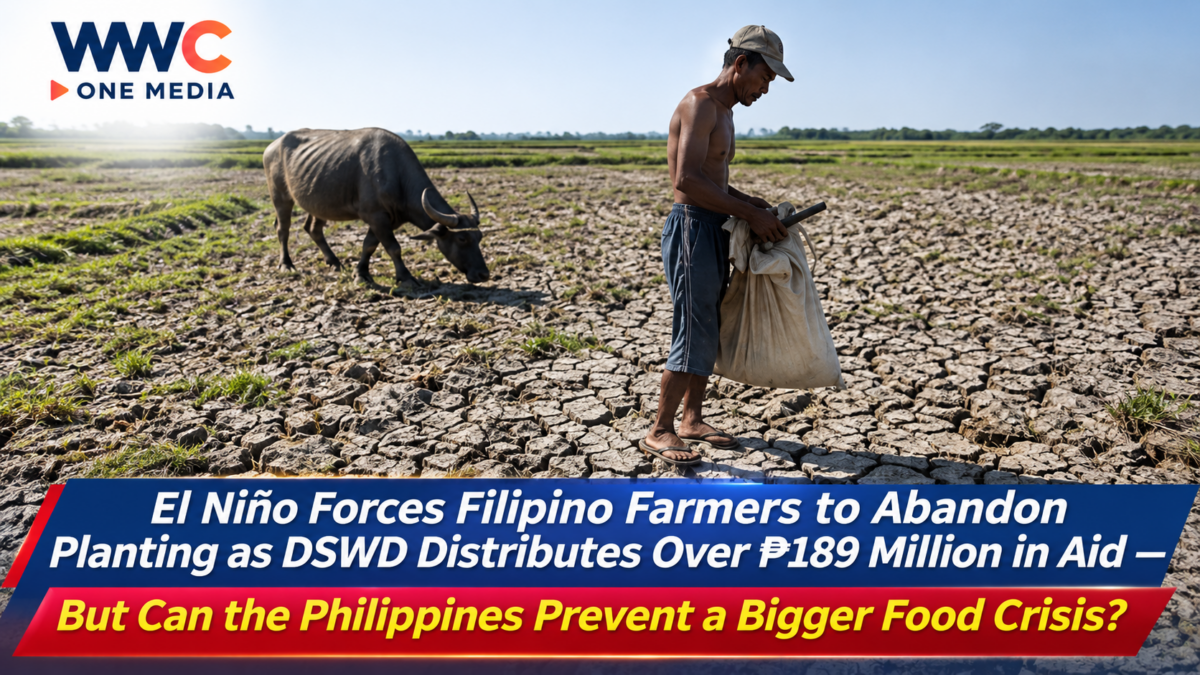
MANILA, PHILIPPINES — Thousands of Filipino farmers are receiving emergency financial assistance as worsening drought conditions threaten their crops, destroy sources of income and force some agricultural families to reconsider planting altogether.
The Department of Social Welfare and Development (DSWD) confirmed on Sunday, November 8, that emergency cash transfers are being distributed in affected areas, including Cagayan Valley and the Bicol Region.
According to DSWD spokesperson Assistant Secretary Irene Dumlao, the government has provided more than ₱189 million in humanitarian assistance under the latest reported response figures.
The aid includes financial support and essential supplies intended to help families survive the consequences of the prolonged dry spell.
But behind the assistance figures lies a more serious development.
Some farmers have reportedly stopped planting because they fear another failed harvest.
For families whose incomes depend almost entirely on agriculture, that decision could mean months without reliable earnings.
And with the Philippine Atmospheric, Geophysical and Astronomical Services Administration (PAGASA) warning that El Niño could persist into the first half of 2027, the country’s agricultural problems may not be over.
The urgent question is whether government intervention can help farmers recover before the next planting season—or whether continued drought will create a deeper crisis for food production and rural livelihoods.
DSWD Distributes Over ₱189 Million as Drought Hits Farming Communities
During an interview on Super Radyo dzBB, Dumlao confirmed that the DSWD had started delivering Emergency Cash Transfer (ECT) assistance to agricultural communities affected by El Niño.
The programme provides financial support to qualified disaster-affected households whose livelihoods have been disrupted.
Unlike ordinary agricultural subsidies intended specifically for fertilizer or seed purchases, emergency cash transfers can help families meet immediate needs.
These may include food, medicines and other essential expenses.
Dumlao said the assistance is particularly important for farmers who have experienced severe crop losses and declining incomes.
The latest DSWD figures cited by GMA News indicate that more than 191,000 families are affected across several regions.
The reported areas include Cagayan Valley, CALABARZON, MIMAROPA, Bicol, SOCCSKSARGEN and Caraga.
The assistance is being delivered through DSWD field offices and coordination with local government authorities.
But the government’s challenge extends beyond distributing emergency cash.
Officials must also help affected farmers prepare for another planting cycle.
Cagayan Valley Receives More Than ₱141 Million in Humanitarian Assistance
Cagayan Valley is among the areas receiving substantial government assistance.
Dumlao said the region had received more than ₱141 million in humanitarian support under the figures discussed during her November 8 interview.
The assistance includes emergency cash transfers and family food packs.
Affected communities include parts of Isabela and Cagayan, where rice and corn farmers have experienced difficult growing conditions.
These crops are important sources of income for rural households.
When prolonged dry weather damages fields, farmers may lose both their harvest and the money invested in production.
Their expenses can include seeds, fertilizer, land preparation, irrigation and hired labour.
A failed harvest can therefore create financial pressure extending beyond the value of the crops themselves.
Emergency assistance can provide temporary relief.
But restoring agricultural production requires adequate water supplies, suitable planting materials and support for the next growing season.
Isabela Rice Farmers Have Already Received Direct Cash Aid
Earlier government reports provide more detail about how assistance has reached individual farmers.
According to the Philippine Information Agency, 10,258 rice farmers in Isabela had received approximately ₱53.85 million in emergency financial assistance by October 13.
Each qualified farmer received ₱5,250 under the relevant payout.
The money was intended to help households cope with lost income and meet immediate expenses.
An earlier October 8 report recorded approximately ₱41.63 million distributed to 7,930 farmers across 24 local government units.
These figures represent different reporting dates and should not be added together as though they were separate, non-overlapping distributions.
The reports demonstrate that assistance had already reached thousands of households before the latest November announcement.
However, farmers’ long-term recovery will depend on whether they can resume productive planting.
A one-time cash grant cannot replace an entire season’s harvest.
Over ₱31 Million Distributed in Camarines Norte
The DSWD has also expanded emergency cash assistance in Camarines Norte.
Dumlao said more than ₱31 million had been distributed through Field Office V to farmers in Capalonga and Paracale.
The assistance was intended for agricultural households whose crops had been damaged by drought.
The department confirmed that distribution activities were continuing in affected municipalities.
The Bicol Region has experienced agricultural damage involving rice and other crops.
The dry conditions have placed additional pressure on families dependent on rainfall and irrigation.
For some farmers, losing a crop means losing the income needed to finance the next planting cycle.
Cash assistance may help them meet immediate household expenses.
But additional agricultural support will be needed to restore production where crops have been severely affected.
Some Farmers Have Stopped Planting Because They Fear Losing Everything Again
One of the most concerning details in the November 8 report involves farmers who have become discouraged from planting.
Dumlao said some agricultural workers had decided not to plant because they believed their efforts would be wasted under prevailing dry conditions.
That reaction illustrates the economic and emotional consequences of repeated crop losses.
Planting requires time, physical labour and financial investment.
Farmers must often spend money before knowing whether weather conditions will support a successful harvest.
When rainfall becomes unreliable, the risk increases.
Choosing not to plant may protect a family from further immediate losses.
But it also eliminates the possibility of earning income from that crop cycle.
If the situation becomes widespread, it could reduce agricultural production.
However, the DSWD did not provide a verified nationwide count of farmers who have stopped planting.
The reports should therefore be understood as a warning about affected communities, not proof that Philippine farmers nationwide have abandoned agriculture.
Davao’s Agricultural Damage Shows How Serious the Threat Has Become
The problems affecting Cagayan Valley and Bicol are part of a wider national agricultural challenge.
In the Davao Region, government assessments have identified extensive crop damage associated with prolonged moisture stress.
As WWC ONE MEDIA reported in its October 30 investigation of Davao’s agricultural losses, reported damage had reached approximately ₱584.68 million.
The assessment covered 6,205 farmers and 6,634 hectares of agricultural land.
Rice accounted for the largest share of losses at approximately ₱390.24 million.
High-value crops, corn and livestock were also affected.
Those losses reflect the specific regional assessment and should not be treated as the total national damage.
The figures demonstrate the vulnerability of agriculture to extended water shortages.
They also reinforce the need for stronger irrigation, drought-tolerant crops and financial protection.
Farmers Warned to Report Crop Damage Before Clearing Their Fields
Timely reporting is another important part of the government’s agricultural response.
The Department of Agriculture has advised affected farmers to notify their local agriculture offices when they observe signs of moisture stress or crop damage.
As WWC ONE MEDIA reported in its November 4 guide for Davao farmers, agricultural authorities are encouraging farmers not to remove damaged crops before the necessary inspection.
The warning is especially relevant to those seeking crop insurance payments from the Philippine Crop Insurance Corporation.
Farmers may need to provide documents establishing the affected crop, location, insured area and extent of damage.
Emergency cash transfers and crop insurance indemnities are separate forms of assistance.
They have different eligibility requirements and purposes.
Reporting damage does not guarantee approval for either programme.
But early coordination with local agricultural officials can help avoid unnecessary delays.
Philippines Faces Widening El Niño Risk Through 2027
The drought threat could become more difficult during the coming months.
PAGASA has warned that El Niño may intensify and persist into the first half of 2027.
The weather phenomenon is associated with changes in tropical Pacific Ocean temperatures that can increase the likelihood of below-normal rainfall in parts of the Philippines.
However, El Niño does not mean every province will experience identical conditions.
Some areas may still receive heavy rain from local weather systems or tropical cyclones.
As WWC ONE MEDIA reported in its analysis of PAGASA’s nationwide drought outlook, earlier forecasts identified up to 85 provinces facing some degree of dry-condition, dry-spell or drought risk through March 2027.
The number refers to forecast risk across different periods and categories, not 85 provinces simultaneously experiencing confirmed severe drought.
For farming communities, the distinction matters because local weather and water availability determine which interventions are most appropriate.
Agriculture Department Proposes ₱61.99-Billion Response Plan
The Department of Agriculture is developing a broader response to the worsening conditions.
The proposed consolidated action plan has an estimated cost of ₱61.99 billion.
Agriculture Secretary Francisco Tiu Laurel Jr. has outlined measures involving irrigation, agricultural inputs, emergency support and coordination among government agencies.
The plans include strengthening water infrastructure and providing assistance to farmers and fisherfolk facing disrupted livelihoods.
The department has also discussed temporary employment arrangements with the Department of Labor and Employment.
Under the Tulong Panghanapbuhay sa Ating Disadvantaged/Displaced Workers (TUPAD) programme, qualified beneficiaries may be offered short-term employment opportunities.
Other interventions under consideration include irrigation improvements and production support in areas with sufficient water.
But the ₱61.99-billion figure refers to a proposed response plan.
It should not be described as money already paid out to farmers.
Up to 4.6 Million Farmers and Fisherfolk Could Be Affected
Government projections suggest that the threat could become much larger under severe conditions.
During an October 21 Senate hearing, Agriculture Secretary Tiu Laurel described a worst-case scenario in which as many as 4.6 million farmers and fisherfolk could be affected.
Agricultural damage could potentially reach ₱20 billion, according to the projections discussed during the hearing.
These are risk estimates, not confirmed final losses.
As WWC ONE MEDIA reported in its coverage of the proposal for a nationwide state of calamity, government officials have been examining whether existing emergency mechanisms will be sufficient if the drought worsens.
A national calamity declaration could affect the government’s ability to coordinate certain emergency responses under applicable law.
But declaring an emergency would not automatically restore irrigation supplies or replace damaged harvests.
The effectiveness of the response will depend on implementation.
House Orders Inquiry Into Whether El Niño Assistance Reaches Farmers
Congress is also examining the government’s preparedness and spending.
On November 4, the House of Representatives announced an inquiry intended to ensure that El Niño assistance reaches its intended beneficiaries.
The House Committee on Agriculture and Food is reviewing the implementation of relief programmes and the coordination of relevant agencies.
Lawmakers are scrutinizing an initial ₱6.2 billion release under the government’s UPLIFT assistance programme.
The committee wants to establish whether funds are reaching more than 310,000 targeted small farmers and fisherfolk.
Officials have also raised concerns about a ₱371-million funding gap affecting additional proposed interventions.
The inquiry is significant because announcing a budget does not guarantee that assistance reaches recipients promptly.
Actual disbursement, transparent records and effective local coordination are essential.
Farmers facing immediate losses cannot rely solely on future spending commitments.
They need timely support.
Could the Drought Eventually Push Food Prices Higher?
The economic consequences of El Niño may extend beyond farming communities.
If prolonged dry conditions reduce rice, corn or other agricultural production, the resulting supply pressures could affect food prices.
Rice remains particularly important because it is a staple food for Filipino households.
Corn also has a significant role in livestock feed.
However, agricultural losses in one region do not automatically create a nationwide shortage.
The overall effect depends on harvests elsewhere, food inventories, imports, distribution systems and other market conditions.
The Department of Agriculture has warned that prolonged drought could threaten production and livelihoods.
That makes food security planning especially important.
Protecting farmers’ ability to plant again may help reduce future supply disruptions.
What Farmers Should Know About Available Assistance
Affected farmers should coordinate with their municipal or city agriculture offices and their local DSWD field offices to determine which assistance programmes are available in their area.
The Emergency Cash Transfer programme provides support to qualified disaster-affected households, subject to applicable programme conditions and validation.
Farmers with crop insurance should also contact the Philippine Crop Insurance Corporation to confirm reporting procedures and filing deadlines.
For agricultural production assistance, farmers may need to verify their registration under the Registry System for Basic Sectors in Agriculture.
Different government programmes may require different documents.
Farmers should not assume that every household will receive the same amount or that assistance available in one municipality is automatically available nationwide.
Official eligibility assessments and local implementation arrangements remain important.
The Bigger Question: Can Emergency Aid Save the Next Planting Season?
The government’s emergency response addresses an immediate problem.
Affected families need money for food, basic necessities and other urgent expenses.
But the longer-term challenge concerns agricultural recovery.
If irrigation water remains unavailable, farmers may struggle to resume planting even after receiving cash assistance.
If crops are planted too early, they may be exposed to another damaging dry spell.
If planting is delayed too long, households may experience extended periods without income.
That is why the response must combine short-term financial support with appropriate agricultural planning.
Drought-tolerant seeds, water-saving practices, irrigation improvements and access to insurance could help reduce future losses.
But each intervention must be matched to actual local conditions.
No single measure can guarantee protection against a prolonged drought.
The Bottom Line: Emergency Cash Helps, but Farmers Need a Path Back to Production
The DSWD has confirmed that emergency cash transfers are reaching agricultural households affected by El Niño.
Its November 8 update cited more than ₱189 million in humanitarian assistance, including support for Cagayan Valley and Bicol.
More than ₱31 million in financial aid has been distributed in Capalonga and Paracale, Camarines Norte.
The department also reported that some farmers had stopped planting because of fears that continued dry conditions would destroy their crops.
Meanwhile, the Department of Agriculture is preparing a ₱61.99-billion consolidated response plan, and Congress is reviewing whether emergency funds are reaching intended beneficiaries.
The challenge will only become more serious if El Niño persists into the first half of 2027.
For Filipino agricultural families, financial assistance can provide temporary relief.
But the next harvest will depend on water availability, planting conditions and the speed of government intervention.
As drought-stricken Filipino farmers receive emergency cash while others lose hope of planting again, one question now confronts the Marcos administration: Will billions of pesos in promised agricultural support reach communities quickly enough to protect the next harvest—or could the Philippines face a deeper food-security crisis before El Niño finally subsides?