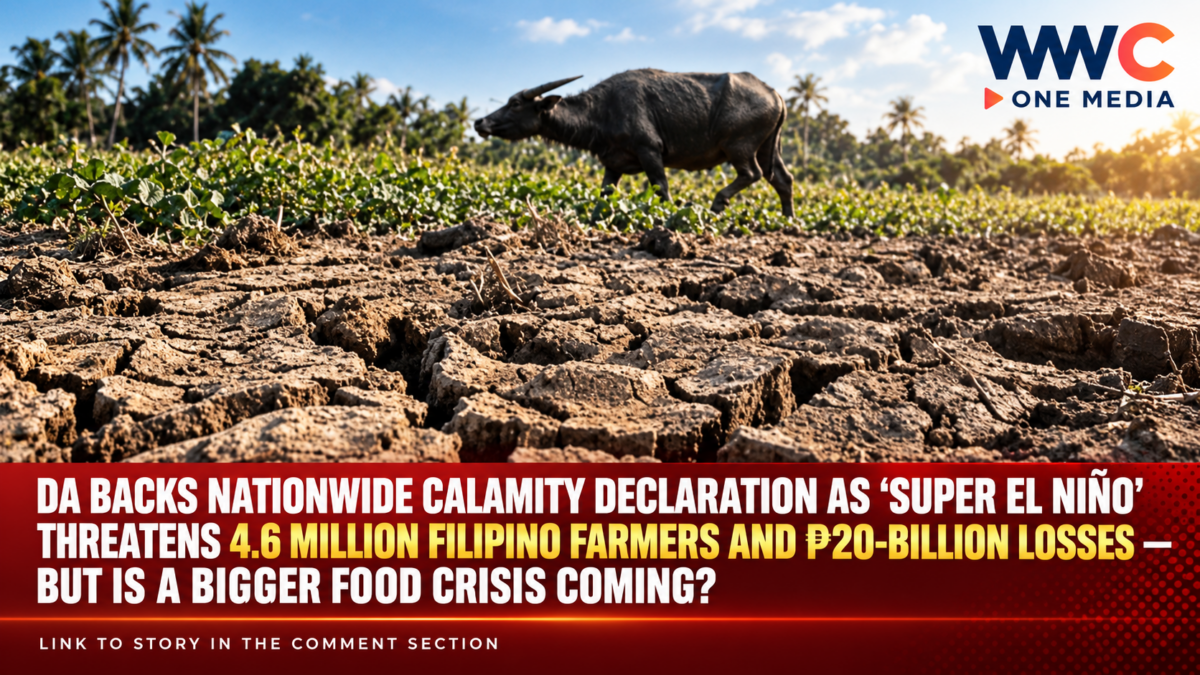
MANILA, Philippines — October 25, 2026 — The Philippines is confronting an increasingly serious agricultural crisis as Agriculture Secretary Francisco Tiu Laurel Jr. supports calls for a nationwide state of calamity amid warnings that an intensifying El Niño could devastate farms, disrupt rice production and threaten the livelihoods of millions of Filipinos.
The Department of Agriculture (DA) has warned that as many as 4.6 million farmers and fisherfolk could be affected under its worst-case scenario, while estimated agricultural losses could climb to ₱20 billion if the climate phenomenon becomes more severe.
The growing threat has prompted Agriculture Secretary Tiu Laurel to endorse a proposal by Senator Francis “Kiko” Pangilinan urging the Marcos administration to consider declaring a national state of calamity to strengthen the government’s response.
The proposal comes as parts of the country are already experiencing agricultural losses, water shortages and prolonged dry conditions.
Agriculture Chief Warns: Government Must Act Before Crisis Deepens
During discussions surrounding the DA’s proposed 2027 budget, Tiu Laurel expressed support for Pangilinan’s recommendation, citing forecasts and assessments pointing toward a potentially powerful El Niño episode.
The agriculture secretary stressed the importance of accelerating government preparations rather than waiting for the damage to worsen.
A nationwide calamity declaration could strengthen interagency coordination and provide a legal framework for mobilizing additional resources, subject to applicable laws and government approvals.
Pangilinan, who chairs the Senate Committee on Agriculture, Food and Agrarian Reform, argued that the country must prepare for a worsening drought before more farms lose their capacity to produce food.
The proposal is particularly urgent because agricultural damage has already been documented across multiple regions.
However, the endorsement does not mean that a nationwide state of calamity has already been declared. The measure remains a proposal requiring action by the national government.
₱8.57 Billion in Agricultural Damage Already Recorded
The scale of the threat is becoming increasingly visible.
According to figures reported by GMA News on October 21, the Department of Agriculture had recorded ₱8.57 billion in agricultural damage and production losses linked to El Niño.
The assessments identified 288,058 affected farmers and approximately 291,154 hectares of agricultural land impacted by dry conditions.
Corn accounted for about ₱5 billion in reported losses, followed by rice at approximately ₱2.95 billion. High-value crops, livestock and other agricultural products were also affected.
These figures remain subject to government validation and could change as agricultural offices update their assessments.
The damage is not limited to crop production. Extended dry spells can reduce water availability for irrigation, disrupt livestock operations and weaken the incomes of rural households dependent on agricultural production.
Rice Supply Faces Another Major Test
One of the government’s biggest concerns is the possible effect on the country’s rice supply.
Agriculture officials have outlined a worst-case scenario in which palay production could decline by roughly 1 million metric tons because of prolonged drought and extreme weather conditions.
The projected reduction represents a potential loss, not an outcome that has already occurred.
Such a decline could increase pressure on the country’s food supply, particularly if domestic production weakens while demand remains strong.
Officials have also discussed additional rice requirements and measures to expand buffer stocks to protect consumers from possible disruptions.
For Filipino households, the economic concern is clear: reduced agricultural production can increase supply pressure, potentially contributing to higher food prices if adequate safeguards are not implemented.
However, actual retail rice prices will also depend on imports, inventories, distribution costs, global market conditions and government policy.
109 Local Governments Have Already Declared States of Calamity
The push for a nationwide declaration follows emergency actions taken at the local level.
According to an October 14 report by GMA News citing the National Disaster Risk Reduction and Management Council (NDRRMC), 109 cities and municipalities had already declared states of calamity because of El Niño.
Affected localities were reported in Cagayan Valley, the Cordillera Administrative Region, CALABARZON, Bicol, Eastern Visayas, SOCCSKSARGEN and Caraga.
The disaster agency reported that approximately 451,889 individuals had been affected as of that reporting period.
These local declarations are separate from the nationwide declaration now being proposed by Pangilinan and supported by Tiu Laurel.
The increasing number of affected communities underscores the potential need for stronger coordination among national agencies, local governments and agricultural support institutions.
Government Proposes ₱61.99 Billion El Niño Response Plan
The Department of Agriculture is also pursuing a ₱61.99-billion action plan intended to cushion the impact of El Niño on agricultural production and rural livelihoods.
Announced on October 19, the plan includes previously released government funding and proposed interventions requiring further financial support.
Government measures include crop insurance, distribution of agricultural inputs, irrigation assistance, water pumps, adjustments to planting schedules and cloud-seeding operations where conditions permit.
The DA has also been strengthening food storage capabilities and preparing additional rice reserves to reduce the risk of serious supply disruptions.
But the success of these measures will depend on implementation, funding availability and whether assistance reaches vulnerable communities before losses become irreversible.
Could El Niño Push Food Prices Higher?
The agricultural crisis could have consequences beyond farming communities.
If prolonged drought significantly reduces rice, corn and vegetable production, consumers may face higher prices and additional financial pressure.
Food inflation is particularly important in the Philippines because essential food purchases account for a significant portion of household spending, especially among lower-income families.
The Bangko Sentral ng Pilipinas has also identified El Niño-related supply disruptions as a potential inflation risk.
For policymakers, the challenge is therefore twofold: protect agricultural livelihoods while preventing production losses from translating into broader consumer hardship.
Why the State of Calamity Proposal Matters
A nationwide state of calamity could provide additional mechanisms for coordinating emergency assistance and addressing the impact of prolonged drought.
Senator Pangilinan has cited the government’s response to the coconut scale insect crisis during the Aquino administration as an example of how emergency declarations can support rapid intervention.
According to the senator, approximately ₱500 million in additional assistance was mobilized during that earlier agricultural emergency.
The current El Niño threat, however, presents a broader challenge because its effects extend across multiple agricultural regions and could continue into 2027.
The government must determine whether existing programs and local emergency declarations are sufficient or whether a national declaration is needed to strengthen the response.
The Bigger Question: Can the Philippines Protect Its Food Supply?
With billions of pesos in agricultural losses already reported, the warning signs are becoming difficult to ignore.
The DA’s projection that up to 4.6 million farmers and fisherfolk could be affected illustrates the scale of the possible disruption.
A nationwide state of calamity declaration could become a significant policy decision in the government’s response, but declaring an emergency alone will not restore lost crops or guarantee stable food prices.
What ultimately matters is whether agricultural assistance, irrigation support, financial protection and food-security measures can be delivered effectively.
For millions of Filipinos whose livelihoods and daily meals depend on the country’s agricultural system, the coming months could become a major test of national preparedness.
Will the Marcos administration declare a nationwide state of calamity before the drought causes even greater damage — or will the Philippines face a deeper agricultural and food-price crisis in 2027?