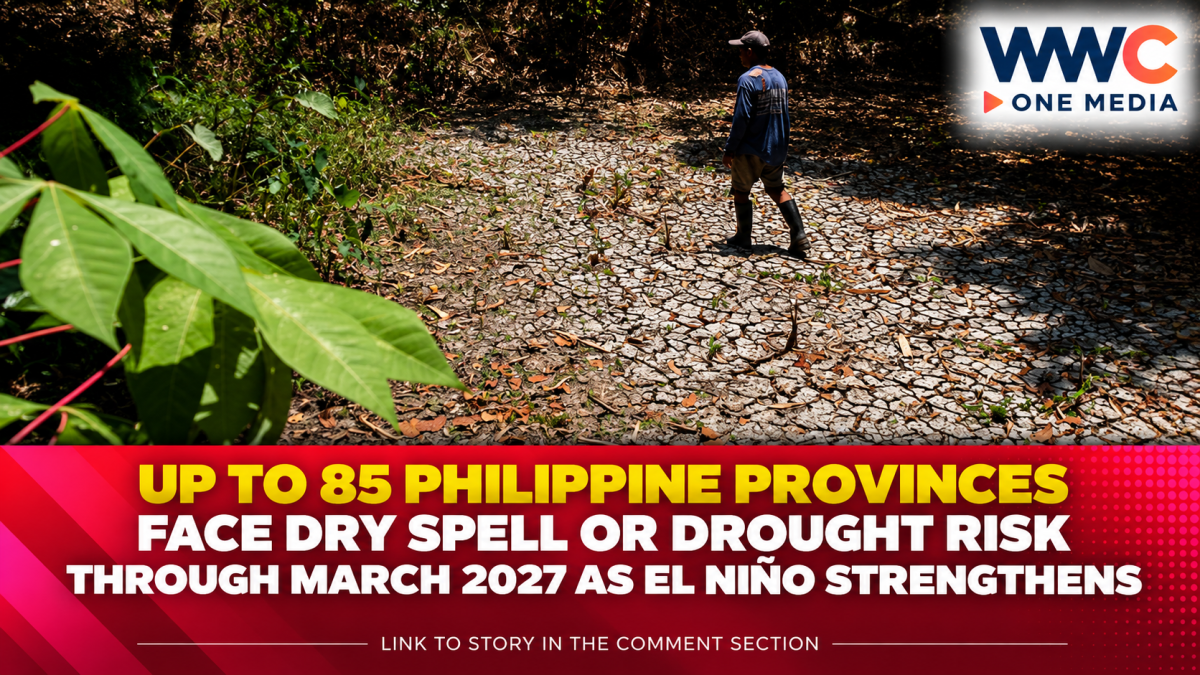
Up to 85 provinces across the Philippines could experience dry conditions, dry spells or drought through March 2027 as a strengthening El Niño threatens to bring prolonged rainfall shortages and warmer-than-usual temperatures across much of the country.
The Philippine Atmospheric, Geophysical and Astronomical Services Administration (PAGASA) said the country is facing an intensifying El Niño that is expected to reach a very strong level between September and December 2026 and persist through the first half of 2027.
PAGASA defines dry conditions as two consecutive months of below-normal rainfall, while a dry spell involves either three consecutive months of below-normal rainfall or two months of rainfall that is more than 60 percent below normal. Drought refers to three consecutive months of severely below-normal rainfall or five consecutive months of below-normal rainfall.
The impact is expected to expand as the dry season progresses. PAGASA officials said Davao del Sur, Davao Occidental and Sarangani are expected to experience dry conditions by the end of September, while Camarines Sur is forecast to enter drought conditions. By the end of October, 16 provinces are projected to experience dry spells.
The number could rise to at least 44 provinces by the end of November, with 17 provinces in Luzon expected to begin experiencing dry spells. By December, PAGASA projects dry conditions in 16 areas of Mindanao and dry spells in 22 provinces nationwide.
The developing conditions could create additional pressure on agriculture and water resources. PAGASA has warned that the significant reduction in rainfall expected after the southwest monsoon season could affect water availability, crops and other climate-sensitive sectors. The agency has urged the public and authorities to practice proper water management and prepare for the warmer and drier months.
The situation comes even as some parts of the country have recently experienced heavy monsoon rains and tropical cyclones. PAGASA’s agroclimatic assessment noted that rainfall patterns have varied considerably across the country, with some areas receiving above-normal rainfall while other regions recorded below- to way-below-normal conditions.
PAGASA is also forecasting hotter-than-usual conditions over most parts of the Philippines from September 2026 through February 2027. Officials have cautioned that the upcoming amihan season will not necessarily mean cooler conditions nationwide because of the influence of the strong El Niño.
The expanding dry-condition outlook could have wider implications for food production, water security and electricity demand if temperatures remain elevated for an extended period. The severity of the impacts, however, will depend on how rainfall patterns evolve and how strongly El Niño develops in the coming months.
With the climate phenomenon expected to persist into 2027, PAGASA is urging government agencies, climate-sensitive industries and the public to closely monitor updated forecasts and prepare for potentially prolonged periods of reduced rainfall.