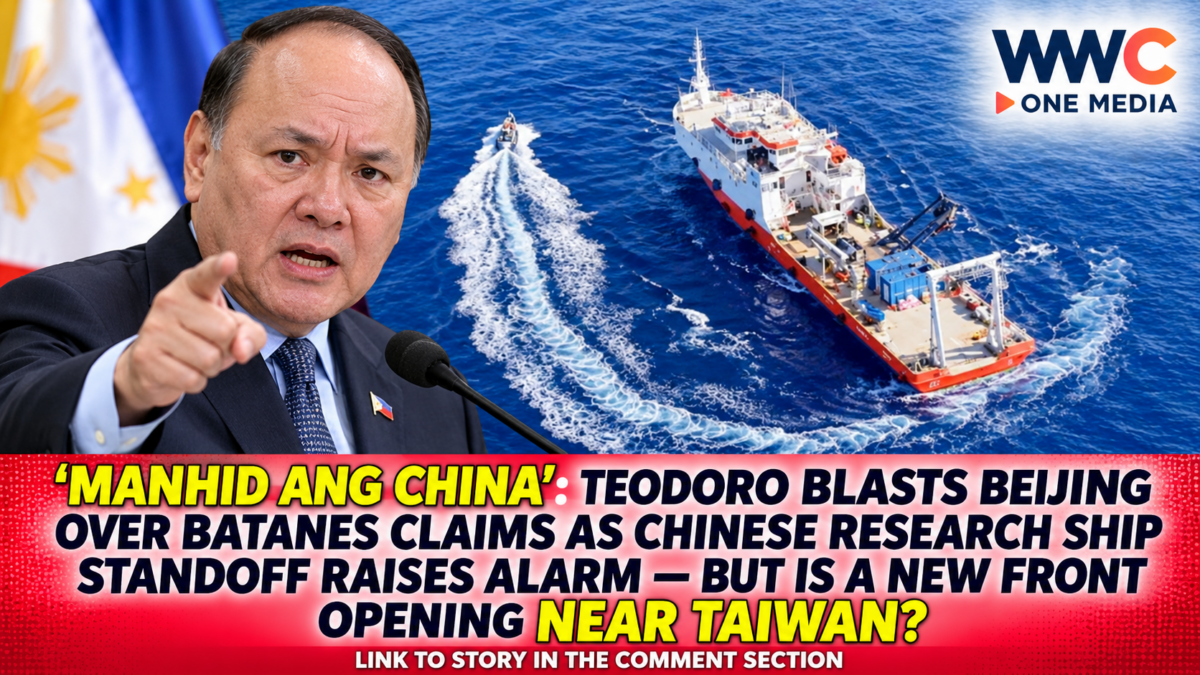
MANILA, PHILIPPINES — November 8, 2026 — Philippine Defense Secretary Gilberto “Gibo” Teodoro Jr. has delivered another sharp rebuke to China, describing Beijing as “manhid” or unresponsive to diplomatic messaging amid renewed controversy over claims questioning the Philippines’ sovereignty over Batanes.
The remarks, made on Saturday, November 7, come as Manila faces growing concerns about Chinese assertions involving its northernmost province and surrounding waters near Taiwan.
Teodoro said repeated messages to Beijing appear ineffective, urging Filipinos instead to reject misleading narratives and support the military personnel defending Philippine national interests.
The latest exchange follows months of controversy that began when Chinese scholars reportedly questioned the historical and legal basis of Philippine sovereignty over the Batanes Islands.
The Philippines rejected those assertions.
In a separate maritime confrontation, Chinese and Philippine authorities also exchanged accusations after a Chinese research vessel operated approximately 37 nautical miles northwest of Itbayat, Batanes, in September and October.
The Philippine Coast Guard challenged the vessel and accused it of conducting unauthorized marine scientific research inside the country’s exclusive economic zone.
China disputed the allegation and asserted jurisdiction over the waters concerned.
Together, the incidents have intensified attention on the strategically important Luzon Strait, which separates northern Luzon from Taiwan.
But as Manila rejects the competing narratives and strengthens its maritime defenses, could the dispute over Batanes become another dangerous flashpoint in the already strained Philippines–China relationship?
Teodoro Calls China ‘Manhid’ as Batanes Dispute Intensifies
Speaking to reporters on November 7, Teodoro was asked what message he wanted to convey to China amid renewed claims concerning Batanes.
His response reflected mounting frustration with Beijing.
The defense secretary described China as “manhid,” suggesting that repeated diplomatic statements were failing to change its position.
Rather than relying exclusively on further appeals, Teodoro encouraged Filipinos to remain alert to misleading information about Philippine territory.
He also urged the public to continue supporting the Armed Forces of the Philippines and other personnel carrying out national defense responsibilities.
The remarks were reported by ABS-CBN News on November 7 and subsequently covered by Bombo Radyo and the Philippine Canadian Inquirer on November 8.
Teodoro did not announce a new military operation against China in those comments.
His remarks were a political and security warning, not confirmation that armed hostilities had begun.
The significance lies in the broader dispute over historical narratives, territorial sovereignty and maritime jurisdiction.
Why Are Chinese Scholars Claiming Batanes Belongs to China?
The controversy dates to a symposium held at Jinan University in Guangzhou on June 30, 2026.
According to accounts reported by Philippine news organizations and addressed by the National Historical Commission of the Philippines, participants argued that the Batanes Islands were geographically connected to Taiwan.
The reported argument went further.
Some scholars suggested that Batanes had historical links to Taiwan’s administration during earlier Chinese dynasties and questioned the legal basis of Philippine sovereignty.
Their conclusions reportedly characterized Batanes as a natural geographic extension of Taiwan.
Under that theory, the islands should fall within China’s territorial claims.
The Philippines rejected the argument.
The reported assertions should not be confused with an internationally recognized determination of sovereignty.
They originated in an academic symposium and were subsequently discussed by Chinese-linked media.
Philippine officials have warned that such arguments could influence public perceptions and potentially support broader strategic claims.
However, the specific scholarly statements should not automatically be described as a formal Chinese government declaration annexing Batanes.
That distinction is important when accurately reporting the dispute.
Philippine Government Says Batanes Sovereignty Is Settled
The Department of Foreign Affairs rejected the Chinese scholars’ claims in July.
DFA spokesperson Analyn Ratonel stated that Philippine sovereignty over Batanes was settled and not open for debate.
The Philippine government maintains that the islands form an integral part of the country’s territory.
Teodoro similarly described the academic argument as baseless and unsupported.
He called on historians and international scholars to challenge misleading historical narratives.
The National Historical Commission of the Philippines also issued a formal response.
In its July 10 statement, the commission rejected the conclusions of the Jinan University symposium.
It questioned the historical evidence cited by the Chinese researchers and reaffirmed the documented history of Philippine administration over Batanes.
For Manila, the dispute is not merely about geographical proximity.
The fact that islands are located near Taiwan does not automatically establish that they belong to Taiwan or China.
Territorial sovereignty requires a legally and historically supportable basis.
The Philippine government maintains that the Chinese scholars have not provided such a basis.
Batanes’ History Undermines the Reported Chinese Argument
The National Historical Commission pointed to historical records documenting the incorporation of Batanes into the Spanish colonial administration in 1783.
The province later formed part of the territory administered under successive Philippine governments.
The commission rejected suggestions that geographic proximity to Taiwan overrides this history.
It also challenged the reported use of historical treaties to question Philippine sovereignty.
These arguments matter because competing historical narratives can affect how populations understand national boundaries.
But historical interpretation and international law require more than selective references to geographic location or old administrative descriptions.
The Philippines’ position rests on its established administration of Batanes and the country’s internationally recognized territorial status.
The dispute also reveals why officials are increasingly concerned about information campaigns involving sensitive maritime areas.
A territorial assertion can influence public debate even without an accompanying military operation.
Why Batanes Matters to China, Taiwan and the Philippines
Batanes is the Philippines’ northernmost province.
Its location gives it strategic importance far beyond its small population and land area.
The island group lies near the Luzon Strait, a major maritime passage between the northern Philippines and Taiwan.
The strait connects the South China Sea with the Philippine Sea and the wider Pacific Ocean.
It is used by commercial vessels and is significant to regional naval operations.
The surrounding waters also contain important subsea communications infrastructure.
For the Philippines, maintaining awareness of activity in this region is an important part of national defense.
For China, the wider area is relevant to regional security and its policies concerning Taiwan.
For the United States and other regional powers, the Luzon Strait is significant to broader Indo-Pacific military and maritime planning.
These considerations help explain why Philippine officials view the Batanes controversy seriously.
However, the geographic importance of the islands does not mean a conflict over Taiwan is inevitable.
Nor does it establish that a military attack on Batanes has been ordered or planned.
Chinese Research Ship Sparks Confrontation Near Itbayat
The latest controversy is also connected to a separate dispute involving maritime activities near Batanes.
On September 28, the Philippine Coast Guard confirmed that the Chinese research vessel JIA HAI KE 7 was operating approximately 37.84 nautical miles northwest of Itbayat.
The location was within the exclusive economic zone claimed by the Philippines under the United Nations Convention on the Law of the Sea.
Coast Guard authorities said the vessel was holding its position rather than moving steadily through the area.
They assessed the behavior as consistent with possible marine scientific research.
The PCG repeatedly contacted the ship by radio and asked its crew to identify its intentions.
According to the Philippine authorities, the vessel did not respond to those challenges.
The incident intensified existing concerns about foreign research and survey activity in waters near important telecommunications infrastructure.
As previously reported by WWC ONE MEDIA, the Philippine Coast Guard accused the vessel of transmitting misleading location information while operating near the Batanes submarine cable corridor.
Related WWC ONE MEDIA coverage: Philippines Accuses Chinese Research Vessel of Spoofing Location Near Batanes Cable Corridor
The alleged location spoofing was a Philippine Coast Guard assessment, not an independently established finding about the vessel’s ultimate purpose.
Philippine Coast Guard Deploys BRP Teresa Magbanua
On October 1, the Philippine Coast Guard deployed BRP Teresa Magbanua, its 97-meter patrol vessel, and an aircraft to challenge the Chinese research ship.
According to the PCG, the operation was intended to disrupt unauthorized marine research and compel the vessel to leave its position.
A Chinese Coast Guard ship also appeared in the area.
Philippine authorities reported that their vessel approached JIA HAI KE 7 and issued further challenges.
The PCG said the operation forced the Chinese research vessel to leave its loitering position.
Reuters independently reported the confrontation and the Philippine deployment.
The incident represented a significant maritime standoff in waters north of the Philippine mainland.
It also brought renewed attention to the security of the Luzon Strait.
Related WWC ONE MEDIA coverage: Philippines Deploys Largest Coast Guard Ship to Drive Away Chinese Research Vessel Near Batanes
The operation did not amount to a declared military conflict between the Philippines and China.
It was a maritime law-enforcement confrontation involving disputed assertions about activities in the surrounding waters.
China Claims Jurisdiction Over Waters Near Batanes
The Chinese Embassy disputed the Philippine Coast Guard’s account.
According to October reporting, embassy deputy spokesperson Guo Wei described the research vessel’s activities as normal operations in waters China considered to be under its jurisdiction.
China also accused Philippine authorities of harassing the ship.
The Department of Foreign Affairs rejected the Chinese position.
In an October 2 statement, the DFA said China had no basis to claim sovereign rights and jurisdiction in the relevant waters off Batanes.
The department maintained that the Chinese vessel was operating within the Philippine exclusive economic zone.
It also noted that Philippine authorities had received no request for permission to conduct marine scientific research.
Under Article 246 of UNCLOS, coastal states have the right to regulate and authorize marine scientific research in their exclusive economic zones and on their continental shelves, subject to the convention’s provisions.
The Philippines said it had not granted such consent.
This dispute concerns sovereign rights and jurisdiction in maritime zones.
That is legally distinct from the Chinese scholars’ assertions about sovereignty over the Batanes Islands themselves.
Teodoro Warns Against Chinese Assertions in Philippine Waters
Teodoro has repeatedly emphasized that the Philippines must protect its maritime rights.
During an October 14 briefing, he said the Department of National Defense and Armed Forces would work to prevent what he characterized as Chinese entitlement over Batanes.
He also referred to the strategic importance of the surrounding international waterway.
The remarks followed the confrontation involving JIA HAI KE 7.
Teodoro indicated that renewed military-to-military communication with China would depend on changes in what he described as Beijing’s coercive activities.
The government’s position reflects wider concerns about how to balance diplomatic engagement with the need to protect maritime interests.
Philippine officials continue emphasizing the importance of international law.
But Teodoro’s November 7 comments suggest he doubts that repeated diplomatic messaging alone will resolve the disagreement.
Is Batanes Becoming Another West Philippine Sea Flashpoint?
The controversy has similarities to disputes involving the West Philippine Sea.
Both concern competing Chinese and Philippine positions, maritime security and interpretations of international law.
However, important geographical and legal differences exist.
Batanes is a Philippine province north of Luzon.
The West Philippine Sea generally refers to maritime areas on the country’s western side.
The 2016 South China Sea arbitral award addressed maritime entitlements and related issues under UNCLOS.
It did not decide sovereignty over the Batanes Islands.
This is an important distinction because the Philippine government has separate historical and legal grounds for its territorial sovereignty over Batanes.
The award remains relevant to the broader Philippines–China maritime relationship, but it must not be portrayed as a specific judgment on Batanes.
As WWC ONE MEDIA previously reported, Teodoro has also warned Beijing against forcibly removing the grounded Philippine Navy vessel BRP Sierra Madre from Ayungin Shoal.
Related WWC ONE MEDIA coverage: Teodoro Warns China: Forcibly Towing BRP Sierra Madre Could Trigger an Act of War—What Happens Next?
That warning concerns a different location and scenario.
It illustrates the wider tensions shaping Manila’s defense policy, not evidence that an equivalent confrontation has already occurred in Batanes.
The Information Battle Is Becoming a Security Concern
One of the central themes in Teodoro’s latest remarks is the importance of countering misleading narratives.
Philippine officials worry that repeated territorial assertions could influence public understanding of the country’s legal rights.
The National Historical Commission’s response shows that the government sees historical research and public information as important parts of defending sovereignty.
This does not mean all foreign academic work should automatically be treated as a government-directed campaign.
Claims need to be examined individually against reliable historical and legal evidence.
But when an unsupported territorial argument receives substantial publicity, governments may regard it as a matter of national security.
The Philippine Coast Guard has similarly called attention to information disputes concerning maritime confrontations.
Officials have encouraged public awareness of documented incidents, including the use of official photographs, vessel tracking and other records.
The challenge is maintaining factual accuracy without exaggerating threats or concealing legitimate uncertainties.
The Philippines and China Remain Divided Over the 2016 Arbitration Award
The wider diplomatic relationship has also been shaped by disagreements over the July 12, 2016 South China Sea arbitral ruling.
The tribunal rejected the legal basis for China’s claims to historic rights to resources in maritime areas beyond the entitlements permitted under UNCLOS.
China rejected the ruling.
The Philippines maintains that the award is binding on the parties and continues to invoke it in defense of its maritime rights.
During a September defense forum in Seoul, Teodoro publicly criticized China’s position after receiving a note restating Beijing’s opposition to the award.
Chinese officials later responded by accusing him of provocative behavior.
As WWC ONE MEDIA reported, the exchange became another example of escalating rhetoric between the two governments.
Related WWC ONE MEDIA coverage: China Fires Back at Teodoro: “Cut the Provocations and Theatrics” — But What Happens Next in the West Philippine Sea?
The Batanes controversy adds another dimension to that relationship.
The legal questions differ, but the disputes share a common problem: Manila and Beijing continue to disagree sharply over the limits of their respective rights and jurisdiction.
What Could the Batanes Dispute Mean for Regional Security?
The strategic importance of Batanes makes the controversy relevant to countries beyond the Philippines.
The Luzon Strait is a major passage for maritime activity in the Indo-Pacific.
Any serious confrontation in the area could affect regional security calculations.
The possibility of a Taiwan-related crisis adds further sensitivity.
But there is a difference between identifying a strategically important location and predicting an imminent conflict.
The available November 8 reporting does not establish that China has ordered an attack on Batanes or that Philippine forces have entered combat with Chinese military personnel.
Nor has the Chinese scholars’ argument changed Batanes’ status as Philippine territory.
The more immediate concerns involve diplomatic messaging, maritime surveillance, research-vessel activity and the prevention of dangerous encounters.
Continued communication and accurate monitoring will be important as both countries maintain their positions.
What Happens Next?
The Philippine government is expected to continue rejecting unsupported claims concerning Batanes.
The Department of National Defense and Armed Forces will also maintain responsibility for defending the country’s territory and national interests.
The Coast Guard is likely to continue monitoring suspicious maritime activity near the province.
For the Department of Foreign Affairs, the challenge is maintaining a firm position while leaving room for peaceful diplomacy.
The National Historical Commission’s work also demonstrates the importance of reliable records in addressing misleading claims about history.
The main developments to watch include any new official Chinese government statements specifically addressing sovereignty over Batanes, further activity by research vessels and additional diplomatic exchanges.
A new maritime encounter would be significant.
But until one occurs, the November 7 remarks should be reported as a renewed warning rather than evidence of an active military confrontation.
The Bigger Picture: Can Manila Defend Batanes Without a Wider Crisis?
Teodoro’s description of China as “manhid” is the latest sign of frustration within the Philippine government over Beijing’s conduct and public messaging.
The controversy began with disputed academic claims about the historical status of Batanes.
It intensified when a Chinese research vessel operated in waters off the province and the two governments exchanged accusations about maritime jurisdiction.
Philippine authorities have rejected the claims concerning both the islands and the surrounding maritime activities.
The government has also emphasized the need to counter disinformation and maintain credible defensive capabilities.
Yet there is no verified indication that the Batanes Islands have changed hands or that armed conflict is underway.
The challenge for Manila is therefore both practical and diplomatic.
It must protect its territorial sovereignty, monitor maritime activities and explain its position accurately to the public and international community.
At the same time, both countries have an interest in preventing misunderstandings or confrontations that could escalate into a wider crisis.
Batanes remains Philippine territory. The immediate question is how the country’s leaders will respond to continuing challenges involving narratives, maritime jurisdiction and regional security.
And as Teodoro warns that China appears unmoved by diplomatic appeals, one question remains: Will Beijing and Manila find a way to prevent further tensions around the Luzon Strait—or is Batanes becoming the next major flashpoint in their increasingly strained relationship?