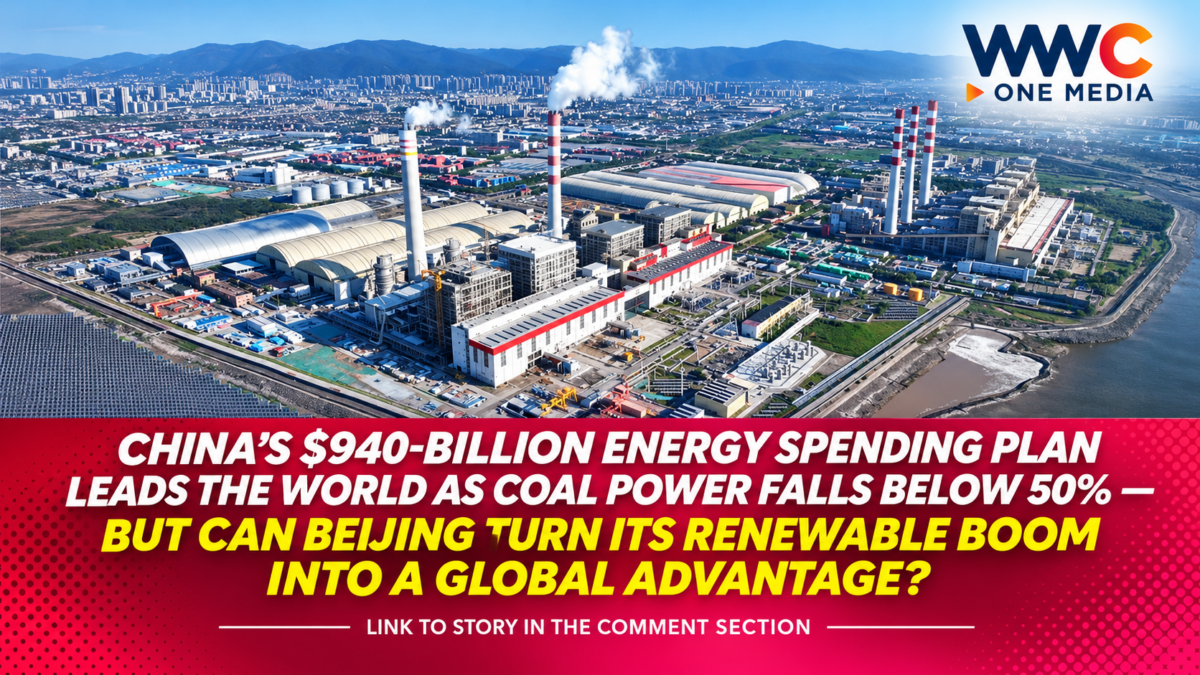
BEIJING, CHINA — November 8, 2026 — China is on track to become the world’s largest energy investor in 2026, with spending projected to reach an extraordinary US$940 billion as Beijing accelerates investment in electricity grids, renewable power and infrastructure supporting its rapidly electrifying economy.
The forecast comes from the Global Energy Transition Report 2026, released by the China Enterprise Reform and Development Society on November 7 and reported by state broadcaster China Central Television (CCTV).
According to Bloomberg, China is expected to invest more in energy this year than any other country, reinforcing its central position in global electricity infrastructure, solar manufacturing and wind-power technology.
But behind the enormous spending figure lies an important transformation.
China is moving beyond simply building more solar and wind farms.
The country is increasingly investing in the networks, storage systems and supporting infrastructure needed to deliver renewable electricity reliably to factories, businesses, households and data centers.
At the end of 2025, renewables represented approximately 60.1% of China’s installed electricity-generation capacity.
During the first half of 2026, coal-fired power’s share of electricity generation reportedly dropped to 49.7%, falling below half for the first time.
The shift highlights the extraordinary scale of China’s energy transition.
Yet the challenges remain substantial.
An expanding renewable-power system needs modern transmission lines, storage facilities and electricity-market reforms to ensure that the power being generated can actually reach consumers.
With nearly a trillion dollars in projected energy investment, could China transform its electricity infrastructure into a lasting competitive advantage—or will power-grid bottlenecks and growing energy demand become the next major obstacles?
China Set to Lead Global Energy Investment With $940 Billion
The new report estimates that China’s total energy investment will reach US$940 billion in 2026.
That would make it the world’s largest national energy-investment market.
The projection is consistent with the broader findings of the International Energy Agency, which estimates that worldwide energy spending will reach approximately US$3.4 trillion this year.
On a simple comparison, China’s projected US$940 billion would represent about 27.6% of that global amount.
However, the two figures come from different organizations and may not use identical reporting methodologies.
The comparison should therefore be treated as an indication of scale rather than an exact audited share.
The IEA estimates that global energy investment will increase by approximately 5% in 2026.
It expects around US$2.2 trillion to flow into clean-energy technologies and infrastructure, including renewable electricity, nuclear power, grids, batteries, energy efficiency and electrification.
Approximately US$1.2 trillion is expected to support fossil-fuel activities.
Those figures illustrate the growing financial importance of electricity and low-carbon technologies.
But China’s US$940-billion total covers energy investment broadly.
It should not be described as money allocated exclusively to solar panels, wind turbines or other renewable projects.
China Now Has 2,337 Gigawatts of Renewable Capacity
China’s enormous investment is supported by one of the fastest expansions of renewable electricity infrastructure in history.
According to the CCTV-reported findings, the country had 2.337 billion kilowatts, equivalent to 2,337 gigawatts, of installed renewable-power capacity at the end of 2025.
That accounted for approximately 60.1% of China’s total installed electricity-generation capacity.
The report also states that China accounted for 63.6% of new renewable-power installations worldwide.
These figures underline the scale of the country’s construction activity.
But installed capacity and actual electricity generation are different measurements.
A solar farm cannot produce electricity at its maximum rated capacity during the night.
Wind generation depends on weather conditions, while hydropower output depends partly on water availability.
Therefore, a 60.1% renewable share of installed generating capacity does not mean renewables provided 60.1% of China’s actual electricity output.
That distinction is essential to understanding the country’s progress.
Renewable Electricity Reaches 3.99 Trillion Kilowatt-Hours
According to the report, China’s renewable-energy facilities generated approximately 3.99 trillion kilowatt-hours of electricity in 2025.
That represented 38.3% of national electricity generation.
The report further states that the increase in renewable generation was sufficient to cover the entire growth in national electricity consumption during the year.
This is significant because China’s electricity demand continues to expand.
Industries, transport systems, buildings and digital infrastructure require increasing amounts of power.
The expansion of electric vehicles and artificial intelligence also creates additional demand for electricity.
According to the IEA, growing electrification is reshaping how countries plan energy investment.
For China, renewable power’s growing contribution means the country can meet a greater portion of electricity demand through sources other than fossil fuels.
However, the grid must still balance electricity supply and consumption throughout the day.
Renewable generation increases the need for flexible infrastructure because output can change with sunlight, wind and seasonal conditions.
China’s Electricity Demand Exceeds 1 Trillion kWh in a Single Month
China’s electricity demand illustrates why energy investment remains such a major economic priority.
In August 2026, the country consumed approximately 1.0332 trillion kilowatt-hours of electricity.
That was the second consecutive month in which consumption exceeded the 1-trillion-kWh threshold.
The country’s maximum power load also reached approximately 1.56 billion kilowatts.
These figures reflect the immense scale of China’s electricity system.
Traditional manufacturing remains a major consumer of power.
But newer industries—including electric vehicles, batteries, communications equipment and data centers—are also contributing to demand growth.
As previously reported by WWC ONE MEDIA, China’s electricity system is experiencing a major transition as both conventional and emerging industries require more dependable power.
Related WWC ONE MEDIA coverage: China’s Electricity Demand Tops 1 Trillion kWh as Power Load Hits Record — And AI, EVs Are Driving the Surge
The rapid increase in electricity consumption explains why China cannot rely solely on constructing new generating facilities.
It must also expand the infrastructure that transports and manages electricity.
Why China Is Spending More on Power Grids
A major finding in the latest investment report is China’s changing spending priorities.
The country is increasingly emphasizing electricity grids and supporting infrastructure.
The International Energy Agency expects Chinese investment in power networks to reach approximately US$140 billion in 2026, according to the reporting cited by Bloomberg and Investing.com.
This reflects a fundamental challenge in renewable-energy development.
China has extensive solar and wind resources in inland and western regions.
Many of its largest factories, commercial centers and population hubs are located elsewhere.
Electricity must therefore travel across long distances.
That requires high-voltage transmission systems, modern substations and more sophisticated grid-management technologies.
Without sufficient infrastructure, a region may have large amounts of renewable generating capacity but still be unable to deliver all that power to distant customers.
The result can be renewable-energy curtailment, when generation is reduced because the electricity system cannot absorb the available output.
For China, reducing those bottlenecks is becoming a major policy priority.
State Grid Plans a Massive Five-Year Investment Program
China’s grid expansion extends beyond the latest annual investment forecast.
State Grid Corporation of China has outlined a multiyear program involving approximately 4 trillion yuan in investment between 2026 and 2030.
The plan covers transmission infrastructure, distribution systems and upgrades intended to support an increasingly complex electricity network.
Long-distance high-voltage lines are particularly important.
They can transport power from regions with strong renewable resources to more heavily populated industrial areas.
The expansion could also support greater integration of battery storage and other flexible electricity resources.
However, large transmission projects face challenges involving financing, construction schedules, land requirements and coordination with local authorities.
Even when financing is available, the benefits depend on completing the infrastructure and integrating it effectively into the electricity system.
The growing emphasis on grids demonstrates how China’s energy transition is evolving.
The country must now make better use of the enormous generating capacity it has already installed.
Coal’s Share of Chinese Electricity Falls Below 50%
The report also highlights an important milestone involving coal.
During the first half of 2026, coal-fired power reportedly accounted for 49.7% of China’s electricity generation.
That represented the first time its share had fallen below 50% for the period, according to the China Enterprise Reform and Development Society.
The change reflects the growing role of renewable sources.
But coal remains a major component of China’s energy system.
It continues supplying electricity when renewable output is insufficient and supports the reliability of the wider grid.
A decline in coal’s percentage share does not necessarily mean that coal plants have stopped operating or that coal-fired generation has fallen by the same proportion.
The absolute amount of coal-generated electricity depends on total demand and the performance of other energy sources.
The country is therefore pursuing a complicated transition.
It is rapidly expanding renewables while retaining conventional capacity to support energy security.
China’s Carbon Emissions Declined 0.5% in 2025
Another finding concerns greenhouse-gas emissions.
The report estimates that China’s energy-related carbon dioxide emissions declined approximately 0.5% in 2025.
The decrease is significant because China remains the world’s largest annual greenhouse-gas emitter.
A sustained shift toward lower-carbon electricity could contribute to global climate efforts.
But a one-year reduction does not establish that the country has achieved a permanent decline.
Emissions could change with industrial production, economic growth, weather conditions and the operation of fossil-fuel facilities.
The longer-term trend will depend on whether renewable and other lower-emission energy sources continue displacing fossil fuels.
The expansion of electricity storage and grid infrastructure could become increasingly important to that outcome.
More renewable capacity helps only when its electricity is generated, transmitted and used.
China Supplies 70% of Wind Equipment and 80% of Solar Equipment
China’s influence extends far beyond its domestic energy market.
According to CCTV’s reporting, Chinese manufacturers supply approximately 70% of global wind-power equipment and 80% of photovoltaic equipment.
These are industry estimates reported by the Chinese organization, and product definitions may affect the exact shares.
Nevertheless, China’s manufacturing scale is a major factor in global renewable-energy supply chains.
Chinese companies produce solar modules, battery materials, electric vehicles and numerous components used in energy infrastructure.
Large production volumes have contributed to lower costs for many clean technologies.
That can benefit countries seeking to expand renewable energy without building entire manufacturing industries from the ground up.
However, concentrated supply chains also create strategic concerns.
Governments may worry about dependence on imported technology, trade disputes and the ability of domestic manufacturers to compete.
Countries are increasingly weighing lower equipment prices against energy-security and industrial-policy priorities.
China Is Changing the Economics of Clean Energy Worldwide
Reuters reported on November 6 that Chinese clean-technology exports and investments have become increasingly important to developing economies.
The analysis estimated that Chinese exports and overseas investments in clean technologies reached approximately US$132 billion in 2025.
These commercial activities have helped expand access to solar panels, batteries, electric vehicles and related equipment.
Their financial scale also demonstrates that China’s energy transition is creating international business opportunities.
But commercial exports and investments should not be confused with government climate-development assistance.
The two forms of financing serve different purposes and should not be treated as identical.
For many developing countries, Chinese equipment may provide a relatively affordable route to reducing fossil-fuel dependence.
Others are seeking to expand local manufacturing and diversify suppliers.
Both approaches reflect the growing strategic importance of clean-energy technology.
India’s Energy Transition Shows the Risk of Supply-Chain Dependence
China’s dominance in renewable-energy manufacturing has particular implications for India.
India is pursuing ambitious solar, wind and battery-storage expansion.
But many of the technologies and materials required for those projects remain connected to Chinese supply chains.
As previously examined by WWC ONE MEDIA, India’s effort to expand clean electricity illustrates how a country can reduce its dependence on imported fossil fuels while becoming more reliant on imported energy technologies.
Related WWC ONE MEDIA coverage: India Is Racing Toward 500 GW of Clean Power — But Its Battery Boom Still Runs Through China
The issue is not limited to India.
Governments in Europe, North America and Southeast Asia are considering how to balance access to affordable Chinese equipment with their own manufacturing and security priorities.
China’s position in renewable supply chains provides commercial advantages.
But it also exposes Chinese exporters to tariffs, restrictions and political disputes.
The Global AI Boom Makes Electricity a Strategic Asset
Artificial intelligence is introducing another major source of electricity demand.
AI data centers require large amounts of power for processors, networking systems and cooling equipment.
Countries that can provide reliable and competitive electricity may be better positioned to attract certain technology investments.
China’s large generating fleet could support domestic AI expansion.
But data centers need power where they operate, not simply excess electricity somewhere else in the country.
This creates demand for upgraded transmission systems, storage and better coordination between electricity producers and industrial users.
It also introduces competition for equipment and investment capital.
The same issues are emerging in the United States and other major economies.
The growing importance of electricity to digital infrastructure means energy policy is becoming increasingly connected to technology and industrial policy.
However, China’s investment totals alone do not prove that it will dominate global artificial intelligence.
AI competitiveness also depends on semiconductors, software, computing hardware, research and international trade conditions.
What China’s Energy Boom Means for the Philippines
China’s expanding renewable-energy industry is particularly relevant to the Philippines.
The country is seeking to improve electricity security and diversify its energy supply while managing high power costs.
Chinese-manufactured solar panels, batteries and other components are part of the global supply chain available to Philippine energy developers.
Their affordability could support additional renewable-energy projects.
But the success of those investments depends on local conditions.
Projects need land, financing, permits, transmission connections and electricity buyers.
Cheap equipment does not automatically translate into lower electricity rates.
The Philippines is already attracting substantial investment interest in power infrastructure.
According to the Board of Investments, energy-related investment approvals reached approximately ₱740.14 billion during the first nine months of 2026.
That represented more than 82% of the BOI’s overall approved investment value for the period.
As WWC ONE MEDIA previously reported, the country registered approximately ₱900 billion in total investment approvals during the same nine months.
Related WWC ONE MEDIA coverage: Philippine Investment Approvals Surge 53% to ₱900 Billion, Just ₱100 Billion Short of Target — But Will 21,524 Promised Jobs Become Reality?
Those figures show the scale of planned investment.
However, investment approvals are not the same as completed construction or commercial electricity production.
The actual benefits will depend on which projects move forward.
Philippine Grid Expansion Is Also a Major Challenge
The Philippines faces infrastructure challenges similar in principle to those confronting China, although on a much smaller scale.
New renewable generating facilities need suitable connections to the national grid.
Without sufficient transmission capacity, completed power plants may be unable to deliver all their electricity to consumers.
In the first half of 2026, the Philippine Department of Energy endorsed projects representing more than 17.8 gigawatts of potential generating and storage capacity for system impact studies.
Those assessments are an important part of determining whether proposed developments can connect safely to the electricity network.
As WWC ONE MEDIA previously reported, many of the endorsed projects involved battery storage, wind and solar facilities.
Related WWC ONE MEDIA coverage: 17.8 GW of Philippine Energy Projects Cleared for Grid Studies as Power Pipeline Expands
A project receiving an endorsement for a system impact study has not necessarily secured every permit or completed construction.
But the large pipeline illustrates the importance of transmission planning.
China’s experience offers a useful lesson: constructing generation capacity is only part of building a reliable modern energy system.
Could China’s Renewable Expansion Lower Global Energy Costs?
China’s manufacturing scale has helped reduce the prices of many clean-energy technologies.
Lower equipment costs can make new solar and battery projects more commercially attractive.
That may help countries diversify their electricity sources and reduce dependence on imported fossil fuels.
But final energy costs depend on multiple factors.
Project financing, grid connections, storage, land costs, operating expenses and regulation all influence electricity prices.
A low-cost solar panel does not guarantee a low electricity bill.
Large investments may also require substantial upfront spending on transmission and distribution systems.
Those costs must eventually be funded through appropriate commercial or public arrangements.
The benefits of China’s expanding clean-energy industry are therefore potentially significant, but they vary across countries and projects.
China’s Energy Investment Boom Still Faces Major Risks
The projected US$940-billion investment total is substantial, but it does not eliminate the industry’s challenges.
Grid bottlenecks: Renewable power must be connected to consumers through sufficient transmission and distribution infrastructure.
Manufacturing overcapacity: Rapid expansion in solar and other clean-technology manufacturing can create intense price competition.
Coal dependence: Conventional power remains important to electricity reliability, complicating emissions-reduction efforts.
Financing costs: Large infrastructure programs require substantial capital and long-term financial commitments.
Trade restrictions: Tariffs and other barriers can complicate international sales of Chinese clean-energy equipment.
Electricity demand: AI, electric vehicles and manufacturing can increase power consumption even as renewable generation expands.
These issues are central to assessing the long-term benefits of China’s energy investment.
The amount spent matters, but it is not the only measure of success.
Electricity reliability, project utilization, affordability and emissions performance will ultimately determine the results.
The Bigger Picture: Is China Building the Infrastructure of the Next Global Economy?
China’s projected US$940-billion energy investment in 2026 reflects the enormous financial resources being directed toward electricity and energy security.
The country has already developed an extensive renewable-generation system.
It is investing heavily in the networks needed to use that electricity.
And its manufacturers occupy important positions in the global supply chains for solar panels, wind equipment and batteries.
These developments could support industrial productivity, transport electrification and the expansion of digital infrastructure.
But the next phase of the transition may be more difficult than the initial construction boom.
China must integrate variable renewable output, modernize its electricity networks, manage financing risks and continue reducing reliance on fossil fuels.
Other countries must decide how much of their own energy transitions should depend on Chinese technology.
For the Philippines and Southeast Asia, the opportunity lies in accessing affordable equipment while developing reliable local grids and diversified energy supplies.
China’s projected investment leadership is clear. What remains uncertain is how effectively that capital will translate into dependable electricity, lower emissions and long-term economic benefits.
And as Beijing prepares to invest nearly US$1 trillion in energy in a single year, one question now stands at the center of the global power race: Will China’s massive spending create a lasting advantage in the age of electricity—or will the challenge of connecting and managing its enormous renewable system become the next major test?