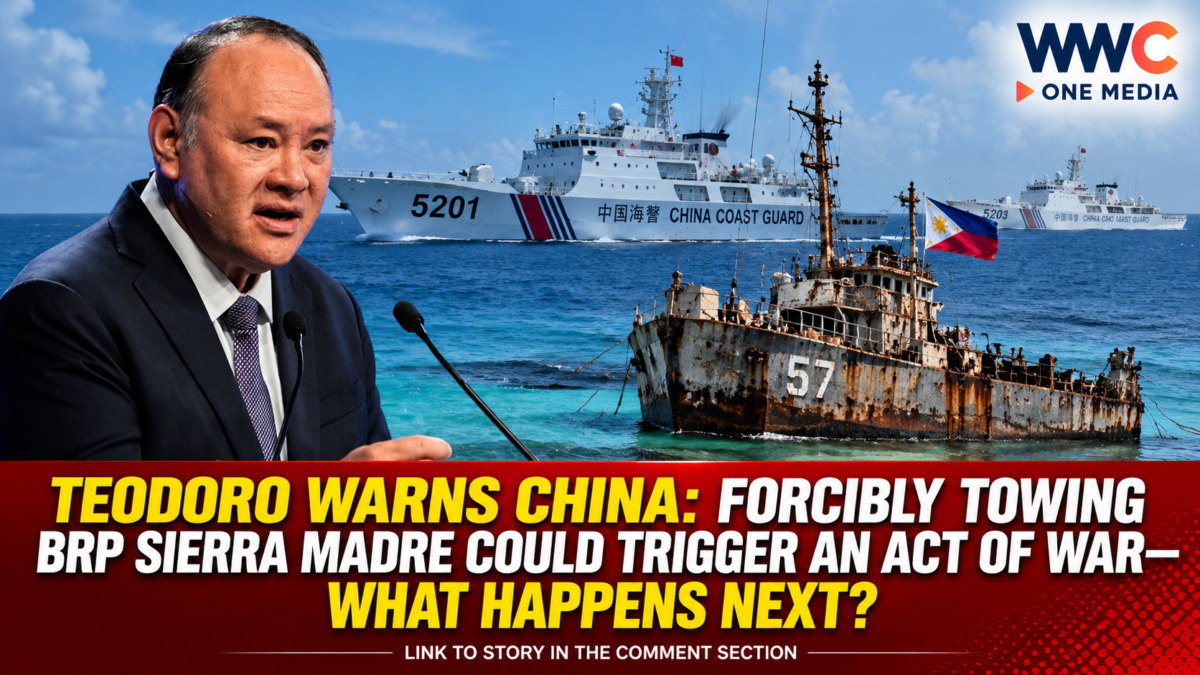
MANILA, Philippines — A forced removal of the BRP Sierra Madre from Ayungin Shoal could trigger a major confrontation between the Philippines and China, Defense Secretary Gilberto Teodoro Jr. has warned, underscoring the high stakes surrounding the two countries’ increasingly tense maritime dispute.
The Philippine Navy vessel, which has been deliberately grounded at Ayungin Shoal in the West Philippine Sea since 1999, serves as a military outpost where Filipino personnel maintain the country’s presence in the contested waters.
Teodoro has previously stated that any Chinese attempt to take or forcibly remove the ship would constitute an act of war against a Philippine naval vessel. His warning highlights the potential consequences of an action that could put Filipino personnel at risk and test Manila’s defense arrangements with Washington.
But what makes the BRP Sierra Madre so important—and why could an attempt to tow it away have consequences far beyond the disputed shoal?
Why BRP Sierra Madre Is a Critical Flashpoint
The BRP Sierra Madre is more than an aging military vessel. It is a symbol of the Philippines’ determination to maintain its presence at Ayungin Shoal, also known internationally as Second Thomas Shoal.
The Philippine Navy deliberately grounded the former World War II-era ship at the reef in 1999. Since then, Filipino personnel have remained aboard the vessel, with regular rotation and resupply missions delivering essential supplies to sustain the outpost.
China, which claims sovereignty over much of the South China Sea, has repeatedly opposed the Philippine presence and called for the ship’s removal.
Manila, however, maintains that its operations in the area are consistent with its maritime rights under international law.
In September 2026, the Department of Foreign Affairs reiterated that the Philippines had made no agreement obligating it to remove the BRP Sierra Madre. It also reaffirmed that the 2016 South China Sea arbitral award remains final and binding on the parties.
Chinese Tugboat Sighting Raises Questions
Concerns about the possibility of forcibly removing the vessel have arisen before.
In August 2025, the Philippine Navy confirmed that a Chinese Navy tugboat had been spotted approximately five nautical miles south of the BRP Sierra Madre.
At the time, Navy spokesperson Rear Admiral Roy Vincent Trinidad played down speculation that the tugboat had been deployed to remove the Philippine outpost. He said the vessel was strongly anchored to the coral reef and that a tugboat alone would not be sufficient to tow it away.
The Navy also said it had contingency measures to respond to a potential attempt against the ship.
The sighting nevertheless drew attention from maritime security analysts because a direct attempt to remove the BRP Sierra Madre could dramatically escalate the confrontation.
Importantly, the sighting of a Chinese tugboat did not, by itself, establish that China had begun an operation to tow away the Philippine vessel.
The 2016 Ruling and the Dispute Over Maritime Rights
The confrontation takes place against the backdrop of a long-running dispute over maritime rights in the South China Sea.
In July 2016, an arbitral tribunal constituted under the United Nations Convention on the Law of the Sea ruled in favor of the Philippines on key aspects of its case. The tribunal found no legal basis for China’s claim to historic rights to resources within the sea areas encompassed by its nine-dash line, insofar as those claims exceeded the rights permitted under UNCLOS.
China rejected the ruling, and the dispute remains unresolved.
The tribunal did not determine sovereignty over land territory or delimit a maritime boundary. Nevertheless, its findings remain a central part of Manila’s legal position concerning its maritime rights.
The Philippine government has continued to reject China’s demands concerning the BRP Sierra Madre and maintains that it has the right to sustain its personnel stationed at the outpost.
Why the United States Could Become Involved
A forced removal of the BRP Sierra Madre could also place the 1951 Mutual Defense Treaty between the Philippines and the United States under intense scrutiny.
Washington has repeatedly affirmed its commitment to the Philippines and clarified that an armed attack on Philippine armed forces, public vessels, or aircraft—including those of its coast guard—anywhere in the South China Sea would invoke the treaty’s mutual defense commitments.
Teodoro has previously said that Manila expects Washington to honor its treaty obligations in the event of an attack.
However, whether a particular incident would trigger a specific response would depend on the circumstances and the treaty consultations between the two allies. A forced towing attempt should not automatically be described as having already triggered US military intervention.
The possibility of a confrontation involving two treaty partners and China nevertheless underscores the wider regional stakes.
Previous Confrontations Show How Quickly Tensions Can Escalate
The June 17, 2024, confrontation at Ayungin Shoal demonstrated the dangers facing Philippine personnel during resupply missions.
Philippine authorities reported that Chinese maritime forces rammed and towed Philippine boats and boarded some vessels during the operation. At least eight Philippine Navy personnel were reported injured, including one serviceman who lost a finger.
The incident drew international attention and intensified calls for restraint and respect for international law.
More recently, a September 2026 resupply mission was disrupted by Chinese Coast Guard and People’s Liberation Army Navy vessels, according to Philippine authorities. The incident highlighted how routine efforts to deliver supplies to the BRP Sierra Madre can become dangerous maritime encounters.
China has disputed the Philippine government’s characterization of its actions in the contested waters.
What Happens if China Attempts to Remove the Ship?
A genuine attempt to forcibly remove the BRP Sierra Madre would raise several urgent questions: how Philippine forces would respond, whether Filipino personnel would face immediate danger, and how the United States and other regional partners would react.
Such an incident could also lead to diplomatic protests, heightened military readiness, further maritime confrontations, and renewed international calls for de-escalation.
For Manila, maintaining the outpost is closely tied to its position on maritime rights and its determination not to abandon its presence at Ayungin Shoal.
For Beijing, the dispute remains part of its broader contest with neighboring countries over claims and activities in the South China Sea.
For now, the distinction between a warning about a possible act and a confirmed attempt to tow the ship away remains crucial. Any new claim of an actual towing operation must be verified through official statements and credible reporting.
The question facing both countries is whether the dispute can be managed through diplomacy and restraint—or whether another confrontation at Ayungin Shoal could push the region into a far more dangerous phase.
As tensions persist in the West Philippine Sea, the future of the BRP Sierra Madre remains a key test of the Philippines’ resolve, China’s maritime ambitions, and the stability of the wider region.