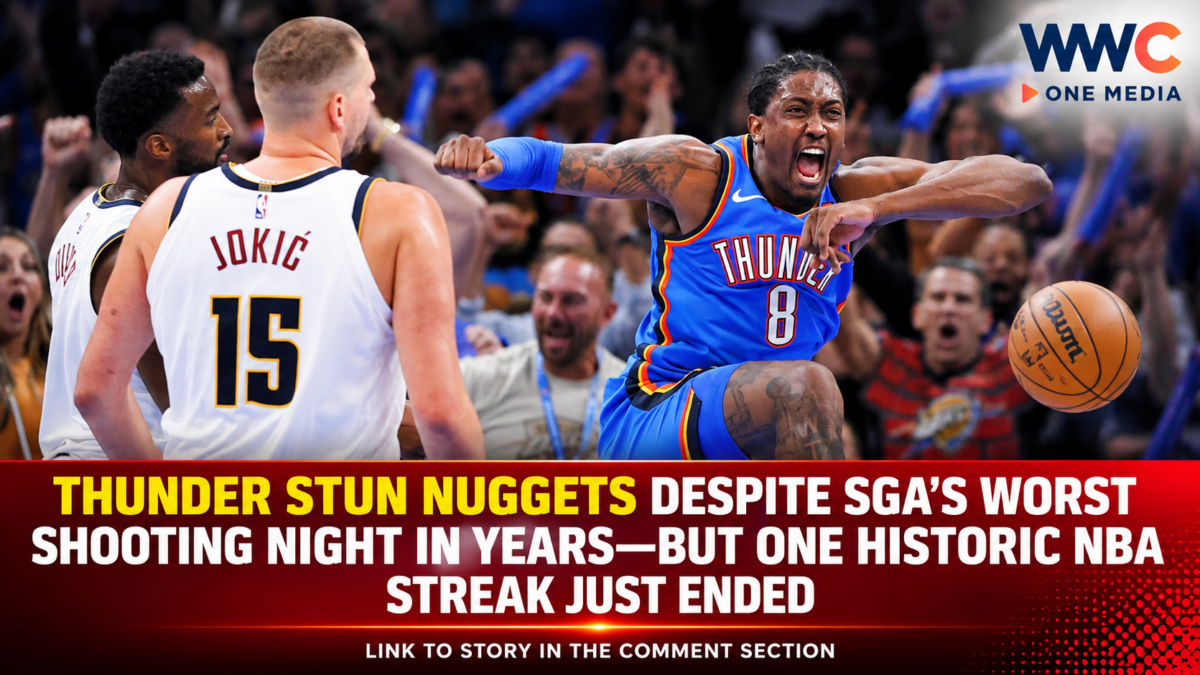
The Oklahoma City Thunder proved they could win even when their superstar struggled, defeating the Denver Nuggets 96–84 on Thursday, October 22, in Oklahoma City. But the victory came with a historic twist: Shai Gilgeous-Alexander’s extraordinary streak of consecutive 20-point games finally came to an end.
The defending champions leaned on their defense, supporting cast and second-half execution to overcome an unusually difficult night for their leading scorer. The result gave Oklahoma City a 2–0 start to the 2026–27 NBA regular season, while Denver opened its campaign with a defeat.
SGA finishes with 17 points as historic streak ends
Gilgeous-Alexander, widely known as SGA, finished with 17 points on 6-of-19 shooting, falling short of the 20-point mark for the first time in 142 consecutive games after a run of 141 straight games scoring at least 20 points.
The remarkable streak began in October 2024 and stood as an NBA record. Against Denver, he missed all seven of his first-half field-goal attempts, struggling to find his usual rhythm as the Thunder searched for offensive consistency.
His scoring drought was a major storyline, but it did not derail Oklahoma City. SGA eventually found his touch in the second half, helping the Thunder regain control as the game progressed.
The end of the streak also underscored an important reality for Oklahoma City: individual scoring milestones matter, but winning remains the priority.
Jalen Williams and Chet Holmgren step up
With their leading scorer having trouble, the Thunder received crucial contributions from other key players.
- Jalen Williams: Led Oklahoma City with 21 points.
- Chet Holmgren: Recorded 12 points and 17 rebounds, providing a strong presence on the glass.
- Shai Gilgeous-Alexander: Added 17 points despite his difficult shooting night.
Oklahoma City also struggled from three-point range, converting just 25.6% of its attempts. Its ability to win despite the offensive shortcomings highlighted the importance of defense and rebounding in a tightly contested matchup.
Thunder defense changes the game after halftime
Denver had opportunities to take control early, building a lead of as many as nine points. However, Oklahoma City gradually turned the momentum around, using defensive pressure to disrupt the Nuggets’ offense.
The Thunder forced 13 second-half turnovers, converting those mistakes into 19 points. Fourteen of those points came in the fourth quarter, when Oklahoma City created separation and protected its lead.
That defensive surge proved decisive. Even without a high-scoring performance from SGA, the Thunder found a way to limit Denver to 84 points and close out a 12-point victory.
Nikola Jokic struggles as Aaron Gordon leads Denver
The Nuggets also had problems getting their offense going. Nikola Jokic finished with 13 points on 5-of-19 shooting, an uncharacteristically inefficient outing for the three-time NBA Most Valuable Player.
Aaron Gordon led Denver with 20 points, while DeMar DeRozan also contributed 13 points. Denver additionally suffered an injury setback when Cameron Johnson sustained a right ankle sprain in the second quarter and did not return.
For Denver, the loss exposed concerns about offensive execution and ball security. For Oklahoma City, it showed that the team could win a physical, low-scoring contest without relying on a spectacular scoring performance from its biggest star.
What this win means for Oklahoma City
The Thunder’s 96–84 victory was more than an early-season result. It offered a reminder of the qualities that can make a championship contender dangerous: defensive discipline, rebounding, multiple scoring options and the ability to adjust when the offense is not clicking.
The end of Gilgeous-Alexander’s 20-point streak will inevitably attract attention, but Oklahoma City still accomplished its primary objective. Williams delivered the leading scoring performance, Holmgren controlled the boards, and the defense forced Denver into costly mistakes.
Denver, meanwhile, will need to improve its offensive efficiency and protect possession of the ball as the season develops.