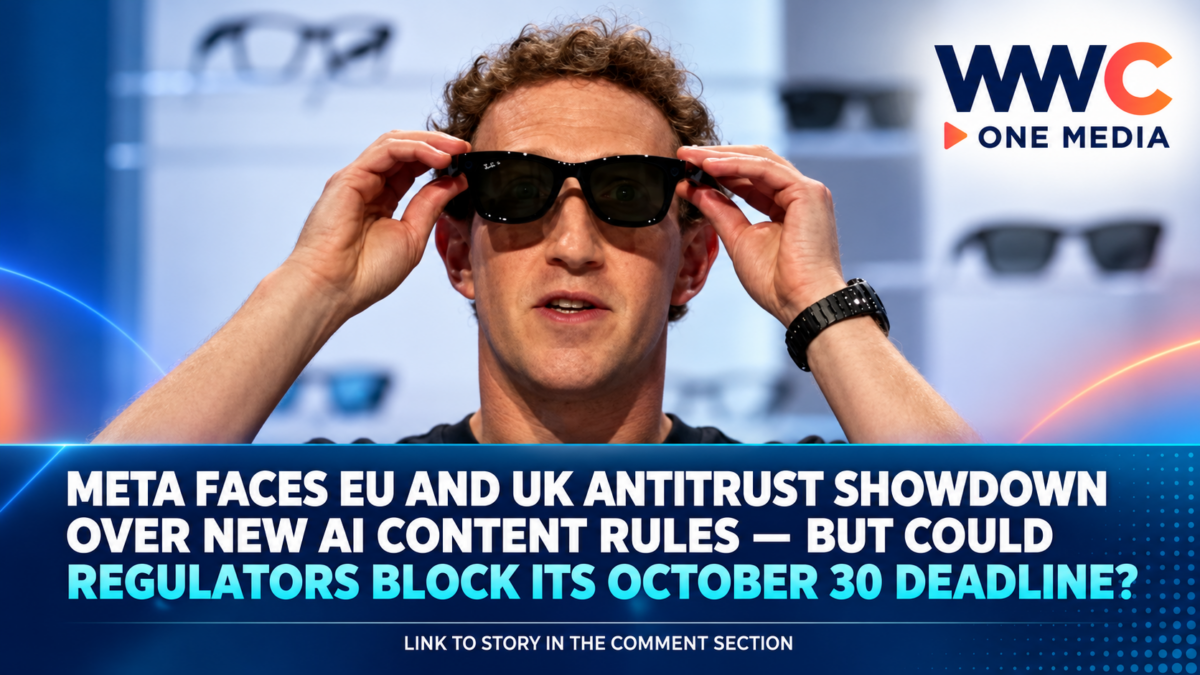
BRUSSELS, October 23, 2026 — Meta Platforms, the technology giant behind Facebook, Instagram and WhatsApp, is facing mounting pressure from publishers and digital advertisers as European and British competition regulators examine controversial new commercial terms scheduled to take effect on October 30.
At the center of the dispute is a potentially far-reaching question: Can one of the world’s most powerful technology companies require businesses using its commercial platforms to accept terms that critics claim could give Meta sweeping access to their online content for artificial intelligence?
Publishers argue the changes could threaten their intellectual property, undermine competition and allow AI services to benefit from valuable online material without adequate permission or compensation.
Meta strongly disputes those accusations, insisting its revised terms do not expand its existing web-crawling rights.
Publishers Demand Emergency Action Against Meta
On October 22, the Movement for an Open Web, an advocacy organization representing digital advertisers and publishers, confirmed that it had complained to the European Commission and the United Kingdom’s Competition and Markets Authority (CMA).
The organization is seeking emergency intervention to suspend the disputed commercial terms before they become effective on October 30.
The complaint alleges that Meta could gain excessively broad rights to access and use businesses’ digital content, potentially strengthening its position in the increasingly competitive artificial intelligence market.
Tim Cowen, co-founder of the Movement for an Open Web, argued that businesses dependent on Meta’s advertising and commercial platforms could face limited practical freedom to reject the conditions.
Critics fear that businesses could end up providing access to valuable content while potentially competing against AI-powered products developed using information from the wider internet.
However, these remain allegations. Neither the European Commission nor the CMA has announced a finding that Meta’s revised terms violate competition law.
Meta Rejects Claims of Expanded AI Content Rights
Meta has pushed back against the complaints.
A company spokesperson told Reuters that the consolidated crawling provisions concern its advertising and business products and do not change how Meta uses web crawlers.
The company also emphasized that website owners can continue communicating their crawling preferences through robots.txt, a standard mechanism used by websites to indicate which automated crawlers should or should not access particular content.
Meta maintains that the updates do not provide new rights overriding those preferences and rejects the claim that the changes are intended to enable unauthorized scraping of news publishers’ websites.
This disagreement over the interpretation and potential effects of the terms is central to the regulatory dispute.
UK Competition Watchdog Opens Urgent Discussions
The UK’s Competition and Markets Authority confirmed that it met with Meta on October 21 to obtain additional information about the revised business terms.
The regulator acknowledged concerns raised by British businesses and said it was holding urgent discussions with the company while considering possible next steps.
Meanwhile, the European Commission confirmed receiving a complaint and said it would assess the matter through its established procedures.
Both developments place additional scrutiny on Meta ahead of the October 30 implementation date.
Importantly, receiving a complaint or holding discussions does not automatically mean that regulators will suspend the terms or launch formal enforcement proceedings.
For emergency competition-law measures to be granted, complainants generally need to demonstrate a risk of serious and irreparable harm from the alleged conduct.
Global News Industry Raises the Pressure
The Movement for an Open Web is not acting alone.
The European Publishers Council and German publishing organizations, including BDZV and MVFP, have also raised concerns about Meta’s updated commercial arrangements.
On October 22, the World Association of News Publishers, known as WAN-IFRA, added its voice to the controversy.
The international organization called on Meta to suspend the disputed provision for news publishers and negotiate clearer terms governing the use of journalistic content.
WAN-IFRA, which represents a global network spanning more than 20,000 media brands, argued that news organizations should have meaningful control over whether their reporting is used to develop or power AI systems.
The association wants publishers to retain access to Meta’s business services without being forced to accept contested content-use provisions.
It also supports arrangements under which AI companies obtain appropriate licenses and provide fair compensation for the journalism they use.
Why This Dispute Matters for Artificial Intelligence
The controversy comes as technology companies race to build increasingly powerful AI systems capable of generating written answers, summarizing news and responding to complex user questions.
These systems can rely on enormous collections of digital information, raising difficult legal and commercial questions about copyright, licensing, consent and compensation.
For publishers, original journalism requires financial investment in reporters, editors, investigations and verification.
The concern is that AI products could benefit from that investment without returning sufficient economic value to the companies producing the information.
Technology companies, meanwhile, argue for the importance of lawful information access, innovation and established technical tools for controlling automated crawling.
The legal boundaries surrounding AI training, content collection and generated outputs continue to develop across jurisdictions.
The Meta dispute brings those questions into sharper focus because of the company’s major role in online advertising, social media distribution and business communications.
Could Smaller Publishers and Asian Businesses Be Affected?
The immediate complaints are directed at European and British regulators, but the underlying questions have wider significance.
News organizations, digital publishers, e-commerce businesses and advertisers throughout Asia also rely on major technology platforms to distribute content and reach customers.
For businesses in markets such as the Philippines, Singapore, Malaysia and Indonesia, the dispute highlights the importance of understanding how platform terms govern the use of digital materials.
Any eventual regulatory decision in Europe could influence future industry standards, contract negotiations and expectations surrounding AI content licensing.
However, no direct changes to Philippine law or automatic restrictions on Meta’s services in Asia have been established by the complaints.
October 30 Becomes the Critical Deadline
The next major milestone is October 30, when Meta’s revised commercial terms are scheduled to take effect.
Publishers are pushing for regulatory intervention before that date, arguing that waiting could leave businesses exposed to potentially harmful conditions.
Meta continues to maintain that the disputed provisions have been misunderstood and do not grant the sweeping new crawling rights alleged by opponents.
Regulators must now determine whether the complaints justify urgent action or further investigation.
The bigger question extends beyond one company’s contractual language.
As artificial intelligence becomes increasingly dependent on digital information, who should control the content powering the next generation of AI services — the platforms collecting it or the businesses and publishers creating it?
That debate could have lasting consequences for the future of online advertising, independent journalism, copyright protection and competition in the global digital economy.