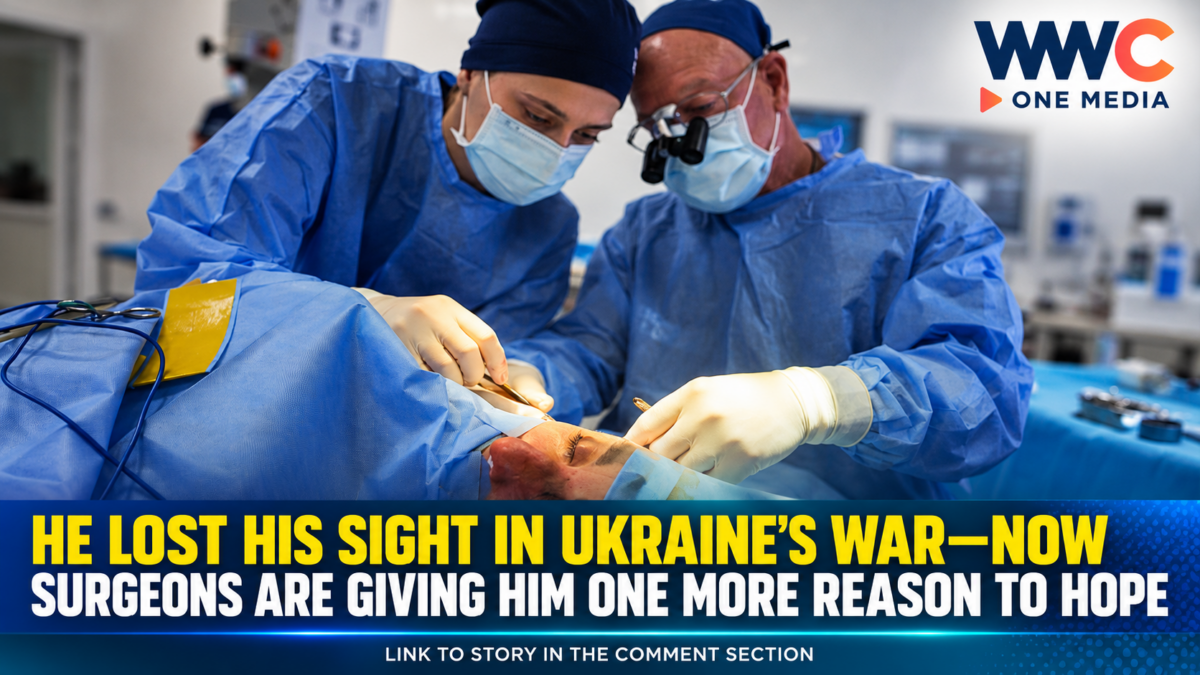
KYIV, Ukraine — After a battlefield explosion plunged his world into near-total darkness, Ukrainian soldier Mykola Kasiuk is holding on to a deeply personal hope: to see his children again.
Kasiuk lost one eye and suffered devastating injuries to the other after stepping on a land mine in eastern Ukraine in April 2024. Following numerous operations and limited improvement, he recently underwent reconstructive eye surgery by a visiting team of American specialists in Kyiv, offering a new possibility for treatment even as the prospect of regaining his sight remains uncertain.
His case highlights the efforts of medical teams working to treat some of the most severe injuries caused by Russia’s war against Ukraine, where damaged eyes, facial trauma and shortages of specialized surgical expertise have created long-term challenges for wounded soldiers and civilians.
According to reporting by The Associated Press, Kasiuk’s latest operation was part of Vision for Ukraine, a medical mission organized by the Christian Medical Association of Ukraine. The visiting specialists perform complex procedures while helping Ukrainian doctors develop skills in reconstructive eye surgery.
A soldier’s hope of seeing his children again
Kasiuk’s injury transformed everyday life for him and his family. Doctors removed one eye after shrapnel pierced it and raised concerns about infection. His remaining eye also sustained serious damage, and doctors suspected that its optic nerve had been injured.
After repeated operations failed to restore meaningful vision, Kasiuk continued searching for another chance.
His remaining eye could detect faint traces of light, but doctors had previously advised that its condition was extremely serious. Rather than give up on the possibility of treatment, he sought help from the visiting surgical team.
For Kasiuk, the goal goes beyond medical recovery. It is about reconnecting with the world he remembers, including the faces of his three children.
His wife, Tetyana, has also faced the emotional and practical burden of caring for her husband while managing the family’s needs and navigating medical treatment and disability paperwork.
What surgeons discovered during the operation
The surgical team focused on rebuilding the damaged eye socket and eyelids, improving the eye’s movement and helping restore its protection.
Surgeons used skin grafted from behind Kasiuk’s ear to help the eyelid protect the injured eye. The results were better than initially expected, according to the AP report, and may create an opportunity to consider additional treatment.
However, the procedure has not confirmed that Kasiuk will regain his sight.
Doctors are concerned about scarring on the cornea, the transparent front surface of the eye. They also need to determine how much deeper damage remains and whether the eye can still transmit visual signals to the brain.
The medical team plans to monitor his recovery before deciding whether further interventions, potentially including a corneal transplant or an artificial cornea, may be appropriate.
The distinction is important: reconstructive surgery can improve the structure and function of a severely damaged eye, but that does not necessarily mean vision can be restored.
Ukraine’s growing challenge of war-related eye injuries
Kasiuk’s experience reflects a wider medical challenge facing Ukraine as the war continues.
In an October 2026 report, the UK-based Association of Optometrists’ publication OT described how Ukrainian eye specialists have been treating a growing burden of traumatic eye injuries while trying to maintain routine eye care amid attacks, displacement and disruptions to medical services.
The report cited figures shared by Ukrainian ophthalmologist Volodymyr Melnyk showing that new cases of trauma-related blindness rose from 380 in 2021 to 928 in 2022. These figures concern reported new cases of blindness attributed to trauma, not the total number of people blinded by the war.
International reporting has also documented the challenges faced by blind Ukrainian veterans after hospital treatment. In 2023, The Associated Press followed veterans attending rehabilitation programs to relearn practical skills, including preparing meals, navigating streets and using public transportation independently.
A separate report by Radio Free Europe/Radio Liberty in 2025 profiled Ukrainian soldier Pavlo Martsenyuk, who lost his sight after a mine blast and underwent extensive treatment for other serious injuries. His experience illustrates why rehabilitation and long-term support remain essential even when medical procedures cannot restore vision.
These reports show that the consequences of battlefield eye injuries extend far beyond the operating room. Survivors may need mobility training, psychological support, accessible public spaces and assistance returning to family and community life.
A medical breakthrough—or a first step toward something more?
For Kasiuk, the latest operation has provided renewed hope, but the outcome remains open.
Doctors must wait for healing and assess the extent of the damage before determining whether further treatment could improve his vision. Even if sight cannot be recovered, reconstructive procedures and artificial eyes may help protect injured tissue, restore appearance and improve quality of life.
His story is a reminder that advances in specialized surgery can create possibilities for patients with devastating injuries, while also showing the limits medicine still faces.
For a father who remembers the sun, blue skies and the faces of his children, even the possibility of seeing again carries enormous meaning.
The next stage of his recovery will determine how far that hope can go.