AUSTIN, TEXAS — October 23, 2026
Formula 1 is racing toward a potentially dramatic end to its 2026 season, but a growing cloud of geopolitical uncertainty is raising questions about whether the championship’s final two races can proceed as planned.
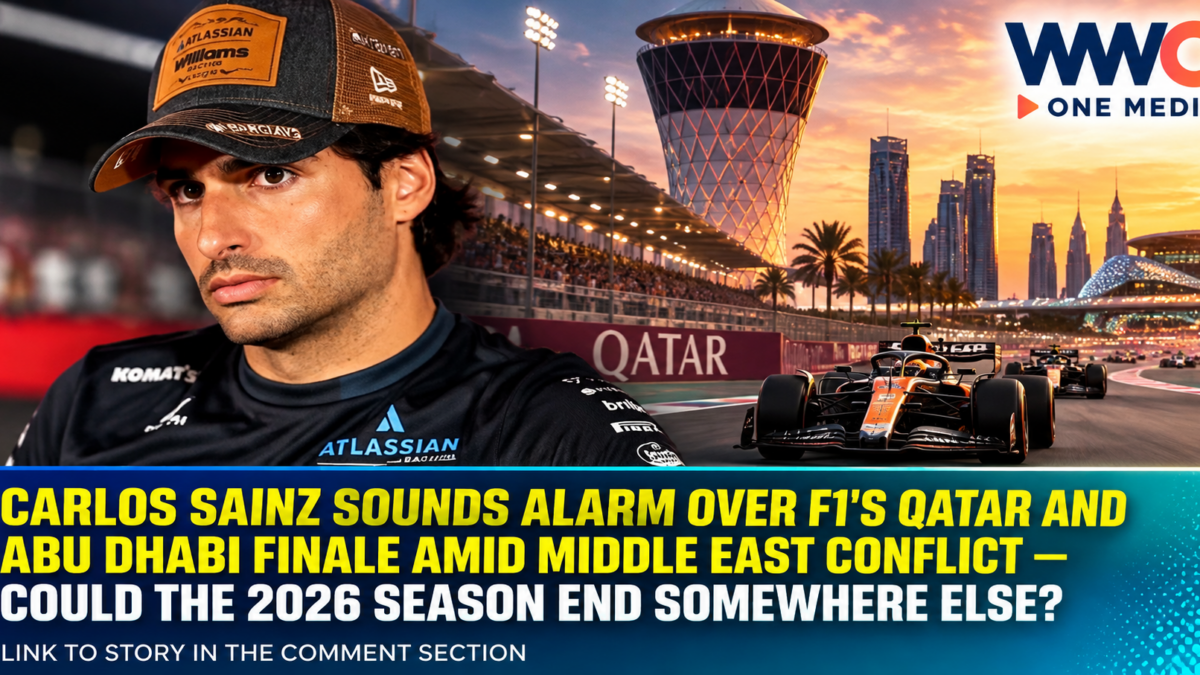
Williams driver Carlos Sainz has questioned the confidence of Formula 1 officials in staging the Qatar and Abu Dhabi Grands Prix amid continuing conflict in the Middle East, warning that the situation could change dramatically before the season concludes.
The Spanish racing star, who also serves as a director of the Grand Prix Drivers’ Association (GPDA), made his concerns known ahead of the United States Grand Prix in Austin, Texas, on October 22.
His comments come as Formula 1 and motorsport’s governing body, the Fédération Internationale de l’Automobile (FIA), maintain that the final two races remain on schedule.
The Qatar Grand Prix is set for November 29, followed by the season-ending Abu Dhabi Grand Prix on December 6.
Yet with regional security concerns still unresolved, Sainz believes declaring the races certain to take place may be premature.
F1 Leadership Remains Confident, but Sainz Sees Warning Signs
FIA president Mohammed Ben Sulayem has publicly expressed confidence that both Middle Eastern races will take place, indicating that he would be comfortable sending officials and teams to the venues under current conditions.
Formula 1’s leadership has also maintained that its calendar remains confirmed.
However, Sainz is less certain.
Speaking in his personal capacity rather than representing the GPDA, the Williams driver said it was difficult to share the same level of confidence while military and political developments continued to unfold across the region.
He stressed that international events over the next several weeks could significantly alter the security outlook.
The concerns are not necessarily about the racing circuits themselves. They also involve wider regional stability, international travel, logistics and the safety of everyone involved in staging a Formula 1 Grand Prix.
Middle East Conflict Raises New Questions Over Race Safety
The uncertainty is linked to the ongoing conflict involving Iran, the United States and Israel.
Military strikes and retaliatory attacks across the region have heightened concerns about whether major international sporting events can be held safely.
According to Reuters, the United States and Israel launched strikes against Iran in February, while Tehran responded with missile and drone attacks against Gulf countries hosting American military forces.
The conflict has already disrupted Formula 1’s 2026 calendar.
Separate reporting by German news agency dpa indicated that the Bahrain and Saudi Arabian races were cancelled earlier in the season, with Malaysia subsequently hosting a replacement round in September.
Those earlier changes illustrate how quickly the championship can be forced to adapt when international security conditions deteriorate.
The November 3 US midterm elections also add another layer of uncertainty. Political decisions and military developments following the vote could influence the regional security environment before Formula 1’s final two race weekends.
For Sainz, this is why flexibility matters more than premature certainty.
Could Italy Replace the Abu Dhabi Grand Prix?
One potential alternative has already entered discussions: Italy’s historic Imola circuit.
Motorsport reporting from Reuters and Autosport identifies Imola as a possible contingency venue should Formula 1 be unable to complete its planned Middle Eastern finale.
But moving a Grand Prix from Abu Dhabi to Italy in early December would create an entirely different challenge.
Cold winter conditions could affect tyre performance, track temperatures and race operations, while unpredictable weather would introduce additional uncertainty.
McLaren driver Oscar Piastri joked about the possibility of needing snowploughs if Formula 1 returned to Imola during the winter.
The Australian also suggested that racing in his home country would be more appealing at that time of year.
These remarks highlight a serious logistical issue: replacing a major international race involves more than identifying an available circuit.
Formula 1 would need to coordinate freight shipments, team travel, broadcasting operations, ticketing and safety arrangements within a limited period.
Importantly, Imola has not been announced as an official replacement for either race.
Other Drivers Place Their Trust in Formula 1 Officials
While Sainz has urged caution, not every driver has expressed the same level of concern.
According to dpa, Mercedes driver George Russell said he remained comfortable trusting those responsible for assessing the security situation.
Russell acknowledged that conditions could change quickly but indicated that he had no personal concerns based on the information currently available.
His position reflects the difficult balance Formula 1 faces.
Drivers, engineers and team personnel must rely on the FIA and Formula 1 management to evaluate risks that may involve sensitive information unavailable to the wider paddock.
Sainz acknowledged this distinction, making clear that the final safety assessment belongs to the sport’s governing authorities and organisers.
His remarks therefore represent a call for continued vigilance rather than a declaration that Qatar or Abu Dhabi is unsafe.
Why the 2026 F1 Finale Matters Beyond Motorsport
The potential disruption carries consequences far beyond an ordinary calendar adjustment.
Qatar and Abu Dhabi are scheduled to host the championship’s final two rounds, making them important events for teams, broadcasters, sponsors and international fans.
Any unexpected changes could affect travel arrangements, event preparations and commercial commitments.
There are also sporting implications.
If the drivers’ or constructors’ championships remain undecided late in the season, changes to the final races could complicate how the title battles unfold.
A replacement race might preserve an additional championship round, while cancellation without a substitute could reduce the remaining opportunities for teams and drivers to score points.
For host countries, Formula 1 is also a prominent international platform that attracts tourism attention and significant global media coverage.
The stakes, therefore, extend from the paddock to the broader business of international sport.
What Happens Next?
For now, there has been no official announcement cancelling or postponing the Qatar or Abu Dhabi Grands Prix.
Formula 1 and the FIA continue to support the published schedule, while contingency discussions indicate that alternatives may be necessary if conditions change.
Sainz’s warning underscores the central dilemma facing motorsport officials: how to preserve a global championship calendar without allowing commercial or sporting expectations to override safety.
As the 2026 championship enters its final stretch, the deciding factor may not be lap times, championship points or mechanical reliability.
It may instead be the security situation thousands of kilometres away from the racetrack.
The biggest question now is whether Formula 1 can safely complete its planned Middle Eastern finale—or whether a rapidly changing geopolitical crisis will force the sport into another major calendar reshuffle.