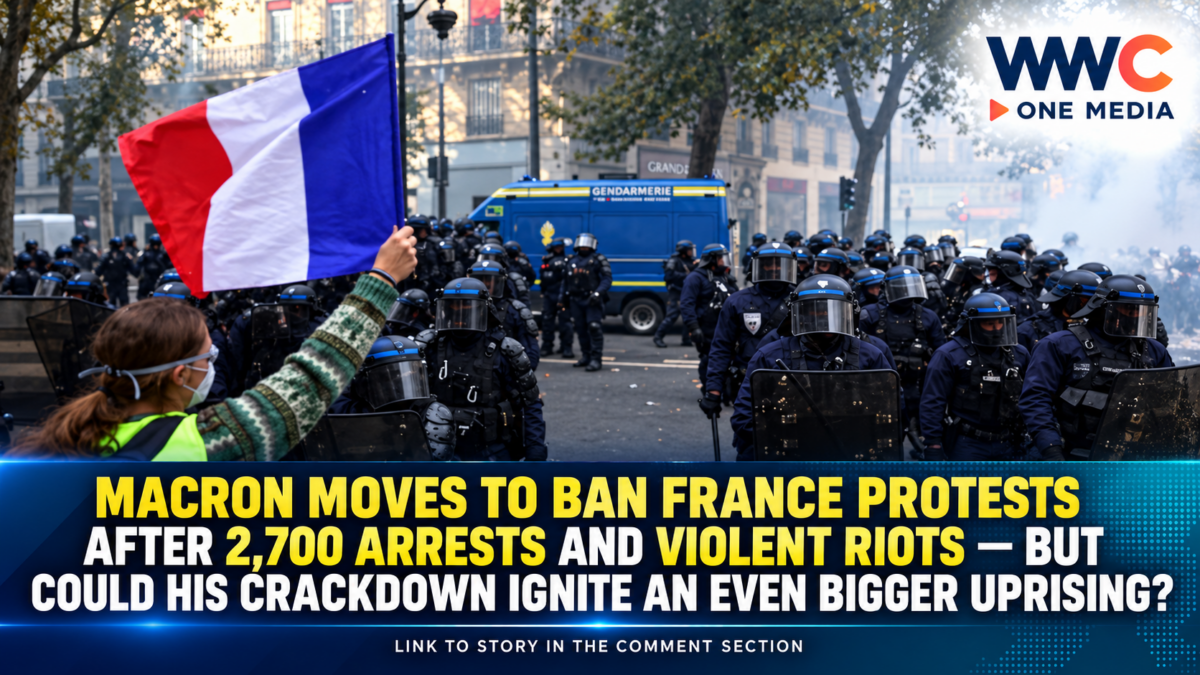
PARIS, FRANCE | October 23, 2026 — France is bracing for another potentially explosive weekend of nationwide demonstrations as President Emmanuel Macron’s government tightens security, restricts protest marches and prepares to deploy thousands of additional police officers following some of the country’s worst street violence in years.
The escalating confrontation has raised a critical question: Will tougher restrictions restore order, or will they intensify public anger against a government already facing deep political and economic frustration?
Authorities announced sweeping protest restrictions on October 22 ahead of fresh demonstrations scheduled for Saturday, October 24, as France continues to recover from widespread clashes, looting, vandalism and arson during the previous weekend.
Macron Orders Tougher Measures as France Faces Another Protest Wave
Following an emergency meeting with ministers and intelligence officials, Macron announced additional security measures, including curfews and restrictions targeting demonstrations organised by groups authorities consider to lack legitimacy.
The French president insisted that restoring stability and protecting public safety were his government’s immediate priorities.
He also accused organised ultra-left groups of helping drive the violence that erupted during the October 17 demonstrations.
Those accusations reflect the government’s assessment and do not establish that all protesters or protest organisers participated in violence.
Macron scheduled another high-level defence council meeting for Friday, October 23, to consider further responses before the next planned nationwide mobilisation.
Although restrictions have been introduced across several cities, France has not imposed a nationwide ban on all demonstrations.
More Than Half a Million Protested as Violence Swept Across France
The latest crisis followed massive demonstrations on October 17, when more than 500,000 people took to the streets to protest rising living costs, economic inequality and worsening conditions in public education.
The protest movement initially emerged from student complaints about overcrowded classrooms, inadequate facilities and teacher shortages before expanding into broader grievances about household finances and public services.
While many demonstrators protested peacefully, violence erupted on the margins of rallies in several cities.
Masked individuals clashed with security forces, shops were looted, vehicles were burned and public buildings were damaged.
French Interior Minister Laurent Nuñez subsequently acknowledged that security forces had lost control during parts of the unrest, prompting questions about whether authorities had adequately prepared for the scale of the demonstrations.
The government also admitted failures in intelligence gathering and anticipation.
2,700 Arrested, Hundreds of Businesses Damaged
Justice Minister Gérald Darmanin said on October 22 that approximately 2,700 people had been arrested during and after the unrest.
Of those, 217 had been jailed, while approximately 1,000 more were facing prosecution.
Authorities continued investigating major incidents of vandalism and arson, including the burning of the historic town hall in Limoges.
In Lyon, officials reported that between 200 and 300 shops were looted during the weekend violence. A tourist office was also set on fire.
The destruction has left business owners concerned about another wave of unrest, especially in heavily commercial areas.
Police and protesters have both suffered injuries during recent confrontations, adding to the controversy surrounding French crowd-control tactics.
Protest Bans Trigger New Battle Over Civil Liberties
The government’s response has created a confrontation over France’s tradition of public demonstrations.
Authorities banned Saturday’s protests in Lyon, while other cities, including Grenoble, Rouen, Le Havre and Toulon, introduced restrictions covering their central districts.
In Paris, police allowed Saturday’s planned march to proceed in the eastern part of the capital, beginning at Bastille, but barred demonstrators from entering the city centre.
Not all proposed bans have survived legal challenges.
On Thursday, a Paris student demonstration went ahead after a court overturned a police prohibition.
Student organisers criticised the government’s attempt to distinguish between acceptable and unacceptable protesters, arguing that public frustration should not be treated as a threat to democracy.
The legal disputes expose a fundamental dilemma: the government has an obligation to prevent violence, but restrictions on peaceful assembly must also respect constitutional rights and applicable law.
France Prepares to Deploy 20% More Police
Security preparations are being intensified ahead of the October 24 demonstrations.
France’s Interior Ministry announced plans to deploy 20% more law enforcement personnel than during the previous weekend.
Additional security preparations reportedly include specialist police units and support from France’s Sentinelle military security operation.
The increase follows criticism that the approximately 60,000 security personnel deployed for the October 17 protests were unable to prevent widespread destruction.
In Paris, major cultural and commercial events have also been affected.
Art Basel Paris announced that it would close two days earlier than scheduled because of concerns surrounding the protests.
The disruption highlights the economic consequences of the unrest, particularly for retailers, tourist destinations and cultural institutions.
Political Pressure Mounts on Macron Ahead of 2027 Election
The crisis comes at a politically sensitive moment as France prepares for its April-May 2027 presidential election.
Macron, who cannot seek a third consecutive presidential term, faces mounting criticism from opposing political camps over his government’s response.
Far-right leader Marine Le Pen has accused the administration of failing to maintain authority and protect public order.
Meanwhile, far-left politician Jean-Luc Mélenchon has criticised the government’s policing strategy, arguing that aggressive repression has contributed to the confrontation.
Prime Minister Sébastien Lecornu has sought dialogue with political leaders and plans consultations with student groups, trade unions, employers and local officials.
However, those efforts have yet to resolve the underlying disagreements over living costs, public services and security.
The Bigger Question: Can Macron Restore Order Without Deepening the Crisis?
France’s current turmoil is about more than a single weekend of street violence.
The demonstrations reveal longstanding frustrations about purchasing power, public spending, educational opportunities and citizens’ confidence in government institutions.
For Macron’s administration, preventing another outbreak of violence will be an immediate test of its ability to govern effectively.
But a security-first strategy carries political and legal risks if peaceful demonstrators believe they are being unfairly restricted.
With another major mobilisation planned for October 24, authorities are preparing for the possibility of renewed confrontations.
Whether the weekend produces largely peaceful protests or further disorder remains uncertain.
For now, one question hangs over France: Will Macron’s crackdown bring the country back under control — or become the spark for an even wider protest movement?