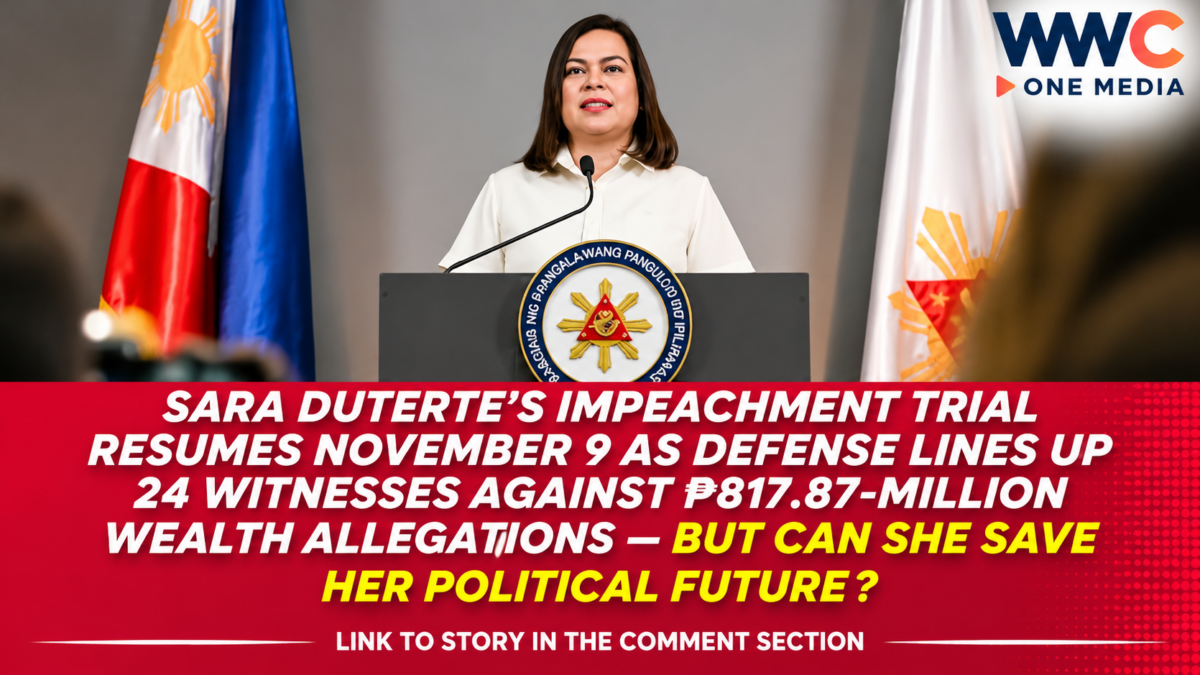
MANILA, PHILIPPINES — Vice President Sara Duterte is entering one of the most consequential stages of her political career as the Senate impeachment court prepares to resume proceedings on Monday, November 9, with her legal team finally taking its turn to present witnesses and evidence.
After months of testimony, financial disclosures, constitutional disputes and political confrontation, the trial is now focused on one remaining impeachment charge: allegations involving unexplained wealth, inaccurate Statements of Assets, Liabilities and Net Worth (SALNs), and prohibited business interests.
The House prosecution has presented financial evidence that it says points to at least ₱817.87 million in undeclared assets and unexplained wealth between 2022 and 2025.
Duterte denies wrongdoing.
Her lawyers maintain that the prosecution has failed to prove its accusations and that she must receive a full opportunity to answer the evidence presented against her.
Now, the defense is preparing to call bank officials, property assessors, corporate representatives and other witnesses to challenge the prosecution’s case.
But the biggest question is no longer how many charges Duterte faces. It is whether the sole remaining impeachment article can withstand the defense’s challenge—and whether the evidence will be enough to convince the senator-judges to remove a sitting vice president from office.
With Duterte’s declared presidential ambitions for 2028 potentially at stake, the proceedings could reshape the country’s political landscape.
Senate Impeachment Court Resumes at 10 a.m. on November 9
According to Abogado and statements from the Senate impeachment court, proceedings are scheduled to resume at 10 a.m. on Monday, November 9.
The defense is expected to begin presenting its evidence after the House prosecution formally rested its case in October.
Hearings are scheduled for November 9 to 13, with additional dates on November 19, 20 and 23.
Some sessions may continue into the afternoon or evening, depending on the Senate’s legislative calendar and the court’s decisions.
The November 9 session marks an important transition.
Until now, much of the trial has focused on the allegations advanced by House prosecutors.
The next stage will allow Duterte’s lawyers to challenge documents, present their interpretation of the financial records and introduce testimony supporting their defense.
The court is presided over by Senator Francis “Chiz” Escudero.
He is responsible for procedural rulings concerning witnesses, subpoenas and the admissibility and relevance of proposed evidence.
The Senate, sitting as an impeachment court, will ultimately determine whether the remaining article warrants conviction.
Defense Prepares 24 Witnesses After Law Professor Declines
Duterte’s defense initially identified 25 potential witnesses for the November 9–13 hearings.
However, the list was reduced after former law dean Ralph Sarmiento declined to testify.
Sarmiento, formerly associated with the University of St. La Salle’s law school, had been expected to discuss constitutional principles relevant to Article II.
He declined the invitation to preserve his independence as a legal scholar.
His withdrawal leaves 24 intended witnesses on the initial defense lineup.
The Senate impeachment court received formal manifestations and requests for subpoenas on November 4.
These requests followed the court’s requirement that the parties provide advance notice of witnesses.
But naming a witness does not automatically mean that every proposed person will testify.
The presiding officer must still consider the relevant rules and determine whether requested testimony and documents are admissible and necessary.
Why So Many Bank Officials Are Being Called
A significant portion of the defense’s witness list consists of representatives from major Philippine banks.
They include officials associated with BDO Unibank, Bank of the Philippine Islands, EastWest Bank, Land Bank of the Philippines, Metrobank, Philippine Savings Bank, Security Bank and UnionBank.
These institutions have featured in the prosecution’s presentation of financial evidence.
The defense intends to use bank testimony and documents to examine the records underlying the allegations.
The witnesses may be asked to identify certified documents, explain transactions or confirm responses to requests sent by Duterte or her husband, lawyer Manases Carpio.
Some of the documents concern correspondence with the defense’s legal representatives.
The presence of bank officials is important because financial records can form a substantial part of an impeachment case involving declarations of wealth.
However, bank records do not automatically establish misconduct.
Their meaning depends on authenticity, ownership, relevant dates, transaction history and the legal requirements governing financial disclosures.
The defense is entitled to challenge how the prosecution has interpreted those records.
The ₱817.87-Million Allegation at the Centre of the Trial
The House prosecution has alleged that Duterte accumulated or failed to properly account for at least ₱817.87 million in assets and wealth during the relevant period.
The allegation is based on financial records and forensic accounting presented during the trial.
Prosecutors maintain that discrepancies between bank records, financial information and declared assets raise serious questions about the vice president’s compliance with disclosure requirements.
The defense disputes the allegations and challenges the conclusions drawn from the documents.
The ₱817.87-million figure must be described as an allegation advanced by the prosecution, not as an amount judicially established to have been illegally acquired.
That distinction is fundamental to fair reporting.
The impeachment court has not issued a conviction.
It has not concluded that every disputed transaction represents unexplained wealth.
The defense presentation will provide an opportunity to challenge the prosecution’s calculations and explanations.
The final determination belongs to the senator-judges after evaluating the admissible evidence and arguments from both sides.
Sara Duterte’s SALNs Remain Under Intense Scrutiny
The Statement of Assets, Liabilities and Net Worth is a central part of the remaining impeachment article.
Public officials are required to disclose specified financial interests under applicable law.
Such documents are intended to promote transparency and accountability in government.
The prosecution alleges discrepancies involving Duterte’s reported assets, cash holdings, properties and business interests.
Its witnesses have examined financial information from different periods to determine whether the disclosures accurately reflected the vice president’s circumstances.
As WWC ONE MEDIA previously reported in its examination of Duterte’s own SALNs, the prosecution has relied on the vice president’s submitted declarations as part of its evidentiary case.
But an apparent discrepancy requires careful analysis.
Differences between documents can arise from timing, ownership, accounting treatment or errors, among other explanations.
Whether a discrepancy violates applicable requirements depends on the relevant facts and legal standards.
The defense will attempt to demonstrate why the prosecution’s interpretation should not be accepted.
Properties Linked to Manases Carpio Become Important Evidence
The impeachment case also involves properties associated with Duterte’s husband, lawyer Manases Carpio.
During earlier proceedings, land registry officials provided testimony concerning properties in Davao City and the Island Garden City of Samal.
The prosecution questioned how those properties corresponded to disclosures in Duterte’s SALNs.
One property in Matina, Davao City, was presented as having been acquired in 2024 for approximately ₱6 million.
Another property in Samal was identified in documents involving a 2018 acquisition worth approximately ₱3.45 million.
As WWC ONE MEDIA reported in its coverage of those property records, prosecutors raised questions about whether the relevant disclosures accurately reflected the couple’s property interests.
That does not establish that either acquisition was illegal.
The central issue is whether the assets were subject to disclosure requirements and whether the submitted declarations complied with the law.
The defense’s proposed witnesses include local assessors and other officials who may explain property records and relevant administrative details.
Corporate Records and Business Interests Also Face Examination
The prosecution’s case extends to allegations involving business interests.
Duterte’s legal team has identified a corporate counsel associated with GenCorp Industries Inc. and Metro City Chow Foods Corp. among its proposed witnesses.
The requested testimony concerns corporate records, including general information sheets and financial statements.
The defense may seek to clarify the extent and nature of Duterte’s alleged interests in these companies.
The legal issue is not simply whether a public official or a family member has a connection to a business.
It concerns whether the relevant interest falls within constitutional or legal restrictions and whether required disclosures or divestments occurred.
These distinctions are likely to be important during the defense presentation.
The court must evaluate specific evidence rather than assume liability based solely on an association with a company.
Three Impeachment Charges Have Already Been Withdrawn
The trial originally involved four articles of impeachment.
Those articles addressed allegations concerning confidential funds, unexplained wealth, bribery and threats against public officials.
On October 13, the House prosecution announced that it would withdraw three of the four articles.
The withdrawn charges involved alleged misuse of confidential funds, bribery and grave threats.
The prosecution chose to proceed solely with Article II, which involves unexplained wealth and related financial-disclosure allegations.
The Senate impeachment court accepted the withdrawal.
According to the Associated Press and Reuters, prosecutors argued that narrowing the case would make proceedings more efficient and allow the court to focus on the financial allegations they considered strongest.
The defense objected to aspects of that strategy.
Duterte’s lawyers argued that withdrawing charges after evidence had been presented could deprive their client of an opportunity to answer damaging accusations publicly.
The disagreement has now become a dispute over the proper scope of the defense’s presentation.
Prosecutors Warn Against Possible Delays
On November 7, House prosecution representatives said they would oppose attempts to prolong the trial unnecessarily.
Legal spokesperson Benjamin “Jay” Tolosa Jr. said the prosecution might seek to reduce the defense’s allotted hearing days because only one impeachment article remains.
The prosecution argued that it would be inefficient to spend substantial time addressing accusations that are no longer part of the case being decided.
It also suggested that some undisputed facts could be formally agreed upon to avoid lengthy testimony.
For example, bank representatives might not need to spend extensive time confirming documents whose authenticity is not contested.
However, the prosecution does not have unilateral authority to determine the defense’s schedule.
The impeachment court must decide the appropriate scope of the proceedings.
The defense retains the right to present relevant evidence and respond to the accusations it still faces.
Duterte’s Lawyers Say Due Process Must Come First
The vice president’s legal team has strongly rejected suggestions that the case against her has already been proven.
Her representatives argue that the prosecution must establish its allegations through credible evidence and that the respondent must be given a meaningful opportunity to challenge them.
Defense lawyer Sheila Sison has previously argued that efforts to streamline proceedings should not undermine fundamental fairness.
Duterte spokesperson Salvador Paolo Panelo Jr. also disputed prosecution claims about the strength of the evidence.
According to GMA News and OneNews, the defense has maintained that the prosecution failed to demonstrate wrongdoing.
Prosecutors reject that characterization and point to the court’s admission of significant documentary evidence.
But neither side’s public assessment is the final judgment.
The senator-judges must evaluate the case under the applicable rules.
For readers, it is important to distinguish competing legal arguments from findings formally issued by the impeachment court.
Senate Admits Key Evidence but Excludes Some Records
On November 5, the Senate impeachment court issued important rulings concerning the prosecution’s documentary evidence.
The court admitted substantial portions of the prosecution’s financial, tax, property and SALN records.
It also allowed relevant materials associated with financial investigations to form part of the record.
However, not every submitted document was accepted.
The court excluded Commission on Audit disallowance records concerning confidential funds associated with the withdrawn Article I.
It also excluded certain corporate records and related forensic calculations involving JTC Group of Companies Philippines Inc. and Pikimong Pikimong Philippines Corporation.
These rulings narrowed the evidence the court may consider.
The decision is particularly significant because the prosecution’s financial case depends on how documentary records are interpreted and connected to the remaining article.
But the court emphasized that accepting a document into evidence does not establish the truth of every allegation or calculation associated with it.
Admissibility and proof are separate legal questions.
Records From Before June 2022 Face Important Limits
The court also clarified how certain historical records may be used.
Documents covering 2007 through 2021 may help establish Duterte’s financial circumstances before she became vice president.
However, the court ruled that they cannot be used to establish liability for separate alleged offenses committed before her current term began on June 30, 2022.
The distinction reflects the legal framework governing the current impeachment proceedings and the Supreme Court’s earlier ruling involving Duterte and the House of Representatives.
Historical records may provide financial context.
But their permissible use is limited by the court’s order.
This could become important when witnesses discuss property transactions, bank balances and corporate interests spanning multiple years.
The defense may challenge attempts to interpret older records beyond their authorized purpose.
The prosecution, meanwhile, may argue that historical information is necessary to understand the vice president’s financial position during the period covered by the remaining charge.
The court will determine which uses are permissible.
The Sub Judice Rule Creates Another Legal Controversy
In a separate November 5 order, the impeachment court reinforced the application of its sub judice rule.
The rule restricts certain public statements concerning the merits of matters pending before the impeachment court.
The order covers all four impeachment articles, including those withdrawn by the prosecution.
The court indicated that violations could be subject to penalties under previously issued guidelines.
The ruling is noteworthy because an earlier decision had relaxed restrictions concerning withdrawn articles.
The latest order therefore places renewed attention on what lawyers, parties and other covered individuals may say publicly.
It does not prevent independent news organizations from reporting verified developments.
However, the need for accurate attribution remains especially important while the proceedings are unresolved.
Public commentary should not be confused with evidence formally accepted by the impeachment court.
A Supreme Court Challenge Could Affect the Conviction Threshold
The trial also faces a major constitutional dispute concerning the number of senator-judges required to convict Duterte.
Under the Constitution, impeachment conviction requires the concurrence of two-thirds of all Senate members.
In September, the impeachment court adopted an interpretation allowing senator-judges who are legally and factually unable to participate to be excluded from the number used to calculate the threshold.
Under the circumstances considered at that time, the revised formula meant that 14 votes, rather than 16, would be required.
However, the interpretation is being challenged before the Supreme Court.
As WWC ONE MEDIA reported in its analysis of the Supreme Court’s order requiring the Senate and House to respond, the high court has sought comments on the legal dispute.
That does not mean the Supreme Court has already overturned the impeachment court’s ruling.
Nor does it establish that the final conviction threshold will necessarily remain unchanged.
The ultimate voting requirement may depend on the status of eligible senator-judges and the outcome of the legal challenge.
Why the Voting Rule Could Change the Trial’s Outcome
The difference between 14 and 16 votes could become politically significant.
An impeachment conviction requires more than a simple majority.
Senator-judges must evaluate the evidence and determine whether the remaining article warrants a guilty verdict.
The legal dispute concerns the membership count used to determine the constitutionally required two-thirds concurrence.
As WWC ONE MEDIA previously reported when the impeachment court clarified that its revised formula applied specifically to Duterte’s case, the decision was not presented as a permanent rule automatically governing all future impeachment trials.
The distinction matters because future cases could involve different circumstances.
For Duterte, the immediate issue is whether the court’s interpretation survives the pending challenge.
The dispute adds another layer of uncertainty to an already complicated proceeding.
Could Sara Duterte’s 2028 Presidential Ambitions Be Affected?
The stakes extend beyond her current position as vice president.
Duterte has publicly discussed plans to seek the presidency in 2028.
An impeachment conviction could result in removal from office and disqualification from holding future public office.
Such an outcome could substantially affect or eliminate her eligibility for a presidential run.
But conviction is not a foregone conclusion.
She remains vice president.
She has not been found guilty by the impeachment court.
Her lawyers have yet to complete their presentation of evidence.
The defense may also pursue available legal remedies involving procedural and constitutional issues.
The political consequences therefore remain contingent on decisions that have not yet been made.
The Marcos-Duterte Alliance Has Become a Political Rivalry
The impeachment trial takes place against a backdrop of deep political tension.
Duterte and President Ferdinand Marcos Jr. were elected together in 2022.
Their political alliance subsequently deteriorated.
Disagreements over government policy, political leadership and accusations involving public funds intensified the conflict.
The vice president’s impeachment has become one of the most prominent developments arising from that breakdown.
Supporters of Duterte have questioned the motivations behind the proceedings.
Prosecutors maintain that the case concerns accountability and constitutional obligations.
Those competing political interpretations should be distinguished from the evidence presented during the trial.
The impeachment court’s responsibility is to evaluate the remaining article under the applicable legal framework.
Political rivalry alone does not establish guilt or innocence.
Will Sara Duterte Personally Testify?
Another unresolved question is whether Duterte will take the witness stand.
The defense’s initial witness list includes officials from financial institutions, local government offices and private companies.
It does not establish that the vice president will personally testify during the November 9–13 sessions.
Some prosecutors have publicly called for her to answer the allegations herself.
They have also cited polling indicating significant public interest in hearing her explanation.
However, public opinion does not determine whether a respondent must testify or whether an impeachment charge is proven.
Any decision about her participation must be assessed within the court’s procedures and her legal rights.
As of November 8, there is no confirmed announcement that Duterte will personally testify when the trial resumes.
Could the Impeachment Trial Finish Before Christmas?
The timetable remains uncertain.
House prosecutors have suggested that the defense may need fewer hearing days because only one impeachment article remains.
Some prosecution officials have expressed hope that proceedings could finish before the end of November.
But Senate President Sherwin Gatchalian has warned that the trial may extend into December.
The Senate must also consider the proposed 2027 national budget.
These legislative responsibilities could affect the scheduling of hearings.
The court has indicated that it will assess the need for additional dates based on the pace of the defense’s presentation.
Consequently, neither a November verdict nor a December conclusion should be presented as guaranteed.
The timetable remains subject to the court’s rulings.
What Happens on November 9?
The most important immediate development will be the start of the defense’s presentation.
The court is expected to consider witnesses and documents addressing the remaining impeachment article.
The defense will seek to challenge the prosecution’s financial findings.
Prosecutors may object to testimony they consider irrelevant or outside the scope of Article II.
The presiding officer will decide procedural issues.
The proceedings could also clarify how much time the defense will receive.
Important questions include whether bank witnesses can establish relevant facts, how corporate and property records will be interpreted and whether the parties can agree on uncontested evidence.
The court’s decisions will help determine the pace of the remaining trial.
But even a lengthy defense presentation would not automatically establish innocence.
Likewise, admission of prosecution documents does not establish guilt.
The final verdict must follow the evaluation of admissible evidence.
The Bottom Line: Sara Duterte’s Defense Finally Takes the Floor
Vice President Sara Duterte’s impeachment trial will resume at 10 a.m. on November 9.
Her legal team has prepared an initial list of 24 witnesses after former law dean Ralph Sarmiento declined to participate.
The witnesses include officials from major banks, corporate representatives and local government offices.
Their testimony is expected to address the remaining impeachment article involving alleged unexplained wealth, SALN discrepancies and business interests.
The prosecution has alleged at least ₱817.87 million in undeclared assets and unexplained wealth.
Duterte denies wrongdoing and disputes the prosecution’s evidence.
Three other impeachment articles have been withdrawn.
The Senate impeachment court has admitted significant financial records while excluding some documents and placing limits on the use of historical evidence.
A Supreme Court challenge to the conviction voting formula also remains unresolved.
The coming proceedings could determine whether the trial concludes within weeks or extends into December.
And the outcome could carry enormous consequences for Duterte’s political future, including her publicly discussed presidential ambitions in 2028.
As Sara Duterte’s lawyers prepare to confront the financial evidence and call their first witnesses, one question now dominates the country’s most consequential political trial: Can the vice president dismantle the prosecution’s remaining case—or will the Senate impeachment court find enough evidence to deliver a verdict that reshapes Philippine politics before the next presidential election?