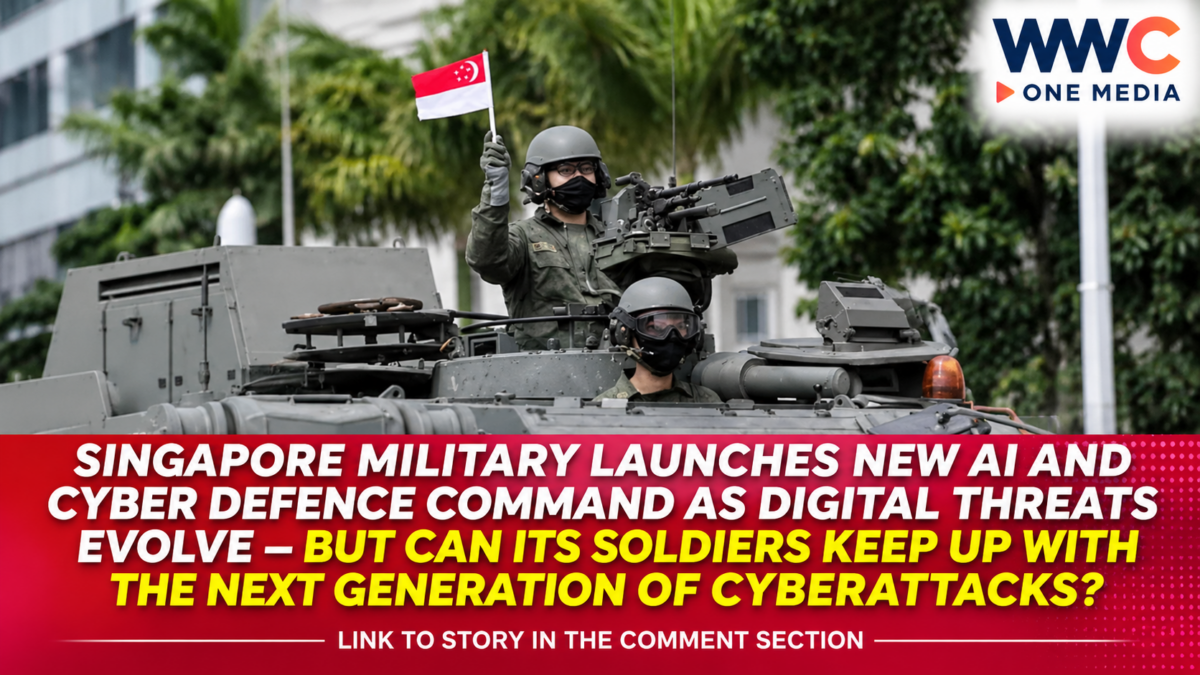
SINGAPORE — Singapore is strengthening its military’s ability to confront the next generation of digital threats, launching a new training command designed to prepare soldiers and intelligence specialists for an increasingly complex world of cyberattacks, artificial intelligence and information warfare.
The Singapore Armed Forces (SAF) officially inaugurated its Digital and Intelligence Service Training Command, known as DTCOM, on Friday, November 6, at Bukit Panjang Camp.
The new command consolidates specialist training under the SAF’s Digital and Intelligence Service (DIS), the military’s fourth service.
Its mission is to develop personnel capable of operating across six critical domains: intelligence, cybersecurity, digital technology, military communications systems, electronic protection and information defence.
But the real challenge is not simply teaching soldiers how to use today’s technology. It is preparing them for threats and technologies that may look completely different tomorrow.
That warning came from Major-General Lee Yi-Jin, chief of the Digital and Intelligence Service, who emphasized that professional expertise can become outdated quickly as technology advances.
The initiative comes as Singapore expands its national cybersecurity strategy and invests in artificial intelligence to strengthen digital defence.
For a highly connected nation that relies on digital systems across government, commerce and essential services, the stakes extend well beyond conventional military operations.
And one major question now emerges: Can Singapore train its digital defenders quickly enough to keep pace with increasingly sophisticated cyber threats?
Singapore’s SAF Opens New Digital and Intelligence Training Command
The inauguration ceremony was held at Bukit Panjang Camp on November 6.
Major-General Lee Yi-Jin officiated at the event and presented the command symbol to its commander, Military Expert 7 Steven Lim.
The establishment of DTCOM marks another stage in the development of Singapore’s Digital and Intelligence Service.
Rather than creating an entirely separate military service, the new command brings existing training entities together under a more coordinated structure.
The Ministry of Defence (MINDEF) says the arrangement will strengthen professional development throughout a service member’s career.
Training will extend from foundational knowledge to advanced specialist skills and leadership development.
This is significant because cyber and digital defence require continuous technical learning.
Military personnel cannot depend solely on the expertise they acquired when they first entered service.
New systems, software vulnerabilities and operational methods can emerge rapidly.
DTCOM is intended to ensure that SAF personnel continue developing their skills as those changes occur.
Why Singapore Is Treating Digital Expertise as a Military Priority
Modern military operations depend heavily on information.
Commanders need reliable communications.
Intelligence specialists need accurate information about potential threats.
Cyber defenders must protect sensitive networks and systems.
Electronic protection specialists help safeguard military capabilities against interference and disruption.
If these systems are compromised, the consequences can extend beyond the digital environment.
Poor information can affect operational decisions.
Disrupted communications can reduce coordination.
Cyber intrusions can threaten the availability or integrity of important systems.
These risks help explain why the SAF established the Digital and Intelligence Service as its fourth service.
The DIS works alongside the Army, Navy and Air Force to strengthen the military’s overall operational effectiveness.
The new training command is designed to support that responsibility by developing personnel with deeper technical expertise.
Its role is primarily educational and operational-readiness focused, not the direct command of every SAF cyber operation.
The Six Critical Domains of Singapore’s New Training Command
According to MINDEF, DTCOM will provide training across six specialist areas.
1. Intelligence
Personnel will learn to collect, evaluate and interpret information to support military planning and decision-making.
This includes understanding developments that could affect Singapore’s security.
2. Cybersecurity
Cyber defenders will receive training to help identify, assess and respond to threats affecting military digital systems and networks.
3. Digital
Personnel will develop capabilities involving software, data and emerging technologies that can improve military operations.
4. Command, Control, Communications and Computers (C4)
Specialists will train in systems that help commanders communicate, coordinate forces and make informed decisions.
5. Electronic Protection
Training will support the protection of military capabilities against threats involving the electromagnetic environment.
6. Information Defence
Personnel will develop capabilities relevant to understanding and responding to threats in the information environment.
Together, the six domains reflect the expanding role of technology in national defence.
They also show why the military needs specialists with different skills working toward common operational objectives.
AI Could Transform How Singapore Detects Emerging Threats
One of the most important developments is the planned Intelligence Technology and Analysis School.
The school is expected to be established in 2027.
Its curriculum will teach personnel how to use digital and artificial intelligence technologies to support intelligence analysis.
According to MINDEF’s fact sheet, the training will cover technologies such as cloud computing, big data, AI models and automation.
The objective is to help intelligence specialists examine large volumes of information and identify potential security threats more effectively.
For example, AI-assisted analysis may help analysts identify patterns within complex datasets.
Automation may also reduce the time spent processing routine information.
But these technologies introduce their own risks.
AI systems can produce inaccurate conclusions or misleading outputs.
Intelligence analysis therefore still requires professional judgment and verification.
The new school is intended to develop the expertise needed to use these technologies responsibly and effectively.
It does not mean Singapore has announced that AI will independently make military decisions.
Joint Intelligence School to Strengthen Strategic Analysis
Another school planned for 2027 is the Joint Intelligence School.
It will train intelligence professionals to assess geopolitical developments and their potential implications for Singapore.
The school will also strengthen collaboration among personnel from different parts of the SAF.
This is particularly important because military intelligence rarely concerns a single service.
Developments affecting maritime security may also influence air operations and broader defence planning.
Regional political tensions can have implications for multiple military domains.
By developing a common understanding of strategic and operational challenges, joint intelligence training can support better coordination.
The programme will emphasize analytical judgment, leadership and an understanding of the wider security environment.
These are capabilities that remain important even as artificial intelligence becomes more sophisticated.
Cyber Defence School Will Prepare Specialists for Evolving Threats
The SAF’s Cyber Defence School is another important component of DTCOM.
It trains personnel for deployment to cyber defence entities across MINDEF and the SAF.
These include defence cyber experts, cyber specialists, digital specialists and other technically trained personnel.
The school’s mission involves developing practical capabilities for identifying and responding to cyber threats.
Training also supports the protection of military systems and networks.
This does not mean all cyber incidents in Singapore are the responsibility of the military.
National cybersecurity involves multiple agencies and organizations.
The Cyber Security Agency of Singapore has responsibilities that extend across the national cybersecurity ecosystem.
The DIS, meanwhile, focuses on military digital and intelligence capabilities and contributes to broader national cyber defence.
Coordination between these different organizations is important because cyber threats do not necessarily respect institutional boundaries.
Singapore’s National Cybersecurity Strategy Is Also Becoming More AI-Focused
The DTCOM launch follows a major national cybersecurity announcement in October.
On October 13, Senior Minister and Coordinating Minister for National Security K Shanmugam unveiled Singapore’s third cybersecurity strategy.
The strategy emphasizes earlier threat detection, stronger coordination and greater use of artificial intelligence in cyber defence.
Singapore plans to evaluate and adapt existing AI models rather than build a unique model for every possible application.
The government is also strengthening capabilities to detect vulnerabilities before they are exploited.
This includes using AI-enabled tools to support national cyber defence operations.
The national strategy and the SAF’s new training command are separate initiatives.
However, both reflect recognition that digital threats are evolving rapidly.
Technology can assist defenders in identifying suspicious activity and processing large amounts of information.
But it can also give malicious actors additional capabilities.
That creates growing pressure on organizations to improve security processes and workforce expertise.
Recent Singapore Cybersecurity Incidents Show Why Digital Resilience Matters
The importance of digital security has become increasingly visible through public cybersecurity disclosures.
In November, Singapore reported that government and critical information infrastructure systems had shown no evidence of exploitation involving certain recently disclosed PHP software vulnerabilities.
However, Senior Minister of State Tan Kiat How warned organizations against waiting for an attack before strengthening their defences.
As WWC ONE MEDIA reported in its coverage of the PHP cybersecurity warning, authorities emphasized vulnerability management, monitoring and preventive security measures.
The PHP issue has not been linked to the establishment of DTCOM.
Nevertheless, it demonstrates why cybersecurity expertise must remain current.
A previously secure system can become vulnerable when new weaknesses are discovered.
Defenders need the skills to assess threats, prioritize responses and understand the consequences of technical failures.
The challenge extends across both civilian and military organizations.
Singapore’s Healthcare Data Breaches Highlight a Wider Security Challenge
Recent incidents involving Singapore’s healthcare sector have also placed cybersecurity under greater public scrutiny.
In October, healthcare administrator Alliance Medinet disclosed a data breach affecting approximately 110,000 members.
As WWC ONE MEDIA reported in its coverage of the healthcare data breach, the incident raised concerns about personal information handled by third-party service providers.
The incident was separate from military networks and the SAF’s training programme.
There is no evidence linking the breach to DTCOM’s establishment.
However, it illustrates how important secure information systems have become in everyday life.
Healthcare organizations, financial institutions, telecommunications providers and government agencies all depend on reliable digital infrastructure.
Each sector has different responsibilities and security requirements.
But all face the need to identify vulnerabilities and train qualified personnel.
Singapore’s military training initiative forms part of a broader national environment in which technical expertise has become increasingly important.
MoneySmart Breach Adds to Concerns About Singapore’s Digital Security
Financial technology companies face similar challenges.
MoneySmart disclosed in early November that an unauthorized third party had accessed its internal systems and copied information relating to customers in Singapore and Hong Kong.
As WWC ONE MEDIA reported in its November 4 coverage of the MoneySmart breach, the incident raised concerns over how exposed information could potentially be misused.
Again, there is no established connection between that incident and the new SAF training command.
The relevance is broader.
Digital security increasingly depends on specialized personnel who can understand emerging threats, investigate incidents and improve defensive practices.
The need for ongoing training is therefore not limited to government or the armed forces.
It affects businesses throughout Singapore’s economy.
Intelligence Analysts Will Learn to Use Open-Source Information
DTCOM will also include an Open-Source Training Wing.
Its purpose is to train personnel to gather, evaluate and analyze information that is publicly available.
Open-source intelligence can involve news reports, official statements, public databases, imagery and other accessible material.
Such information can help analysts build a clearer picture of security developments.
But publicly available information is not necessarily accurate.
Analysts must consider whether sources are credible, whether information has been manipulated and how different reports fit together.
The training therefore involves critical thinking and professional judgment.
This is particularly relevant in an information environment where AI-generated material and misleading online content can complicate analysis.
However, DTCOM’s official announcement does not claim that its open-source training will eliminate misinformation or prevent every form of information manipulation.
Its stated purpose is to improve the SAF’s ability to gather and interpret information effectively.
President Tharman’s DIS Visit Provides Additional Context
Three days before DTCOM’s inauguration, President Tharman Shanmugaratnam visited the DIS Open Source Unit.
According to MINDEF, the November 3 visit included briefings on intelligence operations and demonstrations of monitoring capabilities.
The unit supports SAF situational awareness by following developments involving military and security issues, as well as natural disasters in the region.
President Tharman also met full-time national servicemen and operationally ready national servicemen involved in the work.
He emphasized that digital threats were likely to grow in frequency, scale and sophistication.
His remarks provide additional context for the importance Singapore’s leadership places on digital defence.
However, his visit was a separate event.
It should not be interpreted as evidence of an undisclosed attack or emergency that caused DTCOM to be launched.
National Servicemen Will Also Receive More Specialized Training
The new command will not focus only on full-time military professionals.
Operationally ready national servicemen, or NSmen, will also benefit from structured training and opportunities to develop their technical skills.
This is significant because Singapore’s defence model relies heavily on national service.
Personnel may spend periods away from full-time military duties while technology continues evolving.
When they return for operational commitments, their skills must remain relevant.
DTCOM is intended to support that continuing development.
Training will help personnel refresh existing competencies and learn about new technologies.
The programme could also draw on experience that NSmen gain in their civilian careers.
Many work in industries where software, data analysis and cybersecurity are already important.
However, the specific ways civilian expertise will be incorporated depend on the training programmes and operational requirements.
The official announcement does not establish that every NSman will receive advanced AI or cyber warfare training.
ASCEND Will Connect Military Training With Universities and Industry
Another major component of the new command is the Advanced School for Continuous Education and Development, or ASCEND.
The institution is designed to support professional learning beyond formal military training courses.
It will work with institutes of higher learning, industry partners, technology companies and foreign partners.
The objective is to give DIS personnel opportunities to deepen their technical knowledge throughout their careers.
That matters because universities and technology companies often develop expertise in rapidly changing fields.
Collaboration can help military personnel remain informed about new technologies and professional practices.
ASCEND’s approach also recognizes that learning should not end when a soldier completes an initial training programme.
In digital defence, skills may need regular updating.
The command aims to create a more structured system for that process.
Could AI Make Cyberattacks Harder to Defend Against?
Artificial intelligence is creating both opportunities and risks in cybersecurity.
Defenders can use AI to analyze large quantities of data, identify unusual activity and support security assessments.
Attackers may also exploit AI to increase the speed or scale of malicious activity.
That creates a difficult technological contest.
Improvements in defensive systems can be followed by changes in offensive techniques.
New vulnerabilities can emerge as organizations introduce additional software and connected devices.
But it would be misleading to claim that AI has made conventional cybersecurity expertise obsolete.
Human specialists remain important for understanding context, evaluating evidence and making decisions about appropriate responses.
That is why DTCOM’s focus on professional development is important.
The objective is not simply to introduce more AI tools.
It is to train personnel who understand how those tools work, where they are useful and when their conclusions require scrutiny.
What Happens When the New Schools Open in 2027?
MINDEF says additional training schools and units will be established progressively in 2027.
These include the Intelligence Technology and Analysis School and the Joint Intelligence School.
Their development will expand the training opportunities available to DIS personnel.
The success of DTCOM will depend on whether it can maintain relevant curricula, develop capable instructors and adapt to technological change.
Military expertise cannot be measured solely by the number of training institutions established.
The more important questions concern readiness, practical skills and the ability to support real operational requirements.
MINDEF has not announced a specific budget, total student capacity or numerical recruitment target for the new command in the reviewed material.
Those figures should not be invented or presented as confirmed.
The Bigger Picture: Singapore’s Defence Future Is Increasingly Digital
The launch of DTCOM reflects a broader transformation in military operations.
Traditional military capabilities remain essential.
Aircraft, warships and ground forces continue to play important roles in national defence.
But their effectiveness increasingly depends on digital systems, communications, intelligence and information security.
The SAF’s Digital and Intelligence Service is intended to strengthen those capabilities across the wider military.
The new training command adds a more coordinated approach to developing the personnel responsible for them.
Its emphasis on cybersecurity, artificial intelligence, geospatial analysis and continuing education reflects the changing nature of military expertise.
For Singapore, the long-term challenge is to remain prepared for threats that may evolve faster than conventional training programmes.
The Bottom Line: Singapore Is Training for a Digital Battlefield That Keeps Changing
The Singapore Armed Forces has launched a new Digital and Intelligence Service Training Command to strengthen military expertise in cyber defence, artificial intelligence and intelligence analysis.
Inaugurated on November 6 at Bukit Panjang Camp, DTCOM will coordinate training across six specialist domains.
The command will support professional development from foundational training through advanced technical and leadership courses.
Additional schools are planned for 2027.
The initiative will also support operationally ready national servicemen and strengthen cooperation with universities and industry partners.
MINDEF says the objective is to maintain an adaptable workforce capable of supporting the wider SAF.
The announcement reflects growing recognition that digital threats and technologies change rapidly.
But the new command is not evidence of a specific cyberattack against Singapore’s military.
It is a long-term investment in training, professional expertise and operational readiness.
And as Singapore prepares its soldiers to confront a future shaped by artificial intelligence, cyber threats and increasingly complex information systems, one question now stands above the rest: Will the SAF’s new training command keep its digital defenders ahead of tomorrow’s threats—or could the next technological breakthrough force Singapore to rethink its military preparedness all over again?