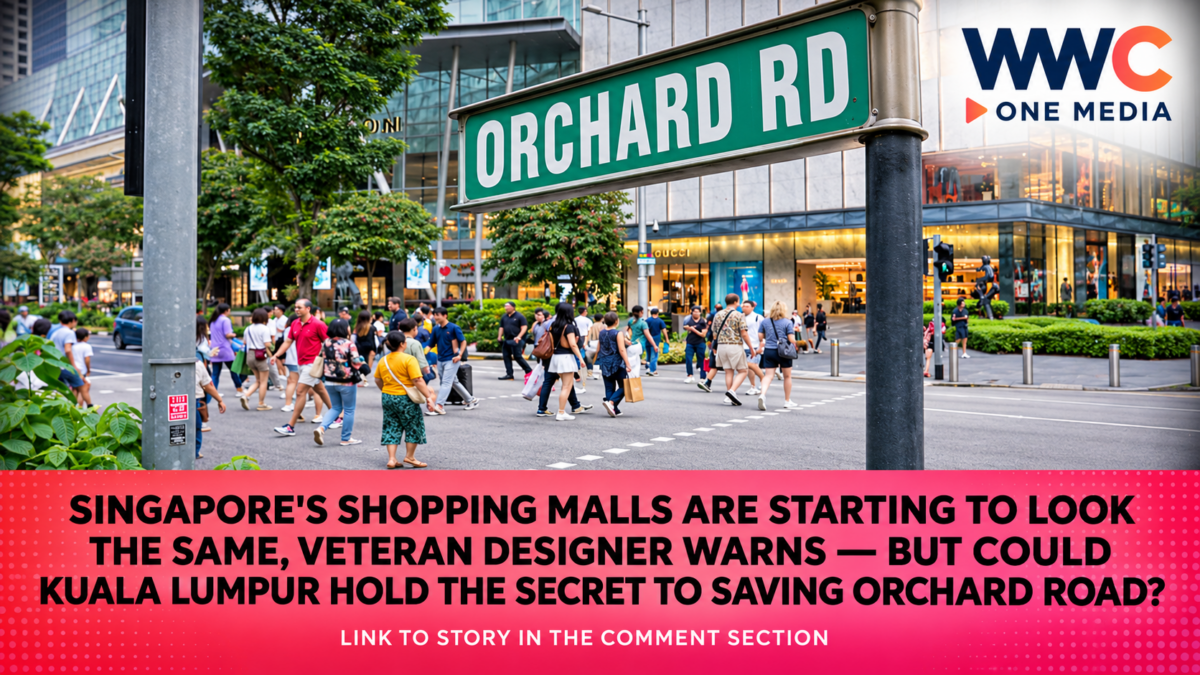
SINGAPORE — Singapore has built a global reputation for its shopping destinations, from the luxury boutiques of Orchard Road to the sprawling suburban malls that serve millions of residents.
But behind the polished storefronts, air-conditioned corridors and familiar international brands, an uncomfortable question is emerging.
Have Singapore’s shopping malls become so similar that shoppers are running out of reasons to visit them?
Veteran interior designer Mike Lim believes the country’s retail industry is facing an identity problem.
The 59-year-old, who leads DP Design, the interior design arm of DP Architects, says too many shopping centres offer comparable layouts, tenant mixes and experiences.
His warning comes as Singapore’s retail property market undergoes major changes driven by online shopping, evolving consumer behaviour and growing competition among physical retail destinations.
But rather than predicting the death of shopping malls, Lim believes their future could be brighter—provided developers rethink what these buildings are actually for.
His solution is simple but potentially transformative.
The shopping mall of the future must become a place where people want to spend time, even when they have nothing to buy.
And the inspiration may already be emerging across the border in Kuala Lumpur.
Singapore’s Shopping Mall Identity Crisis
In an interview with CNA Luxury published on November 7, Lim argued that Singapore’s retail sector has become increasingly homogeneous.
Many shopping centres, he believes, are competing with similar designs and familiar retail offerings rather than creating memorable identities.
Lim has spent approximately 25 years working on interior design projects.
His portfolio includes The Dubai Mall in the United Arab Emirates and The Exchange TRX in Kuala Lumpur, alongside Singapore projects involving Wisma Atria, The Heeren, 111 Somerset and Paragon.
He joined DP Architects in 2007 and became head of DP Design in 2012.
That experience has given him an international perspective on how successful commercial destinations attract visitors.
For Lim, the fundamental problem is not that Singapore lacks shopping centres.
It is that too many of them provide similar experiences.
When shoppers can find comparable products, restaurants and services across numerous locations, individual malls may struggle to stand out.
The question for developers is whether a conventional combination of shops and dining outlets remains enough.
Lim believes the answer increasingly depends on creating spaces that offer something more meaningful.
Are There Too Many Shopping Malls in Singapore?
The debate has already attracted attention from property analysts.
In a separate June 2026 investigation, CNA reported that Singapore had approximately 424 listed malls, based on an assessment cited by urban strategist Calvin Chua.
However, that figure is not an official government count.
It includes a broad range of developments, including some relatively small retail properties.
The same investigation cited approximately 69 million square feet of public and private retail net lettable space in the country during the first quarter of 2026.
Yet industry specialists cautioned against interpreting those figures as proof that Singapore’s retail market is uniformly oversupplied.
Prime shopping malls remain attractive to tenants.
Locations with strong transport connections and carefully selected retail offerings can continue generating substantial demand.
The challenges are more pronounced for properties that lack a distinctive identity or an obvious reason for customers to return.
In other words, the central problem may not be the number of malls.
It may be the mismatch between what consumers increasingly want and what some shopping centres continue offering.
Why Kuala Lumpur’s Ombak KLCC Went Viral
One of the clearest examples of Lim’s design philosophy is Ombak KLCC in Kuala Lumpur.
The six-storey retail podium opened in August 2026 and attracted attention on social media because of its dramatic architectural interior.
Rather than relying on conventional stacked retail floors, Ombak KLCC features an open atrium surrounded by flowing, curved forms.
The design takes inspiration from the terraced tea plantations of Cameron Highlands.
Its levels recede as the building rises, creating striking views through the interior.
Natural light enters through the skylight, while the atrium functions as a place for people to gather and experience the building.
Lim also incorporated ideas associated with gotong-royong, the Malay concept of communal cooperation.
The central gathering space recalls the open areas of traditional villages where residents meet, socialize and participate in community activities.
For Lim, the enthusiastic response to Ombak KLCC demonstrates that shopping-mall design can generate excitement beyond conventional retail offerings.
Visitors may come to admire the architecture, take photographs, meet friends or participate in events.
Shopping remains part of the experience.
But it is no longer the only attraction.
The Exchange TRX Offers Another Model for Future Malls
Lim’s work on The Exchange TRX provides a different example.
The major Kuala Lumpur retail development forms part of a larger mixed-use precinct.
Its design incorporates landscaped public areas, pedestrian connections and spaces intended for social interaction.
One notable feature is a grand staircase connecting a sunken courtyard to the development’s rooftop park.
The arrangement encourages movement between different areas rather than confining visitors to enclosed retail corridors.
The rooftop park also accommodates Apple’s flagship store.
For Lim, the project demonstrates the importance of connecting commercial spaces with areas that people can enjoy without necessarily purchasing anything.
Ombak KLCC and The Exchange TRX have distinct architectural identities.
That distinction is central to his argument.
Successful shopping destinations do not need to follow one design formula.
They can respond to their locations, cultural influences and intended communities.
The objective is to create an experience visitors remember.
Singapore’s Orchard Road Faces a Difficult Reinvention
Lim is particularly concerned about the future of Orchard Road.
For decades, the famous boulevard has been one of Singapore’s leading shopping and tourism destinations.
But the rise of suburban malls and competing lifestyle precincts has changed the retail landscape.
Residents no longer need to travel downtown for many familiar brands, restaurants and everyday services.
Modern transport connections make shopping destinations throughout Singapore accessible.
Meanwhile, online platforms offer another convenient alternative to physical retail.
Lim believes Orchard Road has struggled to distinguish itself sufficiently from newer developments.
He argues that the area needs a stronger identity built around its history, streetscape and public experiences.
His proposals include more car-free events, cultural festivals, outdoor activities and coordinated initiatives involving mall operators.
He also suggests using landscaping and historical references to reinforce Orchard Road’s character.
Rather than treating each mall as a separate enclosed building, he wants developers to think about the entire boulevard as a connected destination.
That could involve restaurants extending into outdoor spaces, improved pedestrian connections and public areas designed to encourage visitors to linger.
Why Breaking Down the Traditional Mall Could Change Everything
One of Lim’s most important ideas is the need to connect indoor and outdoor environments.
Traditional shopping centres often operate as inward-facing buildings.
Visitors enter, move between shops and leave.
Lim believes future developments should encourage a more natural relationship with surrounding streets, parks and public spaces.
He points to his work on Wisma Atria.
During its 2012 renovation, steps were introduced along the Orchard Road-facing frontage.
The design addressed flood-protection requirements while creating a more welcoming transition between the mall and pedestrian boulevard.
The steps also became an informal gathering place.
A practical architectural feature gained an additional social purpose.
For Lim, this illustrates how thoughtful design can make retail developments more connected to the communities surrounding them.
It also shows that successful placemaking does not always require an entirely new building.
Existing properties can be improved through carefully designed public spaces and better connections with their surroundings.
More Than 60% of Older Adults Visit Suburban Malls Every Week
A major study provides evidence that shopping centres are already functioning as social spaces.
Research released in April 2026 by Frasers Property Singapore and Singapore Management University’s Centre for Research on Successful Ageing found that more than six in ten older adults surveyed visited suburban shopping malls at least once a week.
The research drew on a survey sample of 2,013 respondents aged 48 and above.
Dining was a major attraction, with approximately 77% citing it as a reason for visiting.
More than half engaged in activities such as window shopping.
Convenient public transport was important to approximately 69% of respondents.
The findings suggest that shopping centres serve a broader purpose than commercial transactions.
They provide accessible places where people can meet friends, complete errands, enjoy meals and maintain social connections.
This role may become increasingly important as Singapore’s population ages.
According to national demographic projections cited by SMU, approximately one in four Singaporeans could be aged 65 or above by 2030.
For mall operators, the findings create a potential opportunity.
Designing comfortable seating areas, accessible walkways and appropriate community activities may help strengthen relationships with older visitors.
However, the study does not prove that every community-focused investment will automatically increase retail profits.
Commercial success still depends on costs, tenant demand and the effectiveness of individual projects.
The Mall of the Future Could Include Libraries, Gardens and Wellness Centres
Lim believes developers should expand the definition of what belongs inside a shopping mall.
His suggestions include public libraries, community gardens, wellness facilities, sports spaces and cooking studios.
A public swimming pool could operate alongside a commercial gym.
A community garden could complement a restaurant focusing on fresh ingredients.
A cooking studio could host sessions with professional chefs.
Young designers and entrepreneurs could receive opportunities to operate temporary boutiques.
Public exhibitions and cultural performances could bring additional activity to common areas.
These ideas are not announcements of confirmed developments.
They are design proposals intended to encourage more flexible use of retail space.
Their underlying principle is that malls should provide reasons for repeated visits beyond purchasing products.
For younger shoppers, those reasons might involve events, entertainment and social experiences.
For families, they might include educational activities or recreational facilities.
For older visitors, comfortable gathering areas and accessible services could be particularly valuable.
The challenge is balancing those different needs while maintaining commercial viability.
Singapore’s Government Is Encouraging Community-Focused Commercial Design
The transformation is not being driven solely by architects and developers.
Singapore’s Urban Redevelopment Authority already has planning provisions supporting community-oriented facilities in commercial developments.
Under the Community and Sports Facilities Scheme, qualifying commercial projects may receive bonus gross floor area for eligible community or sports uses.
The additional space is subject to specific conditions and limits.
The scheme is intended to encourage compatible community facilities in accessible commercial locations.
Singapore also has guidelines for privately owned public spaces, which can support pedestrian connections, informal gathering and other public functions within private developments.
These arrangements demonstrate that urban planning can help integrate commercial activity with broader community needs.
However, not every proposed public facility automatically qualifies for development incentives.
Eligibility depends on the specific scheme, approved uses and planning requirements.
For developers, the question is how to use such opportunities to create spaces that benefit both businesses and the public.
Odeon 331 Shows How an Office Development Can Become a Community Space
Lim highlights Odeon 331 as another example of successful placemaking.
The Singapore development incorporates a naturally ventilated ground-floor lobby designed to function like an urban park.
Its greenery, open circulation and distinctive bird-shaped benches encourage people to stop and spend time.
The space was not designed exclusively for office tenants.
According to Lim, students, families and other members of the public have begun using the area.
The result is a space that connects the building with the surrounding neighbourhood.
For developers, this demonstrates how public-oriented design can create value beyond a building’s original commercial function.
For visitors, it offers a comfortable place to meet or rest.
For the neighbourhood, it creates a more welcoming pedestrian environment.
The example supports Lim’s broader argument that successful commercial design should consider how people actually use urban spaces.
Singapore’s S$160-Million Mall Revamp Shows the Industry Is Already Changing
Major Singapore property owners are already investing in new approaches to retail.
CapitaLand Integrated Commercial Trust is undertaking a S$160 million combined renovation of Plaza Singapura and The Atrium@Orchard.
The project is being carried out in phases from 2026 to 2028.
Plans include upgraded retail areas, dining concepts, greenery and stronger pedestrian connections.
At Plaza Singapura, proposed changes include landscaped dining areas near the Orchard Road entrance and enhanced connections with surrounding public spaces.
The project illustrates how existing malls are being repositioned around experiences rather than conventional retail alone.
As previously reported by WWC ONE MEDIA in its coverage of Singapore’s major mall redevelopment projects, property owners are exploring combinations of retail, hospitality, residential, office and lifestyle uses.
These projects reflect confidence that physical retail still has a future.
But they also involve considerable financial risk.
Construction costs, temporary disruption and uncertain consumer demand can affect investment returns.
Marina Square’s Redevelopment Could Change the Meaning of a Shopping Mall
Marina Square provides another example of Singapore’s evolving retail landscape.
The long-established shopping complex is scheduled to close on March 31, 2027, for a major redevelopment.
Plans include residential, hospitality, office and retail components alongside additional public spaces.
The redevelopment reflects a wider movement toward mixed-use destinations that generate activity throughout the day.
Rather than relying primarily on visitors arriving to shop, developers hope to attract residents, office workers, hotel guests and people attending leisure activities.
But the transformation also has human consequences.
Existing retailers may need to relocate or close temporarily.
Employees face uncertainty.
And customers can lose familiar places that have become part of their daily routines.
As WWC ONE MEDIA reported in its story about a Marina Square café popular with elderly customers, commercial redevelopment can disrupt spaces with significant community value.
That creates a challenge for the future of retail property.
Developers must decide how to modernize buildings without losing the relationships and experiences that made them important to visitors.
Could Orchard Road’s Historic Buildings Become Its Greatest Advantage?
Another opportunity lies in Orchard Road’s architectural and cultural heritage.
Singapore is preparing to redevelop the former Singapore Chinese Girls’ School site at 37 Emerald Hill.
The government launched a tender in September 2026 seeking proposals that combine heritage conservation with hospitality, lifestyle activities and publicly accessible spaces.
The site contains historic buildings that must be preserved.
As WWC ONE MEDIA reported on the proposed Orchard Road lifestyle destination, the project could introduce a distinctive attraction that combines historical character with modern visitor experiences.
That approach aligns with Lim’s argument that retail precincts should develop stronger identities.
Rather than creating another conventional commercial centre, developers can use local history and architecture to distinguish a destination.
But the project remains at the tender stage.
Its eventual design, commercial performance and completion date will depend on the selected proposal and subsequent approvals.
Shopping Mall Redesign Is Also a Major Investment Question
The retail industry’s transformation is not purely about architecture.
It also concerns property valuations, rental income and long-term investment performance.
Singapore’s real estate investment trusts own major shopping properties.
For those investors, mall renovations can potentially support higher rents, stronger occupancy and greater customer activity.
But those benefits must be balanced against renovation costs.
As WWC ONE MEDIA explained in its analysis of Singapore’s major mall makeovers and investor returns, expensive improvements do not guarantee stronger distributions to investors.
A property owner could attract more visitors while still facing increased maintenance or financing costs.
Similarly, a more attractive building may struggle financially if its tenant mix fails to match the local market.
For developers, the challenge is to measure both commercial and social outcomes.
A successful mall should attract customers and maintain viable businesses.
But it may also need to create public value through accessibility, community programming and better urban connections.
Could Kuala Lumpur Be Showing Singapore the Next Generation of Retail?
The success of Ombak KLCC and The Exchange TRX has given Lim confidence in his approach.
Both projects demonstrate how distinctive design can encourage public interest.
But they also show that there is no universal formula for successful shopping centres.
One project uses dramatic curved architecture and an open atrium.
Another combines multiple retail areas with landscaped public connections.
The important principle is that the design responds to the surrounding environment and its visitors.
Singapore’s developers could learn from those examples without copying them.
A neighbourhood mall serving families may need different facilities from a luxury shopping destination.
A development near a transport interchange may focus on accessibility and convenience.
An Orchard Road property may benefit from tourism, heritage and cultural programming.
The future could depend on understanding those differences instead of treating every shopping centre as another collection of retail units.
The Bigger Picture: Shopping Centres Must Offer What E-Commerce Cannot
Online shopping has fundamentally changed retail competition.
Consumers can purchase an enormous range of products without leaving home.
Price comparisons, delivery services and digital payments have made that process increasingly convenient.
For physical shopping centres, competing solely on product availability is becoming harder.
But online platforms cannot fully replicate the experience of meeting friends, attending performances, enjoying public spaces or participating in community activities.
That creates a potential advantage for physical retail destinations.
According to industry experts interviewed in CNA’s June investigation, successful malls increasingly need to operate as experience-focused destinations rather than simply as landlords collecting rent from shops.
The strategy requires developers to think about the entire visitor experience.
Architecture, tenant selection, cultural activities, accessibility and public space all influence whether people want to return.
Lim’s ideas fit within that broader shift.
He is not proposing that Singapore abandon shopping malls.
He is arguing that they must evolve beyond shopping.
The Bottom Line: Singapore’s Shopping Malls May Need a New Identity to Stay Relevant
Singapore’s retail landscape is entering a period of significant transformation.
Veteran designer Mike Lim believes too many shopping centres have become similar in appearance and purpose.
His work on Ombak KLCC and The Exchange TRX demonstrates how distinctive architecture and community-focused spaces can create memorable destinations.
Research by Frasers Property Singapore and SMU supports the idea that malls already play an important social role, particularly among older adults.
Meanwhile, major redevelopment plans involving Plaza Singapura, Marina Square and Orchard Road show that property owners and government agencies are exploring new approaches.
But the challenges remain substantial.
Developers must balance public spaces with rental income.
Retailers must attract customers in an increasingly digital market.
And investors must determine whether major renovations can produce sustainable financial returns.
For Lim, the most important opportunity is to make Singapore’s malls feel different from one another again.
That means creating places that reflect their communities rather than repeating familiar retail formulas.
And as Singapore spends hundreds of millions of dollars transforming its shopping destinations, one question could decide the future of its retail industry: Will developers create vibrant new places where people genuinely want to gather—or will another generation of expensive, lookalike shopping malls struggle to win back the customers they have lost?