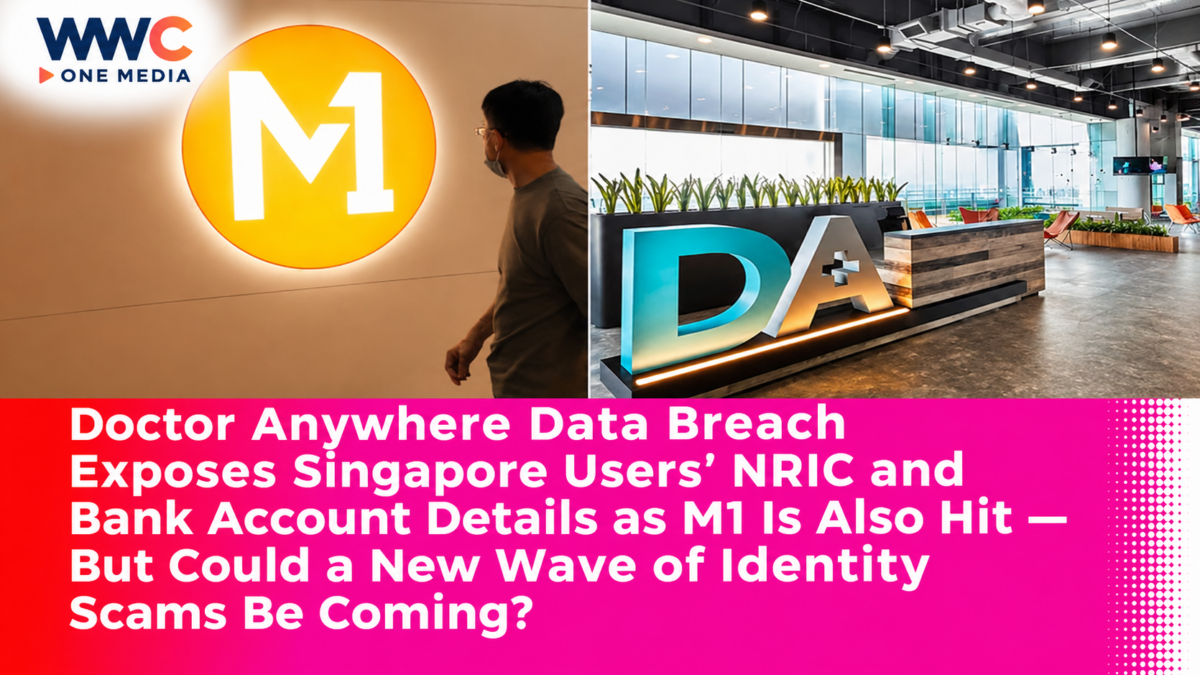
SINGAPORE — Thousands of Singaporeans rely on digital healthcare services and telecommunications providers to manage sensitive personal information. But two separate cybersecurity incidents disclosed on November 6 have raised fresh concerns about how safely that information is being protected.
Telemedicine provider Doctor Anywhere has confirmed that personal data belonging to some users was leaked following unauthorized access to its systems by an unidentified third party.
On the same day, telecommunications operator M1 disclosed a separate breach involving customers’ names, identification numbers, dates of birth and contact details.
The two incidents have highlighted a disturbing possibility: Criminals may not need access to passwords or medical records to create convincing identity scams.
Doctor Anywhere said its clinical records were not affected. M1 said customers’ banking information, payment-card details and account access remained secure.
However, additional reporting by The Straits Times and The Business Times revealed that some Doctor Anywhere customers had been informed of exposure involving identification and bank account information.
The developments have intensified questions about customer privacy, cybersecurity safeguards and the risks surrounding personal information stored by healthcare and telecommunications businesses.
And one important question remains unanswered.
How many people were actually affected?
Doctor Anywhere Confirms Malicious Cyber Incident
Doctor Anywhere disclosed the breach on Friday, November 6.
The Singapore-based healthcare company said an unknown third party had gained unauthorized access to its systems, resulting in the exposure of users’ personal data.
The company characterized the incident as malicious and said it immediately took steps to address the security problems.
Doctor Anywhere did not initially disclose the number of customers affected or identify the exact information involved.
It explained that its investigation was continuing.
However, an email sent to affected customers and reviewed by The Straits Times provided additional details.
According to that reporting, Doctor Anywhere became aware of the breach on October 29.
The exposed personal information included names, email addresses, identity card or passport numbers, dates of birth, emergency contact details and bank account information.
Those details are especially sensitive because they could potentially be combined to impersonate individuals or make fraudulent communications appear authentic.
But the available evidence does not establish that the exposed information has already been used in scams.
The distinction is important.
A data breach creates a risk of misuse; it does not automatically prove that identity theft or financial fraud has occurred.
What Personal Information Was Exposed?
According to customer notifications reviewed by Singapore media and an advisory published by Income Insurance concerning Doctor Anywhere subsidiary Adept Health, the potentially affected information includes:
- Full names and email addresses.
- NRIC, FIN or passport numbers.
- Dates of birth and contact information.
- Emergency contact details.
- Residential addresses and other personal particulars.
- Certain insurance or corporate-benefit information.
- Bank names and bank account numbers.
The exact combination of exposed information may differ between affected individuals.
Doctor Anywhere reportedly told customers that its investigation had found no evidence of compromised passwords, login credentials, payment-card details or images of identity documents.
The company also stated that clinical records were unaffected.
These assurances are significant, but they should be understood precisely.
A bank account number is different from an online banking password.
Exposure of an account number does not establish that criminals can access the account or transfer money.
However, such information may still be valuable in impersonation attempts, especially when combined with a person’s name, identification number and contact details.
Customers should therefore take the breach seriously without assuming that every sensitive item in their accounts has been stolen.
Doctor Anywhere Says Clinical Records Were Not Affected
One of the most important parts of Doctor Anywhere’s statement concerned the security of medical information.
The company said its investigation had found that all clinical records were unaffected by the incident.
That means the company has not reported unauthorized access to its patients’ clinical histories, diagnoses or treatment records.
However, the absence of exposed clinical records does not eliminate the privacy implications.
Personal identification information can still reveal sensitive details about a person.
Furthermore, some individuals use Doctor Anywhere through corporate healthcare-benefit arrangements.
Information about insurance coverage or employee benefits may create additional privacy concerns if improperly accessed.
The company has not publicly confirmed the full number of affected users.
As its forensic investigation continues, customers should rely on official notices for information about their individual exposure.
Ensign InfoSecurity Called In to Investigate
Doctor Anywhere engaged independent cybersecurity and forensic specialist Ensign InfoSecurity to examine the incident and support improvements to its technology infrastructure.
According to the healthcare provider, Ensign validated the security fixes introduced by Doctor Anywhere’s information technology team.
By October 30, the specialist had confirmed that identified vulnerabilities had been secured.
This is an important containment measure.
However, fixing identified vulnerabilities does not necessarily answer every question about an earlier intrusion.
Investigators must still determine how the attacker entered the system, what information was accessed and whether any additional risks remain.
Doctor Anywhere has reported the incident to Singapore’s Personal Data Protection Commission (PDPC) and filed a police report.
Affected users are being notified.
The company also said its services remain operational and customers can continue receiving medical treatment.
That means the confirmed incident involves data security, not a reported shutdown of the company’s healthcare services.
Adept Health and Corporate Insurance Customers Also Affected
The incident has implications beyond Doctor Anywhere’s direct telemedicine customers.
Adept Health, a Doctor Anywhere subsidiary, provides healthcare-related administration services to corporate clients and other organizations.
Its systems hold selected personal information needed to administer employee healthcare benefits.
Doctor Anywhere said Adept Health had informed organizations it works with about the incident.
Income Insurance published a separate advisory on November 6 confirming that it had been informed by Adept Health on November 2 about unauthorized access involving the Doctor Anywhere system.
Income Insurance said the potentially involved data could include personal particulars, insurance information and bank account details.
The insurer reported no evidence that medical records had been accessed.
It also said there was no indication that Income Insurance’s own systems had been compromised.
That distinction is crucial.
A cybersecurity incident affecting an external administrator does not automatically mean that every business using the administrator suffered a breach of its own infrastructure.
But customers may still be affected because their information was entrusted to the third-party service provider.
M1 Announces a Separate Data Breach on the Same Day
Doctor Anywhere was not the only Singapore company reporting a cybersecurity incident on November 6.
Telecommunications provider M1 disclosed a separate breach involving customer information.
According to M1’s official statement, it identified the incident on October 30 and subsequently contained it.
The affected information included customer names, NRIC or FIN numbers, dates of birth, mobile numbers, email addresses and residential addresses.
M1 said no financial or banking information, payment-card details or customer account access had been compromised.
Its telecommunications services and business operations remained operational.
M1 also began notifying affected customers through email or written correspondence.
The Personal Data Protection Commission confirmed that it was investigating the case.
The simultaneous disclosures have heightened concern about cybersecurity in Singapore.
However, there is no publicly established connection between the Doctor Anywhere and M1 incidents.
They should be reported as separate breaches unless investigators identify evidence linking them.
Why Stolen Personal Data Could Become a Powerful Scam Tool
Names, identification numbers and contact details can appear less dangerous than passwords.
But when combined, they can make fraudulent communications much more convincing.
For example, a scammer might impersonate a healthcare provider and refer to a customer’s real personal details.
The message could claim that an urgent account update is needed, that an insurance reimbursement is pending or that a medical appointment must be verified.
A victim who recognizes accurate personal information might mistakenly believe the communication is legitimate.
The same risk exists with telecommunications customers.
A fraudulent caller who knows a person’s name, phone number and residential address could pretend to represent an account-verification department.
The objective might be to persuade the recipient to reveal additional credentials or authorize a transaction.
These examples describe potential misuse, not confirmed cases involving the November 2026 incidents.
Nevertheless, they explain why companies warn customers to remain cautious after personal-information breaches.
Singapore’s Healthcare Sector Has Already Faced Another Major Breach
The Doctor Anywhere incident follows another cybersecurity disclosure involving healthcare-benefit administration in Singapore.
In October, Alliance Medinet reported unauthorized access to personal information belonging to approximately 110,000 members.
That separate incident affected records associated with several insurers, including HSBC Life, Singlife and Income Insurance.
As WWC ONE MEDIA previously reported on the Alliance Medinet breach affecting 110,000 members, the incident highlighted the vulnerability of sensitive information held by third-party healthcare administrators.
The Alliance Medinet incident is not established to be connected to Doctor Anywhere.
But both cases illustrate a recurring challenge.
Healthcare information is frequently exchanged between insurers, employers, administrators and medical-service providers.
These interconnected arrangements can make services more convenient.
They also create additional locations where personal information must be protected.
The security of a healthcare ecosystem depends on more than the systems operated by the most recognizable company involved.
MoneySmart Data Breach Adds to Singapore’s Cybersecurity Concerns
Earlier in November, Singapore financial comparison platform MoneySmart disclosed that an unauthorized third party had accessed its internal systems and copied customer information.
The incident affected personal information belonging to users in Singapore and Hong Kong.
MoneySmart discovered the breach on October 29 and publicly confirmed the incident on November 3.
As WWC ONE MEDIA reported in its November 4 coverage of the MoneySmart data breach, potentially affected details included identity information, contact details and certain financial-product information.
The incident is separate from those involving Doctor Anywhere and M1.
But the disclosures have occurred close together, increasing public attention on cybersecurity practices.
The events also highlight why organizations holding financial or identity information need effective access controls, monitoring and incident-response procedures.
Cybersecurity is no longer a concern confined to traditional technology companies.
It affects healthcare, finance, travel, telecommunications and almost every sector that processes personal information.
Singapore Airlines Also Reported Exposure Through a Third Party
Another recent incident involved Singapore Airlines.
The airline disclosed that approximately 46,000 booking records had been accessed without authorization through the systems of travel technology provider Amadeus.
The affected information included passenger names, reservation references and travel details.
As WWC ONE MEDIA reported in its coverage of the Singapore Airlines booking-data breach, the airline said its own information technology systems were not compromised.
The case demonstrates another dimension of third-party cybersecurity risk.
Businesses may have secure internal systems while relying on outside providers that process customer information.
If an external provider experiences a security incident, the consequences may still reach the organization’s customers.
Across healthcare, finance and travel, businesses are confronting the same fundamental question.
Who is responsible for protecting personal information when it passes through multiple interconnected systems?
The answer depends on contractual arrangements, legal obligations and the facts of each incident.
But companies cannot assume that outsourcing a service eliminates their need to assess information-security risks.
Singapore’s Cybersecurity Authorities Warn Businesses to Stay Alert
The November breaches coincide with broader warnings about cybersecurity threats.
On November 4, Senior Minister of State Tan Kiat How told Singapore’s Parliament that authorities had found no evidence that certain recently disclosed PHP software vulnerabilities had been exploited in government or critical information infrastructure systems.
However, he stressed the importance of monitoring systems and addressing vulnerabilities.
As WWC ONE MEDIA reported in its coverage of Singapore’s response to the PHP cybersecurity threat, cybersecurity agencies had coordinated with government entities and critical infrastructure operators to strengthen protections.
That software-security issue is not established to be related to the Doctor Anywhere or M1 breaches.
But the broader principle is relevant.
Preventing unauthorized access requires more than responding after a breach is discovered.
Organizations must identify weaknesses, apply security fixes, monitor for suspicious activity and investigate whether systems were accessed before vulnerabilities were corrected.
What Doctor Anywhere and M1 Customers Should Do Now
Customers who receive official breach notifications should first determine which information relating to them may have been exposed.
They should then take practical precautions.
Verify unexpected communications. Do not rely solely on contact numbers or links contained in unsolicited messages. Open the provider’s official application or website independently.
Protect banking credentials. Never disclose online banking passwords, one-time passwords or verification codes to someone claiming to represent a healthcare provider or telecommunications company.
Monitor financial activity. Customers informed that bank account details were exposed should pay attention to unusual transactions and contact their bank through official channels if anything suspicious appears.
Watch for impersonation. Be cautious about unexpected messages claiming that insurance payments, medical reimbursements or account-verification steps are urgently required.
Strengthen account security. Use unique passwords and multifactor authentication where available. A password change may be prudent if there are suspicious login attempts, even though Doctor Anywhere has reported no evidence that login credentials were compromised.
Customers should not assume that every notice about the incident is genuine.
Scammers may attempt to exploit publicity surrounding a breach by sending fraudulent security alerts.
What Remains Unknown About the Doctor Anywhere Incident?
Several important details remain unresolved.
The company has not publicly disclosed a verified number of affected customers.
Investigators have not identified the unauthorized third party responsible.
The precise method used to gain access has not been explained publicly.
It is also unclear how long the attacker had access before the breach was discovered.
Although Doctor Anywhere has confirmed that identified vulnerabilities were secured by October 30, the company has not released a complete public forensic report.
The Personal Data Protection Commission and police have been notified, but no final regulatory finding has been announced in the sources reviewed.
These unanswered questions matter because the seriousness of a data breach depends on multiple factors.
They include the amount of information involved, the sensitivity of the data, the duration of unauthorized access and whether criminals subsequently misuse the records.
Until the investigation is completed, reports should avoid assigning a definitive victim count or making unsupported claims about the attacker’s identity.
The Bigger Picture: Digital Healthcare’s Trust Test
Doctor Anywhere’s cybersecurity incident highlights a central challenge for the digital healthcare industry.
Patients increasingly rely on online consultations, digital appointments, medical-benefit platforms and connected insurance services.
These tools can improve access and convenience.
But they also require organizations to collect and protect valuable personal information.
A breach involving identity or bank account details can undermine customer confidence even when medical records remain secure.
The consequences extend beyond a single company.
Hospitals, healthcare providers, insurers and corporate-benefits administrators all depend on trustworthy data-sharing arrangements.
For Singapore, strengthening cybersecurity across these interconnected services will remain essential to sustaining public confidence in digital healthcare.
The Bottom Line: Singapore Faces Another Data Privacy Warning
Doctor Anywhere confirmed on November 6 that personal information belonging to some users had been leaked following unauthorized access to its systems.
Subsequent reporting identified potentially exposed details including NRIC or passport numbers, contact information and bank account details.
The company said its clinical records were unaffected and that identified vulnerabilities had been secured.
It engaged Ensign InfoSecurity, notified the PDPC and police, and began communicating with affected users.
On the same day, M1 separately disclosed a customer-data breach involving identification and contact information.
The telecommunications company said banking details and payment-card information were not compromised.
Both companies reported that their services remained operational.
But the number of customers affected by either incident has not been publicly established in the reviewed reporting.
That uncertainty is now one of the biggest unanswered questions.
And as Singapore’s healthcare, telecommunications and financial-services industries confront a growing series of data-security disclosures, one critical question remains: Will the latest breaches lead to stronger protection for customers—or could exposed identity details become the foundation for a new wave of increasingly convincing scams?