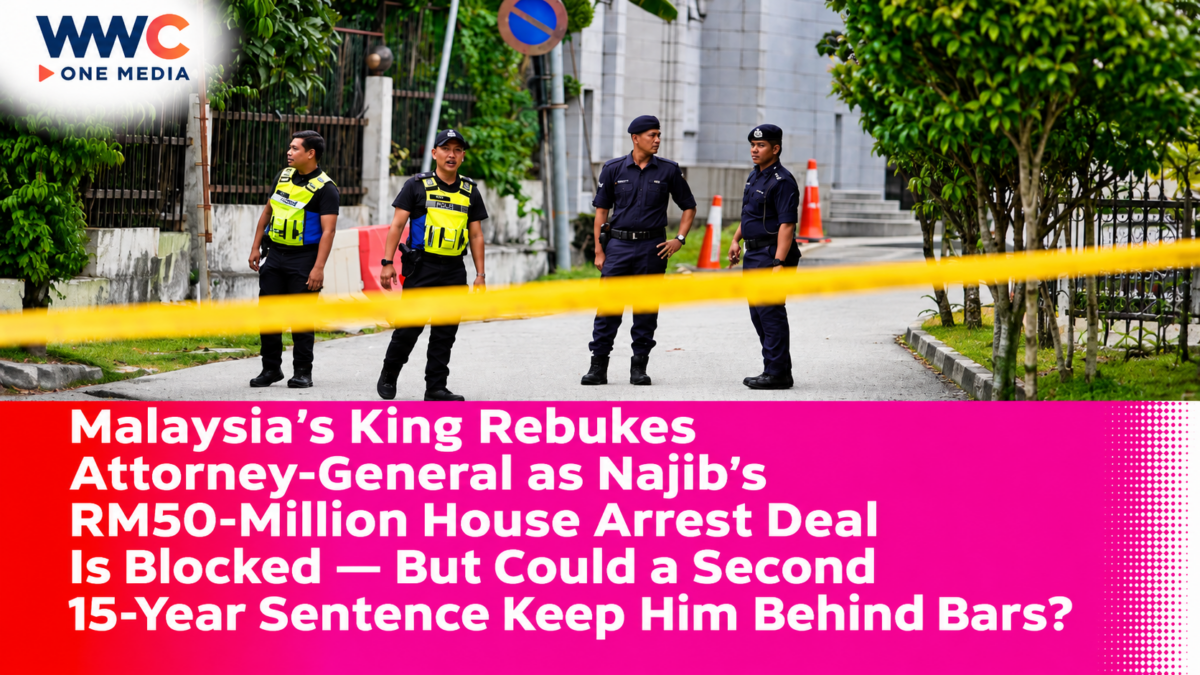
KUALA LUMPUR, MALAYSIA — Former Malaysian Prime Minister Najib Razak appeared to be on the verge of returning home after his political party paid a staggering RM50 million (approximately US$12.3 million) fine required under a royal pardon.
But within hours, the controversial former leader was back in prison.
Now, the dispute over his house arrest has escalated into an extraordinary confrontation between Malaysia’s royal palace and the government’s top legal office.
On Saturday, November 7, King Sultan Ibrahim Sultan Iskandar issued a strongly worded statement insisting that his conditional pardon was clear and must be respected.
The warning followed a decision by the Attorney-General’s Chambers (AGC) to temporarily defer Najib’s transfer from Kajang Prison to his Kuala Lumpur residence.
The AGC rejected accusations that its intervention amounted to defying the monarch, arguing that judicial clarification was necessary to determine how the pardon interacts with another prison sentence.
At the centre of the crisis is a legal question with enormous consequences: Does Najib still have time left to serve under his first corruption sentence, or has that sentence already ended, potentially activating a separate 15-year prison term?
The answer could determine whether Najib is allowed to remain under house arrest or must continue serving time in prison.
Najib’s RM50-Million Payment Was Supposed to Open the Door to House Arrest
The latest developments began on Friday, November 6.
Najib’s party, the United Malays National Organisation (UMNO), paid a RM50 million fine on his behalf.
The payment satisfied a major condition of the royal pardon granted on September 18.
That pardon allowed Najib to serve the remainder of his reduced six-year sentence under house arrest until August 23, 2028, provided he paid the fine and complied with the conditions attached to the decree.
Following the payment, the Kuala Lumpur High Court issued an order connected to Najib’s discharge from prison and the implementation of his house arrest.
His lawyers maintained that the requirements had been satisfied and that authorities should transfer him home.
Najib briefly left prison on Friday. Reuters reported that he had gone out for a dental appointment before returning to detention following the intervention.
But the anticipated move to house arrest did not proceed.
The AGC said the legal consequences of the court order and the pardon required further interpretation.
Its decision transformed what had appeared to be an administrative transfer into a major constitutional and political controversy.
Malaysia’s King Says His Royal Pardon Must Be Respected
On November 7, Sultan Ibrahim publicly reaffirmed his authority to grant pardons under Article 42 of Malaysia’s Federal Constitution.
The king said the conditional pardon for Najib was clear and that its conditions had been fulfilled.
The palace emphasized that the pardon applied specifically to the sentence associated with the SRC International case.
It did not extend to Najib’s other criminal proceedings.
The king also warned against attempts to dispute or undermine the decree.
His statement reflected the significance of the monarch’s constitutional power of clemency.
In Malaysia’s constitutional monarchy, the king serves as head of state, while the elected government administers the country and the judiciary interprets the law.
Royal pardons occupy an important place within that constitutional structure.
However, the palace did not explicitly issue a fresh instruction ordering the AGC to withdraw its request for clarification.
The distinction matters because the legal dispute concerns how existing judicial orders and separate prison sentences should be implemented.
The king’s statement intensified pressure on the authorities but did not, by itself, resolve those questions.
Attorney-General Rejects Accusations of Treason
The Attorney-General’s Chambers responded by defending its decision to seek clarification.
The office rejected allegations that it was challenging the king’s authority or committing treason.
It argued that seeking an interpretation from the courts is different from questioning the monarch’s power to grant a pardon.
According to the AGC, the disagreement concerns the legal effect of the High Court’s November 6 order after the RM50 million payment.
There are two possible interpretations.
Under the first, Najib’s payment satisfies the financial condition, allowing him to continue serving the remainder of his SRC International prison sentence under house arrest until August 2028.
Under the second, the discharge order could mean the first sentence has legally concluded.
That distinction could determine when Najib must begin serving the separate prison sentence imposed in another 1MDB-related case.
The AGC argues that only the courts should resolve the issue rather than allowing competing interpretations to determine his detention status.
It also said clarification could protect Najib’s rights by avoiding unlawful detention or conflicting orders.
The office therefore maintains that its position is consistent with respecting both the royal pardon and the rule of law.
The Second 15-Year Sentence Could Change Everything
Najib’s legal position is complicated by two distinct criminal cases.
His original imprisonment arose from the misappropriation of RM42 million from SRC International, a former subsidiary of state investment fund 1Malaysia Development Berhad (1MDB).
The Federal Court upheld his conviction in August 2022.
He originally received a 12-year prison sentence and a RM210 million fine.
In 2024, the Pardons Board reduced the sentence to six years and the fine to RM50 million.
The September 2026 conditional pardon subsequently allowed the remaining SRC sentence to be served under house arrest.
But Najib also faces a separate conviction.
In December 2025, the Kuala Lumpur High Court sentenced him to 15 years in prison over corruption and money-laundering offences connected to the wider 1MDB scandal.
He is appealing that conviction and sentence.
The separate sentence was ordered to begin after completion of the SRC sentence, and the High Court rejected an application to suspend its execution on October 14, 2026.
That is why the meaning of the latest discharge order is so important.
If the SRC sentence continues under house arrest, the separate prison term may begin later.
If the SRC sentence has already legally ended, the second sentence could become immediately relevant.
The September pardon does not cancel the second conviction or automatically authorize Najib to serve that separate sentence at home.
Najib’s Lawyers Demand Immediate Implementation
Najib’s legal team, Shafee & Co, has strongly rejected the AGC’s interpretation.
The lawyers argue that payment of the RM50 million fine satisfied the outstanding financial condition and should allow the house-arrest arrangement to proceed.
They maintain that the royal pardon remains valid and that the authorities should respect the order already issued.
The legal team has also argued that payment of a fine does not automatically terminate a prison sentence.
In its view, Najib should continue serving the remaining SRC sentence under house arrest, as provided by the pardon.
The lawyers have called on the authorities to transfer him to his residence in Taman Duta, Kuala Lumpur.
Their position conflicts with the AGC’s insistence that the legal consequences must first be resolved by a court.
Neither side’s interpretation should be presented as a final judicial ruling.
As of the November 7 reporting, Najib’s planned transfer remained on hold.
A Royal Pardon That Has Already Sparked Months of Controversy
Najib’s house-arrest dispute began long before the latest confrontation.
In September, the king granted a conditional pardon permitting the former prime minister to serve the rest of his SRC sentence at home.
But questions immediately emerged over payment requirements, monitoring arrangements and the legal procedures for implementing the decision.
As previously reported by WWC ONE MEDIA in its coverage of Najib’s conditional pardon and outstanding legal battles, the royal order did not erase his other conviction or resolve every aspect of the house-arrest arrangement.
The decision was particularly controversial because Najib remains associated with Malaysia’s massive 1MDB corruption scandal.
The case became internationally notorious after investigators alleged that approximately US$4.5 billion had been misappropriated from the state investment fund.
Najib has denied wrongdoing in the wider scandal, although his convictions in the two cases remain central to his legal position.
His treatment continues to provoke strong political reactions.
Supporters argue that the constitutional pardon must be respected.
Critics question whether a convicted former leader should receive an arrangement unavailable to many other prisoners.
The current dispute adds another dimension: how a pardon should interact with a separate enforceable prison sentence.
UMNO’s RM50-Million Payment Triggers a Political Backlash
The RM50 million payment has also become a major political issue.
UMNO launched a solidarity fundraising initiative after Najib received the September conditional pardon.
Supporters contributed toward satisfying the fine.
As WWC ONE MEDIA previously reported on the Najib solidarity fund, the campaign had collected approximately RM1 million by September 19.
The subsequent payment of the full RM50 million on November 6 removed the financial obstacle to implementing the pardon.
But it did not resolve the legal complications.
Prime Minister Anwar Ibrahim expressed disagreement with UMNO’s decision to pay the fine.
He warned against creating the impression that major corruption could be overlooked through a financial settlement.
His comments reflected the political sensitivity of Najib’s case within Malaysia’s unity government.
UMNO is an important coalition partner, while other governing parties have maintained longstanding positions against corruption and preferential treatment.
The result is a delicate challenge for Anwar: maintaining coalition stability while responding to public expectations surrounding accountability.
Anthony Loke’s Resignation Threat Raises the Stakes
The political consequences extend into Malaysia’s Cabinet.
Democratic Action Party secretary-general Anthony Loke announced plans to resign as transport minister in protest against the house-arrest decision.
As WWC ONE MEDIA reported in its update on Loke’s position, Loke agreed to remain in office until Najib actually begins house arrest.
That timing has become particularly significant.
Because Najib’s transfer remains suspended, the condition associated with Loke’s departure has not yet occurred.
The dispute has therefore created an unusual political situation.
A minister’s planned resignation is effectively connected to the outcome of a separate legal process involving a former prime minister.
Loke’s position also reflects tensions between DAP and UMNO, two parties with very different histories and constituencies that cooperate within Anwar’s governing coalition.
The controversy does not establish that Malaysia’s government is about to collapse.
But it demonstrates how Najib’s case continues to influence national politics years after he left office.
Why Malaysia’s Constitutional Monarchy Is Being Tested
The dispute is unusual because it places the royal palace, the Attorney-General’s Chambers and the courts at the centre of competing legal interpretations.
The king possesses constitutional authority to grant pardons.
The judiciary determines the meaning and legal consequences of court orders.
The executive branch is responsible for implementing lawful decisions.
Those roles must function together.
The AGC argues that seeking court clarification protects the lawful implementation of the pardon.
Najib’s lawyers contend that the pardon and discharge order already establish what must happen.
The palace insists that the conditions have been met and its authority must be respected.
The constitutional question is therefore more precise than simply asking whether the attorney-general can oppose the king.
It concerns whether the courts must clarify the effect of one sentence before authorities can implement a change in detention, given the existence of another sentence.
A judicial resolution could establish how these obligations interact.
Until then, competing claims about defiance or constitutional misconduct remain allegations and political characterizations, not findings established by a court.
Najib’s Family Has Been Waiting for Clear House-Arrest Rules
The latest setback comes after weeks of uncertainty about how Najib’s house arrest would operate.
His family previously said it had not received complete instructions on monitoring, movement restrictions and other practical arrangements.
As WWC ONE MEDIA reported on September 25, Najib’s daughter Nooryana Najwa said the family was awaiting clear procedures from the Prisons Department.
The unresolved questions included security, visitation and implementation requirements.
Those were practical issues.
The November dispute concerns something more fundamental: whether Najib can lawfully enter the house-arrest arrangement while his separate conviction remains in force.
Even a complete set of house-arrest rules would not necessarily resolve that sentencing issue.
Authorities may therefore require both legal clarity and operational arrangements before a transfer can proceed.
What Happens Next for Najib Razak?
The immediate focus is on the judiciary.
The AGC wants clarification of the November 6 discharge order and the relationship between the SRC sentence and the separate 1MDB sentence.
Najib’s lawyers are demanding that the royal pardon be implemented without further delay.
The palace has reaffirmed its position that the pardon is clear.
Reuters also reported that the attorney-general sought an audience with the king to explain the legal concerns and apologize for the situation.
The next major development could involve a court’s interpretation of Najib’s sentence status.
That ruling would help determine whether he may serve the remaining SRC term under house arrest or whether the separate 15-year sentence must take effect.
His appeal against the second conviction is another important process, but its ultimate outcome is not yet known.
The political consequences will also be watched closely.
Anwar’s coalition must manage disagreements between UMNO and DAP, while Najib’s supporters continue calling for the royal order to be implemented.
No confirmed outcome should be assumed before the relevant courts and authorities act.
The Bottom Line: Najib’s Freedom Remains Entangled in Two Prison Sentences
Former Malaysian Prime Minister Najib Razak remains at the centre of a rare confrontation involving the country’s monarch and attorney-general.
On November 6, UMNO paid the RM50 million fine required for Najib’s conditional house arrest.
A High Court order followed.
But the Attorney-General’s Chambers temporarily halted his transfer, arguing that the legal effect of the discharge order needed clarification.
The following day, King Sultan Ibrahim reaffirmed his pardon and warned against challenges to the royal decree.
The AGC responded that it was not disputing the king’s authority and rejected accusations of treason.
At the heart of the case are two separate convictions.
The September pardon applies only to Najib’s reduced six-year SRC International sentence.
It does not cover the separate 15-year 1MDB-related sentence imposed in December 2025, which Najib is appealing.
The question of when that second sentence takes effect remains critical.
For now, the former prime minister’s house-arrest transfer remains unresolved.
The dispute has also intensified divisions within Anwar Ibrahim’s governing coalition and raised important questions about the interaction of royal clemency, judicial orders and criminal sentences.
And as Najib’s lawyers demand his transfer home while Malaysia’s attorney-general seeks further court clarification, one question now threatens to overshadow everything: Will the king’s pardon finally open the door to house arrest—or could Najib’s second corruption sentence keep the former prime minister behind bars despite the RM50-million payment?
Sources and Additional Reporting
- Channel News Asia / Associated Press, November 7, 2026: Malaysia’s attorney-general defends halting Najib’s house arrest after king’s rebuke.
- Reuters, November 7, 2026: Malaysia’s king warns against challenging his house-arrest order.
- Associated Press, November 7, 2026: Attorney-general defends move despite palace warning.
- The Star, November 7, 2026: AGC denies defying king, seeks court clarity.
- The Straits Times, November 7, 2026: King’s warning raises stakes as house arrest remains in legal limbo.
- Bernama, September 18, 2026: King grants conditional pardon to Najib.
SEO Publishing Package
SEO Meta Title: Najib House Arrest Halted as Malaysia King Rebukes Attorney-General
SEO Meta Description: Malaysia’s king rebukes challenges to Najib Razak’s house arrest after UMNO pays RM50 million. Attorney-general seeks clarity over a separate 15-year sentence.
Focus SEO Keyphrase: Najib Razak house arrest king attorney general November 2026
Secondary SEO Keywords: Najib Razak house arrest, Malaysia king Sultan Ibrahim, Najib RM50 million fine, Najib royal pardon 2026, Malaysia Attorney General Chambers, 1MDB corruption case, SRC International Najib sentence, Najib 15 year prison sentence, Anwar Ibrahim UMNO, Anthony Loke resignation, Malaysia constitutional monarchy, Kajang Prison, Najib house arrest latest news.
Suggested URL Slug: najib-house-arrest-malaysia-king-attorney-general-50-million-fine-2026
Article Category: Asia News / Malaysia Politics / Law & Justice
Suggested Tags: Najib Razak, Sultan Ibrahim, Malaysia, 1MDB, UMNO, Attorney-General, Anwar Ibrahim, Anthony Loke, Royal Pardon, House Arrest, Constitutional Law.
KUALA LUMPUR, MALAYSIA — Former Malaysian Prime Minister Najib Razak appeared to be on the verge of returning home after his political party paid a staggering RM50 million (approximately US$12.3 million) fine required under a royal pardon.
But within hours, the controversial former leader was back in prison.
Now, the dispute over his house arrest has escalated into an extraordinary confrontation between Malaysia’s royal palace and the government’s top legal office.
On Saturday, November 7, King Sultan Ibrahim Sultan Iskandar issued a strongly worded statement insisting that his conditional pardon was clear and must be respected.
The warning followed a decision by the Attorney-General’s Chambers (AGC) to temporarily defer Najib’s transfer from Kajang Prison to his Kuala Lumpur residence.
The AGC rejected accusations that its intervention amounted to defying the monarch, arguing that judicial clarification was necessary to determine how the pardon interacts with another prison sentence.
At the centre of the crisis is a legal question with enormous consequences: Does Najib still have time left to serve under his first corruption sentence, or has that sentence already ended, potentially activating a separate 15-year prison term?
The answer could determine whether Najib is allowed to remain under house arrest or must continue serving time in prison.
Najib’s RM50-Million Payment Was Supposed to Open the Door to House Arrest
The latest developments began on Friday, November 6.
Najib’s party, the United Malays National Organisation (UMNO), paid a RM50 million fine on his behalf.
The payment satisfied a major condition of the royal pardon granted on September 18.
That pardon allowed Najib to serve the remainder of his reduced six-year sentence under house arrest until August 23, 2028, provided he paid the fine and complied with the conditions attached to the decree.
Following the payment, the Kuala Lumpur High Court issued an order connected to Najib’s discharge from prison and the implementation of his house arrest.
His lawyers maintained that the requirements had been satisfied and that authorities should transfer him home.
Najib briefly left prison on Friday. Reuters reported that he had gone out for a dental appointment before returning to detention following the intervention.
But the anticipated move to house arrest did not proceed.
The AGC said the legal consequences of the court order and the pardon required further interpretation.
Its decision transformed what had appeared to be an administrative transfer into a major constitutional and political controversy.
Malaysia’s King Says His Royal Pardon Must Be Respected
On November 7, Sultan Ibrahim publicly reaffirmed his authority to grant pardons under Article 42 of Malaysia’s Federal Constitution.
The king said the conditional pardon for Najib was clear and that its conditions had been fulfilled.
The palace emphasized that the pardon applied specifically to the sentence associated with the SRC International case.
It did not extend to Najib’s other criminal proceedings.
The king also warned against attempts to dispute or undermine the decree.
His statement reflected the significance of the monarch’s constitutional power of clemency.
In Malaysia’s constitutional monarchy, the king serves as head of state, while the elected government administers the country and the judiciary interprets the law.
Royal pardons occupy an important place within that constitutional structure.
However, the palace did not explicitly issue a fresh instruction ordering the AGC to withdraw its request for clarification.
The distinction matters because the legal dispute concerns how existing judicial orders and separate prison sentences should be implemented.
The king’s statement intensified pressure on the authorities but did not, by itself, resolve those questions.
Attorney-General Rejects Accusations of Treason
The Attorney-General’s Chambers responded by defending its decision to seek clarification.
The office rejected allegations that it was challenging the king’s authority or committing treason.
It argued that seeking an interpretation from the courts is different from questioning the monarch’s power to grant a pardon.
According to the AGC, the disagreement concerns the legal effect of the High Court’s November 6 order after the RM50 million payment.
There are two possible interpretations.
Under the first, Najib’s payment satisfies the financial condition, allowing him to continue serving the remainder of his SRC International prison sentence under house arrest until August 2028.
Under the second, the discharge order could mean the first sentence has legally concluded.
That distinction could determine when Najib must begin serving the separate prison sentence imposed in another 1MDB-related case.
The AGC argues that only the courts should resolve the issue rather than allowing competing interpretations to determine his detention status.
It also said clarification could protect Najib’s rights by avoiding unlawful detention or conflicting orders.
The office therefore maintains that its position is consistent with respecting both the royal pardon and the rule of law.
The Second 15-Year Sentence Could Change Everything
Najib’s legal position is complicated by two distinct criminal cases.
His original imprisonment arose from the misappropriation of RM42 million from SRC International, a former subsidiary of state investment fund 1Malaysia Development Berhad (1MDB).
The Federal Court upheld his conviction in August 2022.
He originally received a 12-year prison sentence and a RM210 million fine.
In 2024, the Pardons Board reduced the sentence to six years and the fine to RM50 million.
The September 2026 conditional pardon subsequently allowed the remaining SRC sentence to be served under house arrest.
But Najib also faces a separate conviction.
In December 2025, the Kuala Lumpur High Court sentenced him to 15 years in prison over corruption and money-laundering offences connected to the wider 1MDB scandal.
He is appealing that conviction and sentence.
The separate sentence was ordered to begin after completion of the SRC sentence, and the High Court rejected an application to suspend its execution on October 14, 2026.
That is why the meaning of the latest discharge order is so important.
If the SRC sentence continues under house arrest, the separate prison term may begin later.
If the SRC sentence has already legally ended, the second sentence could become immediately relevant.
The September pardon does not cancel the second conviction or automatically authorize Najib to serve that separate sentence at home.
Najib’s Lawyers Demand Immediate Implementation
Najib’s legal team, Shafee & Co, has strongly rejected the AGC’s interpretation.
The lawyers argue that payment of the RM50 million fine satisfied the outstanding financial condition and should allow the house-arrest arrangement to proceed.
They maintain that the royal pardon remains valid and that the authorities should respect the order already issued.
The legal team has also argued that payment of a fine does not automatically terminate a prison sentence.
In its view, Najib should continue serving the remaining SRC sentence under house arrest, as provided by the pardon.
The lawyers have called on the authorities to transfer him to his residence in Taman Duta, Kuala Lumpur.
Their position conflicts with the AGC’s insistence that the legal consequences must first be resolved by a court.
Neither side’s interpretation should be presented as a final judicial ruling.
As of the November 7 reporting, Najib’s planned transfer remained on hold.
A Royal Pardon That Has Already Sparked Months of Controversy
Najib’s house-arrest dispute began long before the latest confrontation.
In September, the king granted a conditional pardon permitting the former prime minister to serve the rest of his SRC sentence at home.
But questions immediately emerged over payment requirements, monitoring arrangements and the legal procedures for implementing the decision.
As previously reported by WWC ONE MEDIA in its coverage of Najib’s conditional pardon and outstanding legal battles, the royal order did not erase his other conviction or resolve every aspect of the house-arrest arrangement.
The decision was particularly controversial because Najib remains associated with Malaysia’s massive 1MDB corruption scandal.
The case became internationally notorious after investigators alleged that approximately US$4.5 billion had been misappropriated from the state investment fund.
Najib has denied wrongdoing in the wider scandal, although his convictions in the two cases remain central to his legal position.
His treatment continues to provoke strong political reactions.
Supporters argue that the constitutional pardon must be respected.
Critics question whether a convicted former leader should receive an arrangement unavailable to many other prisoners.
The current dispute adds another dimension: how a pardon should interact with a separate enforceable prison sentence.
UMNO’s RM50-Million Payment Triggers a Political Backlash
The RM50 million payment has also become a major political issue.
UMNO launched a solidarity fundraising initiative after Najib received the September conditional pardon.
Supporters contributed toward satisfying the fine.
As WWC ONE MEDIA previously reported on the Najib solidarity fund, the campaign had collected approximately RM1 million by September 19.
The subsequent payment of the full RM50 million on November 6 removed the financial obstacle to implementing the pardon.
But it did not resolve the legal complications.
Prime Minister Anwar Ibrahim expressed disagreement with UMNO’s decision to pay the fine.
He warned against creating the impression that major corruption could be overlooked through a financial settlement.
His comments reflected the political sensitivity of Najib’s case within Malaysia’s unity government.
UMNO is an important coalition partner, while other governing parties have maintained longstanding positions against corruption and preferential treatment.
The result is a delicate challenge for Anwar: maintaining coalition stability while responding to public expectations surrounding accountability.
Anthony Loke’s Resignation Threat Raises the Stakes
The political consequences extend into Malaysia’s Cabinet.
Democratic Action Party secretary-general Anthony Loke announced plans to resign as transport minister in protest against the house-arrest decision.
As WWC ONE MEDIA reported in its update on Loke’s position, Loke agreed to remain in office until Najib actually begins house arrest.
That timing has become particularly significant.
Because Najib’s transfer remains suspended, the condition associated with Loke’s departure has not yet occurred.
The dispute has therefore created an unusual political situation.
A minister’s planned resignation is effectively connected to the outcome of a separate legal process involving a former prime minister.
Loke’s position also reflects tensions between DAP and UMNO, two parties with very different histories and constituencies that cooperate within Anwar’s governing coalition.
The controversy does not establish that Malaysia’s government is about to collapse.
But it demonstrates how Najib’s case continues to influence national politics years after he left office.
Why Malaysia’s Constitutional Monarchy Is Being Tested
The dispute is unusual because it places the royal palace, the Attorney-General’s Chambers and the courts at the centre of competing legal interpretations.
The king possesses constitutional authority to grant pardons.
The judiciary determines the meaning and legal consequences of court orders.
The executive branch is responsible for implementing lawful decisions.
Those roles must function together.
The AGC argues that seeking court clarification protects the lawful implementation of the pardon.
Najib’s lawyers contend that the pardon and discharge order already establish what must happen.
The palace insists that the conditions have been met and its authority must be respected.
The constitutional question is therefore more precise than simply asking whether the attorney-general can oppose the king.
It concerns whether the courts must clarify the effect of one sentence before authorities can implement a change in detention, given the existence of another sentence.
A judicial resolution could establish how these obligations interact.
Until then, competing claims about defiance or constitutional misconduct remain allegations and political characterizations, not findings established by a court.
Najib’s Family Has Been Waiting for Clear House-Arrest Rules
The latest setback comes after weeks of uncertainty about how Najib’s house arrest would operate.
His family previously said it had not received complete instructions on monitoring, movement restrictions and other practical arrangements.
As WWC ONE MEDIA reported on September 25, Najib’s daughter Nooryana Najwa said the family was awaiting clear procedures from the Prisons Department.
The unresolved questions included security, visitation and implementation requirements.
Those were practical issues.
The November dispute concerns something more fundamental: whether Najib can lawfully enter the house-arrest arrangement while his separate conviction remains in force.
Even a complete set of house-arrest rules would not necessarily resolve that sentencing issue.
Authorities may therefore require both legal clarity and operational arrangements before a transfer can proceed.
What Happens Next for Najib Razak?
The immediate focus is on the judiciary.
The AGC wants clarification of the November 6 discharge order and the relationship between the SRC sentence and the separate 1MDB sentence.
Najib’s lawyers are demanding that the royal pardon be implemented without further delay.
The palace has reaffirmed its position that the pardon is clear.
Reuters also reported that the attorney-general sought an audience with the king to explain the legal concerns and apologize for the situation.
The next major development could involve a court’s interpretation of Najib’s sentence status.
That ruling would help determine whether he may serve the remaining SRC term under house arrest or whether the separate 15-year sentence must take effect.
His appeal against the second conviction is another important process, but its ultimate outcome is not yet known.
The political consequences will also be watched closely.
Anwar’s coalition must manage disagreements between UMNO and DAP, while Najib’s supporters continue calling for the royal order to be implemented.
No confirmed outcome should be assumed before the relevant courts and authorities act.
The Bottom Line: Najib’s Freedom Remains Entangled in Two Prison Sentences
Former Malaysian Prime Minister Najib Razak remains at the centre of a rare confrontation involving the country’s monarch and attorney-general.
On November 6, UMNO paid the RM50 million fine required for Najib’s conditional house arrest.
A High Court order followed.
But the Attorney-General’s Chambers temporarily halted his transfer, arguing that the legal effect of the discharge order needed clarification.
The following day, King Sultan Ibrahim reaffirmed his pardon and warned against challenges to the royal decree.
The AGC responded that it was not disputing the king’s authority and rejected accusations of treason.
At the heart of the case are two separate convictions.
The September pardon applies only to Najib’s reduced six-year SRC International sentence.
It does not cover the separate 15-year 1MDB-related sentence imposed in December 2025, which Najib is appealing.
The question of when that second sentence takes effect remains critical.
For now, the former prime minister’s house-arrest transfer remains unresolved.
The dispute has also intensified divisions within Anwar Ibrahim’s governing coalition and raised important questions about the interaction of royal clemency, judicial orders and criminal sentences.
And as Najib’s lawyers demand his transfer home while Malaysia’s attorney-general seeks further court clarification, one question now threatens to overshadow everything: Will the king’s pardon finally open the door to house arrest—or could Najib’s second corruption sentence keep the former prime minister behind bars despite the RM50-million payment?