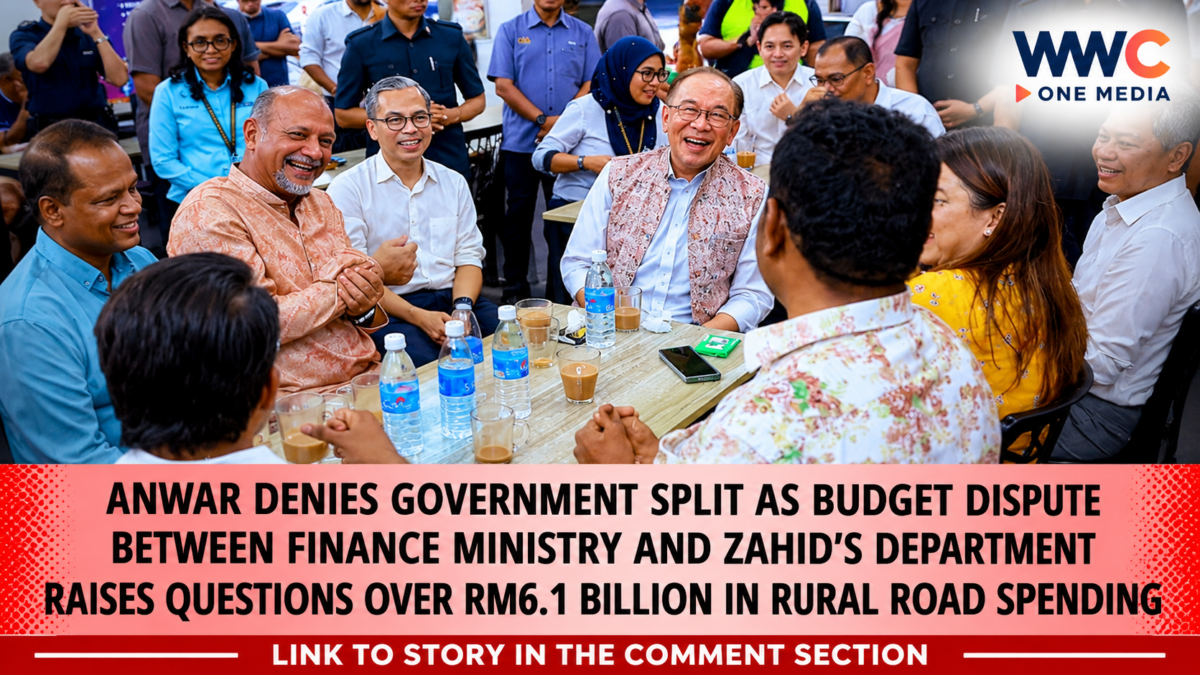
KUALA LUMPUR, November 6, 2026 — Malaysian Prime Minister Anwar Ibrahim has moved to calm growing speculation about divisions within his administration after a public disagreement between the Finance Ministry and the Rural and Regional Development Ministry over billions of ringgit in rural road funding.
Anwar insisted that differences between government departments do not necessarily indicate a political split, describing them instead as part of the normal process of policy discussions and deliberations.
His clarification came after Opposition Leader Hamzah Zainudin questioned whether conflicting statements from the two ministries reflected deeper divisions within the MADANI government and asked who ultimately determines the administration’s official position.
The dispute centres on the Rural Road Programme, known as JALB, and the management of its funding between 2023 and 2025. The controversy intensified after Deputy Prime Minister Ahmad Zahid Hamidi rejected claims that his ministry had overspent by approximately RM2.1 billion.
At the heart of the disagreement is a major distinction between the programme’s original budget allocation and its subsequently revised funding.
Although Zahid maintains that expenditure remained within the approved revised allocation, the Finance Ministry has raised concerns about commitments exceeding original annual budgets, delayed contractor payments and the need to identify additional funds.
The controversy has become more than a disagreement over accounting figures. It has raised questions about financial planning, government coordination, rural infrastructure delivery and accountability for public money.
Anwar Says Differences Between Ministries Do Not Mean the Government Is Divided
In a written parliamentary reply dated November 4, Anwar said disagreements over policy approaches and departmental priorities should not automatically be interpreted as evidence of divisions within the government.
He explained that each ministry has its own responsibilities, jurisdiction and priorities, meaning differences can emerge during discussions over how government programmes should be implemented.
However, decisions requiring a collective government position must be brought before the Cabinet for consideration and approval.
Anwar stressed that the administration follows the principle of collective Cabinet responsibility, under which major government decisions are coordinated rather than determined independently by individual ministries.
He also said the government would continue strengthening cooperation between departments, monitoring economic indicators and ensuring that policies produce tangible and sustainable benefits for the public.
The Prime Minister did not directly identify either ministry in his parliamentary response, but the clarification followed weeks of public exchanges involving the Finance Ministry and Zahid’s department.
Anwar’s statement was also intended to address concerns about who has the final authority when government departments present conflicting explanations over public spending. AsiaOne+2
RM2.1 Billion Discrepancy Explained: Why Zahid Says the Money Was Not Missing
The most controversial figure in the dispute is approximately RM2.1 billion.
Former finance minister Lim Guan Eng had questioned the difference between the original allocations for the Rural Road Programme and the amount eventually spent between 2023 and 2025.
Zahid rejected suggestions that the difference represented missing funds, financial leakage or misappropriation.
During his October 26 parliamentary explanation, the Deputy Prime Minister presented three important figures:
- RM3.982 billion: The programme’s original allocations for 2023–2025.
- RM6.143 billion: The revised allocations after approved adjustments.
- RM6.108 billion: Actual expenditure during the three-year period.
Based on the revised allocation, the programme spent approximately RM34.3 million less than the amount available.
Zahid argued that comparing actual expenditure directly with the original allocation produces a misleading impression because it ignores subsequent funding adjustments.
He explained that revisions were necessary to accommodate project commitments, including work progressing faster than expected and outstanding claims from earlier projects.
He also maintained that adjustments had to pass through government approval procedures and could not simply be authorised by a minister’s personal instruction.
The figures therefore show that expenditure exceeded the original allocation but remained below the revised allocation.
That distinction is important: the RM2.1 billion difference is not, by itself, proof of missing money or wrongdoing. However, it has prompted further questions about how additional allocations were approved, documented and managed. Ahmad Zahid+2
Finance Ministry Raises Concerns Over Spending Commitments and Contractor Payments
While Zahid defended the revised funding figures, the Finance Ministry has highlighted a different problem: the management of annual budgets and the financial commitments made by the Rural and Regional Development Ministry.
The disagreement first became public in September, when Zahid expressed frustration over delays in payments to contractors working on rural development projects.
He said some contractors had completed their work and achieved required milestones but were still waiting for payments.
According to Zahid, the delays had created serious cash-flow difficulties, with some contractors reportedly struggling to continue operations.
Treasury Secretary-General Johan Mahmood Merican responded that the Finance Ministry had not imposed restrictions on the ministry’s approved rural road allocation.
Instead, he said the payment constraints were connected to the near-exhaustion of the available annual allocation after commitments and spending exceeded the original budgets.
The Finance Ministry also said it was working with the Rural and Regional Development Ministry to identify savings and reorganise funding to address outstanding payments.
An additional RM300 million was initially approved in 2026 to help settle payment arrears.
The dispute exposed a fundamental disagreement over financial management: Zahid emphasised the need to ensure contractors received payment for completed work, while the Finance Ministry stressed that ministries must plan commitments according to approved budgets and available funding. Malaysiakini+2
How the Rural Road Budget Increased From RM3.98 Billion to RM6.14 Billion
The revised allocations provide a clearer picture of how the programme’s funding changed over three years.
| Year | Original allocation | Revised allocation |
|---|---|---|
| 2023 | RM1.09 billion | RM1.85 billion |
| 2024 | RM1.32 billion | RM2.02 billion |
| 2025 | RM1.57 billion | RM2.27 billion |
| Total | RM3.98 billion | RM6.14 billion |
The figures show that the programme’s funding was increased through adjustments in each of the three years.
The Finance Ministry has explained that the revised allocations involved internal budget adjustments, including Notices of Change, which allow approved expenditure to be reorganised within government development allocations.
The ministry has also said these adjustments were necessary because existing project commitments had created funding requirements beyond the original annual budgets.
However, the controversy has not ended simply because the final expenditure remained below the revised allocation.
The central governance question is whether the additional funding was properly approved and whether ministries made commitments at a pace consistent with available resources.
This is particularly important for infrastructure programmes involving multiple contractors, long-term construction schedules and payments linked to verified work.
Rural Road Projects Were Not Cancelled, but New Approvals Faced Restrictions
Another complication emerged when contractors and lawmakers raised concerns about the status of rural road projects.
The Finance Ministry disclosed that the Rural and Regional Development Ministry had been instructed to suspend the issuance of new Letters of Acceptance for certain rural road projects from September 10.
The measure was intended to prevent additional financial commitments from worsening existing payment arrears.
However, the distinction between suspending new approvals and cancelling projects became a source of confusion.
Finance Minister II Amir Hamzah Azizan later maintained that rural road projects had not been cancelled, although the issuance of new Letters of Acceptance had been postponed.
Some contractors, however, reportedly told lawmakers that they had received letters indicating that projects were being revoked.
The issue became particularly sensitive in East Malaysia, where rural road construction is important for connecting communities, improving access to public services and supporting economic activity.
Sarawak MP Willie Mongin urged ministers to resolve the disagreement behind closed doors, saying conflicting public statements had left lawmakers and contractors uncertain about the actual status of projects.
Minister in the Prime Minister’s Department responsible for Sabah and Sarawak Affairs Mustapha Sakmud also maintained that projects had been deferred rather than cancelled.
The controversy demonstrates why clear communication is essential when infrastructure funding decisions affect contractors, local communities and ongoing development work. Malaysiakini+2
Cabinet Has the Final Say on Major Government Decisions, Anwar Says
Anwar’s parliamentary response also addressed a broader constitutional and administrative question: who determines the government’s official position when ministries disagree?
His answer was that decisions requiring collective approval must be brought before the Cabinet.
This reflects the principle of collective Cabinet responsibility, under which ministers are expected to work within an agreed government position once decisions have been made.
The arrangement does not mean ministries cannot challenge one another’s proposals or raise concerns about spending.
Instead, it establishes a process for resolving disagreements through consultation and collective decision-making.
For the administration, the challenge is ensuring that internal discussions do not create unnecessary uncertainty among businesses, contractors, lawmakers and the public.
The rural road funding dispute has demonstrated how disagreements over technical budget matters can quickly become politically sensitive when senior government leaders make competing public statements.
Why the Dispute Matters to Malaysia’s Budget 2027
The disagreement is unfolding while Parliament is examining Malaysia’s 2027 national budget.
The RM459.8 billion spending plan, tabled by Anwar on October 9, sets out the government’s financial priorities for the coming year.
The Rural Road Programme controversy is therefore particularly significant because it highlights the importance of financial discipline when government departments undertake major infrastructure commitments.
Malaysia is trying to balance development spending with fiscal consolidation, while also addressing household expenses, public infrastructure needs and economic uncertainty.
Anwar’s government has pledged to manage public funds carefully and improve the effectiveness of government spending.
But infrastructure projects require more than headline budget allocations. They also depend on accurate cost estimates, realistic implementation schedules, effective procurement and timely payments to contractors.
If ministries commit to projects faster than funding can be made available, the consequences can include delayed construction, unpaid contractors and disruption to communities waiting for improved roads.
The dispute therefore raises a wider question about whether Malaysia’s budget planning and project approval processes are sufficiently coordinated across government departments.
WWC ONE MEDIA previously examined the financial and political pressures surrounding the spending plan in Malaysia’s 2027 Budget Targets Living Costs and Fiscal Risks as Early Election Speculation Grows.
The administration’s broader economic priorities were also explored in Malaysia Unveils RM459.8-Billion Election-Year Budget With Higher Wages and Tax Cuts — But Anwar Faces a Bigger Test as Living Costs and Political Pressure Rise.
Political Pressure Grows as Anwar and Zahid Face Questions Over Government Unity
The funding disagreement has also attracted attention because it involves two of the most senior figures in Malaysia’s government.
Anwar serves as Prime Minister and Finance Minister, while Zahid is Deputy Prime Minister, Rural and Regional Development Minister and president of UMNO.
Their ministries’ public disagreement has inevitably raised questions about political coordination within the governing coalition.
However, there has been no official confirmation that the funding dispute represents a formal split between Anwar and Zahid or that either leader intends to leave the government over the issue.
Zahid has previously said UMNO would remain in the administration until the end of the current term, even as the party discusses the timing of the next general election.
That political backdrop makes the dispute especially sensitive.
WWC ONE MEDIA has examined the relationship between UMNO and Anwar’s administration in UMNO Wants GE16 Sooner After Johor and Negeri Sembilan Gains — But Zahid Says It Will Stay in Anwar’s Government Until the End.
Anwar’s own approach to questions involving government accountability and public funds has also been discussed in Anwar Challenges Opposition Over Salary Debate as He Questions Focus on Alleged Financial Misconduct.
The latest developments do not establish a government breakup, but they show how disagreements over public spending can become politically damaging when the administration struggles to present a consistent explanation.
What Happens Next for the Rural Road Programme?
The immediate challenge is to resolve the funding and payment issues without disrupting projects that communities and contractors are depending on.
Several questions remain important:
- Will the Finance Ministry and Rural and Regional Development Ministry agree on a clearer funding arrangement for ongoing projects?
- Will contractors receive outstanding payments without further delays?
- How will the government ensure that new project commitments match available funding?
- Will the ministries provide clearer explanations about projects that have been postponed or had their approvals suspended?
- Can the Cabinet prevent future disputes from becoming public controversies?
The answers will matter beyond the current disagreement.
Rural road projects are essential to communities that depend on reliable transport links to reach schools, hospitals, markets and employment opportunities.
Delays can affect not only construction companies but also residents who rely on completed infrastructure.
For that reason, the government’s response will be judged not just by how it explains the accounting figures, but by whether it delivers the projects and pays contractors on time.
Anwar’s Message Is Clear, but the Funding Controversy Is Not Over
Anwar has attempted to put an end to speculation that the dispute represents a split within his government.
His position is that ministries are allowed to debate policies and funding priorities, but major decisions must follow proper procedures and receive Cabinet approval when collective agreement is required.
Zahid, meanwhile, has defended the rural road programme’s spending figures by pointing to the revised allocation of RM6.143 billion, against which actual expenditure of RM6.108 billion remained within budget.
The Finance Ministry’s concerns about annual spending commitments, payment arrears and project approvals nevertheless remain important issues for the administration to address.
The controversy is therefore not simply about whether two ministries disagree. It is about whether Malaysia can strengthen financial discipline while ensuring that essential infrastructure projects continue without unnecessary delays.
For Anwar, the challenge is to demonstrate that policy deliberation leads to better decisions rather than prolonged public confusion.
For Zahid’s ministry, the challenge is to show that its funding requirements, project commitments and spending adjustments are properly documented and sustainable.
And for Malaysians waiting for better rural roads, the most important outcome will be whether the government can turn its promises into completed projects.