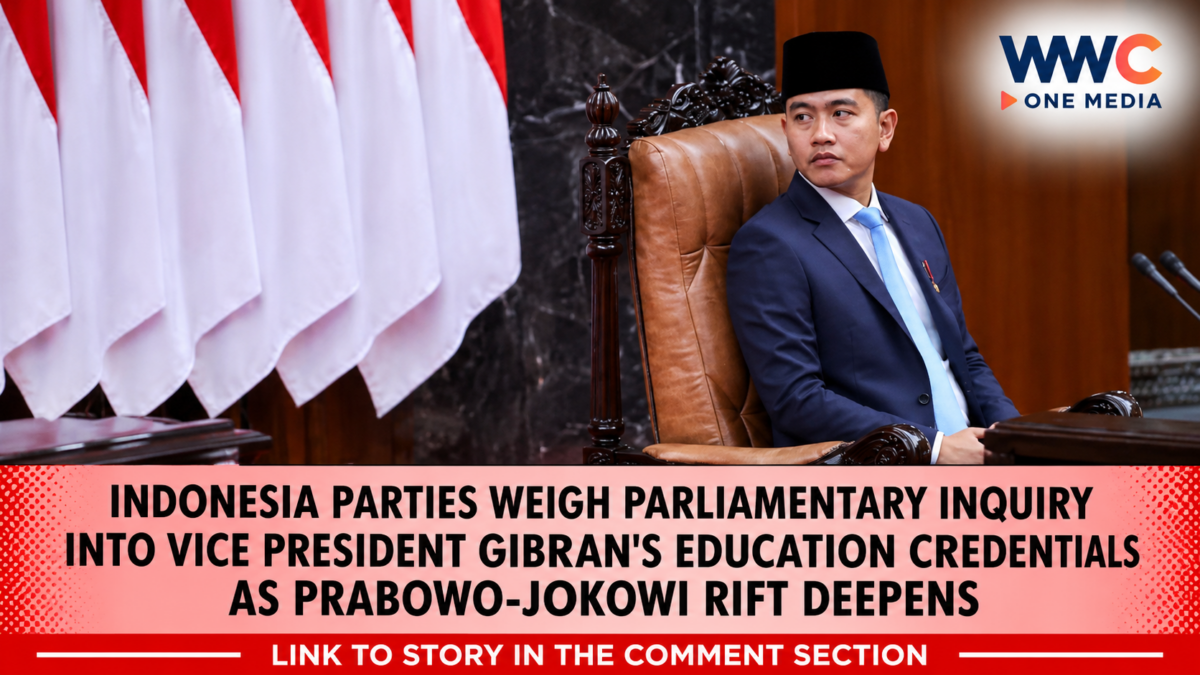
JAKARTA, November 6, 2026 — Indonesia’s political establishment is facing a fresh test of stability as several parliamentary parties consider launching an inquiry into Vice President Gibran Rakabuming Raka’s educational credentials, potentially opening a new constitutional battle over his eligibility to hold office.
The controversy has intensified following two court developments questioning the documentation used to establish Gibran’s overseas education qualifications for the 2024 presidential election.
The debate is also unfolding amid growing political tensions between President Prabowo Subianto and his predecessor, Joko Widodo, widely known as Jokowi, who is Gibran’s father.
Several political parties are now discussing how Parliament should respond to the court rulings. Their options include formally seeking an explanation from the government, launching a parliamentary investigation or issuing an official statement on alleged legal or constitutional violations.
Although none of the parties has formally announced an impeachment initiative, the possibility has become part of the wider political discussion because parliamentary proceedings involving alleged constitutional violations can potentially become an initial stage of impeachment.
The controversy has taken on greater significance following the arrest of former national police chief Listyo Sigit Prabowo in a separate wiretapping investigation. Listyo was regarded as close to Jokowi, and the scandal has added another layer of tension to relations between the former president and Prabowo’s administration.
For Indonesia, the question is no longer limited to Gibran’s academic documents. It now involves parliamentary accountability, constitutional procedures, political alliances and the balance of power within Southeast Asia’s largest democracy.
Political Parties Consider Parliamentary Action Against Gibran
Several Indonesian political parties are discussing possible parliamentary action following the court decisions concerning Gibran’s educational qualifications.
According to Reuters, three parties within Prabowo’s governing coalition and one party outside it are considering different constitutional options.
The Prosperous Justice Party (PKS), which belongs to Prabowo’s coalition, confirmed that it was consulting other political groups about the appropriate response.
PKS official Muhammad Kholid said the party was reviewing the available options and communicating with other parliamentary parties.
He also indicated that there was growing agreement among political groups that the court rulings should receive a parliamentary follow-up.
Another coalition party, the National Awakening Party (PKB), said it was seriously considering the possible courses of action.
Golkar lawmaker Ahmad Doli Kurnia, meanwhile, reportedly viewed a formal parliamentary statement expressing the legislature’s position as the most appropriate response.
The Indonesian Democratic Party of Struggle (PDI-P), the largest party outside Prabowo’s governing coalition, also said lawmakers were increasingly discussing the use of their constitutional powers.
PDI-P secretary-general Hasto Kristiyanto said discussions had intensified, particularly following the separate wiretapping scandal.
However, these discussions do not mean Parliament has already approved an investigation or decided to remove Gibran from office.
The parties are still weighing their options, and no formal impeachment decision has been announced. AsiaOne+2
Two Court Rulings Put Gibran’s Education Credentials Under Renewed Scrutiny
The political debate follows two important judicial developments involving the documentation used to establish Gibran’s eligibility for the 2024 presidential election.
The first came from Indonesia’s Constitutional Court on October 6.
The court dismissed a petition seeking to invalidate Gibran’s election victory, but its ruling included a significant finding: it did not find convincing evidence in the proceedings that Gibran possessed a foreign diploma, certificate or degree proving completion of senior high school or an equivalent qualification.
Indonesia’s election law requires presidential and vice-presidential candidates to have completed senior high school or an equivalent level of education.
The court also explained that it could not remove Gibran through that particular election-dispute proceeding because he had already been sworn in as vice president.
The second development came from the Supreme Court.
In a separate administrative-law case, the Supreme Court overturned an earlier appellate decision and annulled the education-equivalency certificate that Gibran had submitted as part of his 2024 candidacy documentation.
The certificate had been issued by the education authorities to recognise his overseas education as equivalent to the required Indonesian qualification.
These decisions have renewed questions about whether the documents used during the election registration process satisfied the country’s legal requirements.
Importantly, neither ruling automatically removed Gibran from office.
The Constitutional Court dismissed the petition seeking to annul his election victory, while the Supreme Court’s decision concerned the validity of the administrative certificate.
The distinction is crucial because the political debate is now moving into Parliament, where lawmakers are considering whether further constitutional action is warranted. MKRI+2
What Is Gibran’s Education Background?
Gibran, the eldest son of former president Jokowi, attended Orchid Park Secondary School in Singapore before continuing his education at UTS Insearch in Australia.
He subsequently earned a bachelor’s degree through the Management Development Institute of Singapore (MDIS).
The controversy does not simply concern whether Gibran attended schools overseas or obtained a university degree.
The central legal issue is whether the documentation submitted to Indonesian election authorities adequately established that he had completed an education level equivalent to senior high school, as required by election law.
During the earlier court proceedings, an education ministry official acknowledged that a graduation diploma had not been submitted alongside the application for the equivalency assessment.
The Constitutional Court later stated that it had not found convincing documentary evidence establishing the required foreign senior-high-school-equivalent qualification in the case.
Gibran has previously defended his educational background, pointing to his studies in Singapore and Australia and his subsequent university degree.
The vice president’s office did not respond to a request for comment regarding the latest parliamentary discussions, according to Reuters.
The controversy therefore centres on the legal sufficiency of the documents and administrative decisions, rather than simply the locations where Gibran studied. CNA+2
Could Parliament Launch an Investigation or Begin Impeachment Proceedings?
One of the most important questions surrounding the controversy is what Indonesian lawmakers can legally do next.
Indonesia’s constitutional framework provides Parliament with several mechanisms for exercising oversight over the government.
These include:
- Right of interpellation: Lawmakers can request an explanation from the government concerning important policies or matters of public significance.
- Right of inquiry: Parliament can investigate the implementation of laws and government policies in matters considered important, strategic and having a broad impact on society.
- Right to express an opinion: The legislature can formally state its position on government policies or alleged violations of laws and constitutional provisions.
These mechanisms are not interchangeable, and each follows its own parliamentary procedures.
A parliamentary inquiry could allow lawmakers to examine the administrative decisions and government actions connected to Gibran’s eligibility.
However, an inquiry does not automatically remove a vice president.
Under Indonesia’s constitutional impeachment framework, the House of Representatives (DPR) must first formally express an opinion that the president or vice president may have committed specified constitutional violations or no longer meets the requirements for office.
The Constitutional Court then examines the allegations before the People’s Consultative Assembly (MPR) can consider the final decision under the constitutional process.
That means any attempt to remove Gibran would involve several institutional and legal stages.
For now, the political parties discussing parliamentary action have not formally announced that they are pursuing impeachment.
The possibility remains a potential consequence of the wider constitutional debate, not an outcome that has already been decided. Reuters+1
Prabowo’s Coalition Controls Parliament, but Political Pressure Is Growing
The political arithmetic makes the situation particularly interesting.
Seven of the eight political parties represented in Indonesia’s Parliament have joined Prabowo’s governing coalition, giving the president’s political camp control of approximately 81 per cent of parliamentary seats.
Neither Jokowi nor Gibran has a political party represented in Parliament.
That arrangement means Prabowo’s coalition partners hold considerable influence over whether parliamentary action against the vice president gains momentum.
The fact that some parties within the governing coalition are considering a response is significant.
It suggests that the controversy is not being treated solely as an opposition-driven political attack.
However, the coalition’s overwhelming majority does not guarantee that every party will agree on the appropriate course of action.
Some lawmakers may prefer a formal statement responding to the court rulings, while others could support a more extensive inquiry.
Others may want to avoid escalating the dispute into a constitutional confrontation that could destabilise the administration.
The next parliamentary discussions will therefore be important in determining whether the controversy develops into a formal investigation or remains a political and legal debate.
Wiretapping Scandal Adds Pressure to the Prabowo-Jokowi Rift
The debate over Gibran’s credentials is unfolding alongside another major political controversy involving alleged illegal surveillance of President Prabowo and other prominent figures.
Three senior police officers were arrested in connection with an investigation into alleged unauthorised wiretapping.
One of them was Listyo Sigit Prabowo, a former national police chief who had also served as Prabowo’s chief of staff.
Listyo was widely regarded as close to Jokowi, having led the National Police during the former president’s administration.
Prabowo dismissed Listyo from his presidential chief-of-staff position after the arrests.
Indonesian authorities have said the alleged surveillance involved communications belonging to the president and other individuals, including politicians, journalists, government officials and businesspeople.
The motive behind the alleged operation has not been publicly established.
Police chief Suyudi Ario Seto said the investigation was strictly a law-enforcement matter and should not be interpreted as part of political rivalries.
Jokowi, meanwhile, said he respected the legal process.
The timing of the wiretapping investigation has nevertheless intensified speculation about the relationship between Prabowo and his predecessor.
The controversy is particularly sensitive because Prabowo entered office in 2024 with Jokowi’s political support, while Gibran became his running mate.
The two scandals are separate investigations and should not be treated as proof of a coordinated political operation. However, together they have increased pressure on an administration already facing questions about political unity and institutional accountability. Reuters+1
Why the Relationship Between Prabowo and Jokowi Matters
The relationship between Prabowo and Jokowi remains one of the most important political factors in Indonesia.
Jokowi served as president from 2014 to 2024 and played a significant role in shaping the political environment that brought Prabowo back to power.
His support helped strengthen Prabowo’s 2024 presidential campaign, while the selection of Gibran as running mate created a political partnership between the two families.
However, the relationship has become increasingly strained amid changes in government appointments, political influence and the latest controversies.
Listyo’s arrest has added another sensitive issue because of his perceived ties to Jokowi.
Meanwhile, the parliamentary discussions surrounding Gibran could place Prabowo’s coalition in a difficult position.
If coalition parties support an investigation, they could increase pressure on the vice president, who is the son of the president’s predecessor.
If they oppose further action, they could face criticism from lawmakers and members of the public who believe the court decisions require a formal response.
For Prabowo, maintaining unity among coalition partners while allowing legal and parliamentary processes to proceed could become a major political challenge.
Gibran’s Position Is Not Automatically Terminated
Despite the growing controversy, Gibran remains Indonesia’s vice president.
Neither the Constitutional Court’s dismissal of the election petition nor the Supreme Court’s decision annulling the equivalency certificate automatically ended his tenure.
The Constitutional Court explicitly stated that it could not grant the petitioners’ request to disqualify him through that particular case.
The Supreme Court ruling has, however, created a separate legal issue concerning the administrative certificate used in his candidacy.
Whether further action can affect Gibran’s position will depend on the relevant constitutional and legal procedures.
This is why the parliamentary debate matters.
Lawmakers are now considering how to respond to the court decisions and whether the issue warrants further investigation.
It would therefore be inaccurate to report that Gibran has already been impeached, removed or formally ordered to resign.
The political process is still developing.
WWC ONE MEDIA’s Coverage of Indonesia’s Growing Political Crisis
The latest parliamentary debate is part of a wider series of developments testing Indonesia’s political institutions under Prabowo.
WWC ONE MEDIA previously examined the legal controversy surrounding Gibran in Indonesia Court Dismisses Challenge to Gibran’s Education Credentials — But Its Ruling Raises a Bigger Legal Question.
The earlier report explained why the Constitutional Court dismissed the petition while leaving questions about the documentation used to establish Gibran’s eligibility.
Another report, Indonesia Court to Rule on Bid to Annul Vice President Gibran’s Election Win, examined the legal challenge before the October ruling.
The growing surveillance controversy is covered in Indonesia Arrests Former Police Chief and 2 Generals Over Alleged Spying on President Prabowo — But Who Ordered the Secret Wiretaps?.
For additional context on the political environment surrounding the president, read Indonesia Deploys Nearly 21,000 Troops to Jakarta as Three Police Generals Are Detained in Explosive Wiretapping Scandal.
These developments illustrate how legal disputes, security investigations and political alliances are increasingly intersecting in Indonesia’s current political environment.
What Happens Next in Indonesia’s Parliamentary Showdown?
The coming parliamentary sessions could determine whether the controversy develops into a formal investigation or remains a political debate.
Several developments will be important to watch:
- Whether PKS formally proposes parliamentary action: The party has confirmed discussions with other political groups but has not announced a final decision.
- Whether PKB and Golkar support an inquiry: Their positions could be influential because both belong to Prabowo’s governing coalition.
- Whether PDI-P pushes for a stronger response: As the largest party outside the governing coalition, it could play an important role in building pressure for parliamentary scrutiny.
- Whether the government provides an official explanation: Lawmakers may seek clarification about the administrative decisions connected to Gibran’s education equivalency certificate.
- Whether the issue moves towards impeachment procedures: This would require formal constitutional steps and cannot happen automatically through a parliamentary inquiry.
The vice president’s office has yet to publicly respond to the latest parliamentary discussions.
Prabowo’s government must also manage the separate wiretapping investigation, which has raised concerns about the use of state surveillance powers and relationships within the security establishment.
Indonesia Faces a Critical Test of Political Accountability
The controversy surrounding Gibran’s education credentials has developed into a major test of Indonesia’s constitutional institutions.
What began as a dispute over academic documentation has now reached the centre of parliamentary politics, with parties from both inside and outside Prabowo’s coalition considering how the government should respond.
The court decisions have raised serious questions about the documentation used to establish Gibran’s eligibility, but they have not automatically removed him from office.
The next stage will depend on whether lawmakers choose to exercise their constitutional oversight powers and how the relevant institutions interpret the legal consequences of the rulings.
For Prabowo, the challenge is to maintain political stability while ensuring that the courts’ decisions and parliamentary procedures are respected.
For Jokowi, the controversy surrounding his son and the arrest of a perceived ally have added pressure to an already sensitive political relationship.
And for Gibran, the parliamentary debate could become one of the most consequential challenges of his vice presidency.
Indonesia now faces a question that could reshape its political landscape: Will Parliament pursue a full investigation into Gibran’s eligibility, or will the governing coalition find a way to contain the controversy before it develops into a wider constitutional crisis?