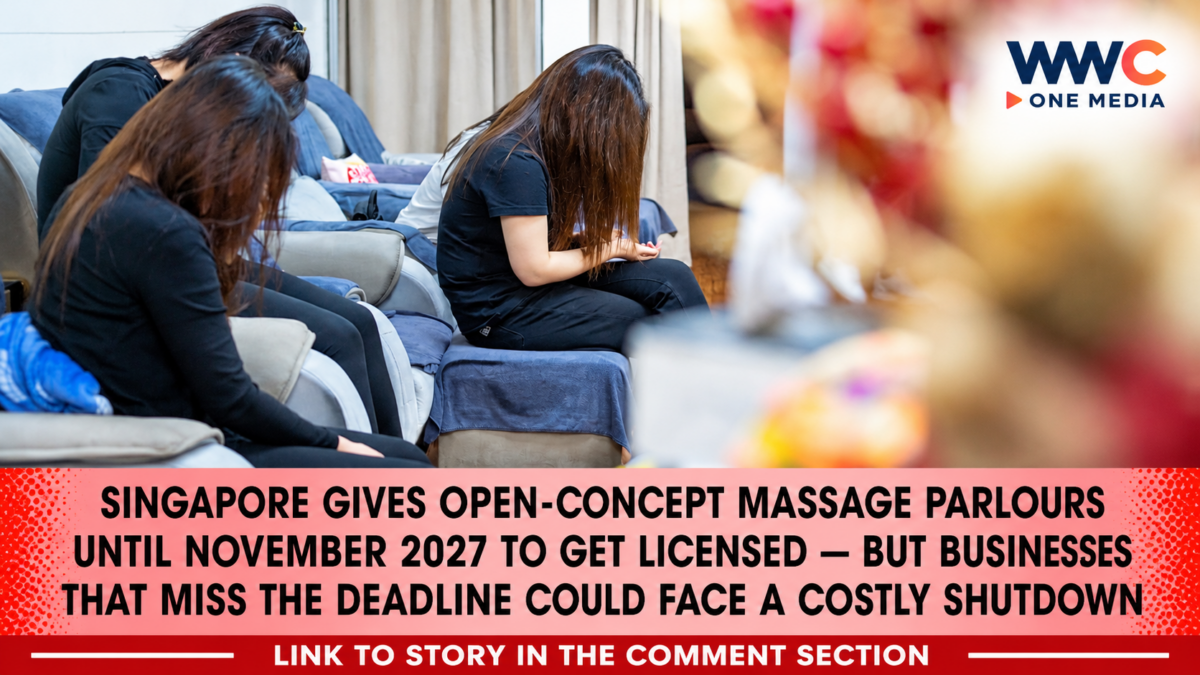
Singapore is tightening its regulatory grip on massage establishments, with open-concept massage parlours set to lose their licensing exemption from December 1, 2026. The changes will require operators to obtain a new Category 3 licence, meet stricter eligibility requirements and secure approval for the premises from the relevant land authorities.
The Singapore Police Force (SPF) confirmed the implementation date on November 5, following consultations with massage establishment associations and operators. The changes are intended to strengthen oversight, address vice-related activities and prevent businesses operating under the guise of legitimate massage services from undermining the safety and living environment of Singapore’s residential neighbourhoods.
National Development Minister Chee Hong Tat has also pledged continued cooperation between the Housing and Development Board (HDB) and police to remove errant operators from heartland commercial areas.
The move is significant for businesses that have operated under the open-concept exemption since 2018. Existing operators will receive a one-year transition period, but those that fail to obtain the required licence by the deadline will have to stop operating.
Open-Concept Massage Parlours Must Obtain Category 3 Licences
Under the new rules, open-concept massage establishments (OMEs) will no longer be exempt from licensing.
From December 1, operators must apply for a new Category 3 massage establishment licence and undergo a police assessment to determine whether they and their businesses are fit and proper to operate.
Applicants must also submit the relevant land-use approval from HDB or the Urban Redevelopment Authority (URA), depending on the location and type of premises.
The requirements are designed to bring open-concept outlets under a formal licensing framework similar to the existing controls governing other massage establishments.
However, the new Category 3 regime does not mean operators can simply install partitions or private treatment rooms after receiving approval.
The rules specifically require open-concept establishments to maintain an unobstructed view of massage services from both inside and outside the premises. Rooms, partitions, cubicles, curtains and other features that could allow massages to be conducted privately are prohibited.
Existing open-concept operators may continue operating during the transition period from December 1, 2026, to November 30, 2027. They must obtain their Category 3 licence and the necessary employee approvals by the end of that period or cease operations.
To encourage early compliance, existing operators who secure their licences before June 1, 2027, will receive a 50 per cent concession on the licence fee. Singapore Police Force+2
All Massage Establishments Must Display Police-Issued Licence Posters
The regulatory changes will not apply only to open-concept outlets.
All licensed massage establishments, including Category 1, Category 2 and the new Category 3 businesses, must prominently display a police-issued poster at their shopfronts.
The poster will contain important licence details and key operating conditions. It will also provide a website link through which members of the public can report suspected regulatory breaches to the authorities.
Existing Category 1 and Category 2 establishments will have until January 31, 2027, to comply with the poster requirement.
Failure to display the required notice will constitute an offence.
The measure is intended to make it easier for customers and residents to identify licensed businesses and understand how to alert police when an establishment appears to be violating its operating conditions.
Police Introduce Clearer Employee Uniform Standards
Another change concerns employee uniforms.
Previously, certain massage establishment operators were required to seek police approval for their employees’ uniforms. Under the revised framework, prior approval will no longer be necessary for Category 1 and Category 2 establishments.
Instead, operators must follow specific uniform standards set out in the regulations.
Employees must wear a shirt or blouse with sleeves displaying the establishment’s name or logo and the employee’s name. They must also wear trousers or pants that reach at least knee length.
Any deviation from the prescribed requirements will still require police approval.
The rules also make clear that employees across all categories, including Category 3 establishments, must not be indecently dressed while working on the premises.
The change is intended to reduce administrative work for compliant businesses while retaining clear standards on workplace conduct and public decency. Singapore Police Force+1
Compliant Operators Could Receive Licences Valid for Three or Five Years
The revised framework also introduces longer licence periods for massage establishment operators with satisfactory compliance records.
Under the new system, licences across all categories will generally be issued for three or five years, depending on the operator’s compliance history and police assessment.
For new Category 1 and Category 2 establishments, the existing one-year provisional licence will remain. Operators may subsequently qualify for a three- or five-year licence.
New Category 3 operators, meanwhile, may receive licences lasting three or five years from the outset, subject to the police’s assessment.
The longer licence periods are part of the Government’s wider effort to simplify regulations and reduce administrative burdens for businesses that consistently comply with the law.
However, the extended tenure should not be interpreted as a relaxation of enforcement. Operators that breach licensing conditions can still face investigations and regulatory action. Singapore Police Force+1
Chee Hong Tat Reveals HDB Action Against 26 Vice-Related Cases
The regulatory changes come amid continuing efforts to address illicit activities at commercial premises in Singapore’s heartlands.
Chee Hong Tat said HDB had taken action on 26 cases involving vice activities since January 2026. The cases involved both HDB-sold and rental shops.
The measures included working with owners of sold shops to evict errant operators and terminating the tenancy of a rental shop.
Chee also reminded commercial property owners that they have a responsibility to ensure their premises are not used for unlawful activities.
The minister stressed that HDB would continue working with the Singapore Police Force to prevent undesirable activities from spreading into residential neighbourhoods.
His warning is significant because enforcement is not limited to the massage businesses themselves. Landlords and shop owners may also face consequences when premises are found to be involved in prohibited activities.
The latest announcement therefore signals a coordinated approach involving police licensing, HDB tenancy enforcement and land-use approvals. AsiaOne+1
Police Previously Reported Rising Concerns Over Open-Concept Outlets
The Singapore Police Force first announced plans to tighten the regulatory framework in April 2026.
At the time, police said they had observed a steady increase in public unhappiness associated with the growth of open-concept massage establishments. Authorities also reported an increase in vice-related activities and breaches of exemption conditions.
Open-concept establishments had been exempt from licensing since 2018, provided they complied with specific requirements, including registering with police and ensuring that massage services were not conducted in enclosed private rooms.
However, authorities said some operators had breached those conditions.
The figures released by the Ministry of Home Affairs in February 2026 also showed that vice-related activities had been detected in licensed massage establishments.
There were 907 massage establishment licences in 2023, 877 in 2024 and 868 in 2025. During those years, police detected 45, 40 and 30 vice-related activities respectively in licensed establishments.
These figures do not include open-concept establishments that were exempt from licensing.
In a separate parliamentary response in May, the Ministry of Home Affairs said police investigated close to 350 vice-related breaches involving unlicensed massage establishments between 2023 and 2025.
The authorities have also conducted enforcement operations against businesses allegedly operating outside their approved conditions, including outlets presenting themselves as traditional Chinese medicine clinics. Ministry of Home Affairs+2
Recent Police Raids Highlight the Enforcement Challenge
The latest regulatory overhaul follows a series of enforcement operations targeting suspected vice activities at massage establishments.
In October 2026, two women aged 37 and 39 were arrested during a police operation at a massage establishment along Sims Avenue. The arrests formed part of continuing enforcement efforts against suspected vice-related activities.
WWC ONE MEDIA previously reported the incident in Two Women Arrested During Police Raid at Sims Avenue Massage Parlour.
Singapore Police Force reporting also documented raids in June 2026 involving three massage establishments suspected of facilitating vice activities. Five women aged between 36 and 51 were arrested across the operations, while three establishment operators were investigated for possible breaches of the Massage Establishments Act.
In one outlet, officers reportedly found massage beds hidden behind curtains and partitions, despite the establishment being registered to operate on an open-concept basis.
These cases illustrate why authorities are placing greater emphasis on visibility, licensing and compliance inspections. WWC One Media+1
The wider issue of illegal activities linked to massage businesses has also appeared in cases outside Singapore. WWC ONE MEDIA covered a separate US investigation involving a Singaporean woman convicted in a prostitution-related case in Singaporean Woman Convicted in US Prostitution Case Added to Federal Criminal List.
What Happens to Operators Who Break the New Rules?
The consequences for operating without a valid licence can be severe.
Under Singapore’s Massage Establishments Act 2017, operating a massage establishment without a valid licence is an offence.
A person convicted of the offence may face:
- A fine of up to S$10,000.
- Imprisonment of up to two years.
- Both a fine and imprisonment.
For a second or subsequent conviction, the penalties can increase to a fine of up to S$20,000, imprisonment of up to five years, or both.
The police have said they will conduct regular compliance checks and take enforcement action against operators who breach the regulatory requirements.
Applications for the new Category 3 licence can be submitted through the GoBusiness portal from November 5, 2026. Police said the assessment process will generally take about four weeks and may include a site inspection.
Operators are therefore being encouraged to begin the application process early rather than wait until the transition deadline approaches. Singapore Police Force+1
What Customers and Residents Should Expect From December 2026
For customers, the new rules could make it easier to identify whether a massage establishment is properly licensed and operating within its approved conditions.
The mandatory shopfront posters will provide licence information and a channel for reporting suspected violations. The open-concept requirements will also make it harder for businesses to operate concealed private treatment areas while claiming exemption from licensing.
For residents, the changes are intended to address complaints about undesirable activities around neighbourhood shops and commercial centres.
However, the impact will depend on how consistently the authorities enforce the new requirements and whether operators comply with the rules throughout the transition period.
The changes also affect legitimate massage businesses, which will need to understand the new licensing categories, display requirements and uniform standards.
Singapore’s approach is therefore aimed at tightening oversight without imposing unnecessary administrative burdens on operators that maintain a clean compliance record.
A Major Regulatory Shift for Singapore’s Massage Industry
The December 1 implementation marks an important change in how Singapore regulates massage establishments.
Open-concept operators will no longer be able to rely on the previous licensing exemption. They must apply for a Category 3 licence, satisfy the fit-and-proper assessment and secure the necessary land-use approval.
At the same time, all licensed establishments will face clearer public-display requirements, while compliant businesses may benefit from longer licence periods.
For Chee Hong Tat and the authorities, the broader objective is to keep heartland commercial areas safe and prevent legitimate businesses from being used as cover for illicit activities.
The real test will come during the one-year transition period, when existing open-concept operators must decide whether they can meet the new standards and continue operating.
With the deadline set for November 30, 2027, businesses that delay their applications could find themselves running out of time.