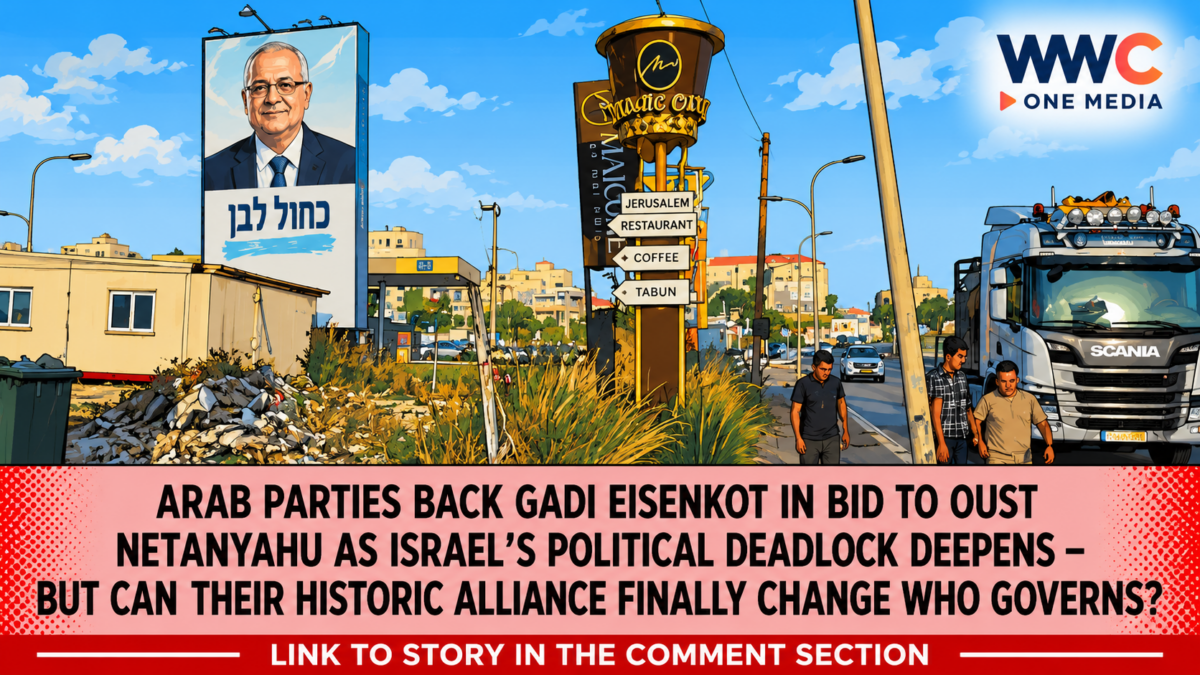
Israel’s Arab-led political parties are offering a potentially decisive lifeline to opposition leader Gadi Eisenkot as efforts intensify to end Prime Minister Benjamin Netanyahu’s long-running hold on power. But although the latest election has given Arab lawmakers unprecedented influence, deep political divisions and conflicting demands could still prevent the opposition from forming a government.
The offer marks a significant shift in Israeli politics. Ahmad Tibi, a senior lawmaker from the Arab-led Joint List, has said his bloc is prepared to support a Jewish-led government aimed at replacing Netanyahu, even if it does not become part of the governing coalition.
The development follows Israel’s October 27, 2026, general election, which produced no clear parliamentary majority. Netanyahu’s bloc secured 53 seats in the 120-member Knesset, while the Jewish-led opposition bloc led by former military chief Gadi Eisenkot won 48. The two Arab-led parties, the Joint List and Ra’am, secured a combined 19 seats.
With 61 seats required for a parliamentary majority, the Arab parties have emerged as potential kingmakers in the negotiations over Israel’s next government.
Arab Lawmakers Offer Support to Remove Netanyahu
Ahmad Tibi’s announcement represents a notable departure from the traditional reluctance of the Joint List to support Jewish-led Israeli governments.
Speaking to the Associated Press, Tibi said his bloc was prepared to consider political cooperation that had previously been off the table if it could help remove Netanyahu’s government.
The proposal does not necessarily mean the Joint List wants ministerial positions or a formal place in the Cabinet.
Instead, the party is prepared to support an alternative government from outside the coalition, potentially by voting in favour of it or abstaining during crucial parliamentary votes.
That arrangement could give Jewish-led opposition parties the support they need without requiring Arab lawmakers to take direct responsibility for government decisions, including military operations in Gaza and Lebanon that the Joint List opposes.
Tibi has argued that cooperation could help improve the lives of Palestinian citizens of Israel, particularly in areas such as public safety, violent crime and equal political representation.
However, he has also acknowledged that replacing Netanyahu would not automatically end Israel’s wars or deliver Palestinian statehood. AP News+1
Eisenkot Receives Support From 67 Lawmakers — More Than Netanyahu
The political balance shifted further on November 5, when the Arab-led Joint List formally recommended Eisenkot to President Isaac Herzog as the candidate who should receive the first opportunity to form a government.
The recommendation increased Eisenkot’s support to 67 lawmakers, compared with 46 backing Netanyahu.
The figures are significant because 67 is more than the 61 seats required for a majority in the Knesset. However, these recommendations do not automatically create a functioning governing coalition. The parties must still negotiate an agreement and secure sufficient support for a government to survive parliamentary confidence votes.
The Joint List holds 11 seats, while the United Arab List, commonly known as Ra’am, has eight.
Ra’am leader Mansour Abbas has also backed Eisenkot. Unlike the Joint List, Ra’am has indicated that it could potentially participate directly in an alternative government.
The remaining uncertainty centres on whether the Jewish-led opposition parties can agree on the terms of cooperation and whether their political differences can be overcome.
Reuters reported that Herzog was expected to identify the candidate he believes has the strongest chance of forming a government on Sunday, November 8. ReutersFeed+2
Why Arab Parties Have Become the Key to Netanyahu’s Political Future
The October election produced an unusually consequential result for Israel’s Arab political parties.
Netanyahu’s coalition fell short of a parliamentary majority, while Eisenkot’s opposition bloc also failed to secure enough seats to govern independently.
The 19 seats won by the Joint List and Ra’am therefore became crucial to the formation of any alternative administration.
Arab citizens make up roughly one-fifth of Israel’s population, but Arab-led parties have historically faced political isolation and resistance from many Jewish-led factions.
The latest result, strengthened by a major increase in Arab voter participation, has given those parties greater leverage in negotiations.
The political significance extends beyond the immediate question of who becomes prime minister. It also raises questions about whether Arab lawmakers can play a more influential role in national decision-making, particularly on issues affecting Arab communities.
These include violent crime, housing shortages, public services and political representation.
The Associated Press reported that Tibi sees the current negotiations as an opportunity to improve conditions for Palestinian citizens of Israel, even if cooperation with the opposition does not resolve the broader Israeli-Palestinian conflict. The Journal+1
A Historic Partnership Faces a Major Political Obstacle
Despite the numbers, forming a government with Arab-party support will not be straightforward.
Eisenkot leads a broad opposition alliance that includes parties from the centre-left to the political right. Although these groups share an interest in ending Netanyahu’s leadership, they do not agree on every issue.
Some opposition politicians are open to relying on Arab lawmakers, while others have ruled out formal cooperation with the Joint List.
Avigdor Lieberman, leader of Yisrael Beiteinu, has rejected working with Arab-led parties in a coalition or partnership. Other opposition figures have also expressed reservations about relying on the Joint List because of disagreements over Israel’s national identity and security policies.
The disagreement is particularly sensitive because the Joint List includes factions that reject Israel’s definition as a Jewish state and advocate equal rights for all citizens.
For many Jewish Israeli politicians, this position is a major obstacle to cooperation. For the Joint List, however, accepting the political status quo without meaningful changes would undermine the purpose of supporting a new government.
The result is a difficult political calculation: Eisenkot may need Arab support to replace Netanyahu, but securing that support could alienate some of his own potential coalition partners. Al Jazeera+2
Hamas and Israel’s Identity Become Conditions for Cooperation
One of the most contentious issues involves the conditions Eisenkot has raised for cooperation with Arab-led parties.
Among the reported requirements is that potential partners recognise Israel as a Jewish state and condemn Hamas as a terrorist organisation that must be defeated.
The Joint List has condemned the October 7, 2023, Hamas-led attack and violence against civilians. However, its representatives have refused to adopt the specific language demanded by some Jewish-led opposition politicians, arguing that doing so could be used to justify Israel’s military campaign in Gaza.
Tibi has maintained that the conditions should not necessarily apply in the same way to a party providing outside parliamentary support rather than joining the government itself.
That distinction could become central to negotiations.
If the Joint List supports an Eisenkot-led government without entering the Cabinet, both sides may be able to avoid some of the political compromises associated with a formal coalition.
But even an external-support arrangement would require trust, negotiations and agreement over how the parties would vote on major government decisions. The Times of Israel+2
Netanyahu’s Allies Question the Election Results
The negotiations are unfolding amid a dispute over allegations of electoral misconduct.
Netanyahu and members of his Likud party have accused Arab-led parties of benefiting from voter fraud and irregularities. Arab political leaders have rejected the accusations, describing them as an attempt to undermine their electoral gains and discourage cooperation with the opposition.
Israeli election officials have said the election’s integrity was not systematically compromised. Authorities have investigated suspected incidents, but the allegations have not established that the overall results were fraudulent.
President Herzog has also warned against blaming an entire community for suspected individual offences, emphasising the importance of protecting public confidence in the democratic process.
The dispute has intensified concerns about whether political rhetoric could further deepen divisions between Jewish and Arab citizens.
Reuters reported that Netanyahu’s accusations came as his opponents considered relying on Arab-party support to form a minority government. Investing.com+1
The controversy also connects to broader questions about Netanyahu’s political accountability following the October 7 attack. WWC ONE MEDIA previously examined the controversy surrounding an allegation that Netanyahu had received an advance warning before the Hamas assault in Netanyahu Faces Political Firestorm Over Report He Was Warned Before October 7 Hamas Attack. The allegation was disputed by Netanyahu’s office and should not be treated as an established finding.
President Herzog Faces a Crucial Decision
President Isaac Herzog now has a major role in determining the next stage of Israel’s political future.
After consulting representatives of the elected parties, Herzog must choose the lawmaker he believes has the best chance of forming a government.
Eisenkot’s 67 recommendations give him a stronger initial position than Netanyahu’s 46. But the president must consider whether those endorsements translate into a workable coalition.
If Eisenkot receives the mandate, he will initially have 28 days to assemble a government. Herzog can grant an extension of up to 14 additional days.
If the attempt fails, another lawmaker may be given an opportunity under Israel’s parliamentary procedures. If no government can ultimately secure the necessary support, the country could face another election.
The process is especially sensitive because Israel is already dealing with major security and diplomatic challenges, including the conflicts involving Gaza and Lebanon and wider regional tensions.
Herzog has urged political leaders to avoid another election and work toward a stable government. ReutersFeed+2
What This Could Mean for Israel’s War and Palestinian Citizens
A change in government would not automatically bring an end to Israel’s military operations or produce a breakthrough in negotiations with the Palestinians.
Tibi himself has acknowledged that supporting an alternative administration would not guarantee an end to the wars or the establishment of a Palestinian state.
Nevertheless, a government relying on Arab-party support could face different political pressures over military policy, settlement expansion, relations with the Palestinian Authority and the treatment of Arab citizens inside Israel.
For Palestinian citizens of Israel, the negotiations also represent an opportunity to press for action on domestic issues that have long been central to Arab political campaigns.
The question is whether a parliamentary arrangement built around removing Netanyahu can also deliver a shared policy programme once the immediate political objective has been achieved.
The continuing debate over Israel’s military actions and international standing has already generated significant domestic and diplomatic pressure. WWC ONE MEDIA previously covered the controversy surrounding Netanyahu’s address to the United Nations in Netanyahu Rejects Gaza Genocide Allegations at UN as Delegates Walk Out During Speech.
The issue of accountability for the October 7 security failures has also remained a major political fault line, as explored in Thousands Flood Tel Aviv in Protest Against Netanyahu — Will Israel’s Election Finally Deliver Answers on October 7?.
Meanwhile, developments in the occupied West Bank continue to add pressure to the political debate. WWC ONE MEDIA has also reported on Palestinian Families Return to Damaged Hebron Homes After Israeli Troop Withdrawal — But Recovery Is Just Beginning.
Netanyahu’s Political Future Hangs in the Balance
The latest election has placed Netanyahu in one of the most difficult political positions of his leadership.
His bloc remains the largest governing camp, with 53 seats, but it does not have the numbers required to form a majority government. Eisenkot, meanwhile, has secured recommendations from 67 lawmakers, including the support of both Arab-led parties.
That gives the opposition a potential path to power, but not a guaranteed victory.
The central challenge is whether parties with sharply different positions on Israel’s identity, military policy and Palestinian statehood can agree on a common political programme.
For the Joint List, the negotiations offer a rare opportunity to turn electoral strength into meaningful influence. For Eisenkot, Arab support could be the difference between forming a government and allowing Netanyahu to remain in office.
Herzog’s decision on November 8 could therefore become a defining moment in Israel’s post-election crisis.
The biggest question is no longer simply whether Netanyahu’s opponents have enough recommendations to challenge him. It is whether they can overcome their own divisions before the opportunity slips away.