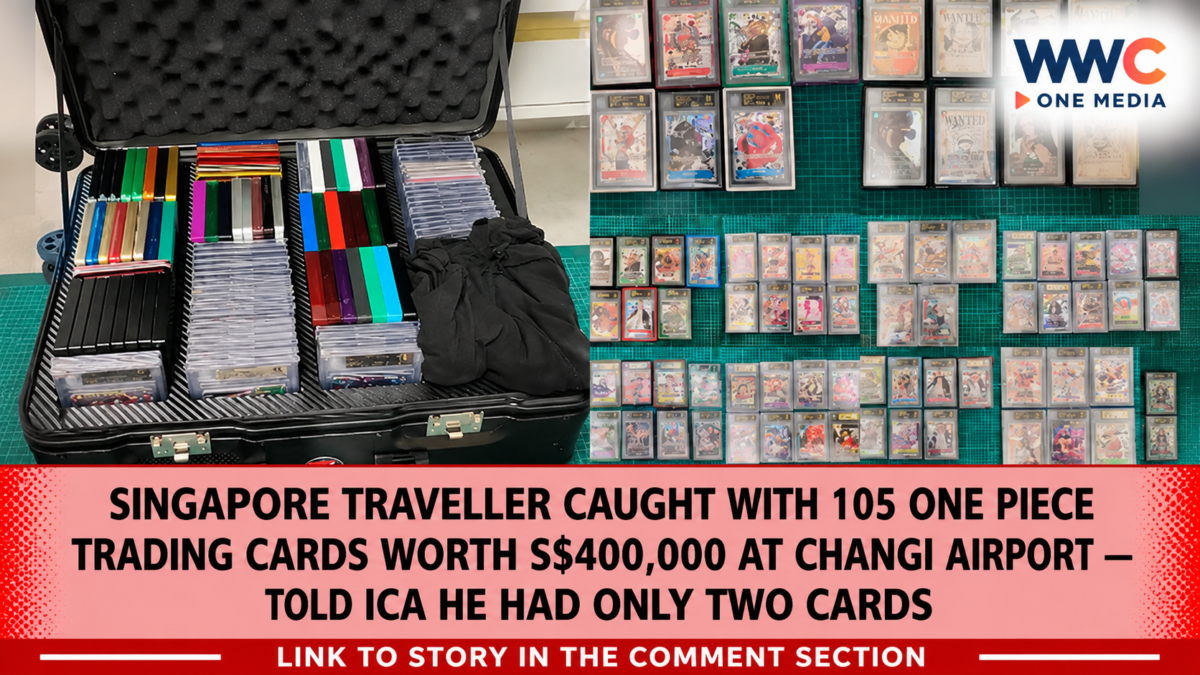
A Singaporean traveller is under investigation after Immigration and Checkpoints Authority (ICA) officers discovered 105 One Piece trading cards estimated to be worth approximately S$400,000 in his luggage at Changi Airport — despite him declaring that he had only two cards.
The discovery was made on November 2, 2026, during baggage screening at Changi Airport Terminal 4. The 31-year-old Singaporean man was referred to the screening area and questioned by ICA officers about whether he had anything to declare.
According to ICA, the man said he possessed two trading cards. However, officers noticed anomalies in one of his bags during screening. A more thorough examination uncovered 105 assorted One Piece trading cards and a luxury branded bracelet.
The estimated value of the cards alone was approximately S$400,000.
The case has since been referred to Singapore Customs for further investigation, raising questions about the declaration of expensive collectibles, overseas purchases and the tax obligations travellers face when bringing valuable goods into Singapore. AsiaOne+1
ICA Discovers S$400,000 One Piece Card Collection After Baggage Screening
The incident happened on November 2, when ICA officers at Terminal 4 directed the returning traveller to the baggage screening area.
When asked whether he had anything to declare, the man reportedly stated that he had two trading cards.
However, the subsequent baggage scan revealed irregularities in one of his bags.
ICA officers then conducted a detailed physical examination, uncovering 105 assorted One Piece trading cards and a luxury branded bracelet.
The authorities have not publicly identified the specific cards, their individual market prices, the brand of the bracelet or the traveller’s intended use for the collection.
It is also important to note that the S$400,000 figure is an estimated value provided by ICA. The agency has not publicly detailed how the individual cards were valued or whether the collection was intended for personal collecting, resale or another purpose.
The traveller was referred to Singapore Customs, which will investigate the circumstances surrounding the undeclared goods. AsiaOne+1
Why Are One Piece Trading Cards Worth So Much?
One Piece is one of Japan’s most successful manga and anime franchises, following Monkey D. Luffy and his crew as they search for the legendary treasure known as the One Piece.
Created by Eiichiro Oda, the franchise has expanded into television animation, films, video games, merchandise and a popular trading card game.
Some cards have become highly sought-after collectibles because of their rarity, condition, special artwork, limited availability and demand among international collectors.
The market can produce extraordinary prices for particularly desirable cards, although not every card has a high resale value.
The scale of Singapore’s latest airport discovery becomes clearer when compared with another recent One Piece collecting story.
In May 2026, AsiaOne reported that a Singaporean collector traded eight One Piece cards valued at approximately S$180,000 for a Patek Philippe watch worth S$160,000 and S$20,000 in cash at a collectors’ convention in Kuala Lumpur.
That transaction demonstrated how some rare trading cards can command prices comparable to luxury watches and other high-end assets. AsiaOne
The S$400,000 collection discovered at Changi Airport is considerably larger in estimated value, although authorities have not disclosed its exact card-by-card composition.
Changi Airport Has Seen Previous Cases Involving Expensive Trading Cards
The latest discovery is not the first time Singapore authorities have uncovered large quantities of valuable collectible cards in travellers’ luggage.
In October 2025, ICA officers at Changi Airport Terminal 1 discovered Pokémon trading cards worth more than S$30,000 in the luggage of a 25-year-old Singaporean man.
According to The Straits Times, the traveller had been directed to the baggage screening area and reportedly told officers that he had nothing to declare.
A subsequent examination uncovered the cards, and the case was referred to Singapore Customs for investigation. The Straits Times+1
Singapore Customs’ 2025 annual report also documented another significant Pokémon-card case.
In April 2025, officers stopped two travellers suspected of bringing Pokémon cards from Japan into Singapore without declaring them for tax payment.
Investigations uncovered 2,330 cards in their possession, with another 336 cards found during a follow-up search at their residence.
Authorities said the pair operated a business helping customers in Singapore purchase Pokémon cards from Japan for a commission of between 10 and 15 per cent.
The GST evaded on the cards amounted to approximately S$3,691, with another S$1,906 in short-paid GST associated with cards seized from their residence.
The cases demonstrate why customs authorities pay attention to high-value collectibles, particularly when large quantities are brought across international borders. File.gov.sg+1
Singapore’s GST Rules: What Travellers Need to Know
ICA reminded travellers that newly acquired goods brought into Singapore may be subject to GST and, where applicable, customs duties.
Singapore residents returning from overseas trips can qualify for GST import relief depending on how long they have been away.
Under the relief arrangements cited by AsiaOne:
- Away for 48 hours or more: GST import relief of up to S$500.
- Away for less than 48 hours: GST import relief of up to S$100.
- Goods exceeding the applicable relief: GST is calculated on the amount above the relief threshold.
For example, a traveller who has been overseas for at least 48 hours may qualify for up to S$500 in GST import relief. If newly acquired goods exceed that amount, the excess may be subject to GST.
The applicable treatment depends on the goods, the traveller’s circumstances and the relevant customs requirements.
ICA also warned that failing to declare goods or making an incorrect declaration can result in penalties. AsiaOne reported that fines for failing to declare or incorrectly declaring non-dutiable goods may reach up to 20 times the GST amount involved.
Travellers who are uncertain about their obligations are advised to declare their goods at the Red Channel or approach the Singapore Customs Tax Payment Office. AsiaOne+1
Red Channel vs Green Channel: Why the Difference Matters
Singapore’s airport clearance system provides two channels for travellers arriving at checkpoints.
The Green Channel is intended for passengers who do not have dutiable, controlled or prohibited goods to declare.
However, choosing the Green Channel does not mean a traveller is automatically exempt from inspection. ICA officers can still screen baggage and conduct further checks when necessary.
The Red Channel is for passengers who need to declare goods requiring customs attention.
ICA advises travellers to use the Red Channel if they are unsure whether their purchases need to be declared.
Importantly, making a false or incorrect declaration is an offence. Items requiring permits or further clearance may also be retained and referred to the relevant authorities.
The distinction is especially important for collectors who purchase expensive items overseas and bring them home in their personal luggage. Immigration & Checkpoints Authority+1
Singapore Is Also Preparing New Rules for Trading Card Packs and Blind Boxes
The Changi Airport discovery comes as Singapore is developing additional safeguards for trading card packs and blind-box products.
In February 2026, the Ministry of Home Affairs announced that it intended to regulate blind boxes, including trading card packs, to address concerns about gambling-related inducement and excessive spending.
These products are typically sold in sealed packaging, with buyers not knowing exactly which collectible they will receive until opening it.
In May 2026, Home Affairs Minister K. Shanmugam clarified that the Government did not intend to force retailers to open sealed trading card packs and sell their contents individually.
Instead, proposed safeguards would aim to address gambling-related risks without effectively banning blind-box products.
The regulatory discussion is separate from the Changi Airport customs investigation. The proposed blind-box rules concern how such products are sold, while the airport case concerns the declaration of goods brought into Singapore.
Nevertheless, both developments highlight the growing attention being paid to the trading-card and collectible market. CNA+1
One Piece Collectibles Have Built a Growing Following in Singapore
Singapore’s enthusiasm for One Piece extends beyond trading cards.
In September 2025, the official Mugiwara Store opened at Jewel Changi Airport, attracting fans who arrived hours before its launch.
The outlet sold official merchandise, including figurines, apparel, accessories, stationery and other products inspired by the popular manga and anime franchise.
AsiaOne reported that some fans queued from early morning to attend the opening, with a limited-edition Harajuku Chopper figurine selling out within minutes.
The store subsequently announced that its Jewel outlet would close on August 31, 2026, while hinting that the brand could continue its journey elsewhere.
The popularity of the franchise helps explain why One Piece merchandise and collectibles have become a visible part of Singapore’s retail and collector culture. AsiaOne+1
WWC ONE MEDIA has also reported on other developments involving Changi Airport and Singapore’s travel sector:
- Changi Airport’s Self-Check-In System Suddenly Went Down — Then Passengers Started Queuing Across Multiple Terminals
- Man to Be Charged Over Alleged Perfume Theft Spree at Singapore’s Changi Airport
- British Man, 52, to Face Court After Hidden Camera Was Found in Plane Toilet on Japan-Singapore Flight
- Travellers Reminded to Update MyICA App for Enhanced Singapore Arrival Card
Singapore Customs Investigation Continues
The 31-year-old traveller has been referred to Singapore Customs following the discovery of the 105 One Piece trading cards and luxury bracelet.
As of the November 6 report, authorities had not announced whether charges would be filed, whether the items would be seized permanently or what the final tax assessment would be.
The estimated S$400,000 value makes the discovery particularly striking, but the central issue is not simply how expensive the cards are.
Travellers bringing newly acquired valuables into Singapore must understand their declaration obligations, even when the items are collectibles rather than conventional luxury purchases.
For One Piece fans, rare cards may represent prized pieces of a collection. For customs authorities, however, their collectible status does not automatically exempt them from applicable import rules.
The investigation now raises a question that collectors travelling internationally should take seriously: Could a valuable trading-card collection become a costly customs problem if its owner fails to declare it correctly?