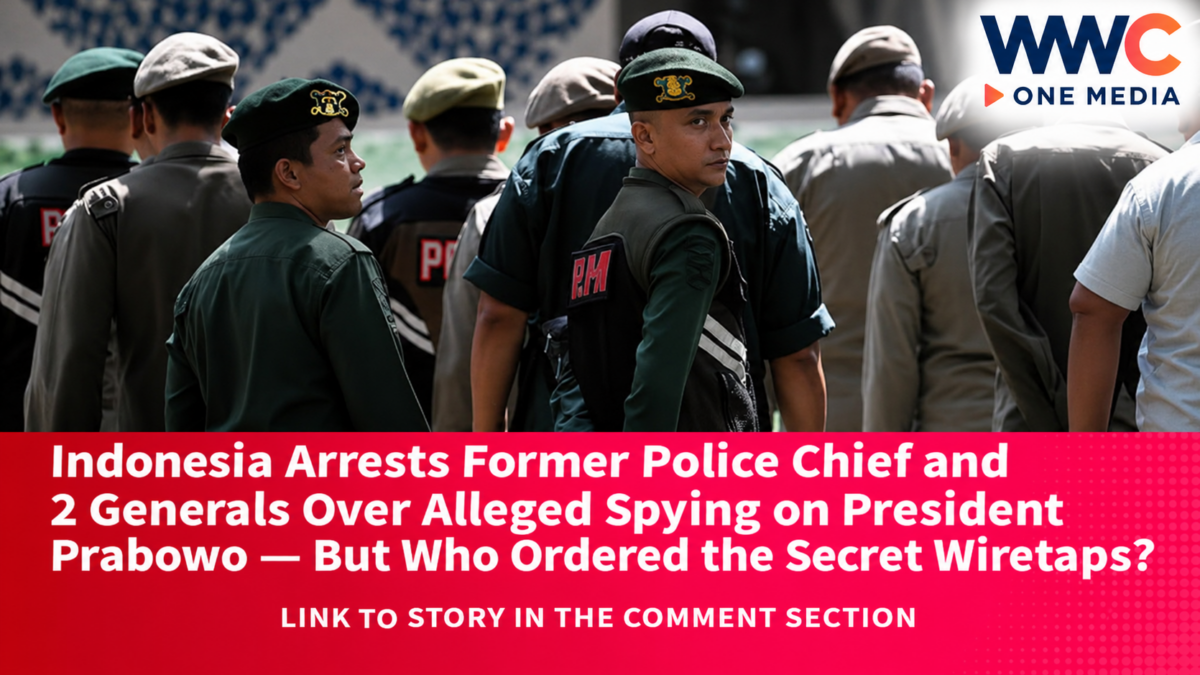
JAKARTA, INDONESIA / MANILA — Indonesia has been rocked by an extraordinary surveillance scandal after authorities detained former national police chief Listyo Sigit Prabowo and two other senior police generals over allegations that they illegally intercepted communications belonging to President Prabowo Subianto, government officials, politicians, journalists and business leaders.
The arrests, announced on November 3, have triggered serious questions about the misuse of state surveillance systems, political trust and the security of communications within Southeast Asia’s largest economy.
According to Bloomberg, Reuters and the Associated Press, investigators believe the unauthorized surveillance took place between 2025 and 2026, allegedly using the Indonesian National Police’s own communications interception infrastructure.
Authorities also accuse the suspects of ordering electronic records deleted in October 2026 to conceal the alleged operation.
The scandal is particularly sensitive because Listyo, who previously led the Indonesian National Police, was appointed President Prabowo’s chief of staff only a month earlier.
Yet the most important question remains unanswered: Why was Indonesia’s own president allegedly being monitored by senior officers entrusted with enforcing the law?
Three Senior Police Generals Detained in Major Security Investigation
Indonesia’s National Police Criminal Investigation Agency, known as Bareskrim, announced that three senior officers had been named suspects.
They were identified as:
- Gen. Listyo Sigit Prabowo: Former national police chief and current presidential chief of staff.
- Insp. Gen. Ahrie Sonta Nasution: Head of the National Police Legal Division.
- Insp. Gen. Eko Hadi Santoso: Senior police instructor at the National Police Education and Training Institute.
The suspects were detained at National Police Headquarters in Jakarta.
Bareskrim chief Commissioner General Asep Safrudin said investigators were examining alleged illegal interception, unauthorized access to electronic systems and the destruction or deletion of electronic information.
A fourth individual, identified publicly only by the initials SU, was being questioned as a witness.
Authorities have not announced that this person has been charged.
The investigation remains ongoing, and the allegations have not been proved in court.
President Prabowo Among Alleged Surveillance Targets
The scope of the alleged wiretapping operation is one of the most alarming aspects of the investigation.
Police said intercepted telephone numbers allegedly belonged to a wide range of people, including President Prabowo Subianto, ministers, politicians, journalists, civil society representatives, nongovernmental organization leaders and businesspeople.
The breadth of the alleged targets has raised questions about whether surveillance capabilities reserved for legitimate investigations were used for unauthorized purposes.
According to Indonesia’s ANTARA news agency, coordinating law minister Yusril Ihza Mahendra confirmed that the president had been informed of the allegations by National Police Chief Suyudi Ario Seto.
The minister described the alleged monitoring of the president and senior government officials as a serious matter involving national interests.
However, authorities have not publicly established what information was obtained or how it may have been used.
No evidence has been presented publicly proving that the suspected surveillance was part of an organized attempt to overthrow the government.
How Indonesia’s Police Interception System Was Allegedly Misused
Investigators believe the suspects used the National Police’s Lawful Interception Management System, or LIMS.
The system is designed to support authorized interception activities connected to legitimate law-enforcement investigations.
Such systems are subject to procedural requirements intended to prevent arbitrary surveillance.
According to investigators, telephone numbers were allegedly entered into the system without the necessary verification, written investigative requests or related law-enforcement justification.
The suspected activity reportedly began in 2025 and continued into 2026.
If established, the conduct could represent an abuse of tools intended for criminal investigations.
But access to a surveillance platform alone does not prove that every communication associated with a targeted number was successfully intercepted.
Investigators must establish what actions occurred, which data was obtained and who authorized the activity.
Those distinctions will be essential in determining individual criminal responsibility.
Investigators Allege Surveillance Records Were Deleted
The scandal became more serious after police revealed allegations of attempts to conceal the activity.
Asep Safrudin said the suspects allegedly ordered records relating to intercepted communications deleted during October 2026.
The records were reportedly associated with the police interception management system.
Investigators believe the deletion was intended to erase evidence of the unauthorized monitoring.
The suspected activity came to the attention of authorities after an officer reported concerns on October 30.
Police subsequently questioned 10 witnesses and three expert witnesses.
Investigators also seized 11 mobile phones, one tablet and four USB flash drives.
Those devices may contain information relevant to identifying communications, instructions or actions associated with the alleged surveillance.
However, the seizure of electronic equipment does not establish guilt.
Forensic examination and appropriate legal proceedings will be necessary to determine the evidentiary value of the materials.
Why Listyo Sigit Prabowo’s Arrest Is Especially Significant
Listyo’s detention carries major political significance because of his seniority and recent appointment to President Prabowo’s administration.
Listyo served as Indonesia’s national police chief from 2021 until October 2026.
He was originally appointed under former President Joko Widodo.
During his tenure, he oversaw one of the country’s most powerful law-enforcement institutions, with responsibility for nationwide policing and criminal investigations.
On October 1, 2026, President Prabowo replaced him as national police chief and subsequently appointed him presidential chief of staff.
The move placed Listyo in a senior position close to the presidency.
WWC ONE MEDIA previously examined that government reshuffle in Indonesia President Prabowo Appoints Career Diplomat as New Foreign Minister.
That report discussed the wider Cabinet changes, including the replacement of the national police chief and Listyo’s reassignment.
His arrest just weeks later raises questions about internal oversight and the handling of sensitive government communications.
However, the timing alone does not prove that the October reshuffle was connected to the alleged surveillance.
The reasons for the suspected operation remain under investigation.
Was the Alleged Wiretapping Connected to a Coup Plot?
One of the most politically sensitive questions is whether the alleged surveillance was connected to an attempt to destabilize President Prabowo’s administration.
Indonesian authorities have cautioned against that interpretation.
Yusril Ihza Mahendra said investigators had found no indication of treason or an attempted overthrow of the government.
He also emphasized that the purpose of the suspected surveillance remained unknown.
That distinction is essential.
Unauthorized monitoring of senior officials can raise serious national-security concerns without necessarily constituting a coup attempt.
Surveillance could hypothetically be motivated by political intelligence gathering, personal interests or other purposes, but investigators have not established any such explanation in this case.
Suggesting that a coup plot has been uncovered would therefore go beyond the available evidence.
The investigation’s next major challenge is determining who authorized the alleged activity, what information was collected and whether additional individuals were involved.
Indonesia’s Political Leadership Faces Another Test
The surveillance allegations arrive during an already difficult period for Prabowo’s administration.
Indonesia has faced public criticism over economic conditions, government spending, environmental emergencies and the implementation of major national programs.
Recent controversies have placed additional pressure on political leadership and institutional credibility.
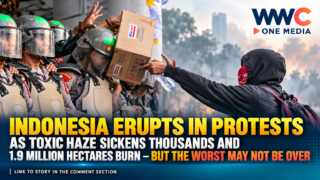
In October, protests erupted over devastating forest fires and widespread toxic haze affecting Indonesia and neighboring countries.
WWC ONE MEDIA reported the developments in Indonesia Erupts in Protests as Toxic Haze Sickens Thousands and 1.9 Million Hectares Burn — But the Worst May Not Be Over.
Those demonstrations reflected broader public frustration involving environmental management, governance and accountability.
The wiretapping investigation is a separate matter.
Nevertheless, multiple controversies unfolding within a short period can intensify scrutiny of government institutions.
A credible investigation that follows established legal procedures will be important for public confidence.
The Scandal Comes After Major Changes Inside Prabowo’s Government
The arrest also follows a series of high-level appointments and reshuffles.
In September, Prabowo replaced Finance Minister Purbaya Yudhi Sadewa with Suahasil Nazara amid growing pressure over government finances and economic growth.
WWC ONE MEDIA examined the transition in Indonesia Just Got Its Third Finance Minister Under Prabowo — But Suahasil Must Chase 6% Growth Without Breaching the 3% Deficit Ceiling.
The reshuffle highlighted the administration’s efforts to manage economic priorities and maintain investor confidence.
Separately, Prabowo expanded his circle of advisers by appointing prominent business leaders, former officials and political figures.
WWC ONE MEDIA covered the appointments in Prabowo Taps Billionaires and Political Heavyweights for New Advisory Council — But Critics Want to Know Who Will Really Shape Policy.
These developments provide context for the administration’s recent changes in leadership.
They do not establish a relationship between the appointments and the alleged wiretapping.
But they illustrate why the detention of a newly appointed presidential chief of staff is especially consequential.
How Serious Are the Possible Criminal Penalties?
Indonesian investigators are examining alleged violations of the country’s Criminal Code and Electronic Information and Transactions Law.
The suspected offenses concern unlawful interception, unauthorized access and deletion or alteration of electronic information.
According to officials, the relevant provisions include penalties of up to:
- 10 years’ imprisonment for certain unlawful interception offenses.
- Six years for specified unauthorized electronic-system offenses.
- Eight years for certain illegal electronic-data alteration or deletion offenses.
The precise sentence, if any, would depend on the offenses proved, applicable legal provisions and judicial findings.
The separate maximum penalties should not automatically be added together as though a 24-year sentence has already been established.
The suspects remain entitled to the presumption of innocence and appropriate legal proceedings.
Authorities must prove the allegations before criminal liability can be determined.
Could the Investigation Trigger a Wider Review of State Surveillance?
The controversy has exposed broader questions about the security of Indonesia’s surveillance infrastructure.
Lawful interception capabilities can be important tools for investigating serious crime and national-security threats.
But these systems can also create risks when access controls, authorization procedures and audit mechanisms are inadequate.
The government’s response may therefore involve more than prosecuting individual suspects.
Yusril said authorities would consider evaluating state agencies that possess interception powers and equipment.
Such a review could examine how sensitive systems are accessed, who approves surveillance requests and how activity records are protected.
Effective oversight would need to ensure that legitimate investigations can continue while reducing the risk of unauthorized monitoring.
The alleged deletion of surveillance records makes audit integrity particularly important.
Systems used for sensitive investigations must be capable of preserving reliable evidence of who authorized and conducted interception activities.
What the Case Means for Journalists and Civil Society
The inclusion of journalists and civil society representatives among the alleged targets raises significant concerns about privacy and democratic accountability.
Journalists sometimes communicate with confidential sources who provide information about government activities, corruption or matters of public interest.
Unauthorized interception of those communications could undermine source confidentiality.
Civil society organizations may likewise need secure channels to communicate with members, witnesses and communities.
However, the public investigation has not established the identities of every alleged victim or confirmed that particular journalistic sources were compromised.
Further evidence will be needed to determine the full consequences.
A transparent and lawful investigation will be important not only for national security but also for public confidence in the protection of lawful communications.
Indonesia’s Institutional Credibility Faces Growing Scrutiny
Prabowo’s administration is also confronting questions about investor confidence and market governance.
In October, the president criticized global index provider MSCI following concerns about Indonesia’s stock-market classification and transparency.
WWC ONE MEDIA reported the dispute in Prabowo Accuses MSCI of ‘Intimidating’ Indonesia After Historic Stock Market Crash — But a Bigger Financial Threat Looms.
That dispute was unrelated to the wiretapping investigation.
However, financial markets and international investors often consider institutional stability, predictable legal processes and government accountability when evaluating investment environments.
A high-profile criminal investigation involving senior security officials could attract additional scrutiny.
This does not mean the arrests will necessarily cause capital flight, currency weakness or an economic downturn.
Any financial-market impact would depend on subsequent developments and broader economic conditions.
What Happens Next? Three Critical Questions
The investigation now faces several important tests.
First, who authorized the alleged interceptions?
Investigators must establish whether surveillance orders originated with the detained officers or involved other individuals.
Second, what information was obtained and how was it used?
Authorities have not established the full purpose or consequences of the alleged monitoring.
Determining whether confidential government, political or journalistic communications were compromised will be important.
Third, can investigators reconstruct the allegedly deleted records?
Electronic evidence may help determine the extent of the suspected operation.
Its reliability and legal admissibility will be crucial to any prosecution.
The answers could determine whether the case remains focused on three senior officials or develops into a wider investigation.
The Bigger Picture: A Major Test for Indonesia’s Security Institutions
The detention of a former national police chief and two other generals is an extraordinary development for Indonesia.
The suspected targets include the country’s president, senior government officials, political figures and members of civil society.
Investigators allege that a state interception system was used without proper authorization and that records were subsequently deleted.
But important facts remain unresolved.
Authorities have not established the motive behind the alleged monitoring.
They have not announced evidence of a coup attempt.
And the suspects have not been convicted of criminal wrongdoing.
The case therefore requires both serious investigation and careful treatment of the evidence.
For President Prabowo, the political challenge is to ensure that an investigation involving powerful security officials proceeds according to law.
For Indonesia’s institutions, the longer-term challenge may be demonstrating that surveillance powers are properly controlled and cannot be used for unauthorized purposes.
With a former police chief and two generals detained over alleged secret monitoring of Indonesia’s president, the country’s security establishment faces a critical question: Was this an isolated abuse of surveillance authority—or could investigators uncover a wider network of unauthorized monitoring reaching deeper into the halls of power?