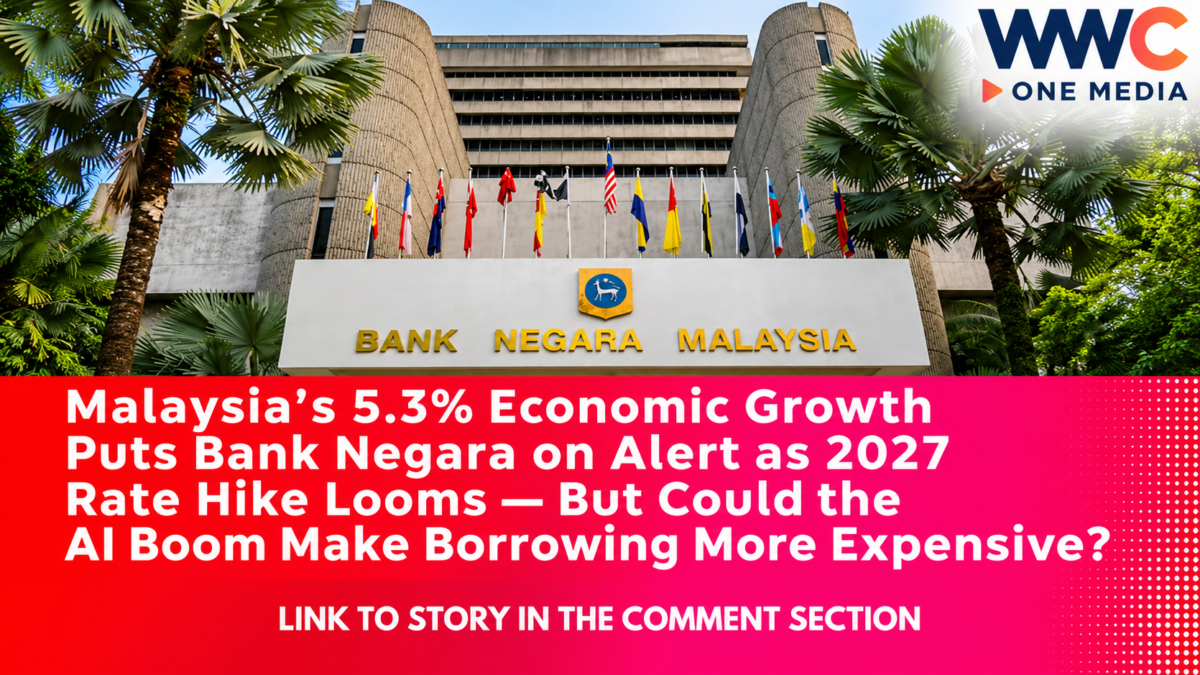
KUALA LUMPUR, MALAYSIA / MANILA — Malaysia’s unexpectedly resilient economy is creating a new dilemma for its central bank: keep interest rates low to support households and businesses, or begin preparing for higher borrowing costs before inflation becomes a bigger problem in 2027.
Bank Negara Malaysia (BNM) is widely expected to maintain its benchmark Overnight Policy Rate (OPR) at 2.75% during its final monetary policy meeting of 2026 on Thursday, November 5.
But the prospect of another rate increase is moving closer as strong consumer spending, technology exports and investment activity continue to support economic growth.
According to Bloomberg, 17 of 23 economists surveyed expect BNM to leave its policy rate unchanged, while six anticipate an immediate increase of 25 basis points to 3%.
Several financial institutions believe the central bank could instead wait until early 2027 before reversing the rate cut introduced in July 2025.
The growing debate reflects Malaysia’s unusually strong economic position compared with several regional neighbors.
The country’s economy expanded an estimated 5.3% year over year in the third quarter of 2026, while inflation remained relatively moderate at 1.8% in September.
Demand for semiconductors and other electronics associated with the global artificial intelligence boom has helped sustain exports, while consumption and investment have supported domestic activity.
Yet rising global energy costs and the possibility of broader inflation are complicating the outlook.
As Malaysia’s economy outperforms expectations, will Bank Negara preserve its relatively low interest rate—or could the very strength of its recovery force households and businesses to pay more for loans in 2027?
Bank Negara Malaysia Expected to Keep Interest Rates at 2.75%
BNM’s Monetary Policy Committee is scheduled to announce its sixth and final decision of 2026 on November 5.
The current OPR stands at 2.75%.
The central bank last adjusted its benchmark in July 2025, cutting the rate by 25 basis points from 3%.
That decision was intended to provide precautionary support to an economy confronting uncertainty from US tariffs and global trade conditions.
Since then, Malaysia’s economic performance has exceeded some earlier expectations.
Strong domestic demand and resilient exports have reduced the apparent need for additional monetary support.
However, policymakers must also consider the possibility that a prolonged period of strong growth could eventually contribute to higher price pressures.
The latest Bloomberg survey illustrates the uncertainty.
Seventeen economists expect the rate to remain at 2.75% during the November meeting.
Six expect an immediate increase to 3%.
The majority forecast favors stability, but the minority expecting tighter policy shows that markets are no longer treating the next rate increase as a distant possibility.
Crucially, these are forecasts made ahead of the decision.
The central bank’s official announcement, rather than the survey, will determine whether monetary policy changes.
Malaysia’s Economy Grows 5.3% as AI Demand Boosts Exports
Malaysia’s growth has been one of the main reasons economists are reconsidering the interest-rate outlook.
According to advance estimates from the Department of Statistics Malaysia, gross domestic product expanded 5.3% in the third quarter compared with the same period in 2025.
Growth during the first nine months of 2026 averaged approximately 5.5%.
The government subsequently raised its full-year growth forecast to 4.8%–5.3%, from its earlier expectation of 4%–5%.
For 2027, it projects expansion of 4.2%–5.2%.
The revised figures reflect resilience across several important sectors.
Private consumption has remained supportive, while investment activity continues to benefit from new projects.
The electronics industry is also experiencing strong demand for components used in advanced computing and artificial intelligence.
Malaysia plays a significant role in semiconductor assembly, packaging, testing and related manufacturing activities.
That position has helped the economy benefit from global technology investment.
However, third-quarter GDP figures remain advance estimates and may be revised when fuller statistical information becomes available.
The AI Boom Is Transforming Malaysia’s Economic Outlook
Malaysia’s position in the global semiconductor industry has become increasingly important as technology companies expand AI infrastructure.
Demand for advanced processors also creates opportunities for companies involved in semiconductor packaging, testing, electronic components and associated services.
Malaysia has sought to move further into higher-value technology activities.
One major example is the development of Penang’s Silicon Island.
WWC ONE MEDIA examined the project in Malaysia Is Building a 2,300-Acre Silicon Island for the AI Boom — But the Real Prize Is Much Bigger Than Data Centers.
The development is intended to support investment in advanced manufacturing, semiconductor technology and related industries.
Its projected economic benefits remain dependent on construction progress, infrastructure delivery and successful investment commitments.
Nevertheless, the project illustrates Malaysia’s long-term ambition to benefit from the growth of global computing demand.
The challenge for the central bank is that stronger exports and investment can support employment and economic growth while eventually increasing demand pressures.
That creates the possibility of higher interest rates even when economic activity remains healthy.
Why Economists Expect a Rate Hike in 2027
Several major banks believe BNM may increase the OPR by 25 basis points during the first half of 2027.
HSBC economists Yun Liu and Madhurima Nag expect a hike in the first quarter.
They argue that the central bank may begin normalizing monetary policy as a precaution rather than waiting for inflation to become severe.
CIMB economists Chew Khai Yen and Michelle Chia also expect the rate to rise to 3% in March 2027.
Their forecast reflects expectations that underlying inflation could strengthen as the economy continues expanding.
CIMB projects core inflation moving toward approximately 2.5% during the third quarter of 2027.
A 25-basis-point increase would reverse the precautionary reduction implemented in July 2025.
However, a forecast rate hike is not a commitment by the central bank.
The timing and size of any adjustment will depend on economic data and the Monetary Policy Committee’s assessment of risks.
Some research firms disagree with the expectation of an increase.
That disagreement is important because it demonstrates that Malaysia’s monetary-policy outlook is not settled.
Fitch Solutions’ BMI Says Rates Could Stay Unchanged Through 2027
Not every analyst believes the central bank needs to tighten policy next year.
BMI, a research unit of Fitch Solutions, expects BNM to retain the OPR at 2.75% throughout 2027.
According to a November 4 report carried by Bernama, BMI believes Malaysia’s economic growth can remain resilient without creating excessive inflation.
The firm also points to stable employment conditions and manageable consumer-price pressures.
Unemployment was approximately 3.1%, according to the figures cited in its assessment.
BMI projects real household spending growth of about 4.08% in 2026 and 4.07% in 2027.
Those forecasts suggest that consumer demand could continue expanding steadily rather than accelerating sharply.
However, BMI also recognizes risks from food and fuel costs, household debt and tighter fiscal conditions.
The competing forecasts offer two different interpretations of the same economy.
One argues that strong growth justifies a gradual return to higher interest rates.
The other maintains that stable inflation gives policymakers sufficient room to keep borrowing costs unchanged.
The final outcome will depend on whether inflation remains moderate as Malaysia enters 2027.
Inflation Remains Low Despite Global Oil Price Pressures
One of Malaysia’s greatest economic advantages has been its relatively contained inflation.
Consumer prices increased 1.8% year over year in September 2026.
That was within the government’s projected 2026 inflation range of 1.5%–2.5%.
The result contrasts with the substantial inflation pressures affecting some other economies.
Government fuel subsidies have helped limit the impact of higher global petroleum costs on Malaysian households.
The country’s position as a producer and net exporter of energy has also provided a degree of protection.
However, this does not mean Malaysia is immune to international oil-price shocks.
Higher energy prices can raise transportation, manufacturing and business operating costs.
If those costs persist, companies may eventually pass more of them on to consumers.
The government expects inflation to range from 1.8% to 2.8% in 2027.
That projection suggests price pressures could increase even if inflation remains manageable by regional standards.
Middle East Conflict Creates Another Risk for Malaysia
The conflict involving Iran and disruptions to international energy markets remain important sources of uncertainty.
Oil-price volatility can influence domestic transport costs, business expenses and government subsidy requirements.
Malaysia has already experienced changes in retail fuel prices during 2026.
WWC ONE MEDIA previously reported the issue in Malaysia Fuel Prices Jump 25 Sen as Middle East War Sends Global Oil Markets Soaring.
That report examined September increases in selected unsubsidized petrol and diesel prices.
Those adjustments demonstrated how international energy costs can affect domestic prices despite Malaysia’s subsidy framework.
The longer elevated petroleum prices persist, the more difficult it may become for government support measures to contain their impact.
Higher subsidy costs can also create pressure on public finances.
For BNM, the central question is whether those pressures remain temporary or begin influencing broader consumer prices and wages.
An interest-rate increase may become more likely if the effects spread throughout the economy.
But higher borrowing costs cannot directly increase global oil production or eliminate geopolitical disruptions.
Malaysia’s 2027 Budget Adds Another Dimension
Fiscal policy may also influence the central bank’s decisions.
Malaysia’s 2027 budget includes measures intended to support households, improve income levels and maintain investment.
At the same time, policymakers must manage fiscal sustainability and the cost of government support programs.
WWC ONE MEDIA examined the outlook in Malaysia Unveils RM459.8-Billion Election-Year Budget With Higher Wages and Tax Cuts — But Anwar Faces a Bigger Test as Living Costs and Political Pressure Rise.
The report discussed planned wage increases, household support and measures intended to encourage investment.
Such policies can influence consumption and business activity.
For example, higher wages may strengthen household purchasing power but can also raise costs for some employers.
Similarly, additional public spending can support economic activity while requiring careful fiscal management.
BNM must consider the interaction between fiscal measures and monetary conditions.
A healthy economy can absorb some adjustments more easily than a weak one.
But sustained demand growth may also increase inflation risks if production cannot keep pace.
Why Data Center Investment Matters to Malaysia’s Economy
Malaysia’s technology expansion extends beyond semiconductor factories.
The country has also become a significant location for data center development, particularly in Johor.
Developers are investing in facilities designed to support cloud computing and artificial intelligence.
WWC ONE MEDIA previously covered a major proposed financing transaction in Singapore’s PDG Seeks $1.2 Billion for Malaysia AI Data Center — But Asia’s Growing Debt Boom Faces a Bigger Test.
The report examined Princeton Digital Group’s attempt to obtain financing for a major data center campus.
The proposed loan was not reported as fully completed at the time.
Nevertheless, the project demonstrates the scale of investment required to expand digital infrastructure.
Large developments can support construction, demand for equipment and specialized employment.
They also create financing requirements and substantial electricity needs.
A higher interest-rate environment could increase borrowing costs for companies developing new facilities, depending on their financing arrangements.
That makes the timing of any BNM rate hike relevant to Malaysia’s broader technology investment strategy.
Malaysia’s Ringgit Has Been More Resilient Than Several Regional Currencies
The Malaysian ringgit has also performed comparatively well during the recent period of global financial volatility.
Bloomberg reported that the ringgit was little changed against the US dollar for the year, while the Philippine peso, Thai baht and Indonesian rupiah had weakened by more than 6%.
On November 4, Bernama reported that the ringgit strengthened to approximately RM4.0610–RM4.0660 per US dollar at the local market close.
That compared with RM4.0735–RM4.0775 in the previous session.
The currency’s relative stability can help limit imported price pressures.
However, its performance is influenced by many factors, including export earnings, foreign investment, commodity prices and global interest-rate expectations.
A stable exchange rate does not eliminate inflation risk.
Nor does it mean that BNM must raise rates.
Exchange rates are one consideration within a broader monetary-policy framework.
Could Higher Interest Rates Help Malaysian Banks?
A potential increase in the OPR could have mixed effects on the banking industry.
Some banks may benefit from higher interest income, especially if returns on loans adjust faster than the interest paid on deposits.
Hong Leong Investment Bank estimates that a hypothetical 25-basis-point rate increase in the first half of 2027 could improve net interest margins at banks it covers.
However, greater competition for deposits could reduce those benefits.
Higher interest rates may also increase borrowing costs for consumers and businesses.
Households with floating-rate mortgages could face changes in repayments, depending on their loan agreements.
Companies may find some types of financing more expensive.
Higher deposit rates could benefit savers, but banks do not necessarily pass through policy-rate changes immediately or in full.
The net economic impact will depend on lending conditions, inflation and the pace of broader growth.
What the Malaysia Rate Debate Means for the Philippines
The different monetary-policy conditions in Malaysia and the Philippines highlight the diversity of Southeast Asian economies.
Malaysia’s inflation remained moderate at 1.8% in September.
The Philippines faced substantially stronger consumer-price pressures during the same period.
Malaysia benefits from its energy-production capacity and technology-related exports.
The Philippines relies more heavily on imported energy and has faced additional inflation pressures from food, transportation and currency depreciation.
These differences help explain why central banks across the region may pursue different interest-rate policies.
For Philippine businesses, Malaysia’s relatively strong growth could offer opportunities through trade, manufacturing and regional investment.
But the impact of any rate change would depend on actual policy decisions and financial-market responses.
Higher Malaysian rates could influence cross-border capital flows and currency expectations.
However, those effects are not automatic and cannot be reliably predicted from a single monetary-policy meeting.
Three Signals Investors Should Watch Next
First, BNM’s official November 5 policy statement.
The most important immediate development is whether the central bank maintains its 2.75% rate and how it describes inflation risks.
A more cautious or restrictive tone could influence expectations for 2027.
Second, inflation and wage developments in early 2027.
Economists will monitor whether higher energy and food costs begin to affect a broader range of prices.
Core inflation will also be important.
Third, the durability of technology-led growth.
Malaysia’s outlook depends partly on strong electronics exports and investment.
Any sustained slowdown in global AI infrastructure spending could weaken demand for Malaysian technology products.
Conversely, continued growth could strengthen the case for gradually normalizing interest rates.
The Bigger Picture: Could Malaysia Become a Victim of Its Own Economic Success?
Malaysia enters the final months of 2026 with a comparatively strong economic position.
Growth has exceeded earlier expectations.
The electronics sector continues benefiting from global AI demand.
The ringgit has remained relatively resilient.
And inflation is still moderate despite higher international energy prices.
But the strength of the economy creates a monetary-policy dilemma.
Keeping rates low may support households, investment and business activity.
Raising rates too early could unnecessarily increase borrowing costs.
Waiting too long could allow price pressures to become more persistent.
HSBC and CIMB believe a precautionary increase to 3% may be appropriate in early 2027.
BMI expects the central bank to remain on hold throughout next year.
Those contrasting forecasts show that the economic outlook remains uncertain.
For now, the most important signal will come from BNM’s official policy statement and its assessment of the balance between growth and inflation.