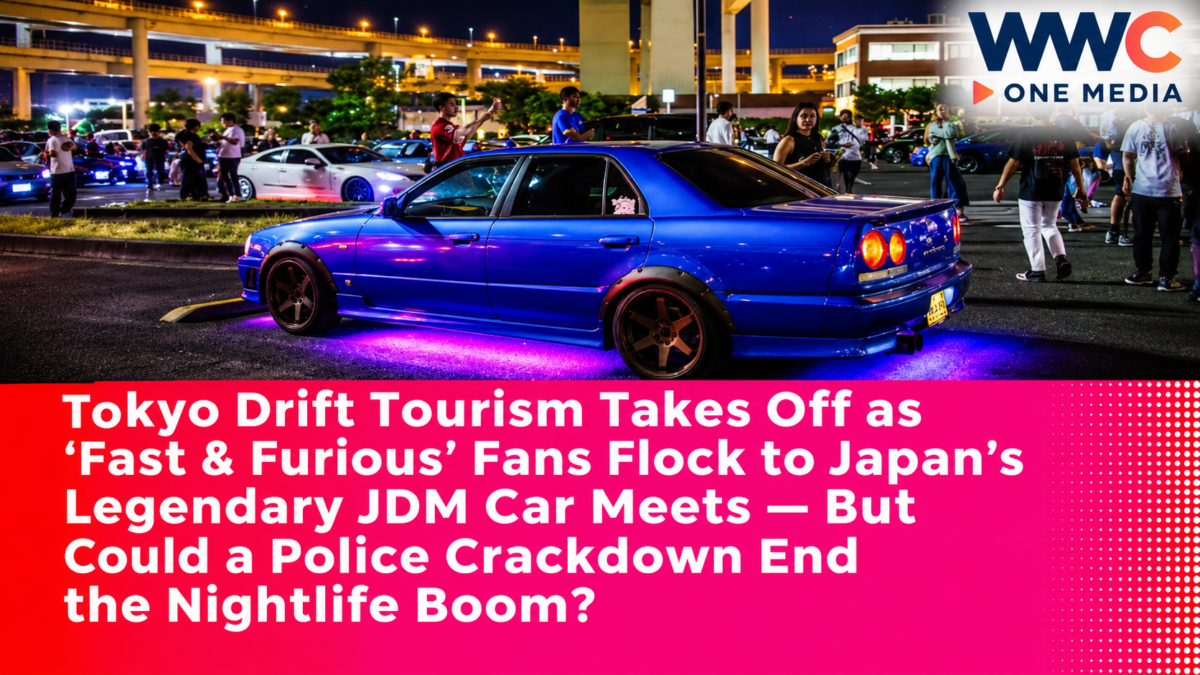
TOKYO, JAPAN / MANILA — Japan’s legendary street-car culture is becoming an international tourism attraction as fans of Fast & Furious: Tokyo Drift, Japanese sports cars and automotive video games travel to Tokyo in search of real-life encounters with the country’s most iconic modified vehicles.
For some visitors, the dream is not another photograph of Mount Fuji or a shopping trip through Shibuya.
It is the sight of a Nissan Skyline GT-R, Toyota Supra or Mazda RX-7 beneath the illuminated expressways surrounding Tokyo Bay.
According to a November 4 Bloomberg feature, international tourists are increasingly seeking out Japanese domestic market, or JDM, automotive experiences inspired by movies, video games and online car culture.
Tour companies are responding with passenger rides, guided driving experiences, photography stops and trips to famous gathering places.
The trend offers new commercial opportunities for local drivers, specialist businesses and tourism operators.
But the rapid commercialization of Japan’s automotive subculture is also creating problems.
Some venues face congestion and police restrictions. Commercial transportation arrangements must comply with Japanese law. And not every tour marketed with the words Tokyo Drift actually includes drifting.
As international travelers turn Japan’s underground automotive heritage into a tourist attraction, can businesses protect its authenticity—or will overcrowding, unsafe driving and tighter enforcement threaten the experience visitors came to see?
Fast & Furious Turns Japanese Car Culture Into a Travel Experience
Japan’s performance-car culture has attracted international enthusiasts for decades.
But the 2006 film The Fast and the Furious: Tokyo Drift helped introduce a wider audience to Japanese tuning, drifting and the visual appeal of nighttime driving through Tokyo.
Anime and manga such as Initial D, as well as racing video games, further popularized Japanese vehicles and driving culture.
Today, social media makes these experiences especially visible.
Videos featuring modified sports cars, brightly illuminated urban roads and gatherings beneath elevated highways can attract viewers from around the world.
For some fans, watching is no longer enough.
They want to visit Japan and experience the automotive culture firsthand.
That growing demand has encouraged businesses to offer specialized activities beyond traditional sightseeing.
However, the cinematic image of high-speed street racing is not an accurate description of most legitimate tourism experiences.
A lawful tour may involve riding in a sports car, visiting automotive businesses or watching cars at a static gathering.
Actual competitive drifting belongs on appropriate closed courses under controlled conditions.
Why Daikoku Parking Area Has Become Famous
One location dominates international discussions of Japanese car culture: Daikoku Parking Area.
Located in Yokohama on the Shuto Expressway network, Daikoku is a highway rest area surrounded by dramatic elevated road structures.
It has long been associated with gatherings of automotive enthusiasts.
Depending on the occasion, visitors may encounter Skyline GT-Rs, Supras, Silvias, RX-7s, Honda NSXs, Mitsubishi Lancer Evolutions and other modified vehicles.
Some nights bring substantial gatherings.
Others may be comparatively quiet.
The important point is that Daikoku is not a conventional tourist attraction with a scheduled exhibition.
There is no guaranteed lineup of vehicles or published public car-meet timetable.
The location can also be temporarily closed or subject to restrictions when traffic congestion or public-safety concerns arise.
Tourists expecting a permanent automotive show may therefore be disappointed.
Daikoku Is Not Actually in Central Tokyo
Despite its association with Tokyo car culture, Daikoku Parking Area is located in Yokohama, in neighboring Kanagawa Prefecture.
It is accessible from the expressway, not through an ordinary pedestrian entrance.
There is no direct train or public-bus service into the parking area.
Visitors therefore need lawful vehicle access.
Trying to reach the facility by walking along expressway infrastructure or climbing fences is unsafe and prohibited.
Another problem is the growing number of commercial tours advertised online.
A September 2026 investigation published by travel guide LIVE JAPAN raised serious questions about the legality of many tours offering passenger transport for payment.
Tourists should not assume an operator is properly authorized merely because its service is listed on a major booking platform.
The distinction matters for customer protection and public safety.
JDM Tourism Expands Beyond Tokyo Bay
The attraction of Japanese automotive culture is not limited to one parking area.
On October 30, the Akihabara Tourism Promotion Association announced a new series of automotive tourism packages connecting Tokyo with Gunma Prefecture.
The initiative, called Touge JDM Premium Quest, is scheduled to run four itineraries between November 16 and December 10.
Each four-day, three-night program costs approximately ¥200,000 per person.
Activities include visits to famous mountain-road locations, motorsport-related experiences, sightseeing and selected cultural attractions.
Some itineraries include controlled drifting experiences or opportunities to ride with professional drivers at suitable venues.
The organizer plans a maximum of eight participants per tour, or 32 places across all four itineraries.
These figures reflect the announced program, not verified sales or bookings.
The initiative illustrates how car-related tourism can encourage travelers to explore regions outside Tokyo.
It also demonstrates how organized experiences can combine motoring enthusiasm with local accommodation, food and cultural activities.
Japan’s 2026 Tourism Numbers Tell a Complicated Story
The new interest in JDM tourism comes at a time when Japan’s broader travel industry faces changing conditions.
According to the Japan National Tourism Organization, the country welcomed approximately 30.73 million international visitors during the first nine months of 2026.
That represented a decline of about 2.9% compared with the same period in 2025.
September arrivals alone totaled 3,103,700, down 5% year on year.
However, international visitor spending continued increasing.
The Japan Tourism Agency reported approximately ¥2.21 trillion in tourist spending during the third quarter, an increase of 3.2%.
That suggests a more nuanced picture than visitor arrivals alone.
Japan received fewer overseas visitors, but those who came spent more on average.
Specialized experiences may offer tourism operators opportunities to attract travelers interested in activities they cannot easily find elsewhere.
However, there is no verified national data establishing how many international visitors specifically traveled to Japan for JDM car experiences.
The broader tourism figures should not be presented as evidence that automotive tourism alone is driving Japan’s travel economy.
Tokyo Is Experimenting With More Unusual Tourist Experiences
Japan’s automotive tourism trend is part of a wider interest in distinctive sightseeing activities.
WWC ONE MEDIA previously reported on Tokyo’s New Sushi Bus, Which Combines Sightseeing With Conveyor-Belt Sushi.
The attraction combines a moving sightseeing experience with Japanese food culture.
It illustrates a similar commercial idea: transforming transportation into a memorable travel activity.
JDM tours take a different approach by using Japan’s automotive heritage and engineering culture.
For some travelers, riding through Tokyo in a distinctive Japanese sports car offers an emotional connection to the movies, games and machines they admired while growing up.
The challenge is converting that enthusiasm into services that are safe, lawful and commercially sustainable.
Police Enforcement Could Become the Industry’s Biggest Obstacle
Japan’s public roads are not open racing circuits.
Dangerous driving, unauthorized drifting and other traffic violations can lead to enforcement action.
Authorities have also responded to problems involving noise, illegal modifications, congestion and crowds near popular automotive gathering places.
These concerns are especially important at expressway rest areas.
Such facilities exist primarily to serve motorists traveling on the road network.
When gatherings interfere with ordinary traffic operations, restrictions or closures may follow.
Commercial tour operators face another obligation: providing transportation within Japan’s legal framework.
A visitor who books a car-culture experience should verify the operator’s licensing arrangements, insurance, vehicle conditions and advertised activities.
A reputable experience should not depend on illegal street racing.
Japan’s Overtourism Debate Is Moving Beyond Famous Landmarks
The tension between popular attractions and local communities is already affecting other parts of Japan.
WWC ONE MEDIA previously reported that Tokyo’s Shinjuku District Is Considering Tougher Restrictions on Vacation Rentals.
The proposed measures reflect concerns about accommodation, neighborhood disruption and the effects of tourism on residents.
Meanwhile, Kyoto Is Considering Higher Tourist Charges at Nijo Castle and on City Buses.
These initiatives are separate from automotive tourism, but they highlight a common policy challenge.
Popular destinations need visitor spending, yet the benefits must be balanced against congestion, noise and everyday quality of life.
For Japanese car enthusiasts, that raises another concern.
An informal community gathering can change character when it becomes a regular destination for large commercial tour groups.
The appeal that attracts visitors may be weakened if the original participants feel overwhelmed.
Professional Drifting Offers a Safer Alternative
Travelers who want to watch genuine drifting do not need to rely on illegal road activity.
Japan has a recognized professional motorsport scene, including the D1 Grand Prix.
The competition’s Tokyo Drift event is scheduled for November 14–15, 2026, in Tokyo’s Odaiba area.
Organizers have also announced a special exhibition involving a screen-used Nissan Skyline GT-R R34 associated with 2 Fast 2 Furious.
The vehicle was driven on camera by Paul Walker’s character, Brian O’Conner.
The exhibition forms part of a broader anniversary tour celebrating the Fast & Furious franchise.
The announced display and competitive drifting events are separate attractions with different admission arrangements.
Visitors should consult organizers for current event details.
Unlike unauthorized street racing, sanctioned motorsport events provide a formal setting for watching professional drivers demonstrate their skills.
Japan’s Unique Attractions Face Growing Regulatory Attention
Automotive tourism is not the only specialist travel sector attracting scrutiny.
WWC ONE MEDIA recently covered Japan’s First Nationwide Survey of Animal Cafes Over Welfare and Disease Concerns.
Although animal cafes and automotive tours have different business models, both demonstrate how distinctive tourism attractions can raise questions requiring regulatory attention.
For car-culture tourism, the issues involve road safety, transport permissions, insurance, crowd management and vehicle condition.
Clear rules could help reputable operators develop legitimate businesses.
But poorly managed growth could lead to restrictions affecting tourists and local enthusiasts alike.
What the Trend Means for Filipino Travelers
Japan remains a popular destination for Filipino tourists, particularly travelers interested in food, shopping, anime, technology and Japanese pop culture.
JDM activities add another option for visitors who want something beyond traditional sightseeing.
The most practical approach is to distinguish among several types of experiences.
A static car gathering is different from a guided scenic drive.
A passenger ride is different from a self-drive rental.
And professional circuit drifting is different from dangerous driving on public roads.
Travelers who intend to drive must check Japan’s licensing rules and the rental operator’s eligibility requirements.
Not every international driving permit is recognized under Japanese law.
Filipino travelers should verify the accepted documentation, driving conditions, insurance and cancellation arrangements before purchasing an experience.
They should also remember that Daikoku gatherings and access can change without warning.
Can Japan Turn JDM Culture Into a Sustainable Tourism Industry?
The growth of automotive tourism creates opportunities for specialized guides, mechanics, car owners, rental providers, hotels and regional destinations.
It can also introduce international visitors to Japan’s engineering heritage and automotive history.
But turning a subculture into a tourism product creates responsibilities.
Operators must deliver what they advertise.
Visitors must respect local rules and residents.
And authorities must balance public safety with the legitimate activities of car enthusiasts.
The strongest long-term opportunities may lie in organized driving experiences, automotive museums, licensed passenger activities and professional motorsport rather than attempts to commercialize unpredictable informal gatherings.
The Bigger Picture: Tokyo Drift Is Becoming a Real Tourism Business
Nearly two decades after Tokyo Drift introduced a generation of viewers to Japanese performance cars, that fascination is helping shape a new type of international travel.
Tourists are no longer content simply to photograph famous landmarks.
Some are traveling to Japan to hear the engines, see the vehicles and experience the culture behind the films and games they love.
Businesses are responding with new automotive itineraries and specialized activities.
However, the industry’s appeal carries risks.
Unofficial gatherings cannot promise a consistent experience.
Some commercial tours raise legal questions.
And public-safety enforcement could become stricter if crowds and irresponsible driving create problems.
As Japan’s legendary JDM culture becomes an increasingly valuable tourist attraction, can operators preserve the authenticity that made it famous—or will police restrictions, questionable tours and overtourism turn the Tokyo Drift dream into a disappointment for international visitors?