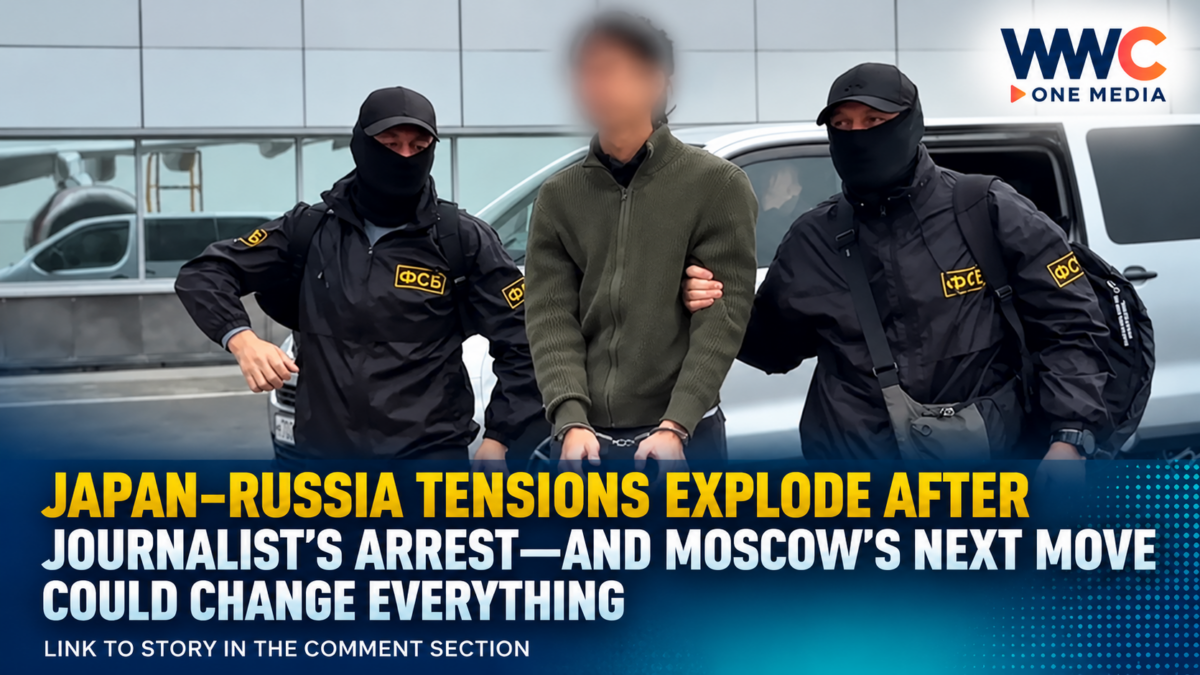
TOKYO/MOSCOW — Japan’s already strained relationship with Russia has hit another troubling point after Moscow detained a Japanese newspaper correspondent on suspicion of espionage, prompting Tokyo to demand access to the journalist and call for his immediate release.
The case has intensified concerns over press freedom, diplomatic relations and the growing security rivalry in Northeast Asia, as the two countries remain divided over Russia’s war in Ukraine and a decades-long territorial dispute.
The journalist, identified by Russian authorities as Yuki Imai, a 34-year-old correspondent for Hokkaido Shimbun, was detained in Yuzhno-Sakhalinsk on Sakhalin Island in Russia’s Far East in mid-October. Russian authorities accused him of gathering information related to the country’s military and defense capabilities.
According to reporting by Reuters, Deutsche Welle and The Japan Times, Russia’s Federal Security Service (FSB) released footage showing security officers detaining a man before he was transferred to Moscow. A court subsequently ordered that he remain in pretrial detention, reportedly until December 12, 2026.
The espionage allegations have not been established in court, and Japan has rejected Moscow’s accusations.
Japan demands access and immediate release
Tokyo has responded with diplomatic protests, demanding an explanation from Moscow, fair treatment for the detained journalist and access for Japanese consular officials.
Japanese Prime Minister Sanae Takaichi rejected the allegation that her government was conducting espionage through journalists. Her administration has emphasized the protection of Japanese nationals and called on Russia to release the correspondent.
The dispute escalated further after Japanese diplomats were unable to meet with Imai despite repeated requests.
On October 20, Japan’s Chief Cabinet Secretary Minoru Kihara described the failure to secure a consular visit within the period stipulated by a bilateral protocol as “extremely regrettable,” according to The Japan Times.
A senior Japanese Foreign Ministry official subsequently traveled to Moscow and met with Russian officials to discuss the detention and other bilateral concerns. Japan reiterated its demand for consular access and Imai’s immediate release, The Japan Times reported on October 21.
The lack of access has raised additional concerns because Japanese officials have not been able to independently verify the journalist’s condition through a consular visit.
Moscow accuses Japan of using journalists for intelligence
Russian authorities have portrayed the case as a national security matter.
The FSB alleged that the journalist collected and stored information about Russia’s defense capabilities for intelligence purposes. Russian Foreign Ministry spokesperson Maria Zakharova also accused Tokyo of using foreign correspondents to gather information that could undermine Russian security.
Japan has denied the allegations, while Imai’s employer, Hokkaido Shimbun, has said that the journalist’s safety is its top priority as it works to establish the details of the case.
The distinction is important: Moscow’s accusations remain allegations, and the available reporting does not establish that Imai was acting as a spy.
The arrest also raises broader concerns about the risks faced by foreign correspondents working in politically sensitive regions, particularly where military activity, territorial disputes and strained international relations overlap.
A diplomatic crisis rooted in years of mistrust
The arrest did not occur in isolation. Japan and Russia have experienced deteriorating relations since Moscow launched its full-scale invasion of Ukraine in 2022.
Japan joined international sanctions against Russia, while Moscow designated Japan an “unfriendly” country. Tokyo has continued supporting Ukraine, including through non-lethal assistance and closer security cooperation with NATO partners.
The two countries also remain locked in a longstanding territorial dispute over islands controlled by Russia since the end of World War II.
The islands, known in Japan as the Northern Territories and in Russia as part of the Southern Kurils, have prevented the two countries from resolving their postwar territorial disagreements and concluding a formal peace treaty to settle the remaining issues from the war.
Russian President Vladimir Putin’s visit to the disputed islands in August 2026 further aggravated tensions, according to international reporting. Japan strongly objected to the visit, viewing it as a challenge to its territorial claims.
The detention of a Japanese journalist in the Russian Far East has therefore become another flashpoint in an already difficult relationship.
Could the journalist become part of a wider diplomatic standoff?
Some analysts have raised the possibility that Russia could use the detention as leverage in future negotiations, including a potential prisoner exchange. Such speculation draws on previous cases involving foreign nationals detained on espionage charges.
One prominent example is Evan Gershkovich, a reporter for The Wall Street Journal who was arrested in Russia in 2023, convicted of espionage and sentenced to 16 years in prison. He was released in a multinational prisoner exchange in August 2024.
However, there is no confirmed evidence that Moscow detained Imai specifically to secure a prisoner swap. That possibility remains speculation, not an established motive.
The case also presents a difficult choice for Tokyo. Japan wants to secure the journalist’s release, but making major policy concessions in response to a detention could create concerns about the use of foreign nationals as leverage in broader geopolitical disputes.
The Straits Times and The Moscow Times have examined how the arrest fits into Moscow’s increasingly confrontational posture toward Japan, including tensions over Ukraine, military cooperation and the disputed islands.
Press freedom and regional security at stake
The International Federation of Journalists has condemned the detention and called for Imai’s immediate release. The case has renewed scrutiny of the dangers faced by journalists reporting in countries where national security allegations can have serious legal consequences.
If convicted of espionage, Imai could face up to 20 years in prison, according to Deutsche Welle’s reporting.
For Japan, the immediate priorities are securing consular access, establishing the journalist’s condition and pursuing his release through diplomatic channels.
For Russia, the case has become another point of friction with a neighboring country whose policies Moscow increasingly views as hostile.
What happens next could shape more than the fate of one correspondent. The outcome may influence diplomatic engagement between Tokyo and Moscow, deepen concerns about the treatment of foreign journalists and add another layer of tension to an already fragile regional security environment.
For now, the central questions remain unanswered: Will Moscow allow Japanese diplomats to meet with Imai, and can Tokyo secure his release without making concessions on the wider disputes dividing the two countries?