WASHINGTON, UNITED STATES / MANILA, PHILIPPINES — November 5, 2026 | WWC ONE MEDIA | US Politics, Artificial Intelligence, Cryptocurrency and Global Business
America’s technology billionaires have suffered a stunning political setback after pouring hundreds of millions of dollars into the 2026 US midterm elections, only to watch voters deliver sweeping victories to Democrats and reject several candidates backed by Elon Musk, cryptocurrency interests and artificial intelligence investors.
The election has raised serious questions about the political power of Silicon Valley’s wealthiest executives, who invested unprecedented sums in hopes of shaping the next Congress and influencing regulations governing some of the world’s fastest-growing industries.
According to Bloomberg’s November 4 report, Midterms Spending Binge by Musk, Crypto and AI Hit Voter Wall, expensive campaigns funded by technology donors failed to prevent major Republican defeats in critical states.
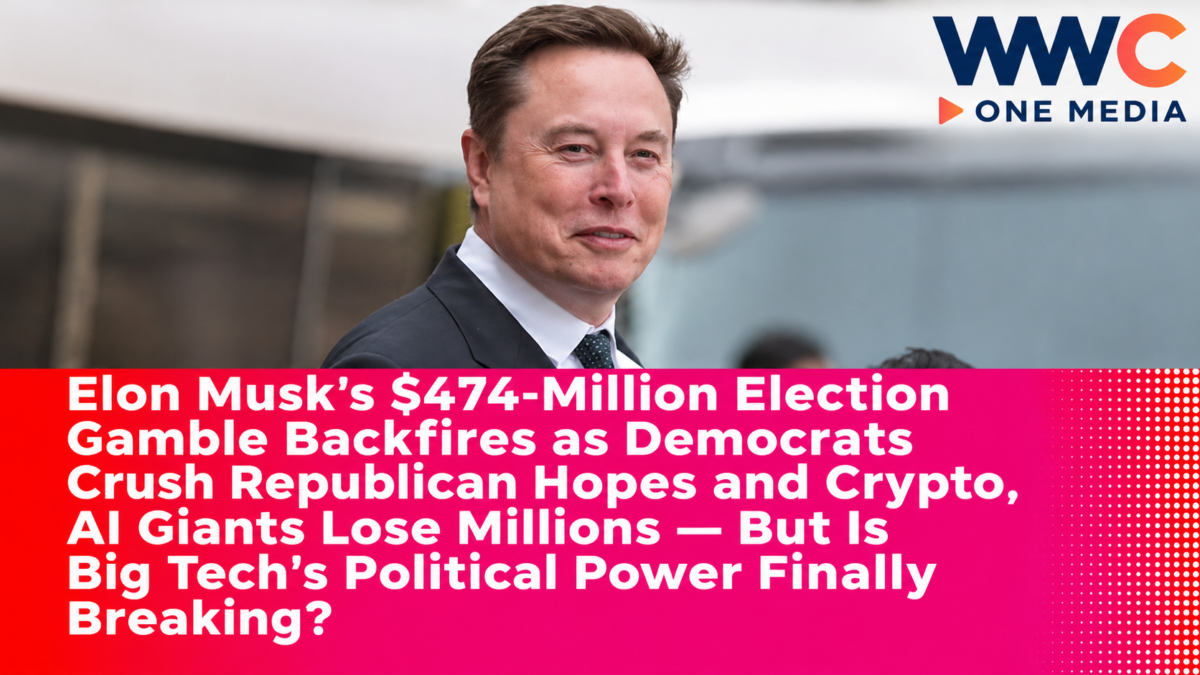
Elon Musk alone spent approximately $474 million supporting Republican candidates and political organizations, according to published campaign-finance tallies.
The Financial Times estimated that Silicon Valley billionaires collectively spent more than $600 million backing Republicans.
Yet Democrats captured both chambers of Congress, delivering a major political defeat to President Donald Trump and raising the prospect of stronger congressional oversight of artificial intelligence, cryptocurrency and major technology companies.
The most revealing results came in Texas and Ohio.
In Texas, Democrat James Talarico defeated Republican Ken Paxton despite a massive financial campaign supporting Paxton.
In Ohio, Democrat Sherrod Brown defeated Republican Jon Husted even after cryptocurrency-linked political organizations spent tens of millions of dollars trying to prevent Brown’s return to the Senate.
But the financial losses went beyond two Senate races.
A separate election-finance analysis showed that approximately $74.7 million in tracked crypto- and AI-focused super PAC general-election spending had gone toward losing sides in races whose outcomes were becoming clear.
The central question is whether the results represent a temporary political setback for America’s technology billionaires — or a fundamental change in how voters respond to wealthy donors trying to influence government policy.
Elon Musk Spends Nearly $500 Million — But Republicans Lose Congress
Elon Musk emerged as one of the most influential individual donors of the 2026 election cycle.
The Tesla and SpaceX chief executive poured enormous sums into Republican campaigns through political action committees and other political organizations.
According to The Washington Post, Musk spent more than $400 million supporting Republican candidates, exceeding his already substantial contributions during the 2024 presidential election.
A New York Times tally cited by Fast Company placed the total at approximately $474 million through October 14.
Musk’s campaign investments targeted competitive congressional races, particularly in states where Republicans hoped to preserve their majorities.
But the outcome was far different from what his political allies had anticipated.
Democrats won control of both the House of Representatives and the Senate, overturning Republican majorities and creating a major obstacle to Trump’s legislative agenda.
The losses demonstrated that financial resources alone could not overcome broader voter dissatisfaction.
High living costs, the war with Iran, concerns about the economy and distrust of political elites became central election issues.
WWC ONE MEDIA had previously examined Musk’s campaign spending in Trump and Musk Unleash Millions for Republicans in Key Battlegrounds — But Where Is the Money Going Next?.
The earlier report detailed how Republican-aligned political organizations were spending heavily to influence closely contested congressional races.
The November 3 results now provide a stark illustration of the limits of that financial strategy.
Texas Delivers Musk’s Most Painful Election Defeat
Texas became one of the most important battlegrounds in Musk’s political investment strategy.
The billionaire backed Republican Attorney General Ken Paxton in the US Senate contest against Democrat James Talarico.
Musk and allied political groups committed substantial resources to helping Paxton win.
The Washington Post reported that Musk directed $168 million to the Senate Leadership Fund, with a large share subsequently transferred to a political organization supporting Paxton.
Other reporting placed Musk’s broader Texas-related political spending at approximately $224 million.
These figures describe overlapping funding channels and should not be added together as separate expenditures.
Despite the financial advantage, Talarico won the election.
His campaign portrayed the race as a contest between ordinary voters and wealthy political donors.
The result was especially significant because Texas had remained strongly Republican in national elections for decades.
Democrat Gina Hinojosa also defeated incumbent Republican Governor Greg Abbott, delivering another major setback to the state’s Republican establishment.
For Musk, who relocated major business operations to Texas and became increasingly involved in its politics, the defeats carried unusual significance.
They also demonstrated that the presence of a powerful financial supporter does not guarantee that voters will accept the candidates or policies receiving that support.
Cryptocurrency Industry’s $200-Million Campaign Suffers a Major Blow
The cryptocurrency industry entered the 2026 midterms with substantial political ambitions.
Companies, executives and industry-backed super PACs invested heavily in candidates they believed would support favorable digital-asset regulations.
Reuters estimated that the sector’s election-related spending campaign reached approximately $200 million.
The industry’s strategy was influenced by its success during earlier election cycles.
Cryptocurrency organizations had helped elect sympathetic lawmakers while pushing for clearer rules governing digital assets, exchanges and stablecoins.
But the latest election produced a more complicated outcome.
Crypto-backed groups won numerous contests, including races involving candidates from both major parties.
However, their most expensive and strategically important defeats undermined claims that the industry could reliably use political spending to shape election outcomes.
The strongest example came in Ohio.
Sherrod Brown Defeats Crypto-Backed Opposition in Ohio
Democrat Sherrod Brown’s victory over Republican Senator Jon Husted became one of the cryptocurrency industry’s most significant setbacks.
Brown had previously criticized aspects of the digital-asset industry and supported stronger financial oversight.
Industry-backed political organizations spent heavily in an effort to prevent his return to the Senate.
Reuters reported that cryptocurrency-linked groups spent more than $60 million attempting to defeat Brown.
CoinDesk separately identified approximately $56 million in spending associated with the Fairshake network’s campaign against him.
The difference reflects variations in which organizations and expenditures were included.
Despite the spending, Brown won the election.
The outcome challenged the perception that cryptocurrency-linked political groups could defeat any candidate who opposed their legislative priorities.
However, the sector did not lose every race.
Reuters reported that the Fairshake network had won 29 of 34 decided contests it tracked at that stage.
Several of those successes involved candidates in favorable political environments.
The distinction is essential.
The cryptocurrency industry’s overall record included significant victories, but the costliest defeats occurred in strategically important races.
Crypto’s Political Strategy Faces a New Test Under Democratic Control
The Democratic takeover of Congress could significantly influence future digital-asset legislation.
The cryptocurrency industry has pushed for a regulatory framework intended to provide greater legal certainty for exchanges, stablecoin issuers and other businesses.
But lawmakers disagree over how much authority federal regulators should have and what protections consumers need.
The CLARITY Act, a major digital-asset market-structure proposal, previously encountered substantial opposition.
With Democrats controlling Congress, industry representatives may face greater pressure to negotiate rules addressing investor protections, conflicts of interest and financial stability.
The election could also lead to more investigations involving cryptocurrency companies and politically connected businesses.
WWC ONE MEDIA previously examined market concerns surrounding the changing political landscape in Bitcoin Plunges Below $77,000 as Democrats Threaten Trump’s Crypto Agenda — But Could a Blue Wave Trigger an Even Bigger Crash?.
The report explored how uncertainty over the election influenced digital-asset sentiment.
However, Democratic control does not automatically mean that cryptocurrency will be banned or that all future legislation will be hostile to the sector.
Many lawmakers from both parties support some form of digital-asset regulation.
The immediate consequence is greater uncertainty over the specific rules the next Congress may pursue.
AI Industry’s $100-Million Political Machine Struggles in Competitive Races
The artificial intelligence industry also committed substantial resources to the midterm elections.
One of the most prominent organizations was Leading the Future, a pro-AI super PAC network supported by technology executives and venture capital investors.
Its backers included prominent figures connected to Silicon Valley’s investment community.
The group sought to support candidates favoring rapid AI development and federal rules that could limit the complexity of differing state-level regulations.
According to WIRED, Leading the Future entered the election cycle with approximately $100 million in funding.
It spent roughly $26 million on primary-election contests and about $10 million during the general election, with substantial funds remaining afterward.
The network supported candidates from both parties.
Yet its most difficult contests produced disappointing results.
In South Carolina, Republican Darline Graham lost to Democrat Annie Andrews despite receiving support from pro-AI political organizations.
AI-related funding also became an issue in races where voters expressed concerns about data-center development and electricity prices.
The results suggest that powerful financial backing may be less effective when voters associate an industry with direct costs affecting their communities.
Technology Campaign Money Overwhelmingly Went to Losing Sides in Key Races
Tech Influence Watch, a project tracking cryptocurrency and AI political spending, provided additional evidence of the industry’s election difficulties.
Its November 4 election-results snapshot identified approximately $112 million in independent expenditures during the general election by tracked crypto- and AI-focused political committees.
Of that total, approximately $74.7 million had been spent on losing sides.
Another $25.2 million had gone toward winning sides, while $12.1 million related to contests that had not yet been called.
The figures represent a snapshot, not a final accounting of all political spending.
They also exclude certain primary-election expenditures and direct candidate contributions.
Nevertheless, they reveal how much industry money was concentrated in unsuccessful competitive campaigns.
The outcome demonstrates an important difference between financing a campaign and persuading voters.
Political advertisements can increase a candidate’s visibility.
They can also communicate policy positions and criticize opponents.
But they cannot guarantee that voters will prioritize an industry’s preferred issue over their own economic concerns.
AI Data Centers Become a Political Liability for Big Tech
One of the election’s most significant developments involved public resistance to AI data centers.
Companies are investing heavily in facilities designed to train and operate advanced artificial intelligence systems.
These projects require substantial electricity, cooling infrastructure and high-performance computing equipment.
Supporters argue that data centers create construction jobs, generate tax revenue and strengthen America’s technological competitiveness.
But residents in many communities have raised concerns about electricity bills, water consumption, industrial noise and the scale of new infrastructure.
The controversy became particularly influential in states where data-center development was moving rapidly.
WWC ONE MEDIA had warned of the emerging political backlash in Trump Is Betting Big on AI Data Centers — But His Own Voters Could Turn Them Into a GOP Midterm Nightmare.
That report examined resistance from communities traditionally supportive of Republican candidates.
The midterm results suggest those concerns had become a meaningful election issue.
However, voter opposition to certain developments does not mean Americans universally reject artificial intelligence itself.
The dispute often concerns where facilities should be built, who should pay for supporting infrastructure and how much control local communities should retain.
Voters Push Back Against Data Centers Across the United States
Local ballot measures provided further evidence of the backlash.
Communities across the country voted on proposals involving zoning restrictions, moratoriums, approval requirements and limits on large data-center facilities.
Many measures favoring stronger restrictions were approved.
The results reflect a growing insistence that developers provide clearer information about electricity costs, environmental impacts and economic benefits.
The issue also crossed traditional party lines.
Republican and Democratic voters expressed concerns about projects they believed could affect household expenses or local resources.
For technology companies, the implications are significant.
Securing financing and advanced processors is no longer sufficient to guarantee that a data center can be constructed.
Developers must also secure permits, utility connections and public acceptance.
Political opposition can delay projects, increase expenses or force companies to reconsider proposed locations.
Why Bigger Political Donations Failed to Overcome Voter Anger
The most important explanation for the results may be that voters were focused on issues largely beyond the control of technology donors.
The cost of living remained a major concern.
Higher energy prices affected household budgets.
The war with Iran contributed to public frustration over foreign policy and economic priorities.
Meanwhile, the growing influence of wealthy donors became an issue in its own right.
Some Democratic candidates successfully presented their opponents as being too closely connected to billionaire interests.
The campaigns argued that elections should be decided by voters rather than the size of wealthy donors’ financial contributions.
However, it would be misleading to conclude that campaign donations had no influence.
Political spending can shape candidate visibility, advertising narratives and policy debates even when a particular candidate loses.
The election results show that the spending failed to deliver several of its most important objectives—not that political money has become irrelevant.
Democrats Gain Power to Investigate Big Tech and Cryptocurrency Companies
The shift in congressional control could bring significant changes to federal oversight.
When the new Congress convenes in January 2027, Democrats will gain leadership of committees responsible for investigating government agencies and private-sector activities.
That could lead to hearings involving major technology executives, political donations, AI safety, data-center infrastructure and cryptocurrency regulation.
Democratic lawmakers have already expressed interest in examining the relationships between technology companies and the Trump administration.
Some also want greater transparency surrounding industry lobbying and campaign-finance activities.
Nevertheless, congressional investigations are not proof that a company or individual has committed wrongdoing.
Any allegation must be supported by evidence, and legal conclusions require appropriate proceedings.
The new political balance will also be constrained by presidential authority and existing legislative procedures.
The Democratic victory creates stronger opportunities for scrutiny, but specific regulatory outcomes remain uncertain.
What the Election Means for Elon Musk, Tesla and SpaceX
Musk’s enormous political spending has made him a central figure in the debate over corporate influence in American elections.
His companies operate in industries closely connected to federal policy.
Tesla is affected by transportation regulations, energy policy and manufacturing incentives.
SpaceX participates in government space programs and holds contracts connected to federal agencies.
Musk’s artificial intelligence businesses also operate in areas where future regulation could influence commercial development.
Democratic control of Congress may increase oversight of these relationships.
However, the election results do not automatically change existing contracts or establish that any company has violated federal law.
For shareholders and business partners, the main uncertainty involves how changes in Washington could affect regulation, government procurement and public scrutiny.
Silicon Valley’s Election Defeat Could Reshape the 2028 Presidential Race
The midterm results may also influence political spending ahead of the 2028 presidential election.
Major technology donors now face a difficult strategic decision.
They can continue supporting the same political candidates and organizations.
They can shift resources toward candidates with stronger prospects in competitive districts.
Or they can increase bipartisan engagement to improve their influence regardless of which party controls the government.
The cryptocurrency industry has already demonstrated a willingness to support candidates from both parties.
Some AI-focused organizations have adopted similar approaches.
But the 2026 election shows that even carefully targeted spending can fail when wider political conditions move against a candidate.
For future campaigns, donors may place greater emphasis on candidate popularity, local issues and the public’s perception of technology companies.
The era of enormous political contributions is unlikely to end.
What may change is the assumption that those contributions can reliably produce favorable election results.
What the Election Means for Technology Companies and Investors in the Philippines
The US midterm results also carry lessons for businesses and policymakers in the Philippines.
Artificial intelligence, digital payments, cryptocurrency and data-center development are expanding across Southeast Asia.
International technology companies often make investment decisions based partly on government policy and regulatory certainty.
Changes in American rules could influence their wider business strategies.
But the US election does not automatically determine Philippine technology regulations or investment conditions.
Local policies, infrastructure costs and consumer needs remain essential.
The most relevant lesson involves public trust.
Technology investment can create economic opportunities, but projects may encounter resistance if communities believe the benefits are unevenly distributed or the costs are insufficiently explained.
Companies hoping to expand in Southeast Asia may therefore need to demonstrate clearer economic benefits and stronger accountability.
The Bigger Question: Has America Reached the Limits of Billionaire Political Spending?
The 2026 midterm elections have produced an extraordinary contradiction.
Technology billionaires spent hundreds of millions of dollars trying to influence the direction of American government policy.
Yet some of the most expensive and strategically important campaigns ended in defeat.
Elon Musk’s political investments failed to prevent major Republican losses.
Cryptocurrency-backed organizations lost a crucial Senate battle in Ohio.
Pro-AI political groups struggled to win competitive races where data-center development became an unpopular issue.
And Democrats captured Congress despite the enormous financial resources deployed by Republican-aligned donors.
However, the election also revealed that technology money remains influential.
Crypto-focused groups won many contests.
AI organizations supported successful candidates in safer districts.
And wealthy donors retain substantial financial resources for future campaigns.
The results therefore do not establish the end of billionaire influence.
They demonstrate that money alone cannot always overcome candidate weaknesses, unpopular policies or widespread voter dissatisfaction.
For the technology industry, the challenge now extends beyond winning individual elections.
Companies must persuade lawmakers and the public that their businesses can deliver economic benefits without imposing unacceptable costs on workers, consumers and communities.
As Elon Musk’s nearly $500-million political gamble falters and crypto and AI donors confront costly defeats, one question could reshape American politics heading into 2028: Will Silicon Valley rebuild its political influence through a new strategy — or have voters finally discovered how to defeat even the most expensive campaigns money can buy?