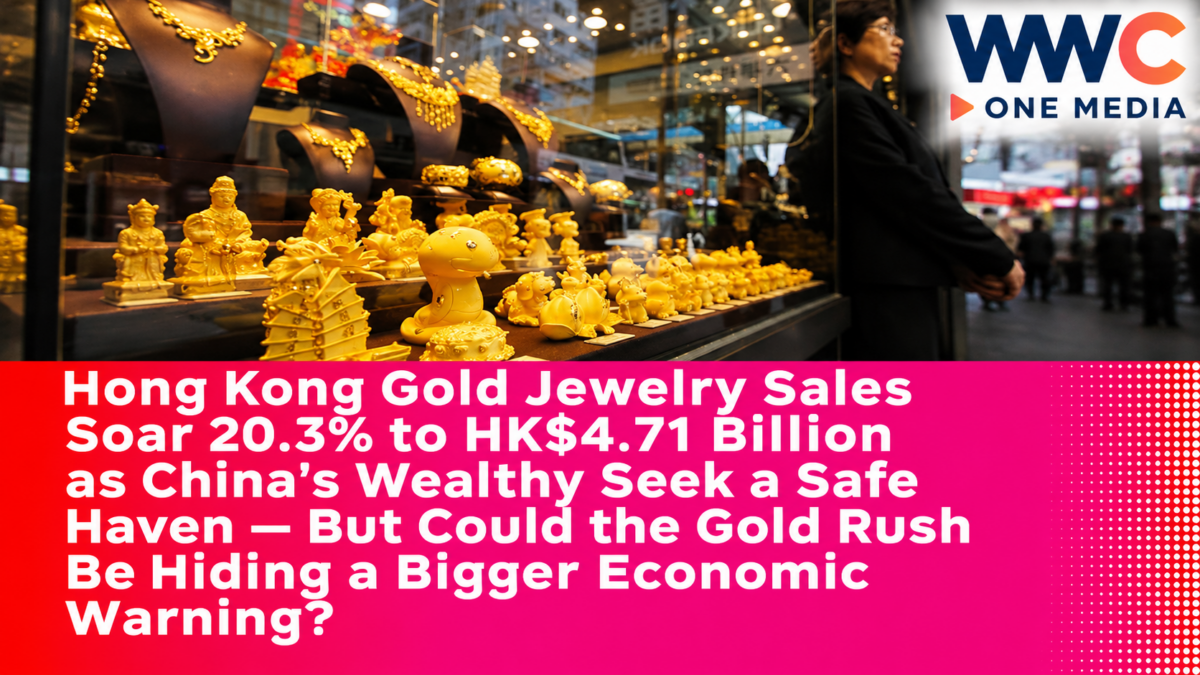
HONG KONG / BEIJING / MANILA — November 5, 2026 | WWC ONE MEDIA | Global Business, Gold Markets, Luxury Retail and Chinese Economy
Hong Kong’s luxury jewelry market is staging a remarkable comeback as affluent Chinese shoppers increasingly turn their attention toward gold, sending sales of jewelry, watches and other valuable gifts sharply higher despite weakening demand for gold ornaments across mainland China.
The city’s latest government statistics reveal that sales in the jewelry, watches, clocks and valuable-gifts category surged 20.3% year over year to approximately HK$4.71 billion (US$600 million) in September 2026.
The increase significantly outpaced Hong Kong’s overall retail growth of 6.4%, highlighting the extraordinary strength of its luxury-goods sector.
According to Bloomberg’s November 4 report, HK Jewelry Sales Soar as China’s Rich Seek Wealth Haven in Gold, the spending boom reflects growing interest in precious metals as wealthy Chinese consumers navigate an uncertain investment environment.
But the figures reveal a much more complicated story.
While Hong Kong’s jewelry retailers are recording strong sales, mainland China’s physical gold-jewelry consumption fell 22% during the third quarter.
Meanwhile, gold prices have suffered a sharp correction after reaching extraordinary highs earlier this year.
The contrast raises an important question for investors and luxury retailers.
Are wealthy Chinese buyers accumulating gold because they expect its value to recover — or are they searching for financial security as confidence in other traditional investments weakens?
Hong Kong Jewelry Sales Jump 20.3% as Retail Recovery Accelerates
Hong Kong’s Census and Statistics Department reported that retail sales reached approximately HK$33.4 billion in September, increasing 6.4% from the same month in 2025.
The result represented the city’s 17th consecutive month of year-on-year retail sales growth.
Within that overall recovery, jewelry and other high-value gifts delivered particularly strong performance.
Sales in the jewelry, watches, clocks and valuable-gifts category increased 20.3%, reaching approximately HK$4.71 billion.
The improvement followed double-digit gains in previous months.
The category expanded 19.7% in July and another 11.9% in August.
For the first nine months of 2026, sales of jewelry, watches and other valuable gifts reached approximately HK$45.82 billion, up 22% from a year earlier, according to industry reporting based on official statistics.
But there is an important distinction.
The government data measures sales revenue across a broad retail category, not just physical gold jewelry.
It includes products such as watches and other valuable gifts.
The increase also reflects the value of sales rather than the physical amount of gold purchased.
Higher gold prices can lift revenue even when customers buy fewer or lighter products.
China’s Wealthy Are Looking Beyond Stocks and Property
The growing interest in gold comes as Chinese households reassess traditional ways of preserving wealth.
For decades, real estate played an important role in household savings and investment.
But the prolonged adjustment in China’s property market has weakened confidence in an asset class once considered a reliable source of wealth creation.
Stock-market volatility has also encouraged some investors to consider alternatives.
Gold has become increasingly attractive because it is a tangible asset with an internationally recognized market.
Unlike shares in an individual company, physical gold does not depend on one business generating earnings.
It can also provide diversification away from property and financial assets.
However, gold is not risk-free.
Its price can fall sharply, and physical jewelry carries additional costs for design, craftsmanship and retail markups.
For wealthy consumers, the appeal may therefore reflect a combination of investment considerations, cultural preferences and luxury spending.
Why Hong Kong Has Become an Important Destination for Gold Buyers
Hong Kong occupies a distinctive position in the regional precious-metals market.
Its proximity to mainland China, established jewelry retailers and international financial infrastructure have long made it an important center for luxury shopping and gold trading.
Brands such as Chow Tai Fook and Chow Sang Sang have extensive histories serving customers from Hong Kong and mainland China.
The city also benefits from its established role as a cross-border financial hub.
In recent years, Hong Kong authorities have been working to expand its position in international bullion trading.
A new gold clearing and settlement framework began trial operations in July 2026, with plans to strengthen connections between Hong Kong and mainland China’s precious-metals markets.
Bloomberg reported earlier this year that Hong Kong’s gold imports exceeded 130 tonnes in June, the highest monthly level since late 2014.
Part of that increase reflected preparations for the new clearing system, which required financial institutions to build physical bullion inventories.
It would therefore be incorrect to attribute all those imports to wealthy individuals purchasing gold.
Nevertheless, the development highlights Hong Kong’s growing importance as both a jewelry destination and a bullion-trading center.
Chow Tai Fook Records Strong Hong Kong Growth While Mainland Stores Struggle
One of the clearest examples of the regional divergence comes from Chow Tai Fook Jewellery Group.
The Hong Kong-listed retailer reported that same-store sales across Hong Kong and Macau increased 29.6% during the quarter ended September 30.
Hong Kong alone recorded a 24% increase.
The results reflected stronger customer traffic and improved demand at existing locations.
However, the company’s mainland China business faced a different environment.
Retail sales value on the mainland declined 5.3%, partly reflecting its decision to reduce its store network.
During the quarter, the company opened 23 jewelry points of sale in mainland China while closing 263.
These figures illustrate how the same jewelry group can experience substantial growth in Hong Kong while restructuring operations across mainland China.
Chow Tai Fook has also been shifting toward higher-margin products and more distinctive designs.
That strategy is intended to attract younger buyers and affluent consumers rather than compete solely on the amount of gold contained in each item.
Mainland China’s Gold Jewelry Demand Falls 22%
The World Gold Council’s November 3 report provides a crucial counterpoint to Hong Kong’s luxury sales boom.
Mainland Chinese gold-jewelry consumption fell 22% year over year to approximately 65.7 tonnes in the third quarter of 2026.
Globally, gold-jewelry demand declined 17% to around 313 tonnes, the weakest third-quarter level in the council’s records dating back to 2000.
High gold prices have made traditional heavy jewelry less affordable.
Consumers have responded by purchasing lighter pieces, choosing products with lower gold content or postponing discretionary purchases.
WWC ONE MEDIA previously examined the pressure facing mainland retailers in Jewellery Shops Shut as Chinese Consumers Turn to Gold Bars and Coins.
That report explored the shift from decorative gold products toward investment-oriented bars and coins.
The latest Hong Kong figures show why the industry cannot be evaluated through one measure alone.
Retail revenue, physical gold consumption, customer traffic and investment demand can move in different directions.
Gold Bars and Coins Are Competing With Traditional Jewelry
For consumers primarily interested in preserving wealth, gold bars and coins may be more appealing than elaborate jewelry.
Investment-grade bullion generally has a more direct relationship to the underlying gold price.
By contrast, jewelry prices often include craftsmanship, branding and retailer markups that buyers may not recover when selling.
According to the World Gold Council, China’s demand for investment gold exceeded jewelry consumption during the first half of 2026.
Chinese investors purchased approximately 342 tonnes of gold through investment-related products, compared with 136 tonnes consumed as jewelry.
The investment category included gold bars, coins and exchange-traded funds.
This shift illustrates how gold is increasingly being used for financial diversification rather than ceremonial or decorative purposes alone.
However, wealthy consumers may continue purchasing premium jewelry because they value both the metal and the craftsmanship.
The market is becoming more divided between investment-focused buyers and consumers seeking exclusive luxury designs.
China’s Wealth Tax Scrutiny Adds Another Layer of Uncertainty
The behavior of wealthy Chinese investors is also being shaped by increased scrutiny of offshore assets and financial arrangements.
Chinese authorities have been strengthening oversight of certain overseas investment income and offshore trust structures.
WWC ONE MEDIA examined the development in China Is Coming for Its Wealth Abroad: Billionaires Face a 20% Offshore Trust Tax—But the Crackdown May Go Much Further.
The report discussed the potential implications for private banking and wealth management in Hong Kong and Singapore.
Such policy changes can encourage affluent investors to reconsider how they diversify and hold assets.
But buying gold in Hong Kong does not automatically eliminate tax liabilities or reporting obligations.
Nor does the increase in jewelry sales prove that customers are purchasing gold to evade taxation.
The documented development is greater scrutiny of wealth structures, while any direct connection to individual jewelry purchases requires separate evidence.
Gold’s Recent Price Crash Creates a Dangerous Contradiction
Gold’s renewed popularity among some Chinese buyers comes despite a difficult period for bullion prices.
Earlier in 2026, the precious metal surged above $5,500 per troy ounce amid geopolitical uncertainty and strong investment demand.
By early November, prices had retreated below $4,000.
The reversal reflected several factors, including rising bond yields, changing US interest-rate expectations and developments surrounding the Iran conflict.
WWC ONE MEDIA examined the volatility in Gold Struggles Near $3,900 After Historic $5,500 Peak as Iran Peace Talks and US Midterms Shake Markets — But Could Another Selloff Be Coming?.
The selloff creates a dilemma for investors.
Some see lower prices as an opportunity to buy gold at a discount to previous highs.
Others worry that bullion could decline further if interest rates remain elevated.
Gold does not generate interest or dividends.
When government bonds offer attractive returns, the opportunity cost of holding bullion can increase.
A surge in jewelry sales therefore does not necessarily imply that gold prices are about to rise.
Central Banks Continue Buying Gold Despite Market Volatility
Institutional demand provides another perspective on the global gold market.
The World Gold Council reported that central banks purchased a net 321 tonnes during the third quarter.
That represented a 42% increase from a year earlier.
China and Poland were among the largest disclosed buyers.
The People’s Bank of China reportedly added approximately 63 tonnes during the quarter.
Central banks typically purchase gold for reserve diversification and long-term financial-management purposes.
Their objectives differ from those of households buying jewelry or private investors trading gold.
For example, the Philippines also holds gold as part of its international reserves.
WWC ONE MEDIA previously reported on the role of bullion valuations in Philippines’ Foreign Reserves Rise to $104.85 Billion — Gold and BSP Investment Gains Power the Rebound.
The report highlighted how changes in international gold prices can alter the value of a central bank’s reserve holdings.
Central-bank accumulation may support longer-term demand, but it does not establish a guaranteed price floor.
Hong Kong’s Luxury Recovery Extends Beyond Gold
The strength of Hong Kong’s jewelry industry is also part of a wider recovery in luxury spending.
High-end shopping destinations have benefited from affluent customers, improving tourism flows and renewed interest in premium assets.
The city’s luxury property market has also attracted attention.
WWC ONE MEDIA previously examined this trend in Hong Kong Home Prices Could Surge 15% in 2026 as Buyers Return and Property Market Rebounds.
The report discussed recovering property prices and demand from mainland buyers.
However, greater activity in luxury markets does not mean all Hong Kong consumers are increasing spending at the same rate.
The government’s September figures showed that department-store sales fell 4.1%, while motor-vehicle and parts sales declined 34.7%.
That uneven performance suggests the retail recovery varies substantially by category.
Wealthy consumers may be spending more on selected luxury goods even while other areas of retail remain weak.
Tourism Helps Push Hong Kong’s Retail Sales Higher
Visitor arrivals have also contributed to Hong Kong’s retail performance.
Government officials attributed part of September’s growth to increased inbound tourism and spending associated with the Mid-Autumn Festival.
Mainland Chinese travelers remain an important customer group for many of the city’s shopping districts.
Retailers benefit when visitors purchase jewelry, cosmetics, fashion and other products during their trips.
But tourism-driven demand can fluctuate with travel costs, exchange rates, consumer confidence and economic conditions.
A sustained jewelry recovery would therefore require continued support from both residents and visitors.
Industry analysts will also watch whether the current increase in sales value translates into stronger retailer profits.
Higher revenue can be offset by elevated inventory costs, rent, wages and promotional spending.
What Hong Kong’s Gold Rush Means for the Philippines and Southeast Asia
The developments have implications for jewelry businesses and investors throughout Asia.
Gold prices are internationally connected, so large changes in the global market can influence jewelry costs in the Philippines.
But local prices also depend on currency movements, product purity, labor expenses and retailer margins.
A decline in international bullion prices does not always translate into an equivalent reduction in peso-denominated jewelry prices.
For Philippine gold buyers, the distinction between investment bullion and finished jewelry is particularly important.
A jewelry purchase may provide personal or cultural value, but it is not necessarily the most cost-efficient way to invest in gold.
Buyers should consider authenticity, premiums, resale discounts, transaction costs and storage security.
The regional jewelry industry is also adapting to changes in consumer preferences and manufacturing requirements.
WWC ONE MEDIA explored one example in Pandora Opens $150-Million Vietnam Jewelry Factory as Asia Becomes Key Growth Engine.
The investment demonstrates how international jewelry companies are expanding their manufacturing operations across Southeast Asia.
However, the drivers of mass-market jewelry manufacturing differ from those influencing wealthy mainland investors’ purchases of gold in Hong Kong.
Could Hong Kong’s Jewelry Boom Continue Into 2027?
Several factors will determine whether the strong sales performance continues.
Gold prices will remain important.
A sustained recovery in bullion could encourage buyers seeking investment gains, but higher prices could also make jewelry less affordable.
Mainland China’s economic outlook will influence spending by affluent visitors.
The performance of property and stock markets may affect households’ willingness to purchase expensive goods.
Hong Kong’s tourism recovery and development as a gold-trading hub could provide additional support.
Retailers will also need to maintain attractive products and competitive pricing.
But there are risks.
Gold could experience further volatility.
Jewelry demand could weaken if economic uncertainty intensifies.
And rising sales revenue may not result in equivalent growth in physical demand or profits.
The strongest indicators will be future government retail statistics, comparable-store sales from jewelry companies, tourism figures and the World Gold Council’s demand data.
The Bigger Question: Is Gold Becoming China’s New Symbol of Financial Security?
Hong Kong’s jewelry market has delivered an impressive recovery.
Sales of jewelry, watches and valuable gifts increased 20.3% in September, reaching approximately HK$4.71 billion.
Chow Tai Fook reported strong comparable-store growth in Hong Kong even as its mainland store network contracted.
Meanwhile, China’s investment demand for gold has increasingly outpaced traditional jewelry consumption.
These developments reveal a significant change in how consumers view the precious metal.
For some, gold remains an important luxury purchase associated with craftsmanship, tradition and personal identity.
For others, it represents a way to diversify savings during uncertain economic conditions.
But neither role guarantees financial protection.
Gold can fluctuate sharply in price, and jewelry often carries additional costs that reduce its investment efficiency.
The most revealing feature of the current market may be the contrast between rising luxury sales in Hong Kong and falling physical jewelry demand across mainland China.
That divergence suggests Chinese consumers are not abandoning gold.
They are becoming more selective about how, where and why they buy it.
As Hong Kong’s jewelry sales surge 20.3% while mainland Chinese buyers increasingly favor precious metals over traditional investments, one question could define Asia’s luxury and gold markets heading into 2027: Is the city witnessing the beginning of a lasting gold-buying boom — or are wealthy consumers quietly preparing for a deeper economic shock?