SINGAPORE / NEW YORK / MANILA — November 4, 2026 | WWC ONE MEDIA | Global Business, Commodities & Financial Markets
Gold is facing one of its toughest tests of 2026 as investors confront a volatile combination of Middle East diplomacy, US political uncertainty, rising interest-rate expectations and a stronger American dollar.
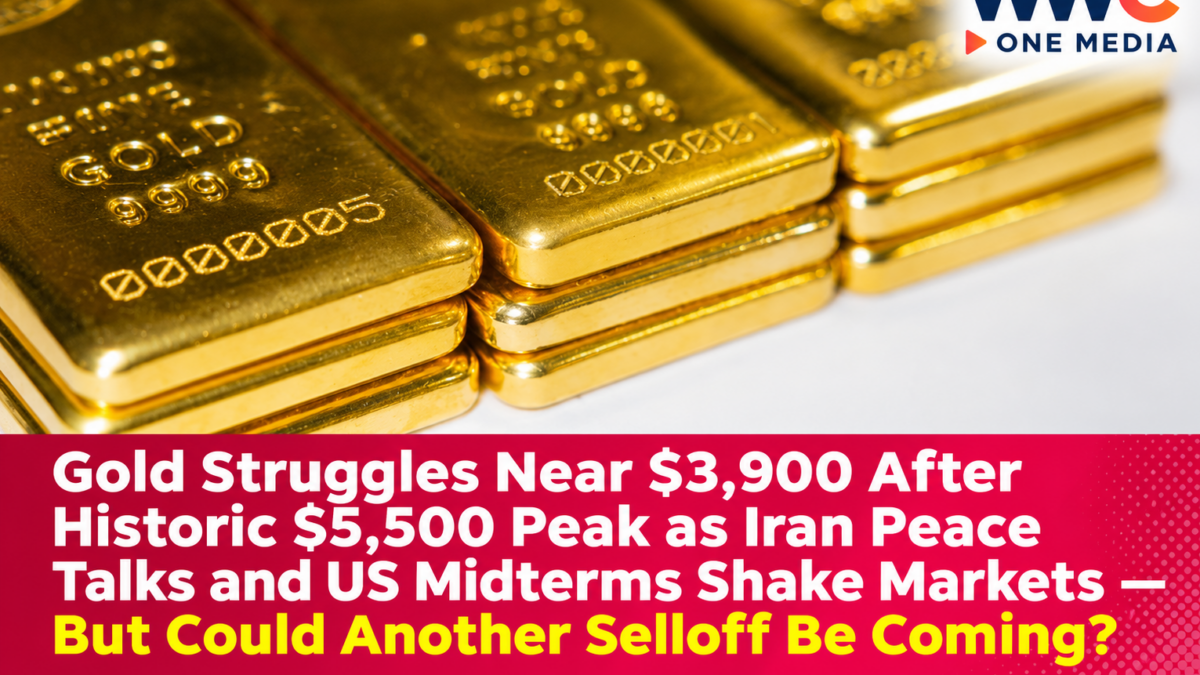
After reaching a record above $5,500 per troy ounce earlier this year, the precious metal has suffered a dramatic reversal, falling below the psychologically important $4,000 level and leaving traders questioning whether its traditional safe-haven appeal is weakening.
According to Bloomberg’s November 4 market coverage, gold steadied as investors assessed the prospects for negotiations between the United States and Iran while monitoring the outcome of the US midterm elections.
The stabilization followed another volatile trading session.
Reuters reported that spot gold declined 0.5% to $3,927.18 an ounce on November 3, after falling as low as $3,893.31 during the session.
US gold futures for December delivery settled 0.7% lower at $3,940.40.
The decline came despite renewed diplomatic efforts aimed at ending the conflict with Iran, which has disrupted global energy markets and intensified inflation concerns.
But the biggest threat to bullion may not be the conflict itself.
Gold is caught between its historic role as protection against geopolitical uncertainty and a global interest-rate environment that makes owning a non-yielding asset increasingly expensive.
With the US election results, Federal Reserve policy and Middle East negotiations all capable of moving markets, investors face a critical question.
Could gold regain its momentum and eventually challenge $5,000—or is another wave of selling about to test the metal’s recent lows?
Gold’s Fall From Record Highs Shakes Investor Confidence
Gold began 2026 with considerable momentum.
Demand for protection against geopolitical uncertainty, inflation risks and concerns about government debt helped propel the precious metal to a record exceeding $5,500 an ounce.
But the rally reversed as rising energy prices pushed inflation expectations higher and encouraged investors to anticipate tighter monetary policy.
By early November, bullion was trading below $4,000.
Bloomberg reported that gold had fallen more than 8% during 2026 as of November 2, putting it on course for its weakest annual performance in more than a decade if those losses persisted.
The reversal has surprised investors accustomed to viewing gold as a dependable defensive asset.
However, gold’s performance during periods of market stress is not always straightforward.
Although uncertainty can encourage safe-haven demand, other financial forces can outweigh that benefit.
Higher bond yields, a stronger dollar and forced selling by leveraged investors can all place downward pressure on bullion.
The latest downturn demonstrates how quickly market sentiment can change.
Why Iran Peace Talks Are Moving Gold Prices
Diplomatic developments involving the United States and Iran have become a major influence on commodity markets.
The conflict has disrupted petroleum supply and shipping through the Middle East, contributing to higher oil prices and renewed inflation concerns.
In early November, Iranian officials indicated that diplomatic contacts involving Qatar were continuing.
The possibility of an agreement encouraged traders to reassess the likelihood of prolonged energy-market disruption.
On November 2, gold rebounded as crude prices plunged amid renewed hopes for negotiations.
WWC ONE MEDIA previously examined the rebound in Gold Surges 2.1% Toward $4,000 as Iran Peace Hopes Spark Biggest Rally in Two Months — But Could One Failed Deal Trigger Another Selloff?.
The report documented gold’s recovery to approximately $3,954 after hopes of a diplomatic breakthrough eased concerns about energy-driven inflation.
But the optimism remains fragile.
The United States and Iran have not finalized a comprehensive peace agreement, while disagreements over sanctions, security and maritime access remain unresolved.
Investors are therefore responding not only to actual developments but also to changing expectations about what negotiations might achieve.
A Strange Relationship: Falling Oil Can Help Gold
Under normal circumstances, geopolitical conflict can increase interest in gold as a safe-haven investment.
But the current Middle East crisis has created a more complicated relationship.
Higher oil prices raise transportation and production costs across the global economy.
Those costs can contribute to inflation.
If inflation remains elevated, central banks may raise interest rates or keep them restrictive for longer.
That can reduce gold’s attractiveness because bullion does not provide interest payments.
Consequently, a rise in oil prices can sometimes weigh on gold even when the underlying geopolitical situation is dangerous.
This helps explain why bullion recovered when crude prices fell sharply on November 2.
Brent futures declined approximately 7.6% to $104.77 per barrel.
WWC ONE MEDIA previously detailed the development in Oil Prices Crash Nearly 8% as Iran Peace Talks Send Brent to $104 — But Could One Failed Deal Trigger a $140-a-Barrel Shock?.
Lower oil prices temporarily eased concerns that central banks would need to respond to prolonged energy inflation.
However, another escalation in the conflict could quickly reverse that improvement.
Federal Reserve Rate Expectations Become Gold’s Biggest Obstacle
The Federal Reserve’s interest-rate outlook is another major factor behind the pressure on gold.
Higher US interest rates generally increase the returns available from interest-bearing assets, including government securities.
Gold, by contrast, provides no coupon or dividend.
When Treasury yields rise, investors may demand a lower gold price to compensate for the opportunity cost of holding bullion.
On November 3, Reuters reported that traders were assigning approximately a 79% probability to another Federal Reserve rate increase in December.
That was a market-implied probability, not an official central bank commitment.
The Federal Reserve had already increased its benchmark rate in September, marking its first increase since 2023.
WWC ONE MEDIA covered that policy shift in The Fed Just Hiked Rates for the First Time Since 2023 — But the Market’s Biggest Reaction Wasn’t in Stocks.
The tightening cycle creates a difficult environment for precious metals.
Even if geopolitical risks remain elevated, traders must consider whether future interest payments from competing investments could offer better returns.
The next major shift in gold prices may therefore depend heavily on inflation data, employment figures and statements from Federal Reserve officials.
US Midterm Elections Add Political Uncertainty
The November 3 US midterm elections have introduced another source of volatility.
Investors are monitoring the results for indications of how control of Congress could affect the Trump administration’s fiscal, regulatory and foreign policies.
A divided Congress could complicate the passage of major legislation.
That could influence expectations about government spending, the federal deficit and financial-market regulation.
Some analysts believe a political shift that weakens the dollar could support gold.
However, that outcome is not guaranteed.
Election results can influence markets through several channels, including Treasury yields, currency movements and expectations for future economic growth.
The effect on gold depends on which forces dominate.
A weaker dollar can make bullion less expensive for buyers using other currencies.
But higher bond yields can offset that potential advantage.
As of the market reports reviewed, investors were still evaluating the political implications of the voting.
Specific election outcomes should not be assumed without confirmed results.
Why the US Dollar Matters So Much
Gold is primarily priced internationally in US dollars.
When the dollar strengthens, the precious metal can become more expensive for buyers using other currencies.
That may reduce demand at the margin.
A stronger dollar can also reflect investor preference for US financial assets, particularly when American Treasury yields are rising.
Reuters reported that both the dollar and Treasury yields strengthened during November 3 trading, contributing to gold’s decline.
The combination creates pressure on bullion from two directions.
First, dollar strength affects the purchasing cost for international investors.
Second, higher yields increase the attractiveness of interest-bearing assets.
However, these relationships are not mechanical.
Gold and the dollar can sometimes rise together during severe financial stress.
The important question is which market forces investors consider most significant at a particular moment.
Gold’s $5,000 Target Now Looks More Difficult
Earlier in 2026, major financial institutions discussed the possibility of gold reaching or exceeding $5,000 an ounce.
Those expectations reflected concerns about geopolitical instability, government debt and long-term demand from institutional investors and central banks.
WWC ONE MEDIA previously explored the bullish scenario in Can Gold Hit US$5,000? Wall Street Turns Bullish Even as Strong US Jobs Revive Rate-Hike Fears.
At the time, investors were weighing gold’s long-term appeal against the possibility of higher US interest rates.
The subsequent decline demonstrates why price targets should never be mistaken for guaranteed outcomes.
For bullion to return to $5,000 from approximately $3,927, it would need to rise by roughly 27%.
That is a significant move.
It might require some combination of stronger investment demand, lower real yields, a weaker dollar or renewed concerns about geopolitical and financial stability.
None of those developments can be guaranteed.
The current market also illustrates why investors need to distinguish between long-term arguments for owning gold and short-term trading risks.
Gold’s Safe-Haven Status Is Facing an Unusual Test
Gold is traditionally associated with protection during political instability, currency uncertainty and financial crises.
However, the metal has not consistently performed that role during the recent market turbulence.
A selloff in technology shares has created pressure across multiple asset classes.
Bloomberg reported that bullion had been affected by investors liquidating holdings to cover losses elsewhere.
This is an important feature of financial-market stress.
Investors sometimes sell assets that remain fundamentally attractive because they need immediate liquidity.
Gold is widely traded and can be sold relatively quickly.
That liquidity can become a disadvantage during periods of forced liquidation.
Instead of rising as a safe haven, bullion may decline alongside equities.
Such price behavior does not eliminate gold’s potential defensive role over longer periods.
But it demonstrates that the metal is not guaranteed to appreciate whenever stock markets fall.
Central Banks Remain an Important Source of Demand
Despite short-term weakness, official-sector demand remains a major factor in the longer-term gold market.
Central banks hold gold as part of their international reserves.
Some use it to diversify reserve assets and reduce dependence on particular currencies or financial instruments.
On November 3, Reuters reported that the World Gold Council had reduced its forecast for annual growth in gold investment to 200 metric tons from 400 metric tons.
At the same time, it raised its estimate for central-bank purchases.
That combination highlights different trends within the gold market.
Private investors may reduce exposure when yields rise or financial conditions tighten.
Central banks may continue purchasing gold for longer-term reserve management reasons.
However, official-sector buying does not guarantee that prices will increase.
Gold prices ultimately reflect the balance between investment demand, central-bank activity, supply, interest-rate expectations and currency movements.
What a Stronger Gold Market Would Need
Several developments could improve the outlook for bullion.
A sustained decline in energy prices could reduce inflation concerns and weaken expectations of further central-bank tightening.
Lower US Treasury yields could also reduce the opportunity cost of owning gold.
A weaker dollar might provide additional support for international demand.
Political uncertainty could encourage renewed defensive buying, depending on how financial markets respond.
But there are also scenarios in which gold remains under pressure.
Inflation could stay elevated.
The Federal Reserve could continue increasing borrowing costs.
The dollar could remain strong.
And investors could sell more bullion to meet liquidity requirements elsewhere.
These competing possibilities explain why gold has struggled to establish a clear direction.
Why Asian Investors Are Watching Closely
Gold-market developments have implications beyond the United States.
Investors in Asia monitor dollar-denominated bullion because currency movements can influence domestic gold prices.
In the Philippines, local gold valuations can be affected by both the international dollar price and the peso-dollar exchange rate.
A decline in global gold prices does not necessarily translate into an identical percentage decline in peso terms.
If the peso weakens against the dollar, part of the international price decline could be offset.
The relationship is particularly relevant to Filipino investors, jewelry businesses and participants in the domestic gold market.
However, investment decisions should consider transaction spreads, fees, storage, product purity and the possibility of significant price losses.
Gold may provide diversification, but it remains a volatile asset.
Iran’s Energy Crisis Could Keep Markets Unstable
The broader geopolitical environment remains central to the gold outlook.
Although renewed negotiations have raised hopes for peace, the conflict continues to disrupt energy markets.
Oil traders remain concerned about the Strait of Hormuz, shipping security and the restoration of petroleum supplies.
WWC ONE MEDIA previously examined the risks in ANZ Raises Oil Forecast to $105 as Iran War Tightens Supply — But Could Brent Surge Beyond $120 and Trigger Another Fuel Shock?.
The analysis explained how persistent supply disruptions could keep crude prices elevated even if diplomatic progress reduces immediate fears.
For gold, the resulting market reaction could be complicated.
Renewed conflict may stimulate demand for safe-haven assets.
But if it also drives energy inflation and higher Treasury yields, bullion could face additional selling pressure.
This is why investors should avoid assuming that every escalation in the Middle East will automatically push gold higher.
What Other Financial Outlets Confirm
Bloomberg’s recent coverage highlights how gold has been caught between expectations for US–Iran negotiations, changing oil prices and the Federal Reserve’s policy outlook.
Reuters reported that bullion fell on November 3 as a stronger dollar and rising US Treasury yields outweighed support from easing energy-price concerns.
The Business Times published Bloomberg’s November 3 analysis showing gold trading around $3,950 after its strongest daily gain in approximately two months.
Investing.com also reported the market’s response to Iran diplomacy and US political uncertainty.
Separately, Associated Press reporting on the Middle East conflict confirmed that diplomatic efforts were continuing despite major disagreements and renewed military incidents.
These reports support the conclusion that the gold market remains highly sensitive to both geopolitical and monetary developments.
They do not establish that a new gold rally has begun or that further losses are inevitable.
The Bigger Question: Gold Rebound or Another Market Breakdown?
Gold’s recent performance reveals a financial market struggling to balance several competing forces.
Investors remain concerned about the Middle East conflict, the outcome of US elections and the direction of the American economy.
Yet those uncertainties have not been enough to protect bullion from higher Treasury yields and a stronger dollar.
The metal has fallen dramatically from its record above $5,500 earlier in 2026.
Its rebound on November 2 demonstrated that lower energy prices and reduced inflation concerns can still attract buyers.
But the renewed selling on November 3 showed how quickly that optimism can fade.
For gold investors, the next important developments will include confirmed US election results, progress in Iran negotiations, oil-price movements and expectations surrounding the Federal Reserve’s December meeting.
The Bottom Line
Gold remains one of the world’s most closely watched defensive investments, but its recent performance is challenging conventional assumptions about safe-haven assets.
A record-setting rally has given way to a sharp correction.
Interest-rate expectations are limiting its recovery.
And political uncertainty is creating volatility rather than a predictable rise in prices.
With gold trading around $3,900 after a historic surge above $5,500, could a breakthrough in US–Iran talks and a shift in American politics revive the precious metal’s appeal—or will higher interest rates and a stronger dollar drive the next major selloff before bullion can reclaim $4,000?