CARACAS, Venezuela — November 4, 2026 | WWC ONE MEDIA | World Politics, Human Rights & Latin America
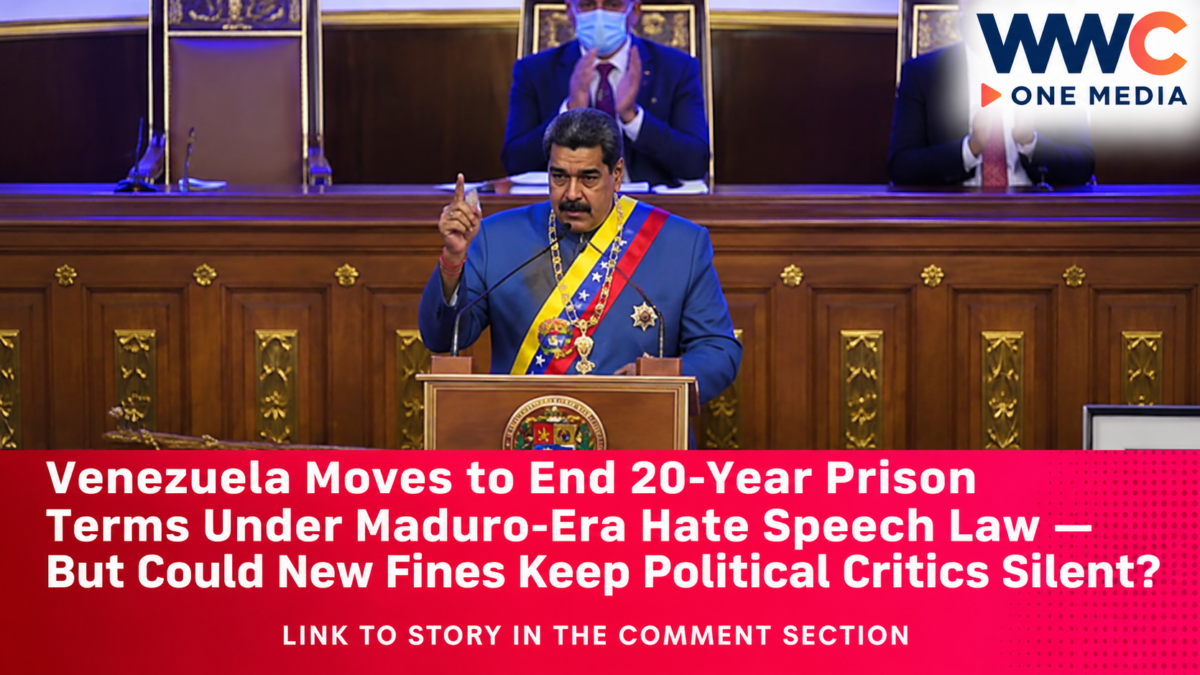
Venezuela has taken a significant step toward dismantling one of the most controversial laws associated with former President Nicolás Maduro’s government, as lawmakers move to eliminate lengthy prison sentences imposed under legislation that critics say was routinely used to punish political dissent.
On November 3, Venezuela’s National Assembly approved the first reading of proposed reforms to the country’s 2017 Anti-Hate Law, which currently allows prison terms of 10 to 20 years for conduct classified as promoting or inciting hatred.
The proposed overhaul would replace those criminal penalties with administrative fines and community service.
It would also introduce clearer definitions and procedures, remove provisions allowing the revocation of media broadcasting licenses, and modify restrictions affecting political organizations.
The move marks another stage in Venezuela’s political transition following Maduro’s capture by US forces in January 2026 and the installation of an interim government led by Delcy Rodríguez.
But the reform is already dividing the country.
While the government presents the changes as an effort to strengthen democratic coexistence, opposition lawmakers and human rights organizations warn that the proposed law could continue restricting free expression through substantial fines and administrative sanctions.
The central question is whether Venezuela is genuinely dismantling the legal machinery of political repression—or simply replacing prison sentences with financial penalties that could still silence government critics.
Venezuela Approves First Step Toward Reforming Controversial Law
The National Assembly approved the proposed reform during its November 3 session in Caracas.
Pedro Infante, the legislature’s first vice president, presented the changes on behalf of a special commission established to review the legislation.
The proposal seeks to remove prison sentences and replace them with administrative sanctions, fines and community service.
It would also clarify the legal meaning of prohibited conduct, including speech considered threatening or discriminatory.
Supporters argue that the changes would allow authorities to address genuine incitement to violence without relying on lengthy imprisonment.
But the proposal has not become law.
Following its initial approval, the draft must undergo public consultation and further parliamentary examination before a final vote.
That distinction is essential because the existing 2017 law remains legally relevant until a valid reform takes effect.
How the 2017 Anti-Hate Law Became a Tool of Repression
Venezuela adopted the Constitutional Law Against Hatred, for Peaceful Coexistence and Tolerance in November 2017.
The legislation emerged after months of deadly protests against Maduro’s government.
Authorities argued that stronger measures were necessary to prevent political violence, discrimination and incitement.
However, the law’s broad language quickly attracted criticism.
Human rights organizations argued that vague definitions allowed authorities to treat peaceful criticism as criminal conduct.
Journalists, opposition supporters, protesters and ordinary citizens faced investigations or prosecutions over statements that officials characterized as hateful.
The legislation’s most severe penalties provided for imprisonment ranging from 10 to 20 years.
Critics said such punishments were disproportionate, particularly when applied to political speech that did not directly incite violence.
The law also gave authorities powers affecting broadcasters and political organizations.
For years, opposition groups argued that its enforcement encouraged self-censorship.
At Least 927 People Accused Under the Law
The Venezuelan legal aid organization Foro Penal has documented at least 927 people accused of incitement to hatred since the law was introduced in 2017.
The figure demonstrates the scale of its application.
However, the statistic requires careful interpretation.
The number of people accused under the law is not equivalent to the number convicted or sent to prison.
Some cases involved additional allegations, including terrorism or criminal association.
Others resulted in reporting requirements, restrictions on movement or other legal conditions rather than imprisonment.
Foro Penal has also documented people who remain subject to judicial restrictions despite being released from detention.
Rights advocates argue that those conditions can continue limiting political participation and freedom of expression.
The legal consequences may therefore extend beyond the time someone spends behind bars.
Delcy Rodríguez Acknowledges the Law Was Abusively Applied
The proposed reform has particular political significance because it was initiated by interim President Delcy Rodríguez.
Rodríguez was president of Venezuela’s Constituent Assembly when the original legislation was enacted in 2017.
In September 2026, she acknowledged that the law had been improperly applied and abused.
That acknowledgment was striking because the legislation had long been defended by the country’s ruling movement.
Rodríguez has argued that Venezuela still needs legal protections against hatred and violence.
But she now supports changes intended to reduce punitive measures and improve the law’s application.
The government describes the initiative as part of a broader process of national reconciliation.
The proposed legislation would be renamed to emphasize democratic coexistence, peace and tolerance.
However, critics question whether changing the law’s name and penalties will provide sufficient safeguards against future political misuse.
The Biggest Concern: Replacing Prison With Expensive Fines
The proposed reform would eliminate imprisonment under the law’s principal hate-speech provisions and introduce administrative penalties instead.
Local reporting on the draft indicates that fines could range from amounts equivalent to approximately $500 to $10,000, depending on the alleged violation and the applicable exchange-rate calculation.
For ordinary Venezuelans, such penalties could be financially devastating.
Human rights organizations warn that a penalty does not need to involve imprisonment to deter speech.
A journalist, activist or ordinary citizen may still avoid criticizing powerful officials if doing so could lead to an unaffordable fine.
The concern is particularly serious when enforcement decisions are handled by government institutions that critics consider insufficiently independent.
Opposition lawmaker Amelia Belisario argued that the reform does not adequately address the authority responsible for imposing sanctions.
Her objection reflects a broader concern: the replacement of criminal punishment with administrative punishment does not necessarily end censorship.
Opposition Demands Complete Repeal
Venezuela’s opposition remains divided over whether the law should be amended or abolished.
The country’s main opposition coalition, Plataforma Unitaria Democrática, has called for complete repeal.
Its position is that the legislation was used to persecute dissent and cannot be adequately corrected through limited amendments.
Several opposition lawmakers voted against the proposal in its first reading.
Others argued that partial reform represents progress, even if more extensive changes remain necessary.
This disagreement reflects two competing approaches to Venezuela’s political transition.
Some opposition representatives believe negotiations with the interim government can deliver practical improvements.
Others fear that accepting partial reforms could legitimize institutions still capable of restricting democratic freedoms.
Both positions reflect concerns about the country’s history of political repression.
The question is whether the legislative process can produce protections strong enough to prevent future abuses.
Media Freedom Remains a Major Test
The reform also proposes removing the power to revoke media broadcasting licenses under the Anti-Hate Law.
That would be an important change for television and radio operators concerned about losing their ability to broadcast.
However, the proposal would still allow certain administrative sanctions affecting media organizations.
The precise consequences will depend on the final legal text and how authorities implement it.
Independent journalists and press-freedom organizations have repeatedly criticized the restrictions imposed during Maduro’s presidency.
Some media outlets faced closures, website blocking or legal pressure.
Others operated in an environment where reporting critically on officials could carry serious risks.
The government has recently permitted greater activity by some independent outlets.
But rights advocates say the broader legal and institutional environment remains restrictive.
Real media freedom requires more than removing one particular sanction.
It also depends on independent courts, transparent enforcement and meaningful safeguards against retaliation.
The United Nations Warns Venezuela’s Repressive Institutions Remain
The proposed law comes amid continuing international concern about human rights conditions.
In September, a UN-mandated fact-finding mission warned that much of the institutional machinery associated with repression under Maduro remained in place.
The mission acknowledged some improvements following the change in government.
Those developments included prisoner releases, expanded political activity and adjustments to restrictions affecting independent voices.
However, investigators warned that progress remained incomplete and potentially reversible.
They also expressed concern about allegations of mistreatment in detention facilities and the continued influence of officials linked to past abuses.
The findings are important because legal reforms must be evaluated alongside how government institutions actually behave.
A new law may promise greater freedom, but its effectiveness depends on courts, police, prosecutors and administrative agencies respecting those protections.
Without institutional accountability, rights organizations warn, reforms could fail to deliver lasting changes.
Political Prisoners Remain a Critical Issue
The proposed overhaul does not automatically free everyone detained under politically related charges.
According to Foro Penal figures cited by Bloomberg Línea, Venezuela had 322 political prisoners as of October 26, 2026.
That included 140 members of the armed forces.
These figures represent a time-specific count and can change as detainees are released or newly arrested.
They also cover a broader range of cases than those involving the Anti-Hate Law.
Human rights groups say political detainees have faced charges under multiple statutes, including terrorism and conspiracy-related provisions.
Consequently, reforming one law would not necessarily resolve every politically motivated prosecution.
The government has denied that it systematically holds people solely for their political beliefs, maintaining that detainees have faced criminal allegations.
Independent rights groups dispute that characterization in numerous cases.
The competing claims highlight the need for transparent case reviews and credible judicial procedures.
Earlier Amnesty Measures Have Produced Mixed Results
Venezuela has already adopted an amnesty initiative as part of the political transition.
The legislation, approved in February 2026, allowed certain individuals connected to past political protests and other specified events to seek relief.
Government officials said thousands of people had benefited through releases or the removal of legal restrictions.
However, human rights organizations argued that the law’s coverage was limited.
Some categories of detainees remained excluded.
Others faced unresolved legal proceedings or continuing restrictions.
The experience illustrates why the proposed Anti-Hate Law reform is attracting intense scrutiny.
Formal legal changes may provide relief to some individuals without resolving the wider problems affecting the justice system.
Rights advocates are calling for the government to review outstanding cases and ensure that people detained solely for peaceful expression are not left imprisoned under alternative charges.
María Corina Machado’s Return Raises the Political Stakes
The legislation is being debated amid renewed activity by Venezuela’s opposition.
Prominent opposition leader María Corina Machado returned to the country in late October, increasing pressure on the interim government to establish a clear timetable for democratic elections.
Machado has argued that Venezuela must restore political rights, strengthen independent institutions and permit genuinely competitive elections.
Her supporters question whether the current negotiations have produced sufficient guarantees.
WWC ONE MEDIA previously examined the political contest in María Corina Machado Leads Venezuela Polls as Political Talks Resume — But a Bigger Battle Over Elections and Democratic Power Lies Ahead.
That report explored the challenges facing the US-backed transition process, opposition representation and the establishment of an election timetable.
The Anti-Hate Law reform is directly relevant to that debate.
An election cannot be considered fully competitive if candidates, journalists and ordinary voters face arbitrary penalties for peaceful criticism.
The legislative process will therefore provide one measure of whether the government is willing to establish stronger democratic guarantees.
No Firm Presidential Election Date Has Been Announced
Rodríguez has pledged that Venezuela will hold elections consistent with its constitutional obligations.
She has also discussed the need to rebuild confidence in the country’s electoral institutions.
However, her government has not announced a definitive date for a new presidential election.
Machado and other opposition figures have called for a faster transition.
They argue that voters should have an opportunity to choose the country’s next government through a credible electoral process.
Government representatives have emphasized political stability and institutional reform.
The competing priorities create tension over the pace of democratic change.
The Anti-Hate Law debate could become an early test of whether the political negotiations are producing meaningful protections.
If the reform is substantially strengthened through public consultation, it may help build confidence.
If broad enforcement powers remain, critics may view the process as insufficient.
Washington’s Role Complicates Venezuela’s Transition
The United States has become a central participant in Venezuela’s political and economic transition.
Following Maduro’s capture in January, Washington established a working relationship with Rodríguez’s interim administration.
The two governments have cooperated on several matters, including energy policy and economic reconstruction.
US officials have also supported political dialogue involving government and opposition representatives.
But critics argue that international commercial interests should not take priority over democratic accountability.
Venezuela possesses extensive oil reserves, making its political future important to global energy markets.
WWC ONE MEDIA examined Washington’s expanding energy interests in Trump’s Venezuela Oil Gamble Just Got Bigger — The US Is Taking a 35% Stake in a 65-Billion-Barrel Prize.
The article explored the commercial and legal questions surrounding a major US-backed Venezuelan oil arrangement.
The energy agreement and Anti-Hate Law reform are separate developments.
However, both illustrate the challenges facing Venezuela as it attempts to restore international relationships while rebuilding domestic institutions.
Economic cooperation may help stabilize the country, but it cannot substitute for credible legal protections.
Human Rights and Foreign Investment Are Connected
Venezuela’s government is also attempting to attract private investment after years of economic disruption.
On October 29, Rodríguez said authorities were assessing nonessential state assets that could potentially be offered to private businesses or returned to former owners.
Reuters reported that the review included infrastructure and assets associated with energy, power and mining.
The government has also discussed new energy contracts and changes intended to stimulate economic activity.
Investors generally seek predictable legal rules, enforceable contracts and impartial dispute-resolution systems.
Restrictions on political speech can raise broader questions about the independence of legal institutions.
A government that can arbitrarily punish critics may also create uncertainty about the treatment of businesses and property rights.
However, passing a speech-law reform does not automatically establish a more reliable investment environment.
Investors will assess whether courts and regulators operate consistently over time.
International Credibility Depends on More Than One Law
Venezuela continues facing international scrutiny over territorial disputes and foreign relations.
One important issue is its longstanding disagreement with neighboring Guyana over the Essequibo region.
The case is approaching a decision by the International Court of Justice.
WWC ONE MEDIA recently examined the dispute in Guyana Rallies Caribbean Allies as Historic Venezuela Border Ruling Nears — But Could a Court Verdict Ignite a New Territorial Crisis?.
The border case is separate from Venezuela’s domestic free-speech legislation.
However, both raise questions about the government’s relationship with legal institutions and its willingness to resolve disputes through established procedures.
For international observers, the credibility of Venezuela’s transition will depend on its conduct across multiple areas.
These include human rights, elections, legal accountability and relations with neighboring countries.
The Wider Global Debate Over Restrictive Speech Laws
Venezuela is not the only country facing criticism over laws used against political expression.
Human rights organizations have raised similar concerns about broadly worded national security and public-order legislation in other jurisdictions.
WWC ONE MEDIA examined one example in EU–Vietnam Trade Is Booming, but Human Rights Are Under Fire — Will Brussels Finally Draw the Line?.
That separate report documented human rights groups’ criticism of restrictions affecting activists and independent voices in Vietnam.
The legal frameworks and political circumstances are different.
Nevertheless, the comparison highlights a recurring concern: laws intended to protect public order may become tools of repression if their wording is excessively broad and enforcement lacks independent oversight.
International human rights standards permit certain narrowly defined restrictions on speech, including measures addressing genuine incitement to violence or discrimination.
But restrictions must satisfy requirements of legality, necessity and proportionality.
The question for Venezuela is whether its revised legislation will meet those standards.
What Happens After the First Parliamentary Vote?
The November 3 vote was an important procedural development, but it did not complete the legislative process.
The proposal will undergo public consultation.
Lawmakers must then examine its provisions in a further debate before a final vote.
The proposed changes could still be amended.
Rights organizations are expected to scrutinize the remaining administrative sanctions, definitions of prohibited speech and the authorities responsible for enforcement.
Opposition representatives may also push for stronger safeguards protecting journalism, peaceful protest and political criticism.
The final law may therefore differ from the proposal initially presented.
Until the process is completed, the public should not assume that the existing criminal penalties have already been abolished.
The timing of implementation and any impact on pending cases will also require clarification.
What Independent News Organizations Confirm
Bloomberg reported on November 3 that Venezuelan lawmakers had taken the first step toward revising the law associated with the Maduro era.
Bloomberg Línea confirmed the initial legislative approval and reported that the proposed reform would remove prison penalties and media-license revocations.
Spanish news agency EFE independently confirmed the National Assembly’s vote and the principal provisions described by Pedro Infante.
Venezuelan publication El Diario examined the draft in greater detail, including the proposed fines and changes affecting political organizations.
Reuters and AFP previously documented Rodríguez’s acknowledgment that the existing law had been misused.
Separately, the UN’s independent fact-finding mission reported that significant obstacles to human rights accountability remain.
These sources establish that a reform initiative is underway.
They do not establish that the proposal has already become binding law or that all victims of past prosecutions have received legal relief.
The Bottom Line: Reform or a New Form of Censorship?
Venezuela’s decision to begin reforming the 2017 Anti-Hate Law is a significant development in the country’s political transition.
The proposed removal of prison sentences could eliminate one of the law’s most severe features.
Changes affecting media licenses and political organizations may also reduce some restrictions criticized by rights groups.
But substantial concerns remain.
The proposed fines could still discourage peaceful political expression.
Government agencies would retain enforcement authority.
Hundreds of political detainees remain imprisoned under various laws.
And the country has yet to establish a firm presidential election timetable.
The proposed reform may reduce some of the most severe punishments associated with the Maduro era. But whether it strengthens democracy will depend on the final legislation, independent enforcement and the treatment of people prosecuted for exercising their political rights.
As Venezuela moves to replace 20-year prison terms with fines and community service, will the changes finally open the door to genuine freedom of expression—or could the same government institutions continue silencing critics through a less visible form of repression?