SINGAPORE / MANILA — October 30, 2026. Global oil markets are facing another period of intense uncertainty after Australia and New Zealand Banking Group (ANZ) raised its year-end Brent crude forecast, warning that physical supply constraints linked to the continuing Iran war could keep energy prices elevated well into the final months of 2026.
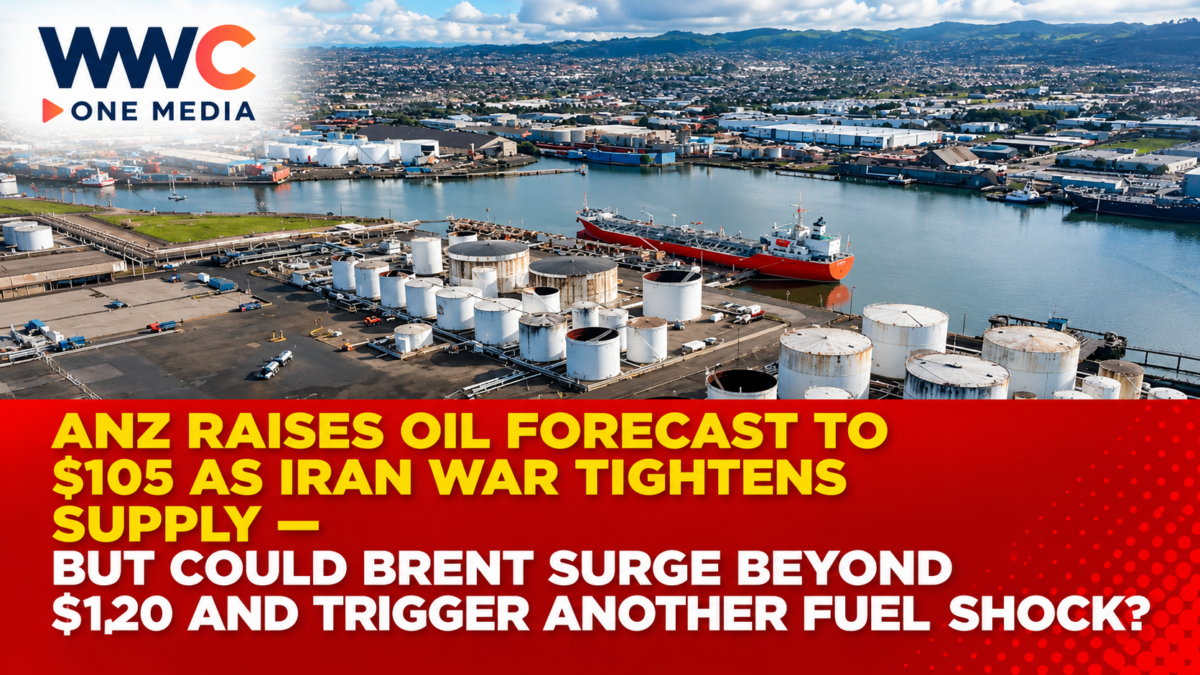
ANZ increased its December 31 Brent forecast from $95 to $105 per barrel, a $10 revision reflecting its expectation that supply disruptions and shipping difficulties will remain difficult to resolve quickly.
The revised projection comes as actual market prices are already trading substantially above the bank’s year-end estimate.
Reuters reported on October 30 that Brent December futures rose to around $116.08 a barrel, while US West Texas Intermediate crude traded near $103.37.
Oil markets were also heading toward a fourth consecutive monthly increase, with Brent on course for an October gain of nearly 11%.
For consumers and businesses, the warning is straightforward: even if oil prices moderate from current levels, a return to inexpensive crude is far from assured.
The bigger question is whether diplomacy can restore stable shipments through the Middle East—or whether another escalation could drive Brent above $120 and trigger fresh economic pressure across Asia.
ANZ increases its Brent forecast by $10
ANZ’s latest revision places its year-end Brent target at $105 a barrel, compared with its previous expectation of $95.
The increase reflects a view that the physical oil market remains tight.
In commodity trading, physical tightness means barrels available for near-term delivery are relatively scarce compared with immediate purchasing requirements.
This is different from a temporary increase in futures prices driven only by speculation or investor positioning.
The bank’s analysis suggests that producers, refiners and traders continue facing difficulty securing reliable supplies under current market conditions.
However, the $105 forecast should not be confused with the actual market price on October 30.
Brent futures were trading around $116 at the time of Reuters’ report.
ANZ’s target therefore implies that crude could decline from current levels by year-end while still remaining substantially above its earlier forecast.
That distinction is important when interpreting the bank’s outlook.
It is forecasting prolonged high prices, not necessarily an uninterrupted increase every day through December.
Why the Iran war is keeping oil markets under pressure
The oil-market disruption is closely tied to the continuing conflict involving Iran, the United States and Israel.
Military activity, attacks on energy infrastructure and risks to commercial shipping have made the movement of petroleum through the Persian Gulf more complicated.
The Strait of Hormuz remains central to the problem.
The narrow passage connects major Gulf oil exporters with international shipping routes and Asian energy consumers.
Even when crude shipments continue, security threats can increase transportation costs, insurance expenses and uncertainty over delivery schedules.
Those additional costs can influence the market well beyond the immediate location of an attack.
Oil buyers may seek alternative suppliers or routes, while traders may pay a premium for cargoes considered more reliable.
ANZ’s concern is that these problems will not disappear simply because oil production remains available on paper.
Crude must also be loaded, transported and delivered to refiners.
Tanker attack raises fresh alarm over the Strait of Hormuz
The risks were highlighted again on October 30.
Reuters reported that the United Kingdom Maritime Trade Operations agency had received information about a tanker struck in the Strait of Hormuz by explosive devices attached to a small boat.
Responsibility for the incident had not been established in the initial report.
That distinction matters because shipping incidents can become politically sensitive, with competing parties making claims that are not immediately independently verified.
The latest development added to concerns about the safety of commercial vessels.
In September, another tanker incident had already drawn international attention.
WWC ONE MEDIA covered the earlier episode in Iran Says It Struck an Oil Tanker in the Strait of Hormuz — Now the World Is Watching What Happens Next.
That report distinguished Iranian military claims from independently confirmed information and examined the consequences for maritime trade.
The events highlight why an end to active fighting may not immediately restore normal shipping conditions.
Shipping operators and insurers must also be confident that vessels can complete voyages safely.
Brent could exceed $120 if the conflict escalates
ANZ’s analysis outlines a more severe scenario if hostilities intensify.
Under that scenario, Brent could climb to $120 a barrel or higher.
That possibility reflects the risk that further attacks, more serious infrastructure damage or renewed restrictions on tanker movements could reduce deliverable supply.
However, $120 is not ANZ’s central forecast.
It is a conditional scenario based on more severe market disruption.
The distinction is particularly important for headlines about oil prices.
Predicting a possible price increase is not the same as announcing that crude has already reached that level.
ANZ also identified a less severe outcome.
If a credible peace agreement is reached and shipping conditions improve substantially, Brent could retreat toward $90 to $95 a barrel.
That means the bank sees a wide range of outcomes, with geopolitical developments remaining a decisive factor.
A ceasefire alone may not restore cheap oil
One of the more important implications of ANZ’s forecast is that political progress may not immediately eliminate physical supply problems.
Oil markets need more than a signed diplomatic agreement.
Tankers must be able to navigate safely.
Export terminals and pipelines must remain operational.
Insurance and freight costs need to normalize.
Refiners must regain confidence in delivery schedules.
Inventories may also need time to rebuild after months of disruption.
If infrastructure has been damaged or tanker routes remain risky, the effects may continue long after military activity declines.
That helps explain why traders continue placing significant value on supply security.
The market is assessing not only whether a ceasefire is possible, but also how quickly it could translate into dependable shipments.
Oil prices remain volatile as diplomacy resumes
The latest oil market movements illustrate the competition between fears of escalation and hopes for negotiations.
On October 29, Reuters reported that Brent settled at $114.88 a barrel, while West Texas Intermediate finished at $102.
Prices declined that day amid reports of renewed attempts to establish diplomatic contact between Washington and Tehran.
However, concerns over attacks involving Saudi energy infrastructure and shipping routes limited the decline.
By October 30, oil had moved higher again.
The pattern demonstrates why petroleum prices can change rapidly even without a confirmed major shift in global production.
Political signals can affect expectations about future supply.
But actual shipping conditions, inventories and refinery demand ultimately influence how much physical crude is available.
For oil-importing economies, such volatility makes budgeting and fuel procurement more difficult.
Saudi Arabia seeks alternative ways to reach Asian buyers
Major oil producers have been adapting their export logistics to maintain deliveries despite regional insecurity.
Saudi Arabia has explored arrangements involving ship-to-ship transfers off Oman to support crude shipments to Asian customers.
WWC ONE MEDIA examined these efforts in Saudi Arabia Is Offering More Oil to Asia Through Oman — But the Crude Still Has to Survive the Strait of Hormuz First.
The report explained that moving crude through an alternative transfer location does not necessarily eliminate the need to navigate dangerous waters.
The distinction illustrates a broader challenge.
Alternative logistics can improve flexibility, but they may not fully remove exposure to the original shipping bottleneck.
They can also add handling costs, logistical complexity and uncertainty.
For Asian refiners, these complications can raise the delivered cost of oil even when exporters continue producing substantial volumes.
ANZ’s warning matters directly to the Philippines
The Philippines is heavily dependent on imported petroleum.
That makes international oil-price developments important for domestic fuel costs.
Crude oil and refined petroleum products are commonly priced in US dollars, so the peso-dollar exchange rate can amplify or reduce the impact on local import costs.
A weaker peso makes a dollar-priced shipment more expensive when converted into Philippine currency, all else being equal.
Higher fuel import costs may eventually affect gasoline, diesel and other petroleum products.
The impact can spread through trucking, public transportation, agriculture, aviation and food distribution.
However, changes in Brent prices do not translate automatically into identical peso-per-liter adjustments at local fuel stations.
Pump prices also depend on refined-product benchmarks, exchange rates, taxes, distribution expenses and company pricing schedules.
Filipino motorists should therefore distinguish international oil forecasts from confirmed domestic retail-price announcements.
The Philippine government is exploring emergency oil reserves abroad
With Middle East disruptions continuing, the Philippine government has been examining ways to strengthen petroleum supply security.
Energy Secretary Sharon Garin has discussed the possibility of reserving access to fuel stored overseas while additional domestic storage capacity is developed.
WWC ONE MEDIA reported on the initiative in Philippines Moves to Secure Oil Reserves Abroad as Middle East Conflict Threatens Fuel Supply — But Will It Prevent Another Price Shock?.
The Department of Energy estimated nationwide petroleum inventory coverage at approximately 53 to 55 days in the statements reviewed.
That suggests the country has a supply cushion, although it does not mean that every barrel is owned directly by the government.
The proposed overseas reservation arrangements could improve access to emergency supplies.
But the government has not confirmed a completed arrangement covering a particular volume or price.
Strategic reserves primarily address supply availability.
They do not guarantee that pump prices will decline if international oil remains expensive.
Why an oil reserve is not the same as a fuel-price subsidy
The difference between security of supply and affordability is crucial.
A country may have sufficient fuel in storage and still face high market prices.
Similarly, a government may reserve access to petroleum without purchasing it immediately.
Depending on the terms, it may need to pay the prevailing cost when the fuel is released.
Transportation and insurance expenses could also apply.
For the Philippines, emergency petroleum arrangements may reduce the risk of physical shortages during severe disruptions.
But they cannot permanently insulate the country from international market prices.
That is why policymakers must consider a broader strategy involving fuel sourcing, domestic storage, transportation infrastructure and energy diversification.
Previous fuel-price warnings show why forecasts need careful handling
Higher global petroleum costs have already affected expectations for Philippine fuel adjustments.
In September, industry estimates suggested that some pump prices could increase by several pesos per liter during a particular weekly pricing cycle.
WWC ONE MEDIA reported on those forecasts in Fuel Shock Looms: Oil Prices Could Jump by Up to ₱5 per Liter Again on September 15.
That article referred to the September 15 adjustment period.
Its figures must not be reused as a confirmed October 30 price increase.
The important lesson is that oil-price forecasts can change as international benchmarks and exchange rates fluctuate.
Consumers should rely on announced pump-price adjustments for actual retail prices, rather than projections made for a different week.
ANZ’s $105 forecast offers information about the broader market direction, not a precise future gasoline or diesel price in the Philippines.
Could crude prices remain above $100 into 2027?
ANZ’s immediate target concerns December 31, 2026.
But the wider oil market is increasingly focused on the possibility that high prices persist beyond the current year.
Other market analysts have warned that damaged infrastructure, slow inventory rebuilding and elevated transportation costs could delay a return to prewar conditions.
MarketWatch reported on October 30 that some analysts expect oil prices to remain relatively high even if the conflict eases.
However, the outlook remains uncertain.
A durable diplomatic settlement and restoration of shipping could reduce risk premiums.
Additional supply and weaker global demand could also place downward pressure on prices.
Conversely, renewed attacks or prolonged infrastructure disruptions could support another price increase.
There is no confirmed oil-price floor at $100.
The future path depends on market conditions that can change significantly over a short period.
The economic risks extend far beyond motorists
A prolonged oil shock affects more than household fuel expenses.
Airlines and shipping operators may face increased operating costs.
Manufacturers can encounter higher transportation and energy expenses.
Agricultural producers may pay more to transport crops or operate equipment.
Businesses may eventually pass some of these expenses on to customers.
That can create pressure on inflation, particularly in economies that import much of their energy.
Central banks may then face a difficult choice.
Higher interest rates can help restrain demand and inflation expectations, but they cannot directly resolve a physical shortage of oil.
At the same time, raising borrowing costs can place additional pressure on households and businesses.
The combination of expensive energy and weaker economic growth is one of the major risks associated with a prolonged supply shock.
Financial markets are also watching the consequences
Oil prices affect companies in different ways.
Producers may benefit from higher selling prices if they can maintain production and shipments.
Refiners, airlines, transportation businesses and fuel-intensive manufacturers may face higher costs.
The effect on energy companies is not always straightforward.
An exporter may receive higher prices but also experience difficulties transporting its products or operating damaged infrastructure.
Financial markets are therefore assessing both price levels and operational risks.
For investors in Asia, the broader concern is whether energy costs will undermine economic activity, corporate earnings and the ability of central banks to stabilize inflation.
ANZ’s latest revision underscores how geopolitical risk has become a major factor in financial forecasts.
What could bring prices back down?
A sustained decline in crude prices would likely require improvements across several areas.
First, diplomatic progress would need to reduce the risk of additional military escalation.
Second, tanker operators and insurers would need greater confidence in the safety of Gulf shipping routes.
Third, damaged export infrastructure would need to recover.
Fourth, oil inventories would need to stabilize after months of disruption.
Finally, changes in global demand and supply could affect how quickly the market returns to balance.
ANZ’s lower-price scenario assumes meaningful improvements in both diplomacy and shipping conditions.
A partial improvement in only one of those areas may not deliver the same price decline.
That is why the bank’s forecast remains sensitive to developments in the Middle East.
The bigger question: Is the next global fuel shock already taking shape?
ANZ’s decision to raise its year-end Brent forecast by $10 reflects growing concern that oil-market disruptions will persist.
Its new $105 target signals that even a decline from current market levels may leave crude unusually expensive.
At the same time, the bank’s scenario of $120 or higher shows how another major escalation could send prices sharply upward.
For the Philippines, the consequences could extend from fuel stations to transport companies, food supply chains and household budgets.
The government is exploring ways to secure more dependable petroleum supplies, but a stronger supply cushion cannot fully eliminate exposure to international prices.
The coming weeks will therefore be critical.
Oil traders will be watching shipping security, diplomatic contacts and developments in the conflict.
Governments will be assessing fuel availability, inflation and the financial cost of emergency supply measures.
ANZ has raised its oil-price forecast because the global market remains vulnerable to war-related supply disruptions. But whether Brent moves toward $90, stays above $100 or surges beyond $120 will depend on one unresolved question: Can the Middle East restore safe and reliable energy shipments before another escalation shocks the world economy?