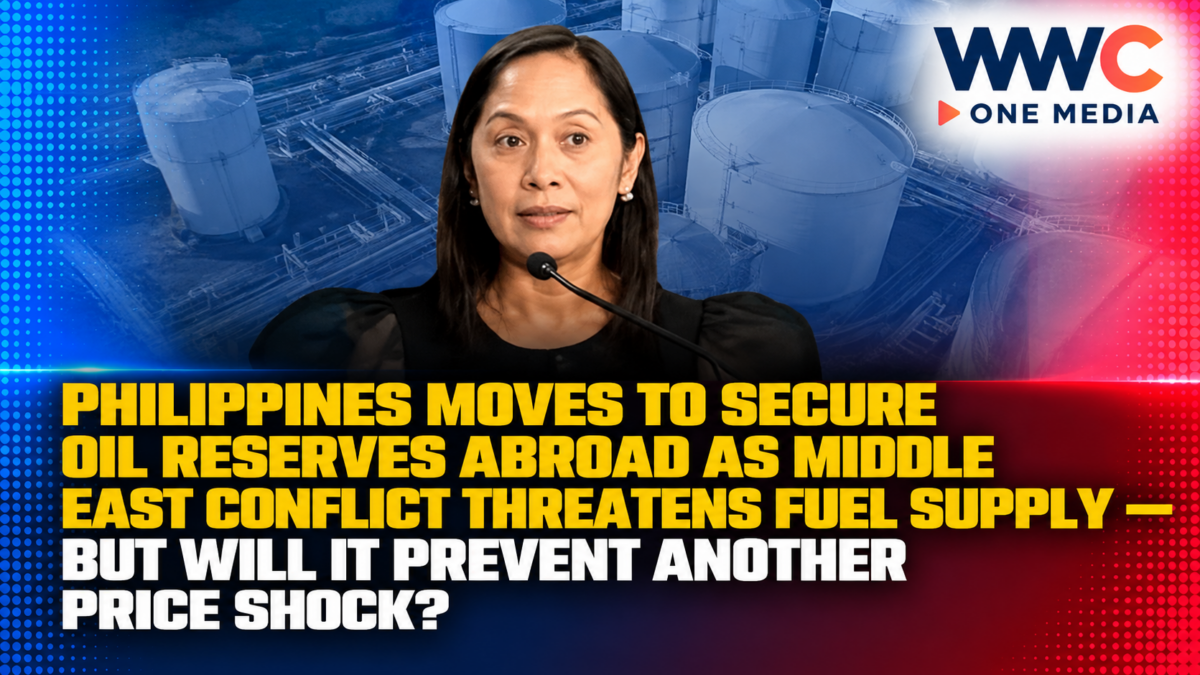
MANILA, PHILIPPINES — The Philippines is preparing a new defense against disruptions in global oil supplies: securing access to petroleum reserves stored in other countries while developing its own strategic fuel-storage facilities.
Energy Secretary Sharon Garin says the government is exploring overseas oil reservation agreements that could give the Philippines access to additional fuel without requiring it to purchase and store the entire supply immediately.
The move comes amid continuing conflict in the Middle East, which has heightened concerns over petroleum shipments, international oil prices and the vulnerability of fuel-importing economies.
According to the Department of Energy, the country currently has enough petroleum inventory to meet approximately 53 to 55 days of demand.
That provides a cushion against immediate shortages.
But government officials are concerned that instability in international markets could persist into 2027, putting continued pressure on the cost and availability of fuel.
The government is therefore exploring multiple strategies, including overseas reservation contracts, new domestic storage facilities and cooperation with Asian energy partners.
The central question is whether these plans can genuinely strengthen the country’s fuel security—or whether Filipinos will remain exposed to another wave of costly gasoline and diesel price increases.
GOVERNMENT SEEKS FUEL RESERVES OUTSIDE THE PHILIPPINES
During an October 26 briefing, Garin explained that limited domestic storage capacity is one of the biggest obstacles to expanding the country’s emergency petroleum reserves.
Even when additional oil is available internationally, the Philippines cannot simply purchase unlimited supplies without sufficient facilities to store them.
Building new tanks and related infrastructure takes time, capital and regulatory approvals.
To address this problem, the DOE is considering agreements that would allow petroleum products or crude oil to remain in storage facilities abroad while the Philippines secures the right to access them when needed.
This would provide an additional layer of supply protection while domestic infrastructure is developed.
However, the government has not announced a finalized overseas storage contract or confirmed the exact volume of oil that will be covered.
The initiative remains under negotiation.
WHAT IS OIL TICKETING, AND HOW DOES IT WORK?
The proposed overseas reservation system is known as oil ticketing.
Under the arrangement being discussed, the government would pay an agreed fee to reserve access to specified petroleum supplies held in existing storage facilities.
It would not necessarily purchase the oil immediately.
Instead, the arrangement would establish the contractual right to obtain the product when required, subject to the terms of the agreement.
The Philippines would then pay for the oil itself when the supply is released for delivery.
This differs from the traditional approach of purchasing and physically storing a large quantity of petroleum domestically.
Ticketing can potentially reduce the immediate capital needed to secure emergency supply access.
But the mechanism is not equivalent to owning fully paid-for oil already stored within the Philippines.
Actual access would depend on contract terms, supplier performance, shipping arrangements and conditions in the international market.
PNOC EXPLORATION CORP. TALKS WITH TWO PRIVATE COMPANIES
Energy Undersecretary Alessandro Sales said the Philippine National Oil Company Exploration Corporation is engaging with two private companies to begin negotiating offshore fuel reservation arrangements.
The talks focus on using existing storage facilities outside the country.
Sales said an indicative reservation fee could be less than US$1 per barrel annually.
That figure is preliminary.
The final rate will depend on the quantities involved and the negotiated contract terms.
The government has not identified the two private companies in the reviewed reports.
It has also not disclosed a finalized reservation volume, supplier guarantee or delivery timetable.
Consequently, the estimated cost should not be presented as an approved government expenditure or a signed contractual rate.
WHY THE GOVERNMENT IS CONSIDERING AN ALTERNATIVE TO A ₱20-BILLION FUEL PURCHASE
Garin said purchasing additional petroleum stocks outright could involve costs of approximately ₱20 billion.
An overseas reservation mechanism could allow the government to secure access without spending that entire amount immediately on oil.
The distinction is important.
A reservation fee may be much smaller than the value of the underlying fuel, but the country would still need to pay for the petroleum when it takes delivery.
Transportation, handling, insurance and other expenses could also apply depending on the agreement.
Ticketing may therefore reduce upfront cash requirements without eliminating the eventual cost of purchasing emergency fuel.
The government must also consider whether reserved supplies would remain accessible during the same international crisis that creates the need to use them.
A contract is only as valuable as the ability to enforce it and deliver the product.
PHILIPPINES HAS ENOUGH FUEL FOR APPROXIMATELY 53 TO 55 DAYS
The DOE says the country currently has a petroleum inventory cushion of around 53 to 55 days.
At the October 26 briefing, Garin cited approximately 53 days.
In a separate interview with Reuters on October 28, she gave a figure of 55 days.
The difference reflects separate statements made on different dates and should not automatically be interpreted as a significant or permanent inventory change.
These figures describe estimated nationwide supply coverage, not the number of days of oil wholly owned by the national government.
They may include different categories of industry and government-held stocks.
Garin told Reuters that the government holds approximately one million barrels in private storage facilities.
That is separate from the broader inventory coverage reported for the country.
The current cushion indicates that the Philippines is not facing an immediate nationwide fuel shortage based on the figures provided.
However, officials are preparing for a situation in which imports become more difficult or expensive.
WHY MIDDLE EAST TENSIONS MATTER TO FILIPINO CONSUMERS
The Philippines depends heavily on imported petroleum.
Because it is a net oil-importing economy, developments in international energy markets can affect local fuel costs.
Disruptions involving major oil-producing countries, shipping facilities or important maritime trade routes may influence global supply.
Even when petroleum continues arriving in the Philippines, higher international prices can place pressure on retail gasoline and diesel prices.
Exchange-rate movements can add further costs because international oil is commonly priced in US dollars.
A weaker peso can make imported fuel more expensive in local currency.
These effects extend beyond motorists.
Businesses that transport food, agricultural products, construction materials and consumer goods also depend on fuel.
When distribution costs rise, companies may eventually pass some of the increase to consumers.
This is why the DOE treats petroleum supply stability as an economic issue, not merely an energy-sector concern.
FUEL RESERVES DO NOT AUTOMATICALLY MEAN LOWER PUMP PRICES
One important distinction must be made.
A strategic petroleum reserve is primarily designed to improve access to fuel during disruptions.
It does not guarantee that consumers will pay less at gasoline stations.
Retail prices are affected by international oil markets, exchange rates, taxes, refining and distribution costs, and competition among fuel retailers.
A supply reserve may reduce the risk of physical shortages.
Its impact on prices depends on when supplies are released, the purchase price, the quantity available and the broader market situation.
Even if the Philippines secures overseas oil reservations, prices could continue rising if international benchmarks remain elevated.
The government’s plan should therefore be understood as an energy-security measure rather than a confirmed fuel-price reduction program.
TALKS INCLUDE THE UNITED STATES, RUSSIA AND MAJOR OIL PRODUCERS
The DOE is also exploring relationships with a wider group of potential suppliers and partners.
At the October 26 briefing, Garin identified Australia, the United States, Canada, Russia, South American countries and ASEAN members among possible sources of additional petroleum.
During the Singapore International Energy Week conference on October 28, she told Reuters that the Philippines was also discussing oil-storage arrangements involving Saudi Arabia, Japan, Kuwait and the United Arab Emirates.
These discussions reflect a strategy of diversifying potential sources and storage locations.
Depending too heavily on a small number of countries can increase exposure to disruptions.
However, international discussions are not the same as secured shipments.
Regulatory restrictions, international sanctions, banking arrangements and practical shipping conditions may affect whether particular supply options can be used.
The government has not confirmed that every country mentioned has committed to deliver specific volumes.
JAPAN AND ASEAN COULD PLAY A BIGGER ROLE IN REGIONAL RESERVES
The Philippines is also working with regional partners to strengthen longer-term energy security.
Japan has been involved in discussions on petroleum stockpiles that could support Asian countries during emergencies.
During the Asia Zero Emission Community ministerial meeting in Manila in October, participating countries examined ways to improve fuel-stockpiling arrangements and energy cooperation.
The initiative is relevant because many Asian economies depend on petroleum shipments from the Middle East.
A regional arrangement could potentially provide access to shared infrastructure and coordinated emergency responses.
But important questions remain.
Participating countries would need to determine how reserves are financed, who owns the fuel, what conditions trigger emergency releases and how supplies are allocated during a crisis affecting several countries simultaneously.
Those issues must be resolved before a regional stockpile can be regarded as operational.
PHILIPPINES COULD BECOME A REGIONAL OIL STORAGE HUB
Another possibility under discussion is the establishment of a regional petroleum storage facility in the Philippines.
Government officials have discussed potential cooperation involving Japan, Saudi Arabia and the United Arab Emirates.
The concept could involve commercial storage and export facilities as well as priority access arrangements for the Philippines.
Such an investment might reduce dependence on storage in distant locations and create opportunities for additional infrastructure activity.
However, the project remains exploratory.
No confirmed final investment decision, completed facility or guaranteed operating date has been established for the regional hub.
It would therefore be premature to describe the Philippines as having already secured a new multinational oil reserve.
BATAAN PROJECT TARGETS THE FIRST GOVERNMENT-OWNED STRATEGIC STORAGE TANK
In parallel with overseas negotiations, the Philippine National Oil Company is developing a government-owned petroleum storage project on its property in Bataan.
The initial target is capacity for approximately one million barrels of petroleum.
Officials aim to complete the first storage tank before the end of 2027.
This would represent an important step in strengthening physical storage capacity under government control.
However, a construction target does not guarantee completion by the announced date.
The project will still require funding, procurement, engineering work, regulatory compliance and successful construction.
Furthermore, a million-barrel facility should not be confused with a full 60-day national strategic reserve.
That broader goal would require considerably greater stockholding capacity or additional reserve arrangements.
GOVERNMENT TELLS PNOC TO PRESERVE EXISTING PETROLEUM STOCKS
Garin said she had instructed the Philippine National Oil Company to stop selling existing petroleum stocks as the government works to preserve its energy-security buffer.
This directive is intended to maintain access to petroleum already held under current arrangements.
Reuters reported that approximately one million barrels of government oil stocks are presently stored in privately operated facilities.
The ability to preserve those stocks provides a foundation for longer-term reserve development.
However, holding petroleum also involves storage costs and operational considerations.
Fuel quality, storage duration and product management must be addressed to ensure that reserves remain usable when needed.
A strategic stockpile requires continuous maintenance rather than simply accumulating barrels.
GOVERNMENT PROPOSES A LARGER STRATEGIC PETROLEUM RESERVE
The DOE has also supported proposed legislation establishing a Philippine Strategic Petroleum Reserve.
According to the Philippine Information Agency, a draft measure cleared the House Committee on Energy in September 2026 and was undergoing Senate technical working group review.
The committee-approved framework envisioned a government-held stockpile equivalent to 60 days of supply.
It also proposed increasing private oil companies’ minimum inventory requirements from 15 to 30 days.
Together, the measures would create a proposed 90-day combined buffer under the framework described by the DOE.
However, the measure had not been verified as enacted into law in the reporting reviewed.
The proposed 60-day government reserve and expanded private inventory requirement should not be presented as already operational obligations.
WHAT A 60-DAY STRATEGIC RESERVE COULD MEAN
The government’s longer-term objective is to establish a reserve capable of supporting fuel supply during severe disruptions.
Garin told Reuters that the government intends to expand stockholding progressively, with a goal of reaching approximately 60 days.
She indicated that the proposed reserve would include crude oil and refined petroleum products.
This mix could provide flexibility in responding to different kinds of supply problems.
However, the economic benefits would depend on sufficient infrastructure and appropriate operational arrangements.
The government would need clear policies governing when oil can be released and how reserves are replenished.
Purchasing stocks at unfavorable prices or maintaining expensive facilities without effective management could impose significant fiscal costs.
That is why strategic reserve development requires transparent procurement and sound financial planning.
EL NIÑO COULD CREATE A SECOND ENERGY CHALLENGE IN 2027
A newer development reported by Reuters on October 28 adds to the urgency of the government’s energy planning.
Garin said the Philippines was preparing for possible declines in renewable electricity generation associated with El Niño conditions during the first half of 2027.
According to the government’s estimates, hydropower output could decline by approximately 60%, while solar generation could fall by 20%.
These are forecasts, not confirmed production losses.
The government is examining how other sources of electricity, including diesel- and gas-fired generation, could help maintain reliable power.
This situation demonstrates the potential overlap between fuel security and electricity supply.
If hydropower generation weakens, some parts of the energy system could become more reliant on fuels whose international prices are already volatile.
However, energy policy must balance reliability, costs and environmental impacts.
A temporary need for backup generation does not eliminate the importance of expanding renewable energy, storage and grid resilience.
REUTERS REPORTS A WIDER REGIONAL PUSH FOR OIL STOCKPILING
The Philippine initiative is part of a broader Asian response to global energy disruptions.
Reuters reported earlier in October that ASEAN countries, Japan and Australia were exploring stronger petroleum stockpiling systems.
The discussions included voluntary regional reserves and emergency cooperation.
The broader objective is to reduce the vulnerability of countries that import much of their petroleum.
However, participating economies also face significant costs and infrastructure constraints.
Regional cooperation cannot remove every risk associated with international shipping or geopolitical conflict.
A successful strategy would need to combine diversified suppliers, accessible reserves, efficient transportation and long-term measures to reduce dependence on imported fuel.
WHAT INDEPENDENT REPORTING CONFIRMS
InsiderPH reported the government’s overseas reservation strategy on October 27, based on the DOE’s October 26 briefing.
The Philippine News Agency independently confirmed that petroleum supply coverage was about 53 days and that the government was exploring overseas suppliers and storage options.
BusinessMirror also reported the negotiations involving two private companies and the oil-ticketing mechanism.
Its coverage cited an indicative reservation program cost of approximately ₱15 million, but the total remains subject to negotiation.
Reuters subsequently reported Garin’s October 28 statements in Singapore, confirming the 55-day inventory estimate, Bataan storage plans and discussions with several international partners.
The Philippine Information Agency separately documented the proposed strategic petroleum reserve legislation and the government’s regional energy-security initiatives.
These reports establish that multiple strategies are under discussion.
They do not establish that overseas reservations have already been finalized or that additional fuel has already been delivered under the proposed ticketing system.
WHAT THIS MEANS FOR FILIPINO MOTORISTS AND BUSINESSES
For Filipino drivers, the immediate issue remains the cost and availability of gasoline and diesel.
The current 53-to-55-day inventory estimate suggests that petroleum supplies remain adequate for the near term, based on government reporting.
The proposed ticketing system could help secure access to extra supplies if international conditions deteriorate.
For transport operators and businesses, more dependable petroleum availability may reduce the risk of severe disruption.
But the initiative does not provide a guarantee against fuel-price increases.
Consumers and businesses should continue monitoring official DOE price announcements and the broader outlook for international oil markets.
Any claims that the new overseas reserve arrangements will immediately make fuel cheaper would be premature.
THE BIGGER QUESTION: CAN THE PHILIPPINES BUILD REAL ENERGY SECURITY?
The government’s plan reflects an important shift toward more proactive petroleum supply management.
Rather than relying entirely on routine commercial imports, officials are exploring emergency reservation contracts, regional partnerships and government-controlled storage capacity.
The strategy recognizes a long-standing vulnerability in the Philippine economy.
The country depends heavily on international petroleum markets but has limited storage infrastructure under direct government control.
Overseas oil ticketing could provide an interim option while new facilities are developed.
Regional cooperation could eventually create additional emergency supply channels.
A government-owned tank in Bataan could strengthen the country’s domestic reserve system.
But these plans still need contracts, financing, construction and operational rules.
The true measure of success will not be how many countries the Philippines holds talks with, but whether it can secure dependable petroleum access when an actual supply emergency occurs.
And as the Middle East conflict continues to threaten international energy markets, one question remains:
Will overseas fuel reservations and new strategic storage facilities finally shield the Philippines from major oil disruptions—or will the next global price surge expose how vulnerable Filipino households and businesses still are?