
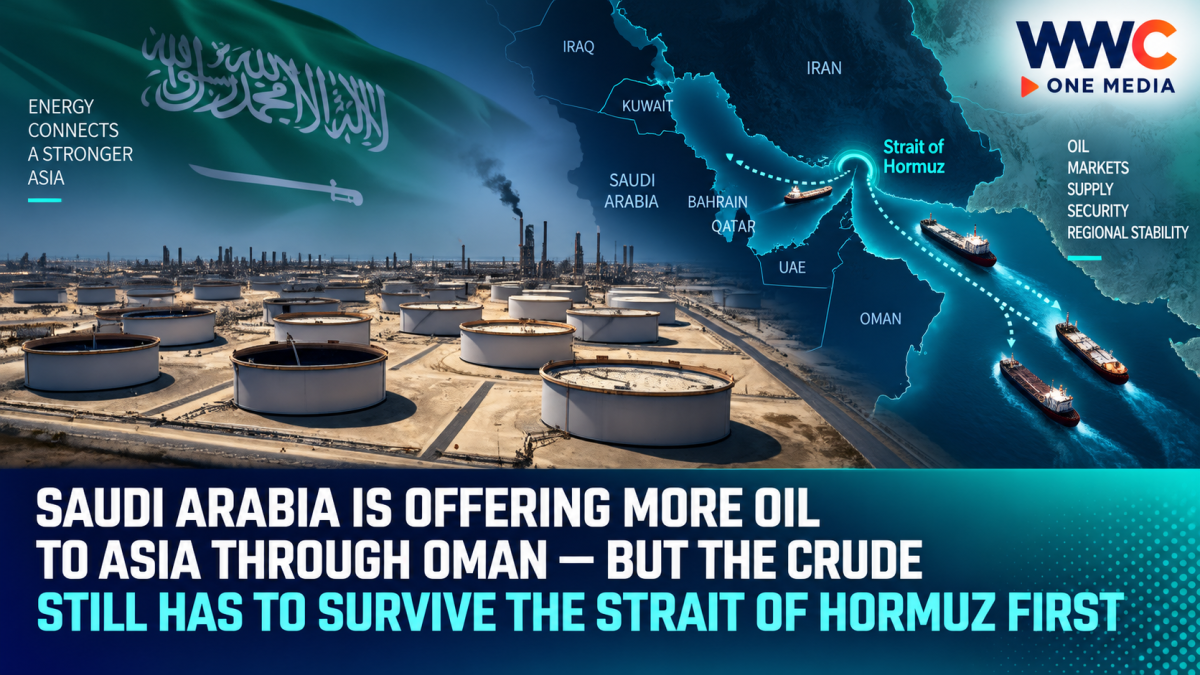
SINGAPORE/RIYADH — Saudi Arabia is improvising a new oil-export route to keep Asian refineries supplied after a drone attack knocked out the pipeline that had become one of the kingdom’s most important escape routes from the Middle East war.
Saudi Aramco is offering Asian customers additional cargoes of Arab Light, Arab Medium and Arab Heavy crude through ship-to-ship transfers off Sohar, Oman, according to people familiar with the sales.
Sohar sits on the Gulf of Oman, outside the Strait of Hormuz, making it a strategically valuable transfer point at a time when shipping through the strait has been severely disrupted.
But there is a catch.
The Saudi oil does not magically avoid Hormuz.
It is being loaded at terminals such as Ras Tanura and Juaymah inside the Persian Gulf, transported through the dangerous strait aboard shuttle tankers and then transferred to other vessels off Oman.
In effect, Saudi Arabia is trying to concentrate the riskiest section of the journey into a specialised shuttle operation while allowing Asian refiners’ larger delivery tankers to receive crude on the safer side of the chokepoint.
That logistical workaround tells a much bigger story about how badly the regional war has disrupted the world’s oil infrastructure.
Saudi Arabia spent months relying on a pipeline across its own territory to avoid Hormuz.
That pipeline was then hit.
Now the world’s largest crude exporter is sending more oil back through the very waterway it had worked so hard to avoid.
Aramco is offering all three major grades
Reuters reported that Saudi Aramco has offered Asian term customers its flagship Arab Light, together with Arab Medium and Arab Heavy, for loading through ship-to-ship transfers near Sohar.
The inclusion of Arab Light is notable.
Aramco had already made at least two recent offers of Arab Medium and Arab Heavy outside Hormuz as it experimented with the transfer system.
The latest offer expands the grades available and suggests the arrangement is becoming a more important part of Saudi export logistics rather than a one-off emergency transaction.
Saudi Aramco declined to comment to Reuters.
That means the detailed cargo information comes from traders, refiners and shipping data rather than an official company announcement.
Why Sohar suddenly matters so much
Sohar’s geography is the key.
The Omani port lies roughly 150 kilometres south of the Strait of Hormuz on the Gulf of Oman, according to Oman logistics group Asyad.
That places it beyond the narrow waterway separating Oman from Iran.
A tanker collecting crude at Sohar can head toward India, China, Japan, South Korea or Southeast Asia without having to sail into the Persian Gulf.
For an Asian refinery, that reduces the direct exposure of its own chartered vessel to Hormuz.
It can also reduce some insurance, security and operational concerns associated with sending a customer’s tanker deep into the Gulf during a conflict.
But the underlying Saudi crude still must get from the Gulf side to Sohar somehow.
That is where the shuttle tankers come in.
Saudi Arabia is loading more oil inside the Gulf
Over the past week, Saudi Arabia roughly doubled daily crude loadings at Ras Tanura and Juaymah to the equivalent of about two Very Large Crude Carriers, or roughly 4 million barrels, according to satellite tracking cited by Reuters.
Kpler separately identified four VLCCs capable of carrying a combined 8 million barrels loading at Ras Tanura on Wednesday.
A standard VLCC can carry roughly 2 million barrels of crude.
That enormous capacity allows Saudi Arabia to move significant volumes even when the number of safe or commercially acceptable voyages through Hormuz is limited.
Other Gulf producers are using similar tactics.
Reuters said producers have secured tankers to shuttle crude through the strait and transfer it to buyers outside, sometimes with vessels’ automatic tracking signals switched off.
The practice makes commercial flows harder for outsiders to monitor accurately.
It also illustrates how extraordinary the region’s oil logistics have become.
Why ships are switching off their trackers
Commercial vessels normally broadcast an Automatic Identification System, or AIS, signal containing information such as identity, position, speed and direction.
The system is fundamental to maritime safety and commercial tracking.
During periods of conflict, however, tankers sometimes go “dark” by disabling transmissions because a constantly broadcasting ship can also become easier to locate.
Reuters has repeatedly documented tankers crossing disrupted Gulf routes with tracking signals switched off.
That makes oil-market analysis increasingly difficult.
Satellite imagery may still reveal a ship.
Port agents may know when it loaded.
Refiners may know when a cargo is expected.
But real-time public tracking becomes much less reliable.
This uncertainty itself adds risk to oil prices.
Saudi Arabia had built a much cleaner escape route
Until last week, the kingdom had a far simpler solution.
Its East-West Pipeline, often called Petroline, carries crude from oil-producing regions in eastern Saudi Arabia across the Arabian Peninsula to the Red Sea port of Yanbu.
Oil moved through the pipeline never has to enter the Strait of Hormuz.
That makes the system one of the world’s most strategically valuable pieces of oil infrastructure.
Aramco said earlier this year that it had increased the pipeline’s maximum capacity to 7 million barrels per day during the first quarter as part of its response to Gulf disruptions.
In practice, Reuters reported the route had recently been moving roughly 4 million to 5 million barrels a day.
That alone represented about 4% to 5% of global oil supply.
Then drones hit it.
The Sept. 11 attack changed Saudi Arabia’s options overnight
Saudi Arabia shut the East-West Pipeline after a drone attack on Sept. 11 damaged infrastructure.
Both Riyadh and Baghdad said the drones originated from Iraq, where Iran-aligned armed groups operate.
At the time of Reuters’ initial report, no group had publicly claimed responsibility for the pipeline strike.
That distinction matters because Saudi Arabia is simultaneously fighting a renewed confrontation with Yemen’s Houthis.
The Houthis have launched separate attacks against Saudi targets.
But the East-West Pipeline attack should not automatically be attributed to them when Saudi and Iraqi authorities said the aircraft originated from Iraq.
The shutdown immediately removed the kingdom’s main large-scale route for avoiding Hormuz.
Europe felt the impact first
The pipeline outage has already forced Saudi Arabia to alter deliveries.
Trading and shipping sources told Reuters that Aramco informed European customers that some September-loading cargoes would be cancelled.
Loadings at Yanbu were suspended.
European refiner Orlen, one of Saudi Arabia’s biggest customers in the region, began looking for alternative crude from producers including the United States, Kazakhstan, Algeria, Guyana and the North Sea.
That demonstrates how quickly disruption to one pipeline in Saudi Arabia can rearrange crude procurement thousands of kilometres away.
Asian customers are being handled differently.
Rather than simply cancelling as much supply, Saudi Arabia is offering more crude through Oman.
Asia matters more to Saudi oil exports
The logic is commercial as well as logistical.
Asia is the most important destination for Gulf crude.
The U.S. Energy Information Administration estimates that in the first half of 2025, about 89% of crude oil and condensate moving through the Strait of Hormuz went to Asian markets.
China, India, Japan and South Korea alone accounted for 74% of Hormuz crude and condensate flows.
CNA reported that Asian refiners source roughly 60% of their crude from the Middle East, importing close to 15 million barrels per day from the region last year.
For Saudi Arabia, maintaining those customer relationships is therefore crucial.
If Aramco cannot reliably deliver, Asian refiners will seek substitutes.
And once a refinery changes its crude slate and signs new supply arrangements, Saudi Arabia cannot assume every barrel of demand will automatically return.
Refiners were already scrambling before the Oman offer
The pressure became obvious earlier this week.
Asian refiners told Reuters they were preparing for tighter supplies of the sour crude grades that dominate Gulf production.
One refinery source summed up the problem bluntly: buyers would have to pay more as companies competed for limited supplies from Iraq, the UAE and other producers.
Saudi Aramco had initially provided little clarity about how long Yanbu shipments might be delayed.
One Asian customer was told its cargo would be postponed but was not given a new loading date.
Several others were still waiting to learn whether shipments would be delayed or suspended.
The new Sohar offers provide one answer.
Saudi Arabia is trying to replace disrupted Red Sea export capacity by pushing more barrels east.
“Sour crude” is not interchangeable with every barrel on the market
This is important because refiners cannot always replace Saudi oil with whatever crude is cheapest.
Crude oils have different characteristics.
One important measure is sulphur content.
Saudi Arab Light, Medium and Heavy are all classified broadly as sour crude, meaning they contain relatively high levels of sulphur compared with sweeter grades.
Many sophisticated Asian refineries were specifically built to process these heavier, sour Middle Eastern barrels.
If Saudi supplies disappear, a refinery may look to similar grades from:
Iraq;
the UAE;
Kuwait;
or other producers.
Buying sweet crude from somewhere such as the United States or West Africa may be possible, but it can change refinery yields and economics.
That is why disruptions to Saudi supply can produce sharp price moves within specific crude categories even if there is technically plenty of oil somewhere else in the world.
Saudi Arabia’s Red Sea route was already under pressure before the pipeline strike
Yanbu had become increasingly difficult to use even before the Sept. 11 attack.
ANZ analysts cited by Reuters estimated Saudi loadings from Yanbu fell to only around 500,000 to 1 million barrels per day in July, down from roughly 6 million barrels per day in June.
The decline followed a Houthi declaration of a blockade in July and heightened threats around Red Sea shipping.
Some vessels continued operating with AIS trackers switched off.
But many Asian refiners became reluctant to send tankers to Yanbu or Egypt’s Sidi Kerir because of security concerns, longer voyage times and high freight costs.
Chinese refiners had stopped loading from the Red Sea route by August, according to Vortexa.
That meant Saudi Arabia’s supposedly safer alternative to Hormuz was already becoming commercially unattractive before the physical pipeline itself was damaged.
Now both escape routes are compromised
That is what makes the current situation unusual.
Normally, Saudi Arabia has options.
If Hormuz becomes dangerous, crude can move west by pipeline.
If the Red Sea becomes difficult, Saudi barrels can leave from Gulf terminals.
Today, Hormuz is heavily disrupted while the East-West Pipeline is simultaneously shut.
The kingdom is therefore forced to combine imperfect options:
load more crude inside the Gulf;
move it through Hormuz on selected tankers;
transfer it outside the strait;
and send it onward to customers.
This is not normal optimisation.
It is emergency logistics.
Hormuz once carried one-fifth of the world’s oil
The scale of the chokepoint explains why markets react so violently to trouble there.
Before the current war, the Strait of Hormuz routinely carried around one-fifth of global petroleum-liquid consumption.
EIA data shows flows averaged about 20.9 million barrels per day in the first half of 2025.
By the second quarter of 2026, amid the conflict, EIA estimates total oil flows through the strait had collapsed to about 4.9 million barrels per day.
Crude and condensate accounted for only around 3.7 million barrels per day.
That is an extraordinary decline.
And even after partial recovery attempts, normal shipping has not returned.
Reuters reported only four visible vessel transits on Tuesday, down from seven the previous day and far below a recent 10-day average of 18.
Saudi oil supply has already fallen to a 30-year low by one measure
The disruption is showing up in supply statistics.
The International Energy Agency estimated Saudi crude supply fell by 2.3 million barrels per day in August to 6 million barrels per day.
That was its lowest level in more than three decades.
Saudi Arabia itself reported somewhat higher figures to OPEC.
It said it supplied 7.122 million barrels per day and produced 6.238 million barrels per day in August.
The difference partly reflects definitions: the IEA’s “supply” measure is intended to estimate how much crude actually reaches domestic or export markets.
The discrepancy illustrates another problem created by the conflict.
Production figures alone no longer tell markets how much oil customers are actually receiving.
A barrel can be produced and still become trapped behind a shipping bottleneck.
Global oil supply is becoming much tighter
The IEA’s September outlook is bleak.
It now expects global oil supply to decline by around 5.7 million barrels per day in 2026, largely because normal Gulf flows have taken much longer to return than previously expected.
The agency also sees world oil demand falling sharply this year because expensive fuel and disrupted supply chains are reducing consumption.
That is a remarkable combination.
Oil is becoming more expensive and harder to move.
Consumers respond by using less of it.
Yet prices remain elevated because physical supply is also constrained.
Brent is still around $108 despite Wednesday’s decline
Oil prices eased on Sept. 16 after U.S. inventory data showed a surprisingly large stock build.
At around 0450 GMT, Brent crude was about US$108.02 per barrel and U.S. West Texas Intermediate around US$104.73.
Both had climbed more than US$3 the previous day to their highest levels since May following the suspension of Yanbu loadings.
U.S. crude inventories unexpectedly increased by about 7.1 million barrels in the week to Sept. 11, according to industry data cited by Reuters.
Analysts had expected a decline of around 1.6 million barrels.
That temporary bearish signal pulled futures lower.
But analysts said the underlying physical market remained tight.
Diesel may be an even bigger problem than crude
The consequences do not stop at the price of Brent.
European diesel futures reached a record high this week, according to Reuters, as disruption to Middle Eastern crude and product flows tightened fuel availability.
The IEA had already warned in August that global refinery throughput remained far below year-earlier levels and that diesel, jet-fuel and gasoline markets were becoming increasingly strained.
This matters because crude is only useful after refineries convert it into products.
A country can technically have access to crude barrels while still experiencing shortages or extreme prices for diesel, aviation fuel or gasoline.
Disruption to Gulf logistics therefore enters the global economy through multiple channels.
The pipeline repair timeline is still uncertain
One of the biggest unanswered questions is how long Saudi Arabia will need the Oman workaround.
U.S. Energy Secretary Chris Wright said he expected the East-West Pipeline to resume operations within days.
Other industry estimates have been considerably less optimistic.
Reuters reported assessments ranging as far as five or six weeks, while AP cited expectations that the system could remain largely out of service for roughly three to five weeks.
Saudi Arabia has not publicly announced a definitive repair schedule.
That uncertainty itself influences prices.
A disruption lasting several days can often be managed with inventories and alternative routes.
A disruption lasting several weeks begins reshaping global procurement.
The Oman system was actually being tested before the pipeline attack
Aramco did not invent the Sohar solution this week.
Reuters reported in late August that the Saudi producer had already been offering Arab Medium and Arab Heavy for September loading through ship-to-ship transfers off Sohar and Fujairah.
At least 4 million barrels had already been sold to China through the emerging outside-Hormuz system.
That is significant.
It means Aramco had already started building a workaround for Hormuz risk before the East-West Pipeline failed.
Now that contingency route has become much more important.
Two Chinese refiners were among earlier buyers
Reuters reported that PetroChina and Sinochem bought heavier Saudi grades through recent outside-Hormuz sales.
Other transferred cargoes were headed toward Sinopec facilities in Ningbo and Zhanjiang.
China’s role is unsurprising.
It is one of Saudi Arabia’s biggest crude customers and one of the world’s largest oil importers.
But Chinese refiners are highly price sensitive.
They can buy from Russia, Iran, Iraq, the UAE and numerous other suppliers.
That makes reliable Saudi delivery particularly important if Riyadh wants to protect Asian market share.
Saudi Arabia was already cutting prices to win buyers back
Only two months ago, the problem looked almost opposite.
Aramco made its largest reduction in Asian official selling prices in more than two decades for August cargoes as it tried to regain market share following earlier disruptions.
Some traders still considered rival Gulf barrels cheaper once freight was included.
Now the market has moved from worries about attracting enough buyers to worries about securing enough physical crude.
That demonstrates how rapidly war can reverse oil-market economics.
Price competition can disappear within weeks when logistics break.
Freight costs are becoming part of the oil shock
Shipping is increasingly expensive too.
Vortexa told Reuters that the pipeline shutdown had pushed Gulf-to-Asia tanker rates to record highs, raising costs for Chinese refiners already relying on ship-to-ship transfers.
That means the final cost of a barrel is no longer just:
Saudi crude price
plus normal freight.
It increasingly includes:
war-risk insurance;
scarce tanker availability;
longer routes;
security risk;
ship-to-ship transfer costs;
and the premium required to convince crews and owners to enter dangerous waters.
Those expenses eventually become part of refinery economics.
Some can then flow into fuel prices.
Ship-to-ship transfers create flexibility — but not new oil
This is perhaps the most important distinction.
Moving crude through Sohar does not increase Saudi production.
It does not repair the pipeline.
It does not reopen Hormuz.
And it does not create additional global supply.
It changes where ownership and transport responsibility change hands.
A Saudi-linked or specially arranged vessel can move crude through the danger zone.
A customer’s vessel can remain outside.
The oil is then pumped from one tanker directly into another at sea.
This is operationally clever.
But it cannot solve a prolonged shortage of safe shipping capacity.
Asian refiners now face a difficult choice
A refinery must decide whether to:
accept Saudi cargo through Oman;
seek substitute Iraqi or Emirati sour crude;
buy more expensive barrels from outside the region;
reduce refinery throughput;
or wait for Saudi logistics to normalise.
Each option has costs.
Alternative grades may not produce the same fuel yields.
Longer-distance cargoes cost more to ship.
Reduced throughput means less gasoline, diesel and jet fuel.
Waiting creates the risk that inventories become too low.
This is why Saudi Arabia is trying to provide as much certainty as possible to long-term customers.
Once a refinery begins chasing alternative barrels, competition spreads through the entire physical oil market.
India, China, Japan and South Korea are particularly exposed
The geography of global energy consumption makes Asia the most vulnerable region to Gulf disruption.
In normal conditions, China, India, Japan and South Korea are among the largest buyers of crude passing through Hormuz.
Many Asian economies import most of the oil they consume.
That makes disruptions a direct inflation risk.
Higher crude costs can translate into:
more expensive gasoline;
higher diesel prices;
costlier aviation fuel;
greater transportation expenses;
more expensive petrochemicals;
and eventually higher prices for goods moved by road, sea or air.
Oil shocks rarely stay inside the energy market.
The wider danger is that two chokepoints are now under pressure
The Gulf crisis was already centred on the Strait of Hormuz.
Saudi Arabia’s answer had been to push more crude west toward the Red Sea.
But Yemen’s renewed conflict has also increased security risks around the Bab al-Mandab, the narrow passage connecting the Red Sea with the Gulf of Aden.
The Houthis have advanced along Yemen’s western coast and threatened shipping associated with Saudi Arabia.
That means both ends of Saudi Arabia’s export map face security problems.
East: Hormuz.
West: the Red Sea and Bab al-Mandab.
And now the pipeline connecting the two sides has been damaged as well.
That is why an otherwise technical ship-to-ship operation off Oman has become globally significant.
This is not primarily an oversupply story
In more ordinary oil-market conditions, Saudi Arabia offering additional cargoes to Asian customers might be interpreted as evidence that it has excess oil to sell or is aggressively defending market share.
There is an element of commercial competition in any Aramco allocation decision.
But the immediate context here is overwhelmingly logistical.
Saudi crude supply has fallen.
Yanbu shipments have been disrupted.
Hormuz remains dangerous.
Tanker rates are elevated.
Some European cargoes have been cancelled.
Asian refiners fear shortages.
So the Oman offers should not be read simply as Saudi Arabia flooding Asia with cheap crude.
They are better understood as an effort to keep contracted barrels moving through a damaged export system.
The workaround also reveals how resilient Aramco’s network can be
There is another side to the story.
Saudi Arabia still has multiple Gulf terminals.
It has enormous storage capacity.
It has the East-West Pipeline when operational.
It can use Red Sea ports.
It has access to large tanker fleets.
And it can increasingly use outside-Hormuz transfer points such as Sohar.
Aramco specifically highlighted its domestic and international storage capacity and logistics flexibility when reporting first-quarter results.
That redundancy is precisely what a strategic oil exporter needs in a crisis.
The problem is that several layers of redundancy are now being tested at the same time.
Sohar does not remove the choke point — it moves the handoff
That may be the simplest way to understand the new system.
Imagine the normal route:
Saudi terminal → Hormuz → Asia.
The new arrangement can look more like:
Saudi terminal → Hormuz → Sohar transfer → Asian buyer’s tanker → refinery.
Saudi crude still crosses Hormuz.
But the Asian customer does not necessarily have to send its own primary tanker through it.
That distinction may seem technical.
In a war zone, it can determine whether a cargo gets lifted at all.
Oil markets are now pricing logistics as much as production
For decades, the central questions in oil trading were often:
How much is OPEC producing?
How much is China consuming?
How much spare capacity does Saudi Arabia have?
Those questions still matter.
But today’s crisis has added another:
Can the barrels physically reach the buyer?
Saudi Arabia can have crude underground.
It can pump the crude.
A refinery in Asia can want to buy it.
Yet if pipelines, ports and shipping lanes are damaged or unsafe, supply can still disappear from the market.
That is why the IEA’s Saudi supply estimate can fall even when oil production itself has not fallen by exactly the same amount.
Logistics has effectively become part of production.
The next few weeks will decide whether Oman is a bridge or a new normal
If Saudi Arabia restores the East-West Pipeline quickly and Red Sea shipping stabilises, the Sohar arrangement may remain a useful contingency route.
If repairs take weeks and Hormuz remains disrupted, ship-to-ship transfers outside the strait could become far more important.
Saudi Arabia may have to devote more tankers to shuttle operations.
Freight rates could remain elevated.
Asian refiners could continue diversifying suppliers.
And physical crude markets could tighten further even if headline global production numbers appear adequate.
That makes the new Saudi offer more than an obscure tanker story.
The world’s biggest crude exporter is being forced to redesign how it gets oil to its biggest customers while a war simultaneously threatens its eastern sea route, western sea route and the pipeline built to connect them.
Saudi Arabia has found another way to move barrels.
But the most important question remains unanswered:
How many emergency routes can the global oil system lose before improvisation stops being enough?




Leave a Reply