
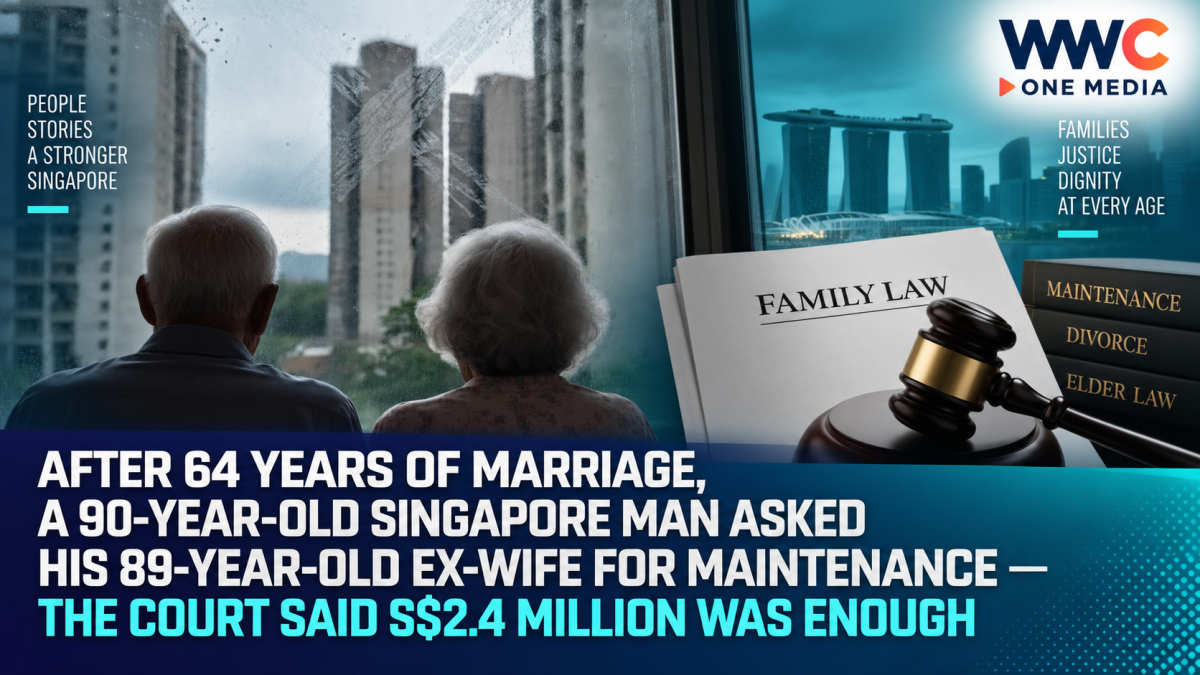
SINGAPORE — They married in 1960.
They raised three children who are now themselves over 60.
They accumulated a home worth about S$5.8 million.
And more than six decades later, their marriage ended with an unusually difficult question before Singapore’s Family Justice Courts:
Should an 89-year-old retired woman have to continue financially supporting her 90-year-old former husband after their divorce?
The court’s answer was no.
The man had sought spousal maintenance from his former wife, pointing to his age, health and mobility problems, limited recurring income and inability to earn a living.
But the court found that once their matrimonial assets were divided, he would receive roughly S$2.4 million.
That, the judge concluded, was sufficient to support him for the rest of his life.
His former wife, meanwhile, would receive roughly S$3.5 million from the matrimonial pool.
The biggest asset — their S$5.8-million home — must now be sold on the open market within six months.
The ruling is striking because of the couple’s age and the length of the marriage.
But legally, it also demonstrates something broader about divorce in Singapore:
maintenance and division of matrimonial assets are related — but they are not the same thing.
A person can qualify to seek maintenance and still receive nothing if the court concludes the division of assets already leaves that person financially secure.
They were married for more than 64 years
The anonymous couple married in January 1960.
An interim judgment of divorce was granted in September 2024, meaning the marriage had lasted more than 64 years by then.
They have three adult children, all older than 60.
That meant there were no disputes over child custody or child maintenance.
The financial fight instead centred on two issues:
the division of matrimonial assets;
and the husband’s attempt to obtain maintenance from his former wife.
Because this was a family-court proceeding, the parties’ identities were withheld.
That is standard practice in many Singapore family judgments.
Almost all the wealth was tied up in one house
The couple’s matrimonial pool was dominated by their jointly held home, valued at about S$5.8 million.
Other assets were comparatively small.
The court added approximately S$14,500 belonging to the husband into the asset pool, most of it from his Central Provident Fund.
Around S$80,000 belonging to the wife was also included, including nearly S$20,000 in CPF funds.
That means the overwhelming economic issue was not cash in bank accounts.
It was the value of the property accumulated during a marriage stretching from the era before Singapore’s independence into the 2020s.
And the parties had dramatically different versions of how that home had been financed.
The wife said she paid for the home
The woman argued that she had effectively financed the matrimonial property herself.
She said an earlier home had been acquired through the Teacher’s Estate housing scheme, and that proceeds from its sale were then used entirely toward the couple’s later matrimonial home.
According to her case, her husband contributed nothing toward buying that property.
The husband disputed that.
He sought an equal 50:50 division of the matrimonial assets and claimed he had contributed financially to both the earlier Teacher’s Estate property and the final matrimonial home.
The difficulty for the court was evidence.
The marriage began more than six decades ago.
Neither party could produce adequate documentary records proving exactly who had paid what over the entire history of their property ownership.
That is hardly surprising.
Bank statements, purchase records and household accounts from the 1960s, 1970s and 1980s may not have survived.
But divorce courts still have to reach a fair outcome when documents do not.
Singapore law does not divide matrimonial property simply according to whose name paid the cheque
Under Section 112 of the Women’s Charter, Singapore courts divide matrimonial assets in proportions considered “just and equitable”.
The law specifically directs judges to consider not only direct financial payments but also contributions such as caring for the home, raising children, supporting a spouse’s career and maintaining family welfare.
That distinction matters enormously in long marriages.
One spouse might earn most of the money.
The other might spend decades doing unpaid domestic work.
Singapore family law recognises that both kinds of contribution can have economic value.
In this case, however, the wife argued that she had done much of both.
She said she was the main breadwinner even when both were working
The woman told the court that during the first half of the marriage she carried most of the family’s financial burden.
She said she paid for:
the children’s tuition and courses;
family holidays;
a domestic worker;
and later expenses associated with the children as they became adults.
She also said she gave one son S$50,000 to establish a business that ultimately failed, and paid expenses connected with her children’s weddings.
The husband disputed the idea that she had carried the family alone.
He said both parties placed their earnings into joint accounts before retirement and that household expenses were paid from their pooled finances.
Again, the court faced a shortage of objective records capable of resolving every dispute from the earlier decades of the marriage.
But after retirement, the financial picture was clearer
The wife retired in 1992.
From that point onward, evidence about the couple’s finances became more concrete.
The husband had no employment income.
His only recurring personal income was an annuity of about S$485.75 per month.
The wife received a monthly pension of around S$2,400.
She said she gave half of that pension to her husband each month.
The court also had records showing that she continued paying property taxes and household expenses.
Those records mattered because they showed actual financial support rather than relying only on memories of what had occurred decades earlier.
The wife was also found to have made greater non-financial contributions
The dispute was not only about money.
The wife described herself as the primary caregiver for the couple’s children.
She said she cooked, supervised schooling, helped with homework, coordinated activities, managed domestic helpers, organised family gatherings and dealt with household upkeep.
The husband said he had done his fair share in raising the children.
But the court found his evidence far less detailed.
According to CNA’s report of the judgment, the judge noted that he provided few specific examples of involvement in matters such as the children’s schooling, health or emotional needs.
The wife’s account was considerably more particularised.
That difference mattered.
The court assessed indirect contributions 70:30 in her favour
After examining the evidence, the judge assessed the couple’s indirect contributions at 70:30 in favour of the wife.
Once direct and indirect contributions were combined, the eventual division was 60:40 in the wife’s favour.
That produced approximately:
S$3.5 million for the wife;
and
S$2.4 million for the husband.
For a marriage lasting more than six decades, that ratio is significant.
It shows that the sheer length of a marriage does not automatically force an equal 50:50 split.
The court still examines what each spouse actually contributed.
The wife wanted an even larger share
The woman asked for an additional 2 percentage points of the matrimonial pool.
She claimed her former husband had unlawfully excluded her from the matrimonial home beginning in March 2025 by placing a padlock on the gate.
The husband disagreed and said his wife and their eldest daughter had moved out voluntarily.
The court did not increase her share.
The judge noted that the exclusion allegation had surfaced only at the written-submissions stage and that both spouses were already going to receive substantial amounts from the matrimonial pool.
So the final ratio remained 60:40.
Then came the unusual maintenance claim
The husband sought maintenance from the wife as an incapacitated former husband.
This may surprise readers because spousal maintenance in Singapore has historically been associated primarily with husbands supporting wives.
But the law changed in 2016.
The Women’s Charter now allows a court to order a woman to pay maintenance to an incapacitated husband or former husband.
The law defines an incapacitated husband as one who, during the marriage, is or becomes unable to earn a livelihood because of physical or mental disability or illness and is unable to maintain himself, with that inability continuing.
So male spousal maintenance exists in Singapore.
But it is considerably narrower than the statutory entitlement available to wives.
Being elderly by itself is not the entire legal test
A man does not become entitled to maintenance merely because he is old.
The statutory framework focuses on incapacity and inability to maintain oneself.
And even where an applicant can bring such a claim, the court must still consider the parties’ actual financial resources and needs.
The 90-year-old husband pointed to:
his medical problems;
limited mobility;
his inability to work;
his very small recurring income;
and the fact that his former wife had moved out, leaving him responsible for expenses associated with the matrimonial home.
Those are relevant considerations.
But they were not enough.
The S$2.4 million asset share changed the equation
The judge focused on what the husband would possess after the divorce was financially completed.
He would receive approximately S$2.4 million.
His former wife would also be retired and living primarily on pension income.
Neither party had realistic prospects of returning to employment at ages 90 and 89.
The judge concluded that the husband’s multimillion-dollar asset allocation was more than sufficient to meet his remaining needs.
That conclusion reflects a principle seen elsewhere in Singapore family law:
maintenance is supplementary to the division of matrimonial assets.
A maintenance order is not necessarily required when the division itself leaves the financially weaker spouse with enough assets to meet reasonable needs.
A separate 2026 Family Division judgment similarly explained that where matrimonial-asset division sufficiently addresses financial inequality, the court may make no maintenance order at all.
Maintenance is not supposed to operate as lifelong financial insurance
Singapore courts have repeatedly emphasised that spousal maintenance is not intended to make one former spouse the permanent financial insurer of the other.
A recent 2026 Family Court decision restated that maintenance is supplementary to asset division and is not designed simply to preserve dependency indefinitely.
That principle became particularly important here.
The husband was not leaving the marriage without resources.
He was leaving with assets worth millions.
And the person he wanted maintenance from was herself 89 years old, retired and dependent on pension income.
Under those circumstances, the judge found another continuing financial obligation unnecessary.
He also asked for a lump sum if monthly maintenance was rejected
The husband proposed an alternative.
If the court would not grant ongoing maintenance, he asked for a lump-sum award equal to 5% to 10% of his share of the matrimonial assets.
The court rejected that request too.
That is another useful reminder that a lump sum does not automatically become available simply because monthly maintenance is inappropriate.
The underlying question remains whether further support is justified.
Here, the judge concluded it was not.
The law requires courts to look at age — but also wealth
Section 114 of the Women’s Charter instructs courts to consider a wide range of factors when assessing maintenance.
They include:
the parties’ income and earning capacities;
property and other financial resources;
future financial needs and obligations;
the standard of living during the marriage;
the parties’ ages;
the duration of the marriage;
physical or mental disability;
and contributions to family welfare.
This case sits at an extreme end of several of those factors.
A 64-year marriage is extraordinarily long.
Both spouses are exceptionally old.
Neither can reasonably be expected to rebuild finances through employment.
Yet the matrimonial pool is also unusually valuable.
That last fact fundamentally changes the maintenance analysis.
The court was effectively dividing retirement security
In a younger divorce, courts may ask whether one spouse can eventually return to employment.
Could someone retrain?
Increase working hours?
Advance professionally?
Become financially independent?
Those questions make little sense when the spouses are 90 and 89.
There is no realistic post-divorce career rebuilding.
The couple’s accumulated assets and retirement income are essentially all the financial resources they have left.
That makes the asset division itself the mechanism for funding the rest of their lives.
And that explains why the S$5.8-million property dominates the case.
Their home must now be sold
The court ordered the matrimonial home to be placed on the open market within six months.
Both former spouses will have joint conduct of the sale.
After the transaction is completed and the matrimonial pool divided, the wife receives her 60% share and the husband his 40%.
For a couple in their late eighties and nineties, that order has a very practical consequence.
A home associated with decades of marriage must now be converted into cash so the spouses can fund separate lives.
Legally, it is an asset.
Emotionally, after more than six decades, it is likely to represent much more.
The judgment, understandably, dealt with the legal and financial issues rather than speculating about those personal dimensions.
They also disputed property tax
Even the cost of maintaining the house after separation became contested.
The husband sought reimbursement for property taxes he had paid for the 2025 and 2026 years of assessment.
He argued that his former wife had contributed nothing after leaving the property in March 2025.
The judge agreed that the husband should not automatically bear the entire tax bill simply because he remained living there.
But he also rejected the argument that the wife should pay everything.
The court ordered the property tax for the two years to be shared equally.
That may seem like a relatively minor dispute beside a multimillion-dollar house.
But it demonstrates how divorce can force courts to untangle even ordinary household expenses after a relationship ends.
Each side must bear its own legal costs
The court also ordered each party to bear its own costs.
That means neither former spouse received a general order requiring the other to reimburse legal expenses for the ancillary proceedings.
The decision therefore leaves the main financial outcome concentrated on:
the 60:40 asset split;
the sale of the home;
equal sharing of the disputed property taxes;
and no spousal maintenance for the husband.
This does not mean husbands can never obtain maintenance in Singapore
That is an important distinction.
The judgment should not be reduced to “men cannot get alimony”.
Singapore law explicitly permits an incapacitated husband or former husband to seek maintenance from his wife.
The provision has existed since July 1, 2016, following amendments to the Women’s Charter passed by Parliament earlier that year.
What this case shows is that having a legal route to apply does not mean maintenance will be awarded.
The applicant’s own wealth can defeat the practical need for additional support.
It also does not mean homemaking contributions are automatically worth half
The same caution applies to matrimonial assets.
Singapore law places real value on non-financial contributions.
Looking after children and managing the family home can be highly significant when assets are divided.
But there is no mechanical rule that a long marriage must produce a 50:50 outcome.
The court looks at the evidence.
In this case, the wife was found to have carried a greater share of both financial responsibilities and homemaking or caregiving responsibilities.
That is why she ultimately received 60%.
Another recent Singapore case shows how different facts can produce a very different result
A 2026 Family Court judgment involving a nearly 48-year marriage illustrates the opposite possibility.
In that case, the husband described himself as a househusband and argued that decades of non-financial contributions justified an equal share of the matrimonial flat.
The court explained that Singapore law recognises homemaking as valuable and noted the general tendency toward equal division in long single-income marriages where one spouse genuinely serves as the primary homemaker.
But the court ultimately examined the actual evidence of who performed those roles rather than relying on labels alone.
That comparison highlights the central principle.
Family law does not reward titles such as “breadwinner” or “homemaker”.
It tries to determine what each spouse actually contributed.
Evidence becomes especially difficult after six decades
This case also exposes a practical challenge that receives less attention.
How do you prove financial contributions made in 1965?
Or childcare responsibilities from 1972?
Or who paid which renovation cost in the 1980s?
Most couples do not spend a marriage preserving receipts in anticipation of divorce more than half a century later.
Memories differ.
Documents disappear.
Financial arrangements change.
Accounts are closed.
Homes are sold and replaced.
Witnesses may no longer be available.
That means courts dealing with extremely long marriages must often reconstruct family economics from incomplete records.
Here, the judge acknowledged that some of the couple’s early financial history simply could not be established with precision.
The later years were easier because payment records existed.
Divorce at 90 creates a different kind of financial problem
Most public discussions of divorce focus on working-age adults.
Mortgage payments.
Child support.
Career sacrifices.
School fees.
Future income.
Those issues look very different when both parties are close to 90.
There is no significant future earning period.
The children are already senior citizens themselves.
Pensions and savings have largely replaced wages.
Housing is no longer primarily an investment for future family growth.
It is retirement security.
So the financial objective becomes less about rebuilding and more about allocating what remains.
The case also shows why maintenance and asset division cannot be viewed separately
At first glance, a man receiving only S$485.75 a month from an annuity while his former wife has a S$2,400 pension appears to have a strong income disadvantage.
Look only at monthly cash flow, and the maintenance claim can seem intuitive.
But once the matrimonial pool is divided, the picture changes dramatically.
The man is expected to receive around S$2.4 million.
That illustrates why Singapore courts assess the broader financial position instead of comparing pensions alone.
A former spouse with low monthly income may still possess enough capital to be financially independent.
A long marriage does not guarantee continuing financial dependence after divorce
That may be the most important legal takeaway.
The parties were together for more than six decades.
The wife had apparently supported the husband financially for a substantial period after retirement.
Yet divorce changes the legal framework.
The court does not simply extend whatever financial arrangement existed during marriage forever.
It asks what is just and necessary after the assets have been divided.
Recent Singapore judgments have repeatedly described maintenance as a tool for addressing remaining financial inequality rather than creating permanent dependency.
Here, the asset division largely answered that question before maintenance ever had to.
The husband leaves without maintenance — but not without money
That distinction is where sensational headlines can easily become misleading.
The court did not leave a 90-year-old man with only his S$485 monthly annuity.
He is expected to receive roughly S$2.4 million from the matrimonial estate.
His former wife, likewise, is not walking away with the entire family fortune.
She receives approximately S$3.5 million.
The house must be sold.
The tax dispute is shared.
And both pay their own legal costs.
The outcome is therefore not simply “wife refuses to support husband”.
It is a judicial decision that their accumulated wealth should now provide the financial separation that continuing maintenance otherwise might have supplied.
Sixty-four years ended with a 60:40 split
Few marriages arriving in Singapore’s divorce courts will resemble this one.
The parties were already elderly when many of today’s family-law principles were developed.
Their children are older than many divorcing couples themselves.
Their property history stretches back through decades in which Singapore’s housing and retirement systems changed dramatically.
Yet the court still had to reduce all of that history to a financial outcome.
60% for her.
40% for him.
No maintenance.
The 90-year-old husband argued that age, limited income and incapacity meant his former wife should continue supporting him.
The court looked instead at what he would possess once a S$5.8-million family home and the rest of their assets were divided.
And after 64 years of marriage, that became the decisive point:
he may have very little earning power left — but with roughly S$2.4 million coming from the divorce, the court found he did not need his 89-year-old former wife to keep paying him after it.



Leave a Reply