
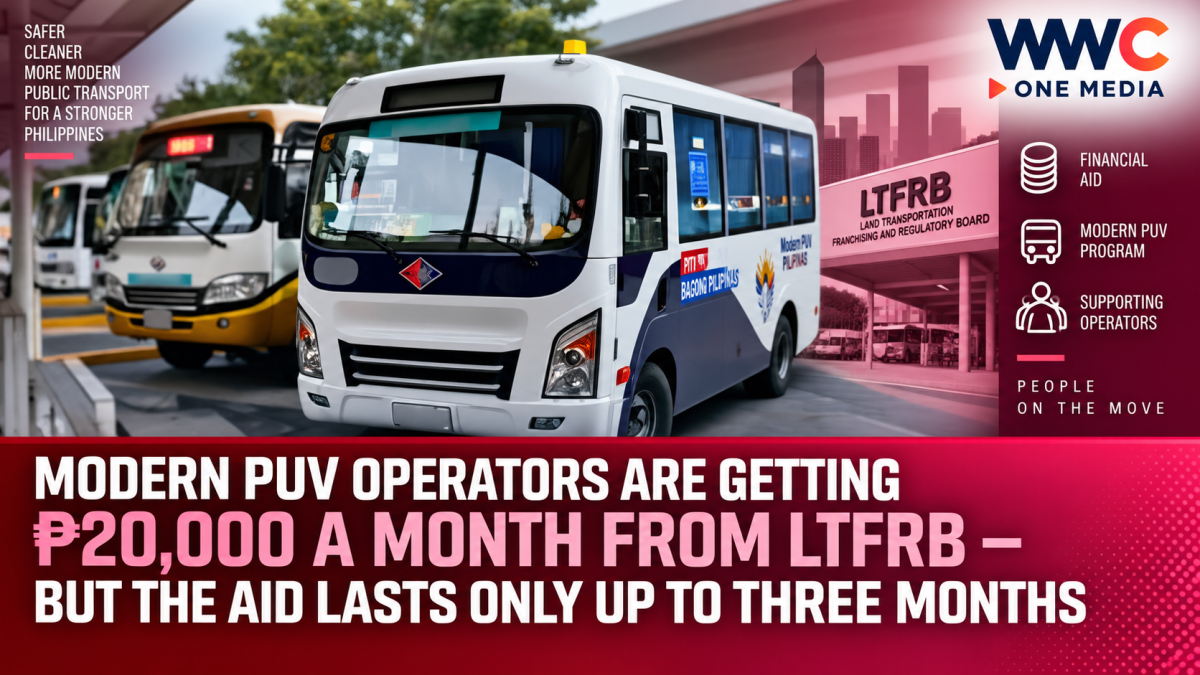
MANILA, Philippines — The government has begun releasing a new round of financial assistance to operators of modern public utility vehicles, offering ₱20,000 per eligible unit every month as transport cooperatives and corporations struggle with loan payments, fuel costs and other expenses tied to the country’s public transport modernization drive.
The Land Transportation Franchising and Regulatory Board (LTFRB) said Wednesday, September 16, that it had released the first batch of the monthly subsidy, marking the actual start of a program announced earlier this month for transport service entities participating in the Public Transport Modernization Program.
The assistance can cover up to three months of vehicle amortization or eligible operating costs, although implementation remains subject to qualification requirements and the availability of the allocated funds.
For transport groups that borrowed millions of pesos to replace traditional vehicles with modern units, the subsidy could provide temporary breathing room.
But it also highlights a persistent problem at the center of modernization: buying the vehicle is only the beginning — keeping up with the loan can be the harder part.
Who Can Receive the ₱20,000 Monthly Subsidy?
The program is aimed primarily at registered and accredited transport service entities, or TSEs, including cooperatives and corporations participating in the government’s modernization program.
According to LTFRB guidelines reported by the Philippine Star, the financial assistance covers:
- modern public utility jeepneys nationwide
- modern UV Express units nationwide
- modern buses operating in Metro Manila
Eligible operators facing arrears, outstanding loan obligations or a risk of default can receive ₱20,000 per qualified unit per month.
The government says the program is intended to help operators continue paying loans on vehicles they acquired as part of the modernization program rather than allowing those units to be repossessed by lenders.
The assistance is scheduled to run for three months beginning in September, or until the money allocated for the program has been exhausted.
That last condition matters: the three-month period describes the program’s intended coverage, but it should not be interpreted as an unconditional guarantee that every modern PUV operator automatically receives three payments.
Fully Paid Modern PUVs May Still Qualify
The assistance is not necessarily limited to operators who still owe money to a bank.
The Department of Transportation has said transport cooperatives and corporations whose modernized units are already fully paid may be allowed to use the assistance for operating expenses instead, subject to LTFRB implementing rules.
Those expenses can include costs such as fuel, maintenance, spare parts, garage or terminal rental and utilities, according to the guidelines reported by the Philippine Star.
That provision broadens the program from pure debt assistance into short-term operational support.
It also reflects the government’s argument that keeping modern vehicles on the road requires more than helping operators purchase them. A cooperative can own its vehicles outright and still face rising fuel, maintenance and staffing costs that threaten daily operations.
Government Earlier Earmarked ₱1.5 Billion for the Program
The subsidy did not appear overnight.
In August, Transportation Secretary Giovanni Lopez announced that the government was earmarking at least ₱1.5 billion to help modern PUV operators meet monthly amortization obligations.
The Philippine Information Agency reported on August 10 that the planned assistance would provide ₱20,000 a month for every qualified modern jeepney unit purchased by participating transport groups under the Public Transport Modernization Program.
DOTr later formalized the assistance through a department order.
Lopez said the objective was to help transport cooperatives and corporations remain operational and reduce the possibility that financial institutions would repossess modern PUVs whose operators could no longer meet their loan obligations.
Acting LTFRB Chairman Greg Pua Jr. subsequently said the agency was putting standardized procedures in place so qualified operators could receive the assistance more quickly.
The September 16 release of the first batch signals that the policy has now moved from announcement to actual disbursement.
Why Modern PUV Debt Has Become a Bigger Issue
Modernization has long carried a difficult financing equation for operators.
The program encourages — and in many cases has pushed — traditional operators to consolidate into cooperatives or corporations and replace aging vehicles with units that meet newer safety, environmental and technical standards.
Those vehicles can be considerably more expensive than traditional jeepneys.
Available LTFRB figures previously cited by GMA News showed modern jeepneys costing roughly ₱2.4 million to ₱2.6 million, compared with substantially lower prices when the modernization effort began years earlier. State financial institutions have played a major role in financing acquisitions through loan programs.
Even with government subsidies toward acquisition, operators can still carry significant debt.
That becomes particularly difficult when the same operators are simultaneously absorbing higher fuel prices, vehicle maintenance, wages and other operating expenses.
LTFRB said those pressures are among the reasons for providing the new monthly assistance.
This Is Different From the Fuel Subsidy
The ₱20,000 monthly assistance should not be confused with several other transport-support programs rolled out by the government in 2026.
Earlier this year, DOTr began distributing a separate fuel-subsidy program covering different classes of public transportation.
During the March rollout, for example, modern public utility jeepney operators were allocated fuel assistance while drivers received separate cash support. Other categories — including buses, taxis, UV Express, traditional jeepneys and transport-network vehicles — received different amounts depending on vehicle type.
The government subsequently expanded fuel assistance as petroleum prices remained elevated.
In Central Visayas alone, LTFRB reported in September that fuel subsidies had already reached more than 19,000 PUV units, representing more than 80 percent of its target for unit-based distribution in the region.
Another program administered through the Department of Social Welfare and Development provided ₱5,000 in one-time cash relief to eligible drivers and delivery riders.
DSWD said that payout concluded on June 30 after reaching more than 1.82 million beneficiaries and disbursing over ₱9.1 billion.
The new amortization assistance is therefore a separate intervention aimed specifically at the financial viability of entities operating modernized vehicles.
Government Is Trying to Prevent Modern Units From Being Repossessed
That distinction explains why the program focuses so heavily on loans.
When a cooperative buys a modern jeepney using financing, falling behind on amortization does not simply create another unpaid bill.
Persistent default can eventually threaten the cooperative’s ability to keep the vehicle.
The government’s stated objective is therefore both financial and operational: ease the debt burden while preventing modern units from disappearing from routes because their operators cannot afford to retain them.
For commuters, that matters because financially distressed transport entities can mean fewer operational vehicles and potentially less reliable service.
For operators, meanwhile, the ₱20,000 payment represents assistance against a much larger cost structure involving loan payments, fuel, maintenance and daily fleet operations.
The Bigger Question Comes After the Three-Month Aid Window
The first payout answers one immediate question: the promised assistance has begun moving to beneficiaries.
The longer-term question is whether temporary support will be enough.
The program is scheduled for only up to three months and is limited by the amount of funding available.
That means the underlying economics of operating modern PUVs — vehicle prices, financing terms, fuel costs, passenger demand, maintenance and fare revenue — will remain even after the assistance ends.
The subsidy may prevent some operators from falling further behind in the short term.
Whether it can prevent defaults over the longer run will depend on what happens after the government stops paying.
For now, however, the modernization program has entered a new phase: the government is no longer only subsidizing the transition to modern vehicles — it is also spending money to help some of the operators who already made that transition keep those vehicles on the road.



Leave a Reply