
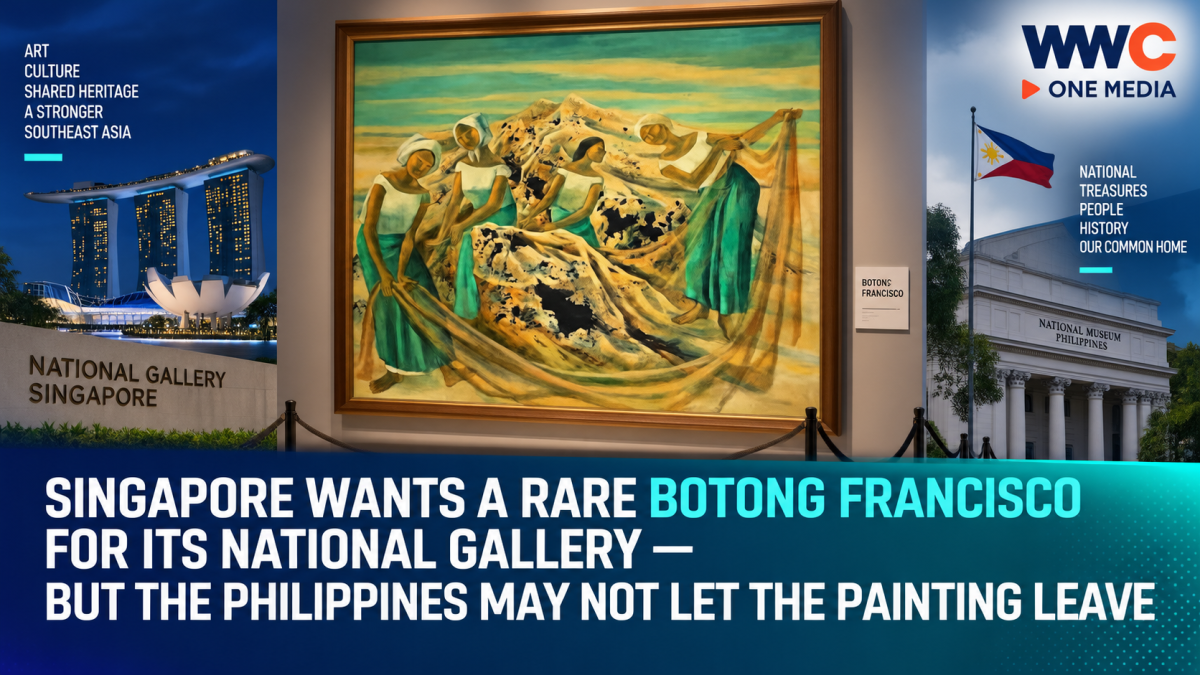
MANILA, Philippines — A rarely seen painting by National Artist Carlos “Botong” Francisco has become the center of an unusual cultural tug-of-war after the Department of Tourism opposed its permanent transfer to Singapore — even as one of Southeast Asia’s leading museums seeks to add the work to its collection.
The artwork, “Kalantiao at Lubluban,” was painted in 1946 and is currently protected under Philippine heritage rules because works by National Artists are presumed to be Important Cultural Properties, or ICPs.
Its owner, Jaime Alfonso Larence Ponce de Leon of León Gallery, has petitioned the National Commission for Culture and the Arts to remove that presumption, a step that could eventually allow the painting to be permanently exported to Singapore. The National Gallery Singapore expressed interest in acquiring it earlier this year, but the proposed acquisition remains dependent on Philippine regulatory approval.
The Department of Tourism is now urging cultural authorities to find another solution: keep the Botong permanently in the Philippines, but allow it to travel abroad for exhibitions, academic research and cultural exchanges.
That turns what might otherwise have been a private art transaction into a much bigger question:
When a privately owned masterpiece is considered part of a country’s cultural heritage, how far should the government go to keep it at home?
What Singapore Wants
According to documents connected with the petition, National Gallery Singapore showed interest in acquiring Kalantiao at Lubluban in early 2026.
National Gallery Singapore chief curator Patrick Flores, a prominent scholar of Philippine and Southeast Asian art, told the NCCA in a July 28 letter that acquiring the work would strengthen the museum’s presentation of Francisco’s independent artistic practice and Philippine modernism. The painting was being considered for long-term display in the Gallery’s revamped Southeast Asia permanent galleries, scheduled to open in November 2027.
Singapore’s museum already has deep engagement with Philippine modern art.
Its current Southeast Asian displays include works involving Francisco, including “Mother Nature’s Bounty Harvest,” created with Victorio Edades and Galo B. Ocampo. National Gallery Singapore describes the trio as major figures who helped advance modernism in early 20th-century Philippine art.
So the interest in another Francisco work is not occurring in isolation.
It reflects Singapore’s broader effort to build a regional collection capable of telling the history of modern Southeast Asian art — including Philippine art — to an international audience.
But DOT Says Permanent Export Is Different
The Philippine Department of Tourism acknowledged that a Singapore acquisition could expose Francisco’s art to more international visitors and scholars.
But it drew a distinction between international exposure and permanently removing the painting from the Philippines.
The agency urged the NCCA to consider arrangements that would let the work participate in overseas exhibitions and scholarly exchanges while maintaining its long-term presence in the Philippines.
DOT linked its position to cultural tourism and the preservation of artworks that help tell the Philippine national story.
The department also acknowledged private ownership rights, according to reporting on its statement, while arguing that works of exceptional cultural significance carry a broader public interest.
Importantly, however, DOT does not make the final decision on the petition.
That decision lies within the Philippine cultural-heritage regulatory process involving the NCCA and relevant cultural agencies.
Why the Painting Is Legally Protected
The controversy is rooted in Philippine heritage law.
Republic Act No. 11961, which strengthened and amended the National Cultural Heritage Act, and its implementing rules provide that works by National Artists are presumed to be Important Cultural Properties unless that presumption is formally removed. Presumed ICPs receive the same level of protection as Grade II cultural properties while that status remains in place.
That protection has major consequences for export.
Current rules say Grade I and Grade II cultural properties generally may leave the Philippines temporarily for approved purposes such as exhibitions, scientific scrutiny, restoration or conservation work. The regulations also specifically contain a procedure for removing the ICP presumption from works of National Artists when permanent export is being sought.
In other words, owning the painting does not automatically give its owner unrestricted authority to permanently send it overseas while its heritage protection remains in force.
The law nevertheless recognizes private ownership. The implementing rules state that registering privately owned cultural property does not by itself divest the owner of possession or ownership.
That tension between private-property rights and heritage regulation is at the core of this case.
What the Owner Is Arguing
Ponce de Leon’s petition does not argue that Francisco is unimportant.
Instead, it challenges whether this particular painting should continue receiving the level of protection associated with an Important Cultural Property.
According to the petition as reported by PhilSTAR Life, it argues that Kalantiao at Lubluban does not meet the necessary threshold of exceptional cultural, artistic and historical significance required for ICP treatment and has never been individually declared an ICP apart from the automatic presumption that attaches to works of National Artists.
The petition also argues that allowing the painting to enter National Gallery Singapore’s collection would not substantially diminish the number or significance of Francisco works remaining in Philippine collections.
Supporting assessments attached to the petition offer similar arguments.
Art critic Cid Reyes, for example, was cited as saying the work should not be considered among Francisco’s indispensable masterpieces, while curator Lisa Guerrero Nakpil reportedly assessed that it did not reach the level of his major works already preserved in Philippine public collections.
Those are expert opinions submitted in support of the petition — not findings already adopted by the NCCA.
An Art Historian Is Challenging That Case
Not everyone in the art community agrees.
Art historian Geronimo Cristobal, a doctoral candidate at Cornell University, has urged the NCCA to keep the work’s presumed ICP protection and conduct a more independent assessment before allowing permanent export.
Cristobal argues that the painting’s importance goes beyond whether it is considered Francisco’s greatest technical masterpiece.
He points to its value as a document of how Filipinos once imagined precolonial history and national identity.
That argument becomes especially interesting because of the painting’s subject.
The Kalantiaw Story Was Later Debunked — Which Gives the Painting Another Historical Layer
Francisco’s painting draws from the story of Datu Kalantiaw, once portrayed in Philippine historical accounts as an ancient lawgiver.
There is a major problem: historians later established that the supposed Code of Kalantiaw had no valid historical basis.
Historian William Henry Scott’s research exposed the supposed code as stemming from fabricated historical material associated with José E. Marco. The National Historical Institute subsequently formally rejected the Code of Kalantiaw’s historical authenticity. NCCA educational material itself includes Scott’s work under the title “Kalantiaw: The Code that Never Was.”
That does not make Francisco’s painting historically worthless.
In fact, Cristobal argues that the opposite may be true: the artwork can now be studied as evidence of how a historical myth became embedded in 20th-century Philippine culture before scholarship corrected the record.
That adds another dimension to the debate.
The painting is not simply an illustration of precolonial Philippine history. It may also document how Filipinos at a particular moment in the 20th century understood their own past.
The Painting Has Rarely Been Seen by the Public
Another unusual part of the story is just how little exposure the artwork has had.
According to the petition, Kalantiao at Lubluban is an oil-on-canvas work measuring approximately 194 by 245 centimeters, making it nearly eight feet across. The documents say Francisco created it as part of his personal collection and that, during the current owner’s period of ownership, it has not been publicly exhibited.
That creates competing arguments about public access.
A Singapore acquisition could potentially put the artwork on long-term museum display and expose it to millions of international visitors.
Opponents of permanent export counter that a culturally important Filipino work becoming more accessible abroad does not necessarily solve the problem of Filipino audiences losing long-term access to it at home.
DOT’s preferred middle ground is therefore international loans rather than permanent relocation.
There Is Still No Final Decision
The controversy should not be reported as though Singapore has already bought the painting or that Philippine authorities have approved its departure.
Neither is established.
The NCCA opened the petition to public comment and is accepting written positions supporting or opposing the removal of the painting’s presumed Important Cultural Property status until September 30, 2026.
Until that process is completed, the artwork retains its heritage protection.
And Philippine regulations make the distinction consequential: protected Grade I and Grade II works face strict limits on permanent export, while specific procedures exist for removing the presumed ICP status of a National Artist’s work when a permanent export permit is sought.
So the immediate issue is not simply whether National Gallery Singapore wants Kalantiao at Lubluban.
It clearly does.
The unresolved question is whether Philippine cultural authorities will decide that this particular Botong Francisco can permanently leave the country — or whether international recognition should come through loans while its permanent home remains in the Philippines.


Leave a Reply