
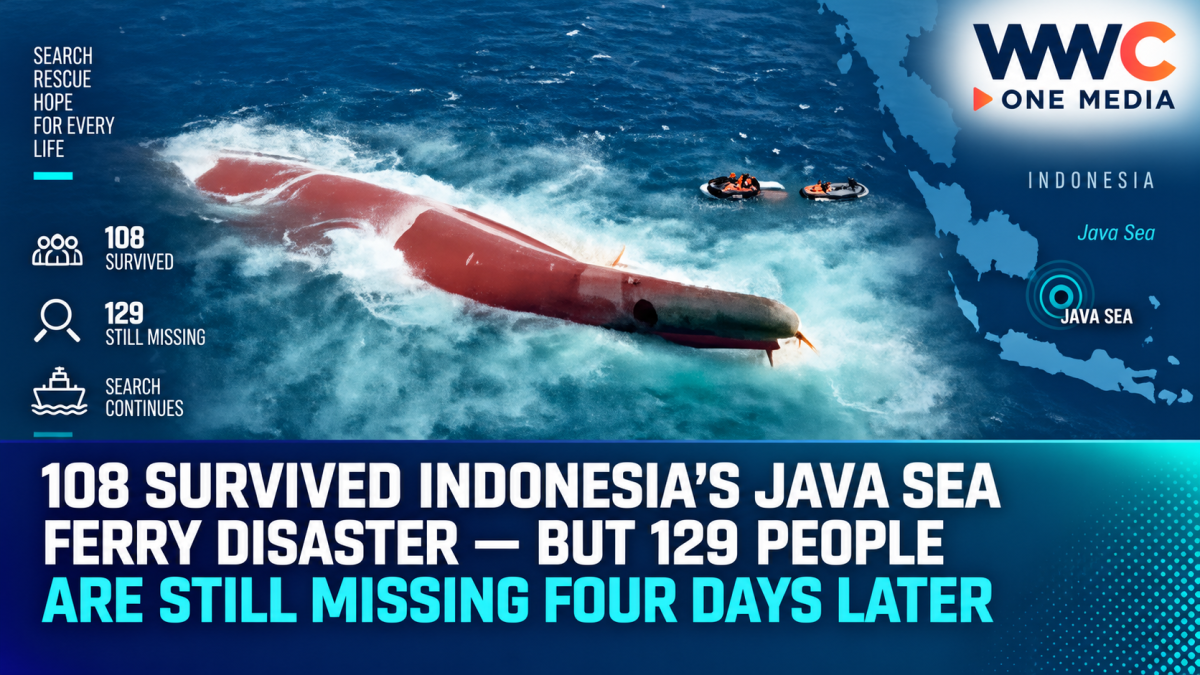
BANJARMASIN, Indonesia — Four days after the Virgo Transport 8 capsized in Indonesia’s Java Sea, families are still waiting for answers as rescuers battle rough seas to find 129 people who remain unaccounted for.
The passenger ferry was carrying 243 people on a roughly 20-hour voyage from Surabaya in East Java to Banjarmasin in South Kalimantan when it capsized in severe weather early Sunday, September 13.
As of Wednesday, authorities had confirmed 108 survivors and six deaths, leaving 129 passengers and crew members missing. The official numbers have remained unchanged since Sunday.
For relatives gathered at the emergency command center in Banjarmasin, the passing days are becoming almost as difficult as the initial disaster.
One man, Fauzi, told Reuters that seven members of his family—including his mother—were aboard the vessel. After waiting days for news, he said what families now need most is certainty.
The ferry was hit by rough seas before it overturned
Virgo Transport 8 had left Surabaya on Saturday and encountered severe conditions while crossing the Java Sea.
Indonesia’s search-and-rescue agency, Basarnas, said the vessel experienced bad weather around midnight before communications were lost at roughly 2 a.m. local time Sunday.
The crew had reported an emergency to the operator and issued distress signals before contact disappeared.
Associated Press reported that the captain told authorities the ferry was listing as waves reached about 3 meters.
Some survivor accounts suggest conditions may have been even worse.
Rizky Apriansyah, a waiter working aboard the vessel, told Reuters he saw waves reaching an estimated 3 to 4 meters as the ship tilted increasingly to one side.
One survivor says the ferry overturned in less than 10 minutes
Rizky was sleeping on the upper deck when friends woke him at around 1 a.m. and told him to grab a life jacket.
By then, he estimated that the ship was already leaning about 30 degrees.
He said there was no alarm that he heard before he and four friends rushed from their cabin. They were swept into the sea and survived by holding on to a floating cooking-gas cylinder.
From the water, they watched the vessel turn over.
According to Rizky, the entire capsize unfolded in less than 10 minutes.
He and his companions then spent about 10 hours adrift before another vessel found them. Reuters reported that the ferry operator, Virgo Karya Shipping, said it could not immediately address the allegation about the alarm without first checking with crew members.
That account has become one of the starkest descriptions yet of how quickly the disaster unfolded.
Another survivor said passengers scrambled to escape
Associated Press spoke to survivor Ahmad Saudi, who described passengers rushing toward the higher side of the ferry as it began tilting.
Saudi said many people appeared to be sleeping in hallways and communal spaces because cabins were full, and he expressed concern that some people inside cabins may not have had enough time to escape.
Those observations are a survivor’s account, however, and do not establish that the ferry exceeded its authorized capacity.
Indonesia’s Transport Minister Dudy Purwagandhi has specifically said that preliminary information indicates Virgo Transport 8 was not overloaded.
He said investigators from Indonesia’s National Transportation Safety Committee, or KNKT, are examining the vessel’s specifications and interviewing surviving passengers and crew to determine the precise cause of the accident.
What was aboard Virgo Transport 8?
The official manifest listed 243 people, including passengers and crew, together with 89 vehicles.
Associated Press reported that the 119-meter vessel was built in Japan in 1987.
Transport authorities said the Indonesian-flagged ferry measured 8,540 gross tons and was operated by PT Virgo Karya Shipping.
Indonesian authorities have cautioned against drawing conclusions about what caused the vessel to overturn until the formal investigation is completed.
Bad weather is confirmed to have been present, but officials have not yet established whether weather alone, vessel stability, cargo positioning, mechanical issues or some combination of factors caused the disaster.
The wreck is only about 30 meters underwater
One potentially important development came when Basarnas located the wreck.
Officials said Virgo Transport 8 rests at a depth of approximately 30 meters beneath the Java Sea.
Basarnas has discussed whether the ship could eventually be moved toward shallower water, although the Indonesian Navy advised that leaving it stable on the seabed could be preferable while rescue operations continue.
The relatively shallow depth raises hopes that specialized underwater equipment could help search areas of the vessel that cannot be reached safely by ordinary divers in poor conditions.
Indonesia deployed the Navy vessel KRI Canopus, equipped with underwater drones, a multibeam echo sounder and a remotely operated vehicle, or ROV, to help examine underwater areas.
But having the technology does not mean it can always be used.
Rough weather is now the rescuers’ biggest obstacle
By Wednesday, heavy seas were still preventing the Coast Guard and Navy from carrying out some underwater operations around the wreck.
Banjarmasin rescue chief I Putu Sudayana told Reuters that waves were reaching about 2.5 meters, accompanied by strong winds.
Six ships were conducting surface searches Wednesday, supported by helicopters and aircraft.
Earlier in the operation, more than 600 rescue personnel had been mobilized across multiple search sectors.
Basarnas expanded the search zone to approximately 2,600 nautical miles, using calculations of currents and waves to estimate where people could have drifted away from the original accident site.
The agency said its search pattern changes as weather, currents and new information alter the areas where missing passengers are most likely to be found.
Why the number 129 has not changed
The lack of change in the casualty count does not mean the operation has stopped.
It means rescuers have not confirmed any additional survivors or recovered victims that would change the official tally.
Basarnas said by Tuesday night that 114 of the 243 people had been located: 108 alive and six dead.
That calculation leaves exactly 129 unaccounted for.
Authorities are searching both the surrounding sea—because currents could have carried people far from the vessel—and areas around the submerged wreck itself.
That dual search is particularly difficult because the Java Sea weather has repeatedly prevented rescuers from operating where they want to.
Families want clearer answers
While the physical search continues at sea, another crisis is unfolding at Trisakti Port in Banjarmasin.
Families have spent days waiting at the rescue command center for information.
Maria Dethan, 21, told Reuters she had remained there hoping for news about her brother Samuel.
She said even eating had become difficult because she kept thinking about what her missing brother might be experiencing.
Basarnas has urged families and the public to rely on official rescue information and said its methods comply with international search-and-rescue standards.
But with no change in the official missing count for days, the uncertainty is becoming increasingly painful.
Indonesia depends heavily on ferries
Maritime transport plays an unusually important role in Indonesia.
The country consists of more than 17,000 islands, making ferries and passenger ships essential links for people and cargo between major population centers.
Sea travel is often cheaper and more widely available than flying, particularly on domestic routes connecting islands.
But Indonesia has also suffered repeated maritime accidents, keeping questions about vessel maintenance, weather decisions, manifests, emergency procedures and regulatory enforcement in the public spotlight.
The Virgo Transport 8 disaster came amid a series of serious ferry incidents in the wider region, adding urgency to renewed scrutiny of passenger-ship safety.
The investigation is only beginning
Authorities have not announced a final cause.
The KNKT investigation is examining technical information about the ferry and collecting testimony from people who survived.
Among the questions investigators may have to resolve are why the ship listed so rapidly, how vehicle and cargo weight was distributed, whether emergency warnings worked as intended and how the vessel responded to severe waves.
For now, claims about those factors remain unproven until investigators publish their findings.
What is established is already devastating:
243 people were aboard Virgo Transport 8. Only 108 have so far been confirmed alive. Six are dead. And four days after the ferry overturned in the Java Sea, 129 families are still waiting to learn what happened to the people they love




Leave a Reply