
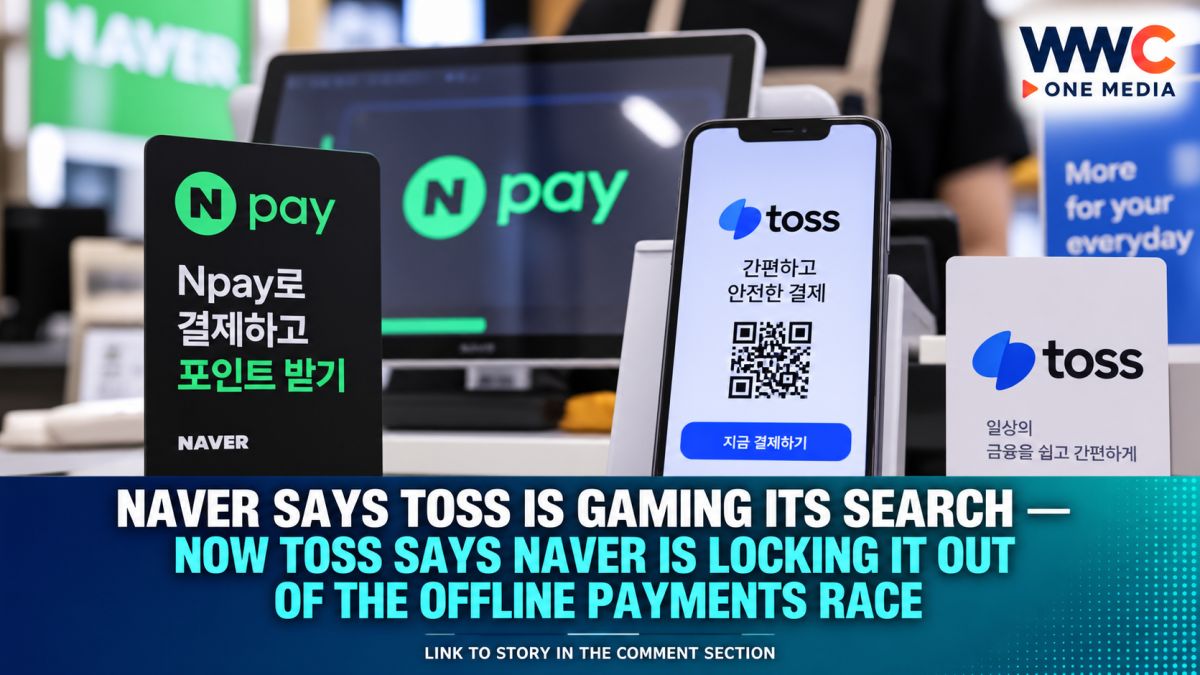
SEOUL — What began as an argument over people earning just a few points for searching restaurant menus has escalated into a much bigger confrontation between two of South Korea’s most powerful digital platforms.
Naver says reward campaigns inside the Toss app could distort the search signals that determine which shops and restaurants appear prominently in its results.
Toss wants Naver to prove it.
And now the dispute has moved beyond search.
Toss Place, the fintech company’s point-of-sale business, is preparing for a possible complaint to South Korea’s Fair Trade Commission over Naver’s decision not to connect Toss POS to a merchant-data service that already works with numerous competing POS providers.
That turns what could have remained a technical argument over search algorithms into something much more consequential:
Who gets to control the digital connection between Korean consumers and the restaurants, cafes and stores where they spend their money?
The fight started with Toss’ ‘attendance check’ rewards
At the center of the original dispute is a feature inside the Toss app commonly described as an “attendance check” mission.
Users can receive small rewards for completing tasks.
Some of those tasks direct participants to Naver, where they may be asked to search for a particular restaurant, product or piece of information and then enter the answer back into Toss.
Yonhap reported that one version of the campaign offered users five points after they searched Naver for information such as a restaurant menu price or walking distance.
That sounds relatively harmless from the perspective of an individual user.
Naver argues the effect could be very different at scale.
If large numbers of people search the same restaurant, product or keyword because they are being rewarded to do so rather than because they genuinely want the information, Naver says those searches could interfere with signals used by its search and local-business systems.
Those signals matter because Naver is one of South Korea’s principal gateways for finding restaurants, products and local businesses.
Visibility inside Naver Search, Shopping and Place can therefore have direct commercial value for merchants.
Naver asked reward marketers to stop
According to Yonhap, Naver began sending notices in July 2025 to Toss and several other companies asking them to stop reward-based campaigns that encouraged people to conduct designated searches on Naver.
Other companies reportedly indicated they would stop the campaigns.
Toss did not take the same approach.
Instead, Toss challenged Naver to provide objective evidence showing that its campaigns had actually distorted search results.
The companies subsequently exchanged multiple communications but did not resolve the disagreement.
That distinction is important.
Naver alleges the reward system threatens the integrity of its search results.
Toss disputes that allegation and has asked for evidence.
There has not been a publicly reported regulatory or court determination establishing that Toss manipulated Naver’s rankings.
Naver then went to police
The dispute intensified in February 2026, when Naver asked the Gyeonggi Nambu Provincial Police Agency to investigate Viva Republica, the company behind Toss.
The request concerned suspected obstruction of business and possible violations of South Korea’s information-network laws, according to Yonhap and other Korean media reports.
Police had questioned Naver representatives as witnesses by early September and were expected to gather information from Toss as the investigation continued.
An investigation request does not establish that a crime occurred, and Toss has not been reported as having been found liable for search manipulation.
Naver says it sought police involvement because the dispute over what it considers search-result distortion remained unresolved.
Then Toss opened a second front
Now the fight is moving in the opposite direction.
Toss Place says Naver is denying its POS system access to Place Plus, a service linking information generated by merchants’ point-of-sale systems with Naver’s local-business platform.
That connection can automate information about stores, menus and business activity that otherwise may have to be updated manually.
For a POS provider, being integrated with Naver can make its product more useful to restaurant and retail clients because Naver is such an important consumer-discovery platform.
Toss says competing POS companies have been allowed into the system while Toss POS has not.
According to the Korea Herald and Yonhap, Toss says 15 other POS providers have been connected and has asked Naver to disclose the criteria it uses and apply the same standards to Toss.
The company says preparations for a possible Fair Trade Commission complaint have been completed.
Naver says Toss is not being singled out
Naver rejects the suggestion that it is unfairly excluding its rival.
The company says Place Plus connections are being expanded gradually according to objective criteria that apply to POS companies generally.
Naver’s own Smart Place documentation explains that Place Plus links participating POS data with merchant pages so businesses can provide richer and more current information through Naver.
But Naver has also connected the POS argument directly to its broader dispute with Toss.
A Naver representative told the Korea Herald that broader cooperation would be difficult while activities that Naver believes are harming its services remain unresolved.
That is why this is no longer merely a disagreement about technical compatibility.
Each side is now challenging conduct that sits close to the other company’s core business.
The real prize is the store itself
Behind the accusations and regulatory threats is a much bigger commercial battle.
Naver built much of its power through search, maps, merchant listings, advertising and digital payments.
Toss began as a mobile-finance platform but has expanded aggressively into physical stores through payment terminals, POS software and merchant services.
Their businesses increasingly meet at the same place:
the checkout counter.
Point-of-sale terminals are valuable not only because they process card payments.
Modern POS systems can generate information about sales volumes, menu popularity, busy periods, returning customers and business performance.
That information can then support merchant-management tools, payment products, financing, advertising, loyalty programs and other services.
Whoever owns the merchant relationship therefore has an opportunity to sell far more than a payment terminal.
Toss already has access to more than 400,000 stores
Toss has built a substantial head start in physical merchant infrastructure.
Toss Place says its POS and payment-terminal services are used by roughly 400,000 stores.
In August, Toss Place announced an alliance with Korean neighborhood platform Karrot, or Danggeun, aimed at linking those merchants with Karrot business profiles.
The companies plan to connect store information, menus, reservations, orders and payments across their platforms.
For Toss, the partnership potentially creates a route from discovering a local shop on Karrot all the way to ordering and paying through Toss-linked infrastructure.
That is precisely the sort of end-to-end local-commerce ecosystem that makes merchant data increasingly valuable.
Naver is expanding quickly too
Naver Pay is pursuing its own strategy through Npay Connect, its integrated offline payment terminal.
Npay Connect had passed 100,000 merchants by the end of the first half of 2026, according to reports citing Naver Pay.
The device is designed to do more than collect payments.
Naver promotes links among transactions, coupons, its FaceSign facial-payment service and Naver reviews, allowing a physical-store visit to feed back into Naver’s broader online ecosystem.
The contrast between the two companies is becoming increasingly clear.
Toss has the larger POS footprint. Naver has enormous strength in search and consumer discovery.
Each is trying to extend its advantage into the other’s territory.
Why offline payments suddenly matter so much
Despite the growth of e-commerce, physical-store payments still represent an enormous market in South Korea.
Bank of Korea figures show payment-card use averaged about 3.6 trillion won per day in 2025, up 4.7 percent from the previous year.
Industry reporting based on the central bank’s data put average daily face-to-face card transactions at approximately 1.786 trillion won, compared with about 1.287 trillion won for non-face-to-face card transactions.
That explains why Korea’s digital platforms are increasingly competing over hardware sitting inside restaurants and stores.
Online commerce may attract enormous attention.
But trillions of won continue to move through physical checkouts.
And payments are only the beginning
The strategic value of a POS network goes far beyond the transaction itself.
Imagine a restaurant using one connected system.
The platform may know:
what customers ordered, when the restaurant is busiest, which menu items sell best, which promotions generate repeat visits and how much revenue flows through the store.
Those insights could eventually support advertising products, inventory tools, lending decisions, loyalty programs and personalized consumer recommendations.
That is why the Naver-Toss dispute matters beyond the two companies themselves.
The fight is about the infrastructure through which South Korea’s small businesses become digitally visible.
Small-business groups have entered the argument
The dispute has also attracted attention from merchants.
Yonhap reported that the Korea Federation of Micro Enterprise called on Toss on September 9 to stop reward-based search marketing.
The group argued that merchants with strong products and authentic customer reviews could be pushed lower in search visibility if incentivized searches influence rankings.
That is the federation’s position, not a proven finding that Toss’ campaigns actually caused specific businesses to lose rankings or revenue.
Toss continues to challenge the premise that Naver has shown evidence of distortion.
Two disputes, one increasingly important market
For now, Naver and Toss are fighting on two fronts.
On one side is the search dispute:
Naver says Toss’ reward missions can contaminate genuine search signals. Toss says Naver should demonstrate that with data.
On the other is the POS dispute:
Toss says Naver has connected numerous competing POS companies to Place Plus while excluding Toss. Naver says integrations are being expanded under neutral criteria and rejects claims of unfair treatment.
Police are examining the first issue.
Toss is preparing to potentially put the second before the Fair Trade Commission.
Neither process has produced a final determination.
The 5-point reward was only the beginning
The irony is that one of South Korea’s most closely watched fintech-platform confrontations began with tiny consumer rewards.
Five points for searching a restaurant menu hardly sounds like the starting point for a major corporate battle.
But the dispute exposed something much bigger.
Naver’s search engine decides how millions of consumers discover businesses.
Toss’ payment infrastructure connects hundreds of thousands of those businesses to transactions happening inside physical stores.
As search, reviews, menus, payments, customer management and advertising merge into a single local-commerce ecosystem, the boundary between a search company and a financial platform is disappearing.
That leaves Naver and Toss increasingly competing for the same thing:
the data, payments and merchant relationships behind everyday Korean spending.
And if their confrontation proceeds simultaneously through a police investigation and a competition-regulator complaint, the fight that began with search rewards may ultimately help determine the rules for Korea’s next generation of offline commerce.




Leave a Reply